
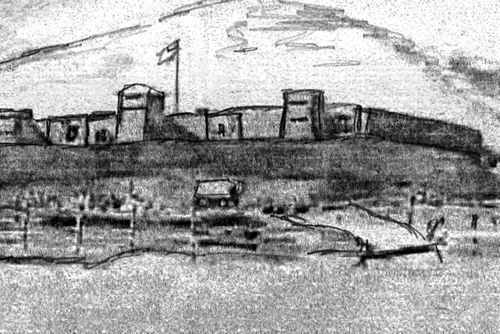
Fort Peck, Montana.
Colonel Campbell Kennedy Peck established Fort Peck in 1867, a partner with Elias H. Durfee in the Leavenworth, Kansas, trading firm of Durfee and Peck. Company employee Abe Farwell built the stockade along the Missouri River. It was constructed of sturdy cottonwood logs and had a 12-foot-tall stockade with several low buildings inside.
For some time, it enjoyed a virtual monopoly in trade with the Sioux and Assiniboine people, rivaling Fort Union in North Dakota.
In 1873, it became the Indian Agency for the Assiniboine and Gros Ventre Indians. A narrow shale ledge supporting the fort made steamboat docking and unloading easier. But the Missouri River would be the fort’s undoing in 1877 when it flooded and destroyed the stockade.
The Indian Agency then moved to Poplar Creek, Montana. Today, Fort Peck Reservoir covers the original site.
The new town of Fort Peck was established about two miles North of the original location. In 1933, the town became the headquarters for constructing and operating the massive Fort Peck Dam. The following year, the Army Corps of Engineers designed a government-owned town that included an administrative headquarters, a hospital, stores, a theater, a recreation hall, and other facilities. Today, the small town still features several buildings listed in the National Register of Historic Places. It also offers views of Fort Peck Lake and interprets Lewis and Clark’s journey through northeast Montana.
©Kathy Alexander/Legends of America, updated October 2026.
Also See:
See Sources.