
“Kansas has but one Dodge City, with a broad expanse of territory sufficiently vast for an empire; we have only room for one Dodge City; Dodge, a synonym for all that is wild, reckless, and violent; Hell on the Plains.”
— A Kansas newspaper in the 1870s
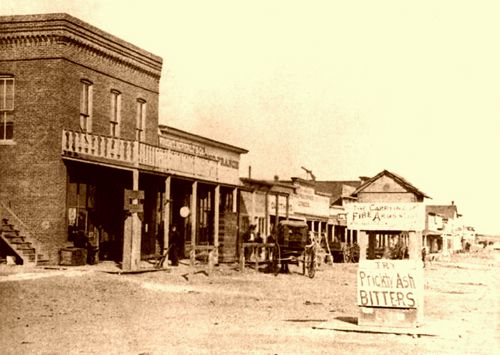
Looking east on Dodge City’s Front Street, 1878.
Famous for its rich history as a frontier cowtown, Dodge City, in Ford County, Kansas, offers travelers a wide array of legends, lore, and history in western Kansas. Once called home or visited by such notables as Wyatt Earp, Doc Holliday, Big Nose Kate, and Clay Allison, this old town was the most wicked in the Old West.
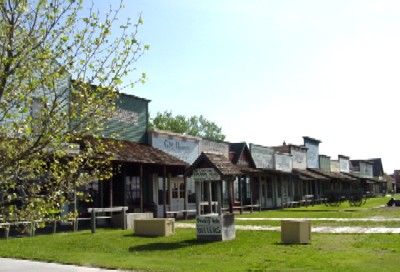
Dodge City Boot Hill Museum, by Kathy Alexander.
In 1865, Fort Dodge was established near the present site of Dodge City. During these rough times, the pioneers were often attacked by marauding Indians. The Fort protected the wagon trains from the Indians, provided mail service, and served as a supply base for troops engaged in the Indian Wars to the south. Major General Greville Dodge was placed in command of the 11th and 16th Kansas Cavalry Regiments and began work during the harsh winter of 1865 to repair telegraph lines and reopen travel routes. The Indians usually refrained from attacks during the winter months.
The long Santa Fe Trail between Franklin, Missouri, and Santa Fe, New Mexico, saw thousands of wagons pass as they traveled the Mountain Branch west of Weste City along the north bank of the Arkansas River into Colorado.
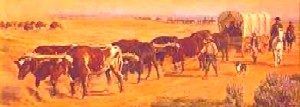
Wagon Train.
A shorter but more dangerous route to Santa Fe was the Cimarron Cutoff, which crossed the river near Dodge City and headed southwest to the Cimarron River. This trail was much more dangerous due to the vast spaces of waterless sand hills and the increased risk of Indian attacks. Despite all the hazards, this route was preferred by many traders and travelers because there were no mountains to be crossed, and the distance to Santa Fe was somewhat shorter than the Mountain Route.
In 1871, a rancher named Henry L. Sitler constructed a three-room sod house five miles west of Fort Dodge. Sitler’s home became a frequent stopping place at the foot of a hill along the Santa Fe Trail for buffalo hunters and traders. Sitler would later say of the Santa Fe Trail and its many wagon trains, “If you stood on the hill above Dodge City, there was traffic as far as you could see, 24 hours a day, seven days a week on the Santa Fe Trail.”
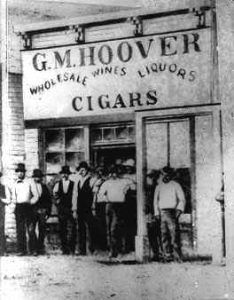
Hoover’s Store, Dodge City, Kansas.
Soon, another man named George M. Hoover would join Sitler, building Dodge City’s first business, a saloon built of sod and boards. On August 15, 1872, a group of businessmen from Fort Dodge, Riley, and Leavenworth, Kansas, organized the Dodge City Town Company and began planning and developing the townsite. At first, the settlement was named Buffalo City, but they learned there was already a town by that name, so it was renamed Dodge City after the fort.
In September 1872, the Atchison, Topeka & Santa Fe Railroad arrived in Dodge City, initiating tremendous growth for many years. Adjacent to the railroad tracks, hastily built frame buildings and tents sprang up, housing two grocery and general merchandise stores, a dance hall, a restaurant, a barbershop, and a blacksmith shop. One of the directors of the Town Company, a man by the name of Robert M. Wright, would say of this time:
“Hardly had the railroad reached there, long before a depot could be built…, business began, and such a business! Dozens of cars a day were loaded with hides and meat, and dozens of carloads of grain, flour, and provisions arrived each day. The streets of Dodge were lined with wagons, bringing in hides and meat and getting supplies from early morning to late at night… I have been to several mining camps where rich strikes had been made, but I never saw any town to equal Dodge.”
There was initially no law enforcement in the burgeoning settlement, and Dodge City quickly earned its infamous reputation for lawlessness and gunslinging. As many buffalo hunters, railroad workers, drifters, and soldiers streamed into the town after long excursions on the prairie, they quickly found the saloons, and the inevitable fights ensued. With the gunfighters dying with their boots on, Dodge City developed the Boot Hill Cemetery, which was used until 1878.
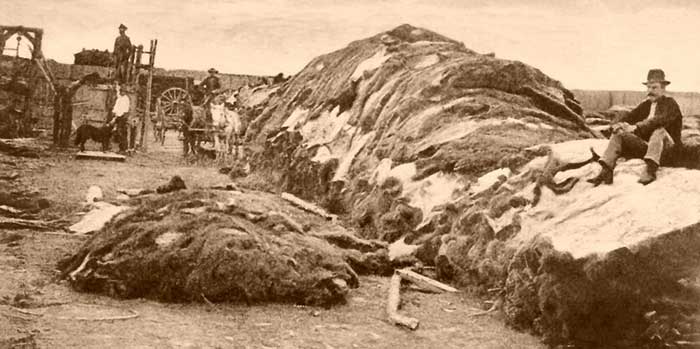
Buffalo Hide Yard in Dodge City, Kansas, 1878.
Dodge City became the buffalo capital of the West, and buffalo hides towered along Front Street, awaiting shipment. Filthy buffalo hunters and traders filled the town’s establishment, and the term “stinker” was coined. However, when General William Sherman, Army Commander-in-Chief, ordered the slaughter of buffalo to drive the Indians onto reservations, the prairie was littered with decaying carcasses.
Though Sherman’s tactic of killing the buffalo effectively won the Indian Wars, it placed hundreds of buffalo hunters out of business. Most buffalo were gone by 1876, but over 1 ½ million hides had been shipped from Dodge City on the railroad. During hard times, farmers gathered the buffalo bones for years and sold them for $6 to $8 a ton. The bones were used to manufacture china and fertilizer.
Though the buffalo no longer offered a revenue source for the townspeople, the cattle drives replaced the buffalo hunters. By the spring of 1876, the cattle trade had shifted west from Ellsworth and Wichita, Kansas, to Dodge City. As the Longhorn cattle from Texas were driven up the Chisholm Trail’s western branch to the railroad at Dodge City, the settlement was alive again. Over 5 million heads were driven on the trail into Dodge City for the next ten years.
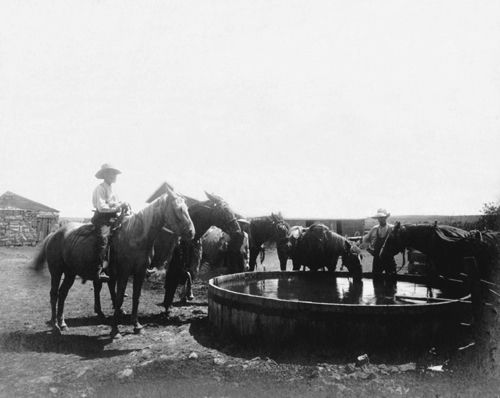
Cowboys at the water tank in Dodge City, Kansas.
But the cowboys brought even more lawlessness to Dodge City, and soon, the mayor contacted Wyatt Earp, a Wichita lawman. Pleading for Earp’s help, he offered Wyatt the Chief Deputy Marshal position with an unheard-of salary of $250 per month.
When Wyatt arrived, Dodge City’s population was 1,200, and 19 businesses were licensed to sell liquor.
Marshal Larry Deger, the last of a long line of officers who had been run out of town or shot in the back by the lawless forces of Dodge, was overwhelmed and heartily welcomed Wyatt. Soon, four assistant deputies were hired — Bat Masterson, Wyatt’s old buffalo hunting friend; Charlie Bassett; Bill Tilghman; and Neal Brown.
Intending to restore order, the new lawmen first initiated a “Deadline” north of the railroad yards on Front Street to keep the commercial part of the city quiet. On the north side, the city passed an ordinance prohibiting the wearing or carrying of guns. On the south side of the “deadline,” those who supported the lawlessness continued to operate as usual, with a host of saloons, brothels, and frequent gunfights. The expression “Red Light District” was coined in Dodge City, where the train masters took their red caboose lanterns to the town’s brothels. The gun-toting rule was in effect around the clock, and anyone wearing a gun was immediately jailed. Soon, Dodge City’s jail was filled.
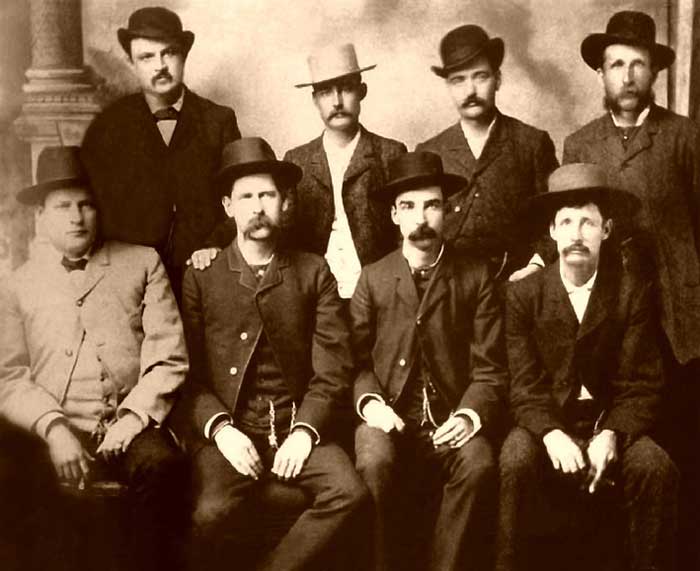
Dodge City Peace Commission 1883. Front Row: Charlie E. Bassett, Wyatt Earp, M. F. McLain, Neal Brown. Back Row: William H. Harris, Luke Short, Bat Masterson, W. F. Petillon.
As Chief Deputy Marshal, Earp would pursue famed train robber Dave Rudabaugh, following the outlaw’s trail for 400 miles to Fort Griffin, Texas. While there, Wyatt visited the largest saloon in town, Shanssey’s, asking about Rudabaugh. Owner John Shanssey said that Rudabaugh had been there earlier in the week but didn’t know where he was bound. He directed Wyatt to Doc Holliday, who had played cards with Rudabaugh.
Wyatt was skeptical about talking to Holliday, since it was well known that Doc hated lawmen. However, when Wyatt found him that evening at Shanssey’s, he was surprised at Holliday’s willingness to talk. Doc told Wyatt that he thought that Rudabaugh had back-traveled to Kansas. Wyatt wired this information to Bat Masterson, and the news was instrumental in apprehending Rudabaugh. The unlikely pair formed a friendship in Shanssey’s that would last for years.
In the fall of 1876, Wyatt Earp and his brother Morgan left Dodge City for a while, traveling for the Black Hills outside of Deadwood, South Dakota, in search of gold. However, he returned to Dodge in May of 1877 after James H. “Dog” Kelley, Dodge City’s new mayor, wired him, asking him to help with the Texas cowboys who were shooting up the town.
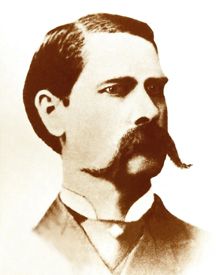
Wyatt Earp.
Wyatt was made the new town marshal when he returned and deputized his brother, Morgan. He pleaded for more severe sentencing, barred certain men from the town, and organized a “citizens’ committee” of reformers to help watchdog the streets.
In June 1877, Ed Masterson was appointed an assistant marshal in Dodge City. Later in the same year, his younger brother, Bat Masterson, was appointed undersheriff until January 1878, when he became the sheriff. On April 9, 1878, Ed Masterson was killed in a gunfight. James, a third Masterson brother, was appointed to the Dodge City police force in June 1878.
By the late 1870s, Dodge City’s reputation for lawlessness had spread as far as Washington, D.C. In a letter in the Washington Evening Star of January 1, 1878, it stated, “Dodge City is a wicked little town. Indeed, its character is so clearly and egregiously bad that one might conclude, were the evidence in the later times positive of its possibility, that it was marked for special Providential punishment.”
Later, an editor of the Hays City Sentinel would write, after visiting Dodge City, “Dodge is the Deadwood of Kansas. Her incorporated limits are the rendezvous of all the unemployed scallawagism in seven states. Her principal business is polygamy without the sanction of religion; her code of morals is the honor of thieves and decency she knows not.”
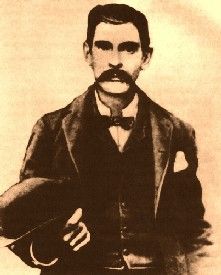
Doc Holliday.
In 1878, Doc Holliday arrived in Dodge City with Big Nose Kate Elder, posing as his wife. Settling in room 24 of the Dodge House, Doc mostly drank and gambled, but occasionally, he provided professional services to the townspeople. Shortly after his arrival, an ad appeared in the Dodge City Times, pronouncing: “J.H. Holliday, Dentist, very respectfully offers his professional services to the citizens of Dodge City and surrounding country during the summer.”
But mainly, he gambled at the Alhambra and dealt cards at the Long Branch Saloon. Though Dodge City citizens thought Wyatt and Doc’s friendship was strange, Wyatt ignored them, and Doc kept the law while in Dodge City.
During those first years, the population varied with the seasons, swelling in the summer with the influx of cowboys, cattle buyers, gamblers, and prostitutes. Business houses, dance halls, and saloons catered to the Texas trade. Gambling ranged from a game of five-cent “Chuck-a-Luck” to thousand-dollar poker pots.
In June 1879, the Ford County Globe reported, “The boys and girls across the deadline had a high old time last Friday. They sang and danced, fought and bit, and cut and had a good time generally, making music for the entire settlement. Our reporter summed up five knockdowns, three broken heads, two cuts, and several incidental bruises. Unfortunately, none of the injuries will prove fatal.”

Dodge City, circa 1875.
In September 1879, Virgil Earp sent word to Wyatt of the boom in Tombstone, and Wyatt headed West with Doc Holliday following shortly after that. By January 1880, Bat Masterson also left Dodge City for the West.
When the Santa Fe Railroad reached Santa Fe, marking the death of the Santa Fe Trail and the many travelers passing through Dodge City, it was a significant milestone. With the Indians effectively “lodged” on reservations, a military presence was no longer needed, and Fort Dodge was closed in 1882. By 1886, the cattle drives had stopped.
An illustrious period of history was over, but the legend lives on in Dodge City’s preservation of its romantic, internationally famous Old West frontier history. Today, 100,000 tourists relive the legend yearly by visiting the Boot Hill Museum and the historic Front Street reconstruction.
Things to do and experience in Dodge City:
Boot Hill Museum – The museum is open 362 days a year, but plan your trip during the summer months for historical interpreters, exciting gunfights, and other re-enactments.
Gunfighters Wax Museum – See Wyatt Earp, Belle Starr, Doc Holliday, Miss Kitty, and more in this life-sized wax museum in the Kansas Teachers Hall of Fame.
Boot Hill Casino Resort – A one-of-a-kind resort designed to recreate the feeling of the elegant Old West.
Fort Dodge – Where it all began.
Historic Trolley Tours – Offered Memorial Weekend through Labor Day.
And much more… Visit this website for more.
Today, Dodge City is home to about 28,000 people. It is located 150 miles west of Wichita in Southwest Kansas.
©Kathy Weiser-Alexander/Legends of America, updated October 2025.
“Dodge is the Deadwood of Kansas.”
— Hays City Sentinel in the late 1800s.
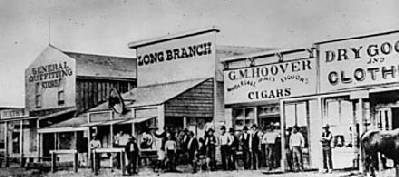
Dodge City, Kansas, 1874, courtesy Ford County Historical Society.
Also See:
Cowtowns of Kansas – Lawlessness on the Prairie
Fort Dodge History and Hauntings
John Henry “Doc” Holliday – Deadly Doctor of the Frontier
Wyatt Earp – Frontier Lawman of the American West
Gunsmoke – A Retelling for the Masses
Legends of Kansas (Our sibling website that’s all about Kansas places and people)
See Sources.