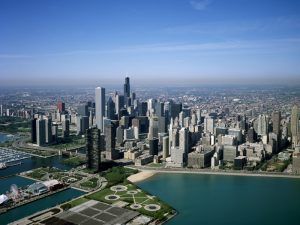
Aerial view of Chicago, Illinois, by Carol Highsmith.
Route 66 in Illinois begins near the shore of Lake Michigan in Chicago. Connecting the Midwest with the Golden State of California, the road from Chicago initially followed State Route 4 from Chicago to East St. Louis. This original gravel road was built before Route 66 existed and was first called the Pontiac Trail in 1915. In 1918, Illinois began paving roads, and by the time Route 66 was established, it was entirely paved. This piece of the Mother Road was Illinois’s first fully paved highway and was quickly recognized as the shortest distance between Chicago and St. Louis. By 1927, Route 66 signs were visible all along the Illinois route.
The route provides a rich history of Native Americans, fur trappers, explorers, waterway adventures, and Chicago gangsters. Not to mention that Abraham Lincoln started his career in Springfield, practicing law, and stayed there until he left to serve as President of the United States during one of the worst times in U.S. history. When Lincoln was assassinated, his remains were returned to Springfield, and his tomb and former home are among the state’s most visited attractions.
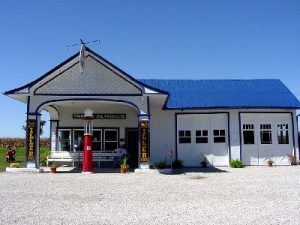
This 1932 Standard Oil Station now serves as a Route 66 Visitor’s Center in Odell, Illinois, by Kathy Alexander.
Route 66 through Illinois offers everything from culture and sophistication to winding roads with seemingly endless rows of corn and small towns with numerous vintage gas stations, motor courts, and cafes.
The vintage highway generally follows Interstate 55 to St. Louis, Missouri, crisscrossing the interstate and meandering into the many small towns along the route. The State of Illinois has done an excellent job of marking Route 66 with clearly posted signs, directing travelers when the road turns onto small towns and country roads. Many of the signs include both the new and old alignments. You will notice along your journey several sections where traces of no longer travelable old alignments appear on either side of the interstate. In other places, portions of the original road are gravel but are still passable.
On January 17, 1977, the original signs along Mother Road in Illinois were removed and replaced by the superhighway Interstate 55. But, as we all know, this piece of Route 66 and all of the rest was not that easily forgotten.
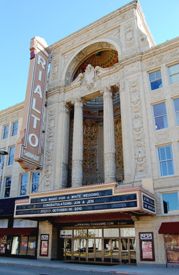
The Rialto Theatre in Joliet, Illinois, by Kathy Alexander.
Begin your journey on Mother Road at Jackson Boulevard and Michigan Avenue in Chicago and see the many historic sites of this principal municipality. Like many large cities along Route 66, urbanization has taken over, and you will have to search hard for vintage icons of the era. On your way out of Chicago, you will pass through the suburb of Cicero, once a stand-alone town outside the city, riddled with tunnels and hidey-holes utilized by Al Capone and his bootleggers.
Head on to Joliet, where you can see the Rialto Square Theatre and Union Station. In nearby Wilmington, don’t miss the Gemini Giant, and in Braidwood, the Polk-A-Dot Drive-In provides a peek at life-size statues of James Dean, Elvis, and the Blues Brothers.
Along this stretch are several abandoned coal mines on your way to Gardner, where the 1928 Riviera Restaurant once stood before it burned in June 2010. Also, here is a two-cell historic jailhouse.
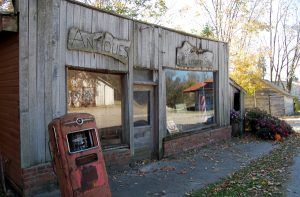
This building once served as a grocery store and gas station in Funk’s Grove. Later, it was utilized as an Antique Store. Photo by Kathy Alexander.
In Odell, you can see a 1930s Sinclair station that continued serving Mother Road travelers until 1975. Today, the Illinois Route 66 Association has restored it and turned it into an information center. In nearby Pontiac are the Old Log Cabin Inn and Restaurant and a Route 66 Museum housed in the old firehouse.
Further down the road at Bloomington, you can still see the Cotton’s Village Inn, and some 15 miles beyond is the ghost town of Funks Grove, where maple sirip (yes “sirip”) has been made since 1881. Here, you can also see an old general store and an old train depot. Near McLean, you will find the Dixie Truckers Home, the first truck stop in the United States, founded in 1928, and, further along, in Atlanta, a large “muffler man” holding a giant hot dog.
Lincoln is home to the Old Mill Restaurant, which opened in 1931 and served its famous schnitzel to many travelers on Route 66. Long closed, this old building is a sight to see, as well as many other historic places where Abraham Lincoln once walked.
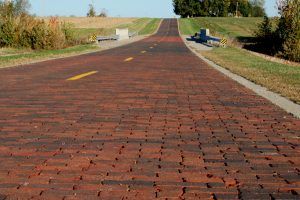
Brick Road Route 66 north of Auburn, Illinois, by Kathy Alexander.
Continuing, you’ll enter the small village of Broadwell, where the famous Pig Hop Cafe did business for more than 40 years. Unfortunately, it, too, has burned to the ground. You’ll then pass through the historic towns of Elkhart and Williamsville before coming to Springfield. In the Illinois State Capitol are Lincoln’s former home and tomb, and the Cozy Drive-In, a Route 66 icon.
From Springfield, two alignments are still intact today. The post-1930s four-lane alignment zigs and zags over and under I-55, passing through the small towns of Glenarm, Divernon, Farmersville, and Litchfield, and is a Route 66 enthusiast’s dream. Litchfield offers several great photo opportunities, with a clear focus on the Mother Road. Check out the Ariston Café, which has been in business for years and is still kickin’. The older pre-1930 two-lane alignment runs west of I-55, through Chatham, Auburn, Virden, Carlinville, and numerous other small towns, before the two alignments rejoin south of Staunton. Both paths offer several vintage glimpses of the Mother Road.
Check out Henry’s Rabbit Ranch in Staunton before continuing your journey south through Edwardsville and Mitchell and into Missouri. Don’t miss the Chain of Rocks Bridge before entering St. Louis and a new state of Route 66 wonders.
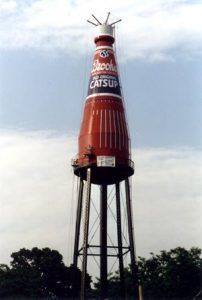
The World’s largest catsup bottle in Collinsville, Illinois, by Kathy Alexander.
While you’re in this area, a couple of great side trips can be found at Collinsville, where you can see the largest catsup bottle in the world, and at Cahokia Mounds, the largest archaeological site in America.
© Kathy Alexander/Legends of America, updated November 2025.
Also See:
See Sources.