
Also see: Women in American History.
Jump to (last name begins with): A B C D E F G H I J K L M N O P Q R S T U V W X Y Z
M
Lucretia “Aunt Lou” Marchbanks (1832-1911) – Except for “Aunt Sally” Campbell, who came with the Custer Expedition in 1874, most believe that Lucretia Marchbanks was the first black woman in the Black Hills of South Dakota. There, she worked hard, saved money, bought a hotel, and earned a reputation as the best cook in the Black Hills.
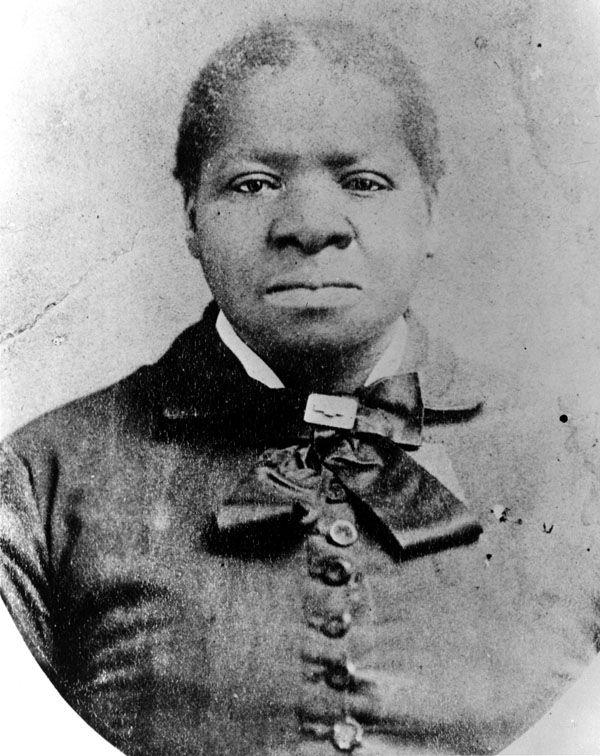
Bridget “Biddy” Mason.
Bridget “Biddy” Mason – Entrepreneur and one of the first African-American women to own land in California.
Susan Shelby Magoffin (1827-1855) – Susan Shelby Magoffin was one of the first women to travel the Santa Fe Trail.
Margaret Mead (1901-1978) Internationally known social scientist, environmentalist, and spokesperson for social and intellectual issues, she introduced the world to anthropology through her 1928 bestseller, Coming of Age in Samoa. Her pioneering research and new techniques of fieldwork revolutionized the field of anthropology.
Adah Isaacs Menken (1835-1868) – Actress, painter, and poet.
F.M. Miller – Female U.S. Deputy Marshal. Commissioned out of the federal court at Paris, Texas, she was the only female deputy working in the Indian Territory in 1891. Known to always wear a cowboy hat and adorned with a gun belt filled with cartridges and a Colt pistol, she was a fearless and efficient officer who locked numerous outlaws.
Maria Mitchell (1818-1889) The first American woman astronomer and observatory director at Vassar College.
Lucretia Mott (1793-1880) An ordained Quaker minister, she was an outspoken abolitionist and pioneering activist in the women’s suffrage movement.
N
Carry A. Nation (1846-1930) - Prohibitionist reformer, she gained fame for wielding a hatchet while destroying saloons.
Natawista – See Natawista Culbertson
O
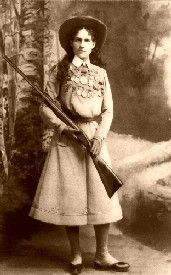
Annie Oakley, 1899.
Annie Oakley, aka Phoebe Anne Oakley Mosey (1860-1926) - An excellent markswoman, Oakley made her living demonstrating her amazing ability to hit her target. As a star of Buffalo Bill Cody’s Wild West Show, she traveled the world.
Georgia O’Keeffe (1887-1986) Known as the greatest American female artist of the 20th century, her paintings are noted for their abstract colors and shapes in depicting flowers, nature, and American landscapes.
P
Cynthia Ann Parker (1825?-1871?) – The mother of Comanche Chief Quannah Parker, Cynthia was captured as a child by a Comanche War Party. She adapted to the Indian ways, married, and had three children. She was “rescued” by Texas Rangers in 1860 but was never happy again.
Charley Parkhurst, aka One-Eyed Charley, Mountain Charley, Six-Horse Charley (1812-1879) – Parkhurst was a tobacco-chewing, cussing, gambling California stage driver.
Rosa Parks (1913-2005) - By refusing to give up her seat on a city bus to a white man in 1955 in Montgomery, Alabama, this hardworking seamstress set off a thirteen-month bus boycott and a long chain of civil rights protests. The result was the national attention of Dr. Martin Luther King, Jr. and a Supreme Court ruling outlawing segregation on buses.
Alice Paul (1885-1977) Activist and suffragist who organized the 1913 women’s rights march through Washington, D.C., and founded the Congressional Union for Women’s Suffrage, a militant branch of the National American Woman Suffrage Association.
Frances Perkins (1880-1965) - A social and political reformer, Perkins became the first woman appointed to the New York State Industrial Commission and the first female member of a United States Cabinet, heading the Department of Labor.
Susan La Flesche Picotte – Omaha Indian Susan La Flesche would overcome the stigma of women in higher education to become the first Native American to receive a medical degree.
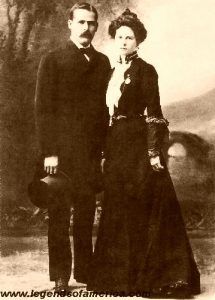
Harry Longabaugh “Sundance Kid” and Etta Place.
Etta Place (1878-19??) – Involved with the Sundance Kid, Etta was a “member” of Butch Cassidy’s Wild Bunch. Born about 1878, little is known of Etta’s life before she met the Sundance Kid.
Mary Ellen Pleasant (1814-1904) – An African American abolitionist, businesswoman, and entrepreneur. Using her money to further abolition, she worked on the Underground Railroad across many states before moving to California during the Gold Rush era. She was a friend and financial supporter of John Brown and well known in abolitionist circles. After the Civil War, she took her battles to the courts and won several civil rights victories, which resulted in her being called “The Mother of Human Rights in California.”
Pocahontas (1595?- 1617) – A Powhatan Indian Princess, she was known for having assisted colonial settlers at Jamestown and allegedly saving the life of the colony’s leader, Captain John Smith.
Poker Alice – See Alice Ivers Tubbs
Fannie Porter (1873-19??) – Porter ran one of the most luxurious brothels in Texas at the turn of the century, often harboring Butch Cassidy’s Wild Bunch.
Harriet “Ma” Pullen (1860-1947) – Harriet Smith Pullen was a wife, mother, entrepreneur, horse team driver, and hotelier who made her way to Skagway, Alaska, in 1897. She is an excellent example of a woman who honed her business skills and seized opportunities from the chaos of the Klondike Gold Rush.
R
Jeanette Rankin (1880-1973) A suffragist, Rankin became the first female elected to the House of Representatives in 1916. A Republican from Montana, she campaigned on a platform of peace and voted against the United States’ entry into World War I.

Delia Haskett Rawson.
Delia Haskett Rawson (1861-1949) – Becoming a driver at the age of 14, Delia was the first female stage driver and maybe the youngest ever to carry the U.S. mail in California.
Toby Riddle – See Kaitchkona Winema
Annie Rogers, aka Della Moore, Maud Williams (18??-19??) – Involved with Kid Curry, Annie was a “member” of Butch Cassidy’s Wild Bunch.
Eleanor Roosevelt (1884-1962) Political and social reformer, humanitarian, and outspoken crusader, this First Lady championed social justice causes worldwide. As a United Nations delegate, she chaired the United Nations Commission on Human Rights.
Betsy Ross (1752-1836) – Betsy Ross is widely credited with making the first American flag.
Lillian Russell (1860-1922) – Russell was a famous actress and singer.
Also see: Women in American History.
Jump to (last name begins with): A B C D E F G H I J K L M N O P Q R S T U V W X Y Z