
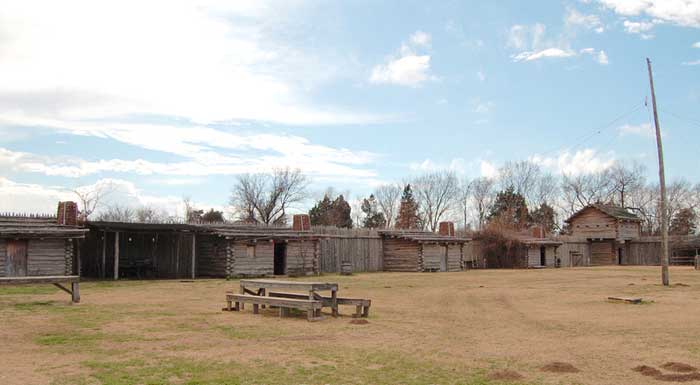
Recreated Fort Parker, Texas, by Kathy Alexander.
Born in Illinois around 1825*, Cynthia Ann Parker’s life would be turned upside down at the age of 11 after being kidnapped by Comanche Indians in Texas.
Her father, Silas M. Parker, met Cynthia’s mother, Lucinda ‘Lucy’ Duty, in Illinois Territory, where they were married in August of 1824. The family quickly grew to four children, with Cynthia as the oldest.
Silas joined the military during the Black Hawk War of 1832, after which he took his family to Texas in 1833. There, he gained admission to the Austin and Williams colony, and his family was granted a “league” of property for settlement.
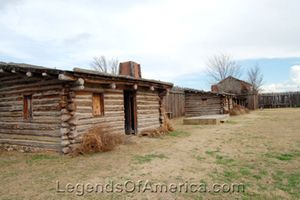
Fort Parker, Texas Buildings
Parker’s land, on the edge of the Comanche frontier, was described as being on the Sterling Fork of the Navasota River. Along with their father, Silas and his brothers, James and Benjamin Parker, immediately set out to build Parker’s Fort. The construction consisted of a large stockade, two-story blockhouses, and two rows of log cabins. Completed by March of 1834, the entire Parker family moved in and began clearing the land for fields.
In May of 1835, Silas was elected as a member of the Committee of Safety and Correspondence for Viesca, and in October was named by the General Council as superintendent over a group of 25 rangers tasked with guarding the region between the Brazos and Trinity rivers.
Only a year later, on May 19, 1836, Fort Parker was attacked by Comanche warriors, along with allies from the Kiowa and Kichai tribes. James Parker, who had been working out in the fields, arrived at the fort during the attack and managed to hide 17 of the residents of the fort, but it was too late for his brother Silas, his other brother Benjamin, and his father John, who were all killed during the attack. It would also be too late for five other family members who had been kidnapped by the Comanche, including his own daughter Rachel, his grandson James Pratt Plummer, his sister-in-law Elizabeth Kellogg, along with Cynthia and her brother John. James Parker managed to save Cynthia’s other two siblings, Orlena and Silas Jr.
James Parker would lead survivors through the underbrush for six days, south to Tinnin’s settlement, where the Old San Antonio Road crosses the Navasota River. There, he immediately began efforts to find and return his family members taken in the raid, but, after raising a company of men, his pursuit was halted by the threat of the Mexican army. It wouldn’t be until June that James would return to Fort Parker to bury the dead.
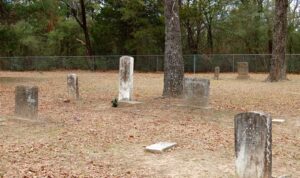
Old Springfield Cemetery, Fort Parker, Texas
In July, he met with Sam Houston, then major general of the Texas Army during the territory’s fight for independence from Mexico. Houston had previously negotiated a treaty with the Cherokee Indians in East Texas to establish peace. He wanted to do the same to secure the return of Parker’s family from the Comanche. James disagreed with the idea and wanted Houston to order an expedition against the tribe, which Houston refused. Houston refused Parker again during a second meeting in August at Nacogdoches. Still, while there, he was reunited with his sister-in-law, Elizabeth Kellogg, who had been purchased by the Delaware Indians and returned to her.
The following year, in June of 1837, Parker asked Sam Houston, now the Texas President, for permission to gather 2,000 men to act against the Comanche. Houston let him have 120, but disbanded the force before it even set out. James’ daughter Rachel was returned to him in February of 1838, but died only a year later. In 1843, James located Cynthia’s brother, John, and his grandson, James Pratt Plummer, at Fort Gibson, although there is doubt as to whether it was really John. Other accounts show John adapted well to the Comanche life until he contracted smallpox during a raid in Mexico, where the tribe abandoned him. He is said to have recovered, moved back to Texas, fought in the Civil War with the Confederate Army, and eventually returned to Mexico to farm.
James would continue to petition the Texas House for forces against the Comanche, but was denied. In 1845, through the efforts of his brother, Isaac Parker, a member of the Texas Congress, a joint resolution was passed for the payment of the redemption to the Kichai tribe.
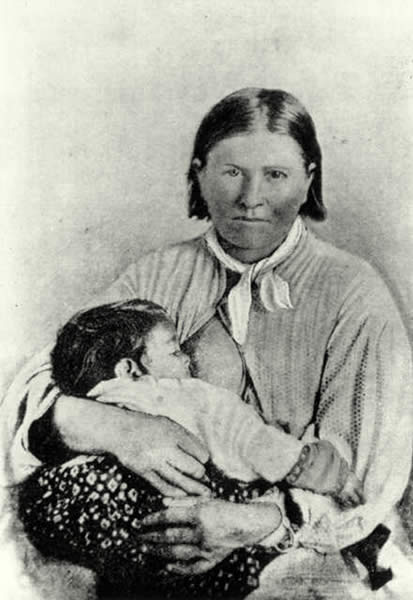
Cynthia Parker, 1861, with infant daughter.
In the meantime, Cynthia’s life with the Comanche was rough at first, abused and treated like a slave, until she was put under the care of a couple to raise her as their own. Under her native name of Na’ura, she quickly adapted and, around 1840, married chieftain Peta Nocona, who had participated in the raid on Fort Parker. Cynthia would have two sons, Quanah and Pecos, and a daughter, Topsanna (Topusana).
A newspaper account from April 29, 1846, described an encounter between Cynthia and Colonel Leonard G. Williams’ trading party along the Canadian River. Reports indicate that Williams tried to secure Cynthia’s release, but tribal leaders refused. It’s also reported that she didn’t want to leave the tribe, as she was in love with Nocona. Later reports show an encounter with federal officials on the Washita River, but again, she refused any attempt to return to her white family.
Finally, on December 18, 1860, after getting a tip that white captives were being held nearby, Texas Rangers attacked a Comanche hunting camp at Mule Creek, during which they took three of the tribe. The event is known as the Battle of Pease River, and Cynthia was one of those captured, along with her infant daughter. Nocona was reportedly killed in the raid; however, that was disputed by Cynthia, who said it was a Mexican slave. Additional reports say that Nocona lived for another year before succumbing to an infection from an injury. She was then taken back to her Uncle Isaac Parker’s home near Birdville, in what is now Arlington, Texas.
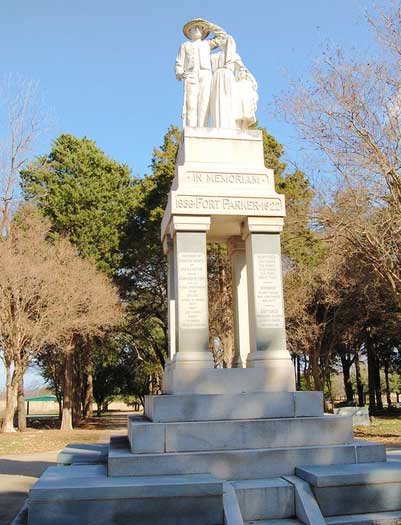
Fort Parker, Texas Cemetery Monument.
Cynthia Parker’s story captured the nation and gave hope to thousands of other families who had suffered the loss of family members during Indian raids. On April 8, 1861, the Texas Legislature awarded her a $100 annual grant for five years and some land. Her cousins, Isaac Duke Parker and Benjamin F. Parker, were made her legal guardians. However, Cynthia still didn’t want to live in white society and made several attempts to flee to her Comanche family.
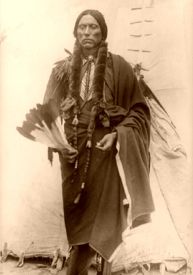
Quannah Parker, Comanche Indian Chief.
Her brother Silas Jr. then took her to his Van Zandt County home, but after he joined the Confederate Army, she wound up with her sister Orlena. Reports indicate that in 1863, she got word that her son Pecos had died of smallpox. Then, a year later, her daughter Topsanna died of pneumonia. The stress of not being able to assimilate back into the white culture and the death of her son and daughter led to severe depression and ultimately her death around 1870.
Cynthia Ann Parker’s son, Quanah, would go on to play an important role as the ‘last Comanche Chief’ for 25 years, providing leadership and promoting self-sufficiency and self-reliance on a Comanche reservation in southwestern Oklahoma. There, he oversaw the construction of schools, helped establish ranching operations, and introduced crops. The reservation was broken up and opened to settlers in 1901, after which Quanah spent the rest of his life on a profitable ranch. In 1910, Quanah moved his mother’s grave to Post Oak Mission Cemetery near Cache, Oklahoma, and was buried beside her when he died in 1911. Both their bodies were moved to Fort Sill Post Cemetery in 1957.
Although Parker’s Fort was lost over the years, in 1936 it was reconstructed at its original site and is now known as Old Fort Parker.
* It should be noted that the exact year and death of Cynthia Parker are not known, as various accounts list 1824, 1825, and 1827 for her birth, and 1870 and 1871 for her death.
More information:
©Dave Alexander/Legends of America, updated December 2025.
Also See:
Indian Captives (Frederick Webb Hodge, 1906)
Comanche – Horsemen of the Plains
Quanah Parker – Last Chief of the Comanche
Sources:
Ancestry.com
Texas State Historical Association
Forgotten Newsmakers
Wikipedia