
Lawman Summaries (name begins with) A B C D E F G H I J K L M N O P Q R S T U V W X Y Z
Old West Lawmen, produced by Legends of America, music by Scott Buckley
U
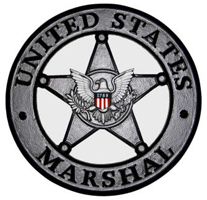
United States Marshal Badge
U.S. Marshals (1789-present) – Created more than 200 years ago in 1789, the congressional act also established the federal judicial system.
David “Big Dave” Updyke (1830-1866) – Though thought to have been the leader of a vicious gang of outlaws, Updyke was elected sheriff of Ada County, Idaho, in 1865. He was lynched on April 14, 1866, for allegedly aiding horse thieves and murderers.
V
Antonio Jose Valdez, aka: EI Mico, EI Patas de Rana) – Both an outlaw and lawman, Valdez was one of Silva’s White Caps of Las Vegas, New Mexico. He later became the city marshal of Wagon Mound, New Mexico.
Stephen Venard (1823-1891) – Nevada City, California Marshal, and Wells Fargo Detective.
Joseph “Joe” W. Ventioner (1852-1941) – U.S. Deputy Marshal commissioned in the spring of 1895 in Oklahoma by Marshal Evett Nix. Residing just three miles from the Doolin-Dalton Gang hide-out, in Lenora, on the Cheyenne-Arapaho Reservation, he was one of the strongest forces in driving them from the area. He was best known for tracking down and killing ruthless Oklahoma outlaw George “Red Buck” Weightman in 1896.
W
Fredrick Tecumseh “Fred” Waite (1853-1895) – A Chickasaw Indian, Waite was a short-time member of Billy the Kid’s Gang and gunfighter for the Regulators during the Lincoln County War but would later serve as a lawman and prominent politician.
Lyman W. Wakefield – Served as a Field Deputy for the U.S. Marshals in Arizona Territory before becoming the sheriff of Cochise County, Arizona, in the 1890s. He shot and killed outlaw Pedro Chavez.
William Alexander Anderson “Bigfoot” Wallace (1817-1899) – Served as a Texas lawman for several years before joining the Texas Rangers and soon made captain. He died on January 7, 1899.
Richard “Dick” Clayton Ware (1851-1902) – While serving as a Texas Ranger, Ware shot Sam Bass at Round Rock, Texas. Later served as Mitchell County, Texas Sheriff and as a U.S. Deputy Marshal in West Texas. He was killed by Constable John Selman in El Paso, Texas.
Matt Warner – See Willard Erastus Christianson
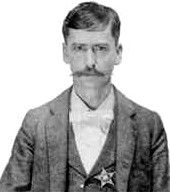
Sheriff Frank Wattron
Frank J. Wattron – When Navajo County, Arizona, was first formed in 1895, Commodore Perry Owens was appointed as its first sheriff, and beneath him worked Deputy Frank J. Wattron, a former school teacher and editor. However, during the first sheriff’s election the following year, Owens moved on, and his deputy, Frank Wattron was elected to the post in 1896. In December 1899, the Navajo County Courthouse held one of its most notable prisoners, a murderer named George Smiley. The killer was sentenced to be the first person executed in Navajo County on December 8, 1899. Wattron, goaded by his friends, issued a “novel” invitation, professionally printed on gilt-bordered paper, to what was quickly looking to be a “social affair.” However, when a reporter got a hold of the invitation, he wired it to the Associated Press. There were soon hundreds of protesting letters regarding the sheriff’s poor sense of humor. Reprimanded for his flippancy, Smiley was granted a month’s reprieve. However, the killer finally went to the gallows on January 8, 1900.
John Joshua (J.J.) Webb (1847-1882) – Both a lawman and an outlaw, Webb served as a Dodge City, Kansas Deputy Marshal before moving on to Las Vegas, New Mexico. He served as a “crooked lawman” when the Dodge City Gang was in control.
Duval West (1861-1949) – Starting as a prospector and a cowboy, West later became a U.S. Deputy Marshal in Texas. He fought the Bill Whitley Gang after the “Great Harwood Train Robbery” in 1888. Later, he became a lawyer and a federal judge.
Ben Wheeler – See Ben A. Robertson
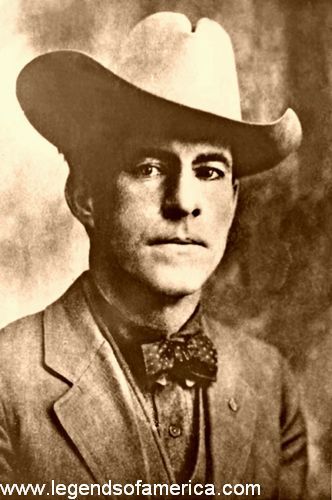
Harry Wheeler
Harry Cornwall Wheeler (1875-1925) – The son of an army officer, Wheeler was born in Florida and grew up on a series of army posts. After serving in the Spanish American War as a Rough Rider, he was transferred to the Arizona Territory. He worked briefly as a miner in Tombstone before joining the Arizona Rangers in 1903. An expert marksman, he soon obtained the rank of captain and replaced Thomas Rynning, who resigned in March 1907. Wheeler, who had served the rangers at every rank, brought discipline and idealism to the group he continued to command until the Arizona Rangers were disbanded in 1909. Later, he was elected sheriff of Cochise County. During a 1917 labor dispute at the Bisbee copper mines, he led the group responsible for the “Bisbee Deportation,” where nearly 1,200 strikers and sympathizers were forcibly removed from the area. During the First World War, Wheeler reached the rank of captain in the U.S. Army. After the war, he was defeated for the Cochise County sheriff’s office in 1922, and he drifted from job to job until his death in 1925 from pneumonia. He is buried in Bisbee, Arizona.
William Fletcher Wheeler (1824-1894) – The third U.S. Marshal in Montana Territory from 1869-1878.
Fred White (1849-1880) – Tombstone Marshal Fred White was killed in October 1880 when a group of five outlaws was shooting up the town.

Harvey Whitehill
Harvey Howard Whitehill (1837-1906) – Miner and Grant County, New Mexico Sheriff.
Chauncey “Cap” Belden Whitney (1842-1873) – One of Ellsworth, Kansas’ earliest settlers, Whitney arrived in 1867, the same year the town was established by the railroad. He left Ellsworth on several expeditions against the Indians and, in 1868, fought at the celebrated Battle of Beecher Island. The following year he was elected the first lieutenant of a militia company that manned a blockhouse near Ellsworth to guard against Indian depredations. In 1871, he became Ellsworth’s constable and built the city’s first jail. In 1872, he became the county sheriff, and on August 18, 1873, he was killed by Billy Thompson, who claimed he fired his bun by accident.
J. Shelby “Sheb” Williams (1850-1931) – Appointed a U.S. Marshal for East Texas and the Indian Territory by President Grover Cleveland on January 15, 1894. He was reappointed by President William McKinley. Williams was the owner of the first ship above White Horse Rapids in the Yukon Territory and the first steam dredge for mining gold there. He was an advisor to the United States Department of Agriculture, Chairman of the American Cotton Congress, and campaign manager for Texas Governor Oscar B. Colquitt.
William “Billy” Wilson – See David L Anderson
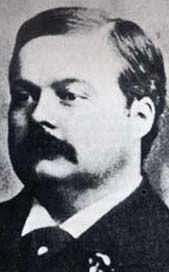
Frank Wolcott
Frank Wolcott (1840-1910) – Frank Wolcott was a soldier, lawman, and instigator in the Johnson County War in Wyoming.
William “Bill” R. Wren – The owner of a large cattle spread in Lampasas County, Texas, Bill befriended a man named Pinckney Calhoun (Pink) Higgins, who was in a bloody feud with neighboring ranchers – the Horrell brothers. Wren lent his assistance to Higgins, soon becoming his chief lieutenant. In June 1877, a gunfight between the two factions broke out in the streets of Lampasas, leaving three men dead and Wren severely wounded. Afterward, Wren signed a truce at the urging of Texas Ranger Major John B. Jones and later used his gun only on the side of the law as a county sheriff.
W.W. “Boss” Wright (18??-1856) – Nevada County, California Sheriff. Citizens killed him in the line of duty when they mistakenly thought he was an escaped convict on November 3, 1856.
X
Y
Jacob “Blake Jake” Yoes (1839-1906) – One of the best-known of Judge Isaac Parker’s U.S. Marshals, Yoes was also a miner, an entrepreneur, and a politician.
© Kathy Alexander/Legends of America, updated November 2022.
Also See:
Adventures in the American West
Lawmen & Gunfighters Photo Gallery
U.S. Marshals – Two Centuries of Bravery
Lawman Summaries (name begins with) A B C D E F G H I J K L M N O P Q R S T U V W X Y Z