LEGENDS OF AMERICA

A Travel Site for the Nostalgic & Historic Minded


  Search


Legends Home

Site Map

What's New!!


Recommend this site


American History

Ghost Towns

Ghostly Legends

Historic People

Native Americans

The Old West

Photo Galleries

Roadside Attractions

Rocky Mtn Store

Route 66

Travel Destinations

Treasure Tales

Legends Blog

Free E-Newsletter


Facebook Fanpage


Twittering


Legends of America's Exclusive Custom Products


Contact Us


Please report broken links, missing pictures, or other problems online by clicking HERE or send us an email.  Thanks!


Kansas Forts of the Old West


<< Previous  1 2 3 4 5 Next >>


Camp Ewing (1864-65?) - When William Quantrill and his men attacked Lawrence, Kansas on August 21, 1863, the town was not properly defended, leaving 180 men and boys dead. By the following year, soldiers were permanently encamped on the top and slopes of Mount Oread (then to Lawrence's southwest.) When a battery of cannon were placed at the top of the hill, the post was renamed Camp Lookout. In August, construction of a fort was begun, which was called Fort Ulysses. By the end of the year, it was not complete but contained several government storehouses. It is not known whether the fort was ever completed, but the troops were removed, probably at the end of the Civil War. Later the University of Kansas was built on the hill.


University of Kansas

University of Kansas, courtesy of the college.

Fort Atkinson (1850-54) - Known by several names during its short tenure, the fort was first established in August, 1850 by Lieutenant Colonel Edwin Vose Sumner, 1st U. S. Dragoons on the Middle Crossing of the Arkansas River near present-day Cimarron, Kansas. The temporary camp, first called Camp Mackay, was the first regular army post on the Santa Fe Trail in the midst of Indian Country.  However, just a month later, Colonel E.V. Sumner determined that the post should be located below the “Crossing” and ordered the post moved to a point on the Arkansas River about two miles west of present-day Dodge City.

Soon soldiers of the Sixth U.S. Infantry were building a “permanent” fort of sod buildings because trees were scarce in the area. The fort continued to be known as Camp Mackay until June, 1851 when it was changed to Fort Atkinson. However, the troops more familiarly referred to it as Fort Sumner, Camp #57 or “Fort Sod.”  Later, when the place became infested with field mice that were destroying their buildings and provisions, they referred to the post as "Fort Sodom.”

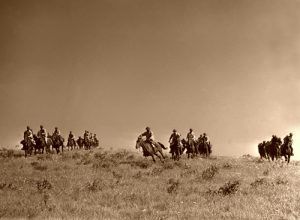
On several occasions the fort was surrounded by Comanche and Kiowa Indians who endeavored to cut off the post supplies which had to come from Fort Leavenworth, some 370 miles away.  The troops were finally relieved by the timely arrival of Major Chilton with a detachment of the First Dragoons. The post was occupied until September 22, 1853 when it was abandoned. It was briefly reoccupied in June, 1854 by the Sixth Infantry, but was again abandoned a few months later in October and the buildings destroyed to prevent their occupancy by the Indians.

Nothing remains of the post today but a small marker located about 2 miles west of Dodge City, south of Highway 50, on the north side of the Arkansas River.

Fort Aubrey (1865-1866) - At the close of the Civil War, a number of regiments were ordered to the western frontier to protect the pioneers from Indian raids. Several temporary posts were built including what was first known as Camp Wyncoop in September, 1865. Built by companies of the 48th Wisconsin Infantry under the command of Captain Adolph Whitman, the post was located at the head of Spring Creek about two ½ miles north of the Arkansas River, about midway between the present towns of Kendall and Syracuse. Because the site was originally recommended by Francis Xavier Aubry, a trader and explorer who was killed in Santa Fe, New Mexico in August, 1854, the fort was later renamed in his honor. Intended as a temporary post, the fort protected travelers on the Mountain Branch of the Santa Fe Trail and the Aubrey Cutoff for only nine months. Though no major battles occurred at the fort during this period, the troops did engage in many small skirmishes with the Indians while out on patrol in the area and while escorting wagon trains along the Santa Fe Trail. It was abandoned in April, 1866. Afterwards, the site was utilized as a stage station until 1867, when it then became part of a private ranch. It has continued to be used for agricultural purposes since then and today the remains of the fort consist only of three clusters of dugout depressions. The fort was located three miles east of Syracuse, Kansas on US Highway 50, then 1/2 mile south on a rural road, ½  mile east on a rural road, and very near a farmstead on the south side of the road.


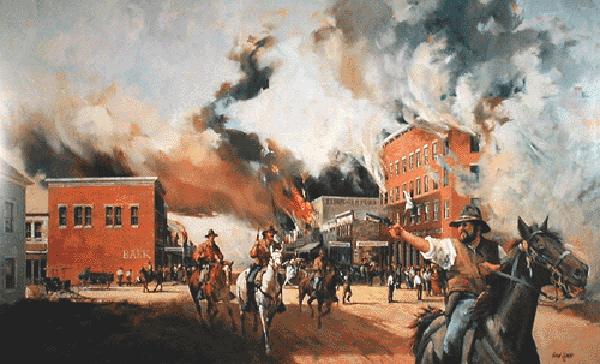
Bleeding Kansas

Jayhawkers and Bushwackers fight it out over Kansas

becoming a free state or a pro-slavery state.


Fort Bain  (1857-58) - A non official military fort, Fort Bain was little more than a log cabin built by abolitionists, John Brown and and Captain Bain to protect the area from pro-slavery forces during the Kansas-Missouri Border War. Located in the northern part of Bourbon County, it was situated on the north side of the Osage River, a little northwest of present-day Fulton, Kansas and about 7-8 miles from the Missouri state line. It became a rendezvous point for not only John Brown, but also anti-slavery leader, Captain James Montgomery and also a site on the Underground Railroad. During this time, John Brown said that he and about 50 men resisted a force of some 500 anti-slavery men at the site. What is recorded is that four pro-slavery men were killed while attacking the fort on December 2, 1857.


It was from here, that John Brown was said to have planned his invasion of Missouri, which occurred in December, 1858. After Kansas was admitted to the Union as a free state on January 29, 1861 Fort Bain became a private residence for some years and was later replaced with a new structure. There is nothing to mark the site today.


Fort Belmont (1860-1864) – Situated two miles west of present day Buffalo, Kansas in Woodson County, Fort Belmont was built to protect area settlers from both Indians and Missouri Bushwhackers during the strife of the Kansas-Missouri Border War. Situated in a wooded area on Sandy Creek, the fort was built near the Belmont Trading Post, which was established in 1856.  


The post included Officers’ quarters in 3-4 small cabins south of the actual fort, which was an earth embankment with logs as a roof. A parade ground was located east of the officers’ quarters. The post was manned with companies from the Kansas 16th Regiment.


For a brief period of time, an Indian Agency was located at the post to service the Osage and Creek Indians of the area. The agency was discontinued in October, 1864 and by the end of the month the fort was abandoned. The most never saw any military action during the Civil War. Though the fort continued to stand until about 1871, it quickly deteriorated and there are no remains today.


Kansas Missouri Border War

A skirmish between abolitionists and pro-slavery factions

 during the Kansas-Missouri Border War.


Fort Blair (Baxter) (1862-1865) - See full article HERE!


Continued Next Page

<< Previous  1 2 3 4 5 Next >>

From the Rocky Mountain General Store

Camera - Vintage Photos IconVintage Photographs of the Old West - From our personal Photo Print Shop, you can now order prints that provide dramatic glimpses into the rich heritage of the American West. From notorious outlaws, to Indian Chiefs, buffalo roaming the range, and pioneers on the trail, this varied collection grows daily.


                                                              Copyright © 2003-2009, www.Legends of America.com