
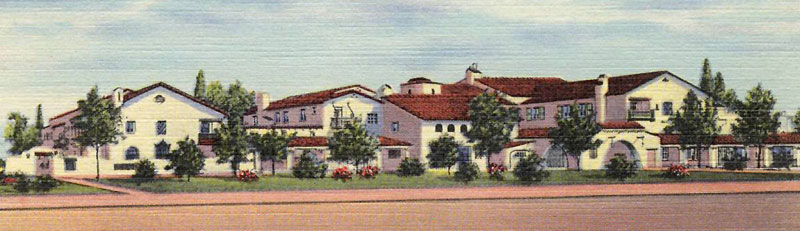
La Posada Hotel in Winslow, Arizona.
Though the famous Harvey House lunch rooms, restaurants, and hotels predated Route 66, the two happily coexisted for many decades. However, change was inevitable, and ironically, Route 66 was in part responsible for the death of this famous chain. As roads improved and automobiles became more affordable, passenger service on trains across America began a gradual decline. Overland trucking also rose, reducing the cargo shipped by rail.
Listed below are the locations along Route 66 that were once part of the Harvey House Chain.
Ashfork- Built in 1905, the Escalante Hotel replaced a vintage Harvey House Hotel and Restaurant from 1895. It closed in 1948. In the 1950s, the Atchison, Topeka & Santa Fe Railroad realigned the railroad through the area, and the city suffered a major economic setback. This was soon compounded when Route 66 was replaced by I-40, which bypassed Ashfork entirely. The Escalante Hotel was demolished in the 1970s.
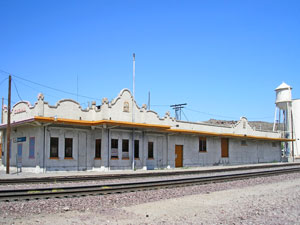
The Kingman, Arizona, depot was directly across from the Harvey House Restaurant, photo by Kathy Alexander.
Kingman – In 1901, a Harvey House Restaurant opened in Kingman. The historic house of hospitality was destroyed in a fire in 1952. A one-story stucco depot still stands across from its location.
Peach Springs – This building, which once housed a Harvey House Restaurant, still stands but is used by the Water Treatment Plant.
Seligman – As railroad traffic increased, the Havasu Fred Harvey House was built. Opening in 1905, the hotel covered 60,000 square feet and included numerous hotel rooms, a large kitchen, a lunchroom, and a newsstand. Abandoned by the railroad years ago, the building stood for years, but by 2007 it was in danger of being demolished. Under federal regulations, any occupied building must be a safe distance from active railroad tracks, and the building was not deemed to be. The owner, Burlington Northern Santa Fe Railway, made plans to demolish the building in 2008. Though locals and Route 66 preservationists worked to save the building, the “Save the Seligman Harvey House” campaign lost, and the building was demolished in May 2008.
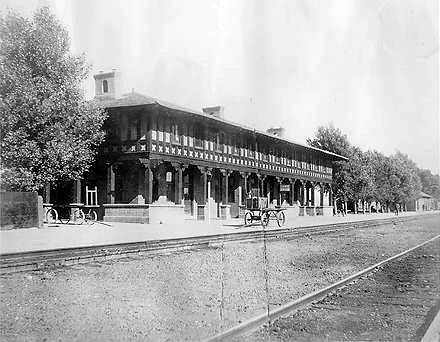
The Havasu Fred Harvey House in Seligman, Arizona.

The old Seligman depot, courtesy of Don Gray, September 2007.
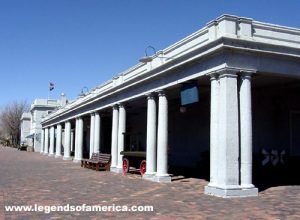
Williams, AZ Depot. Photo by Dave Alexander.
Williams – The Fray Marcos Hotel was built in the early 20th Century. The historic depot still stands, servicing the many passengers headed to the Grand Canyon. Inside the old depot is a museum. The site of the old Fray Marcos is now home to the Grand Canyon Railway Hotel, designed to resemble the century-old depot that housed the original Fray Marcos.
Winslow – On May 15, 1930, the famous La Posada Harvey House Hotel opened its doors. The last one, built by the famous Harvey Hotel and Restaurant chain, Winslow, was chosen for the site because it was the headquarters of the Santa Fe Railway. Designed by Mary Colter, the famed Grand Canyon architect, she carefully blended Native American and Spanish cultural elements into the hotel. In 1957, the beautiful La Posada Hotel was closed. Two years later, all of its museum-quality furnishings were auctioned off. In the early 1960s, much of the building was gutted and transformed into offices for the Santa Fe Railroad.
When the railroad announced plans to move out of Winslow for good in 1994, and the La Posada was scheduled for demolition, the town gathered up and went to work. Today, the La Posada has been fully restored and stands as an oasis in the desert, catering to a new generation of Route 66 adventurers. It is the only original Harvey Hotel on Route 66 that still operates as it was first intended.
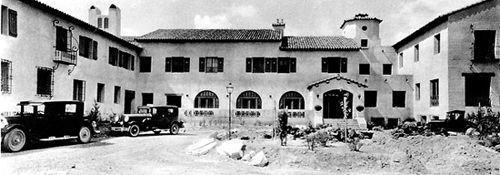
The historic La Posada Harvey House Hotel was the last Harvey Hotel built, and today, it is the only one left standing that still serves as a hotel. Photo courtesy of La Posada Hotel.
Bagdad – The Bagdad Depot once had a small Harvey House lunchroom used primarily by Santa Fe employees.
Barstow – In 1911, the Fred Harvey Company opened the Casa Del Desierto Harvey House. Hotel. After the hotel and restaurant were closed, the building was used mainly for a machine shop, with a cafeteria and a small Amtrak ticket office. Before long, the Casa Del Desierto was abandoned altogether. In the late 1980s, the Santa Fe Railway decided to tear down the old Harvey House until local citizens and Barstow historians raised an outcry. The City of Barstow saved the old building, and restoration began. The Casa Del Desierto was re-dedicated in 1999. It now operates as two museums and city offices.
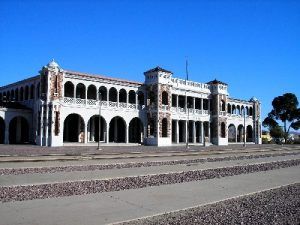
The Casa Del Desierto Harvey Hotel in Barstow, California, Kathy Alexander.
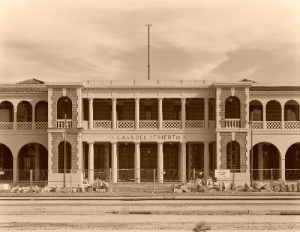
The Casa Del Desierto Harvey Hotel in Barstow, California.
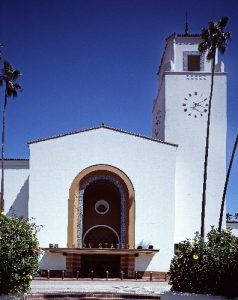
Los Angeles Union Station. Photo by Carol Highsmith.
Los Angeles – In 1893, Santa Fe’s Moorish-style La Grande Station opened between 1st and 2nd streets on Santa Fe Avenue in Los Angeles, California. Six years later, the Harvey House Restaurant opened, serving railroad travelers in style. At that time, the railroad tracks ran right down Alameda, coexisting with trolleys and cars. After years of wrangling and numerous fatal accidents, it was finally decided that a new station needed to be built. Though the voters approved the new station in 1926, it would be more than ten years before it was finally built. With the cooperation of the region’s three principal railroads, the Union Pacific Railroad, the Southern Pacific Railroad, and the Atchison, Topeka, and Santa Fe Railway, the new station opened on May 3, 1939, with some 500,000 people attending its grand opening. Constructed in Spanish Colonial, Mission Revival, and Streamline Moderne styles, with Moorish architectural details, the interior walls were covered with marble and acoustical tiles, and enclosed garden patios adorned either side of the waiting room. The new station also boasted a new and improved Harvey House restaurant and adjoining bar.
The decade after the new station opened marked the heyday of the railroad era, as thousands of people arrived in Los Angeles by rail. During World War II, the Harvey House Restaurant boasted it could feed 800 people an hour. However, as competition from cars and airlines increased, the railroad era was coming to an end. In 1967, the grand Harvey House restaurant closed, and four years later, in 1971, Amtrak took over passenger operations.
Today, Los Angeles’ Union Station is home to the Metrolink, which serves thousands of commuters daily. Union Station is mainly used for special events. Attached to the main building to the South is the old Harvey House Restaurant. It was the last of the Harvey House establishments designed by southwestern architect Mary Colter and the last to be built. The room still boasts its rounded central counter, streamlined booths, and inlaid floor patterns. Today, it is home to a bar and restaurant.
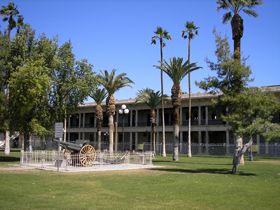
El Garces, Needles, California. Photo by Kathy Alexander.
Needles – When the original depot was destroyed by fire, it was replaced by the El Garces Harvey House and Train Depot, completed in 1908. The building was named “El Garces” in honor of Father Francisco Garces, a missionary who visited the area in 1776. El Garces was considered one of the “Crown Jewels” of the chain and was remembered for its natural linen and silver, distinctive china, and fresh flowers provided daily for guests. The lunchroom had two horseshoe-shaped counters and could serve many people. Community members also utilized the facilities for elegant private dinners, banquets, and special occasions. The El Garces closed as a Harvey House in the fall of 1949, when the building was partitioned and used as Santa Fe Railway offices.
In 1988, the Santa Fe Railroad moved its offices out of the El Garces to another facility, and the building was closed. Sitting abandoned, the historic building was threatened with destruction until the Friends of El Garces was formed in 1993. Through their efforts, the Friends of Needles petitioned the City of Needles to purchase the station, which it did in 1999.
The restoration and reconstruction of the historic building began in March 2007. Plans to sell the facility to a buyer who planned to open an upscale hotel and restaurant were made. However, those plans fell through when the Federal Transit Administration determined that, because it had granted $4.8 million in public funding for construction, the city had to retain ownership. Restoration continued, and the exterior was completed in 2014. However, initial hopes for the building have not been achieved, as it remains vacant and is for lease today.
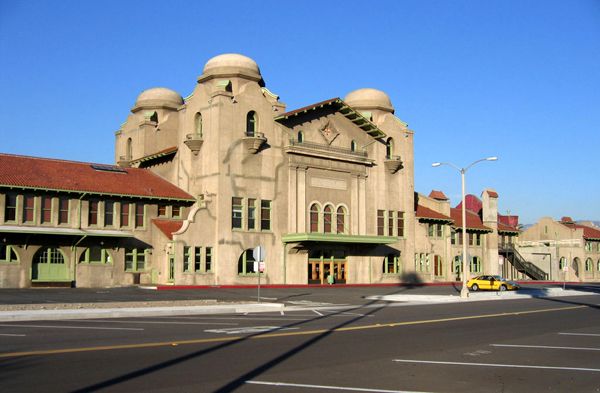
San Bernardino Depot, California, courtesy of Wikipedia.
San Bernardino – In the late 19th Century, San Bernardino was chosen as the headquarters for the Santa Fe Railroad’s massive Pacific Coast Locomotive Works, a transportation center serving rail passengers and the Railroad’s administrative offices. An original wooden depot burned to the ground in 1916 and was replaced by the magnificent depot that stands today. Designed in the Mission Revival style with Moorish influences, the grandiose structure was intended to befit the city’s image as the “gateway to southern California.” For the first half of the 20th Century, the depot flourished; many travelers and businesspeople used it, and many were entertained at the depot’s famous Harvey House Restaurant. In its heyday, approximately 85 percent of the townspeople depended on the railroad for their livelihood.
Unfortunately, the depot’s success did not protect it from the railroad industry’s decline in the latter half of the Century, and it fell into disrepair. For years, the old depot sat abandoned until, in the mid-1990s, the City of San Bernardino began working to bring it back to life. Some $15 million later, after the restoration work, including historically accurate renovations of the interior and exterior and installation of utilities, the depot held its grand reopening in June 2004. Today, the renovated depot serves Metrolink, a commuter rail service, and Amtrak.
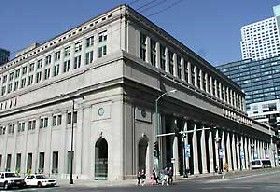
Chicago Union Station.
Chicago Union Station – During Union Station’s boom years in the 1940s, more than 300 trains arrived or departed daily, and 100,000 passengers passed through the terminal. The station also housed one of the famous Harvey House restaurants. Today, Chicago’s Union Station continues to serve as a hub for about 50,000 passengers daily.
Joplin – The Frisco building in Joplin once served as Joplin’s train depot and one of the famous Harvey House Restaurants. Today, it has been refurbished into an apartment building.
Springfield – The original Springfield depot was built in 1882, when the Gulf line built a sizeable two-story depot at the corner of Mill and Main Streets. The depot included a lunchroom built by the Fred Harvey Company on the West end. In 1901, Frisco took over the Gulf line.
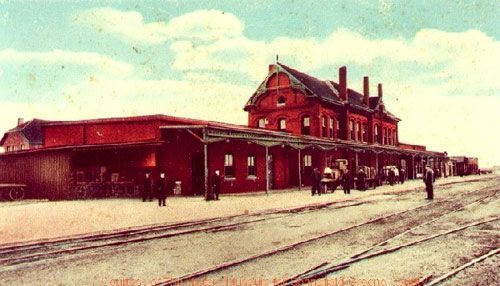
Springfield, MO Frisco Depot
In the early to mid-1920s, several newspaper articles speculated that a new depot would be built. Instead, the Frisco hired architect R.C. Stevens to completely remodel and expand the building in the California mission style. A Harvey House Restaurant still stood on the East side. As railroad travel declined in the 1950s, the depot saw fewer travelers. The popular Harvey House Restaurant was closed down in 1955, the last to close on the Frisco line. On December 9, 1967, the last passenger train left the station. Springfield talked about turning the station into a shopping mall, but it never happened. The building immediately began to decline, as the public did not secure it. Although Springfield placed it on the Historic Sites Register in 1975 to preserve it, the building was demolished on March 5, 1977.
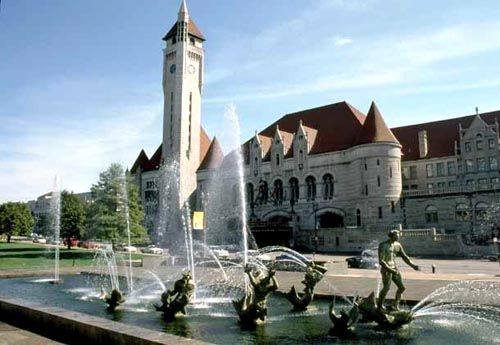
St. Louis Union Station.
St. Louis Union Station – On September 1, 1894, St. Louis Union Station opened as the largest, most beautiful terminal in the United States. This enormous project was built for $6.5 million. The pièce de résistance of this new station was the Grand Hall, which featured a 65-foot barrel-vaulted ceiling decorated with gold leaf, Romanesque arches, and stained glass windows—the most magnificent of these being the Allegorical Window, majestically framed by the famous “Whispering Arch.” The end walls were decorated with low-relief tracery emerging from female figures.
In its heyday in the mid-1940s, the station served over 100,000 passengers daily. During the 1950s, people began choosing other forms of transportation, and as rail traffic declined, the station languished for several years until, in October 1978, the last train pulled out, marking the end of an era.
In March of 1979, Oppenheimer Properties purchased the station for $5.5 million. In August of 1985, after two years of extensive restoration and new construction costing $174 million, St. Louis Union Station celebrated its grand reopening as a specialty retail, restaurant, entertainment, and hotel complex, making it the largest adaptive reuse project in the United States.
Albuquerque – The Alvarado Hotel, designed by Mary Jane Colter, opened in 1902. It also housed the Indian Building, where Native American pottery and jewelry were displayed. In the early 20th Century, the Fred Harvey Company began to popularize and develop markets for Indian craftsmanship. Many such artifacts were actually created in the Indian Building. On February 13, 1970, the wrecking ball smashed into what was one of Albuquerque’s most famous historical landmarks. For years, the site sat empty as a parking lot. However, in 2002, a “new” Alvarado opened to the public.
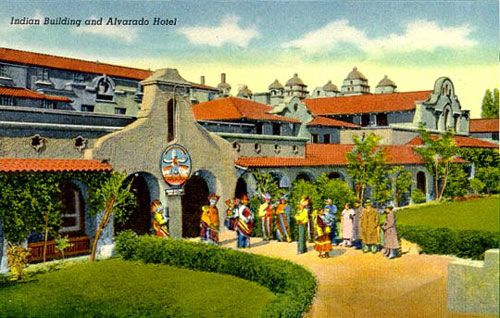
The original Alvarado Hotel was torn down in 1970.
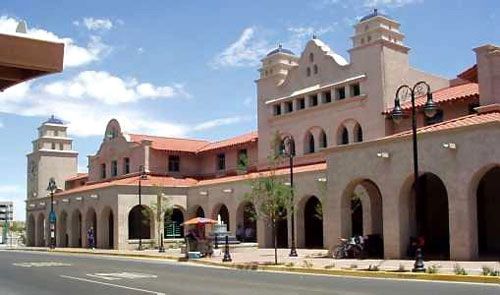
The rebuilt Alvarado Hotel today.
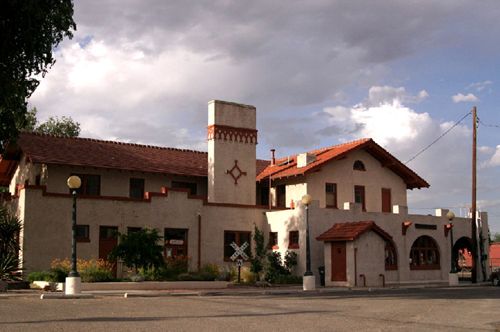
Belen, NM – Harvey House.
Belen – While not actually on Route 66, it’s very nearby. This early 1900s depot housed one of the original Harvey House Restaurants in 1910, and today it is home to the Harvey House Museum. The museum is located just ten miles South of Route 66 in Los Lunas, New Mexico. Take US-85/NM-314 to get to Belen.
Gallup – The El Navaho Hotel was built in 1918. Though the hotel was torn down, the historic railroad station still stands and houses the new Gallup Cultural Center.
Santa Fe – The La Fonda Hotel was built in 1922. In 1925, it was acquired by the Atchison, Topeka Santa Fe Railroad, which leased it to Fred Harvey. For more than 40 years, from 1926 to 1968, the La Fonda was one of the famous Harvey Houses. Since 1968, La Fonda has been locally owned and operated and has continued a tradition of warm hospitality, excellent service, and modern amenities while maintaining its historic integrity and architectural authenticity.
Afton – The Fred Harvey Company operated a newsstand at the Afton Depot.
Miami – The Fred Harvey Company operated a newsstand at the Miami Depot.
Oklahoma City – The Art Deco station still stands in Oklahoma City, but is in poor repair. This was one of only a handful of Santa Fe depots built with a high-ceiling waiting room. The two-story concrete depot is currently undergoing restoration.
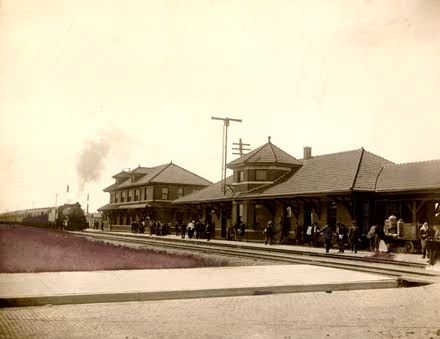
Old Vinita, Oklahoma Depot, courtesy of the University of Arizona Fred Harvey Collection.
Sapulpa – Opened in the late 1800s, a Harvey House Restaurant was located in the Frisco Station. Though the Sapulpa Harvey House was torn down in 1963, the residence used by several of the Harvey girls still stands as the Sapulpa Historical Museum.
Tulsa – This Art Deco-style station was designed by R.C. Stephens and completed in 1931. In its prime, the depot served as many as 36 trains a day. Though the station never housed a Fred Harvey restaurant, it was home to one of their many newsstands. The station ceased operation in 1967, and after years of vacancy and neglect, looters took everything they could reach, from marble to chandeliers and etched glass. Then, in 1982, the Williams Companies began to renovate the deteriorating structure for use as office space. The walls, moldings, and medallions on the ceiling were restored to their original colors.
Vinita – The old depot in Vinita once included a Harvey House Restaurant and a newsstand. Unfortunately, there is no sign of the Harvey House today.
Amarillo – The two-story stucco depot opened in 1910 with a Harvey House Restaurant. It closed in 1940, and in the 1970s, the railroad sold the building. Continuing to stand today, it now houses a large antique store.
©Kathy Alexander/Legends of America, updated October 2026.

Amarillo Harvey House.
The Harvey Girls: Opportunity Bound is a new documentary film from Katrina Parks that tells the story of how over 100,000 railroad station waitresses opened up the doors of the American West and the workplace to women and changed history. It was a James Beard Award finalist, has aired on over a dozen PBS stations, and is currently touring museums across the country.
The Harvey Girls: Opportunity Bound, by Katrina Parks, on Vimeo.