
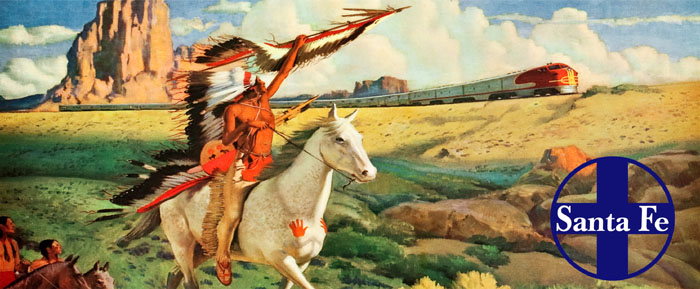
Atchison, Topeka, and Santa Fe Railway Chief.
The Atchison, Topeka & Santa Fe Railroad, more commonly referred to as the “Santa Fe Railroad,” was first chartered by the Kansas Territorial Legislature in February 1859 as the Atchison-Topeka Railroad. The Atchison & Topeka Company was organized on February 11 of that year.
Four years later, in November 1863, “Santa Fe” was added to the name; however, the railroad’s main line never reached there because the terrain was too difficult to lay tracks. Instead, the city of Albuquerque served New Mexico and the Santa Fe area.
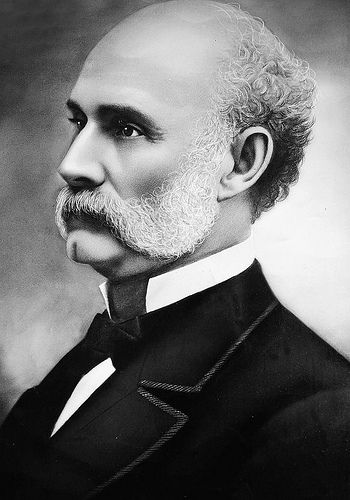
Cyrus K. Holliday.
In 1864, Congress made a large grant of land for the benefit of the road and counties through which it was to run, and voted bonds to aid in its construction. Work commenced at Topeka, Kansas, in the fall of 1868 and was finished the following year at Burlingame, a distance of 27 miles. When the track was completed to Wakarusa, 13 miles from Topeka, an excursion was run there from Topeka to celebrate the event. Cyrus K. Holliday, who planned the enterprise and was the company’s first president, in a speech during that excursion, predicted that the western terminus of the road would one day be located on the Pacific coast. It is said that when the prophecy was uttered, one incredulous individual, unable to control his mirth at the thought of that little crooked road becoming a great trans-continental thoroughfare, threw himself on the grass and exclaimed, “Oh, the old fool!” Yet the prediction proved correct.
As the railroad was being built, many of the tracks were laid directly over the wagon ruts of the Santa Fe Trail. In 1869, the company’s first general office building was constructed in Topeka. This building also served as a passenger station and freight depot. When the line was extended to Newton, Kansas, in 1871, the railroad assured its success by becoming a major cattle shipper. Later, it would also extend to Wichita and Dodge City, making those settlements into instant “cowtowns.”
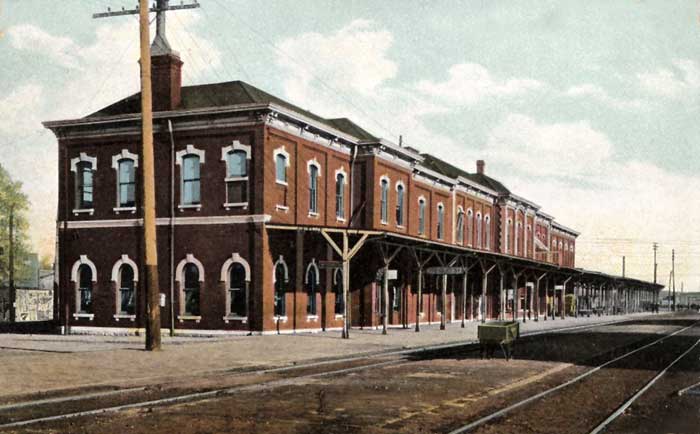
Atchison, Topeka, and Santa Fe Railway Company depot in Topeka, Kansas.
In January 1872, the division between Atchison and Topeka was graded, but the track was not laid until later. As the railroad expanded, it increased its demand for services and profitability by selling farmland from the land grants Congress had awarded it.
Rather than turn its survey southward at Dodge City, the Atchison, Topeka & Santa Fe Railroad headed southwest over Raton Pass due to coal deposits near Trinidad, Colorado, and Raton, New Mexico. In 1873, the mainline of the road was completed to the Kansas-Colorado state line and connected to Pueblo, Colorado, in 1876.
The Denver & Rio Grande Railroad (D&RG) was also aiming at Raton Pass, but Atchison, Topeka & Santa Fe Railroad crews arrived early in 1878 and were hard at work with picks and shovels before the D&RG crews arrived. During this period, the two railroads engaged in a series of skirmishes over the occupation of the Royal Gorge west of Cañon City, Colorado, which culminated in physical confrontations and a two-year armed conflict known as the Royal Gorge Railroad War. The feud continued until the Federal Government intervened, and a settlement was agreed to in February 1880.
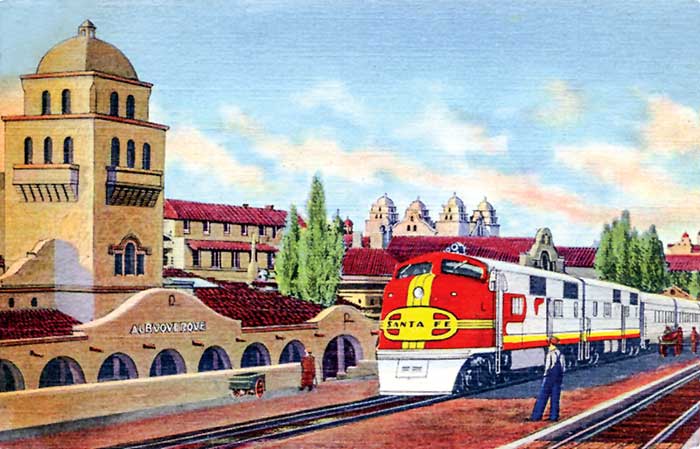
Atchison, Topeka & Santa Fe Railroad in Albuquerque, New Mexico.
The Atchison, Topeka & Santa Fe Railroad reached Albuquerque in 1880, and Santa Fe was served along a short branch from Lamy, New Mexico. In March 1881, the Atchison, Topeka & Santa Fe Railroad connected with the Southern Pacific Railroad at Deming, New Mexico, forming the second transcontinental rail route. The railroad was then built southwest from Benson, Arizona, to Nogales on the Mexican border, where it connected with the Sonoran Railway.
Afterward, the Santa Fe began to expand in California and took control of several lines, including the Gulf, Colorado & Santa Fe Railway in 1886 and a line between Wichita and Fort Worth in 1887; lines from Kansas City to Chicago, Illinois; from Kiowa, Kansas to Amarillo, Texas and from Pueblo to Denver, Colorado in 1888; and purchased the Frisco and the Colorado Midland Railway in 1890. By January 1890, the entire system consisted of some 7,500 miles of track.
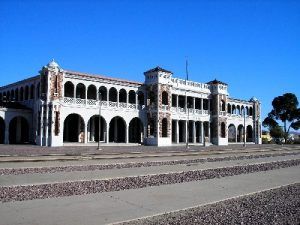
The Casa Del Desierto Harvey Hotel in Barstow, California, by Kathy Alexander.
The Santa Fe Railway still wanted to reach California on its own rails, and the Golden State eagerly courted the railroad to break the Southern Pacific’s monopoly. In 1897, the railroad traded the Sonoran Railway of Mexico to the Southern Pacific for its line between Needles and Barstow, California, giving the Atchison, Topeka & Santa Fe Railroad its own line from Chicago to the Pacific coast.
The Atchison, Topeka & Santa Fe Railroad purchased the Southern California Railway in January 1906. With this purchase, they also acquired the Los Angeles and San Gabriel Valley Railroad and the California Central Railway.
The subsequent expansion of the Santa Fe Railway encompassed lines from Amarillo to Pecos, Texas, in 1899; from Ash Fork, Arizona, to Phoenix; and from Williams, Arizona, to the Grand Canyon in 1901, as well as other smaller lines in New Mexico and Texas. Continuing their expansion over the next few years, they also acquired several short railroads and constructed new lines in California.
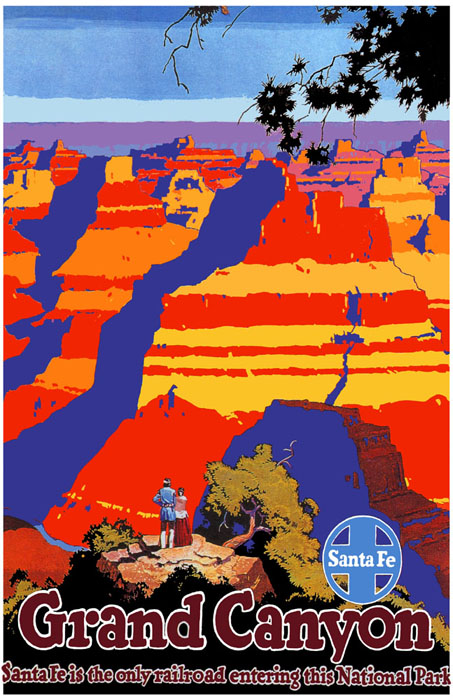
Santa Fe Railroad Grand Canyon Poster
When the railroad began to make its way into the Grand Canyon, the Fred Harvey Company built the El Tovar Hotel in 1905. Realizing that National Parks were becoming a great attraction for the public – and thus generating revenue-producing passengers – the Atchison, Topeka & Santa Fe Railroad then successfully led the lobbying effort to establish Grand Canyon National Park (1919). The railroad continued to build into National Parks and other attractions, including the Petrified Forest National Park.
By 1912, the Atchison, Topeka & Santa Fe Railroad encompassed nearly 10,000 miles of road. According to the railroad commissioner’s report, the railroad operated 2,659 miles in Kansas and expended over $3,000,000 on shops and office buildings in Topeka.
At one time, the enterprise was among the first significant freight operators and included a tugboat fleet, bus service, ferryboats, and an airline—the short-lived Santa Fe Skyway. Its bus line extended passenger transportation to areas not accessible by rail, and ferryboats on the San Francisco Bay allowed travelers to complete their westward journeys to the Pacific Ocean.
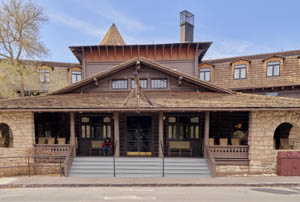
Fred Harvey built the 1905 El Tovar Hotel as part of the Santa Fe Railroad System. Photo by Carol Highsmith.
The Atchison, Topeka & Santa Fe Railroad was also widely known for its passenger train service in the first half of the 20th century, introducing many innovations in passenger rail travel. These innovations included dining cars on its passenger trains in 1891 and Harvey House restaurants and hotels strategically located throughout the system. Several Harvey Houses still survive, most notably the El Tovar, located adjacent to the Grand Canyon, and the La Posada Hotel in Winslow, Arizona. The railroad also began using new passenger cars, such as the Chicago–Los Angeles El Capitan and Super Chief, which included “Big Dome” Lounge cars and double-decker Hi-Level cars. Because long stretches of its mainline traversed areas without water, Santa Fe was one of the first buyers of diesel locomotives for freight service.
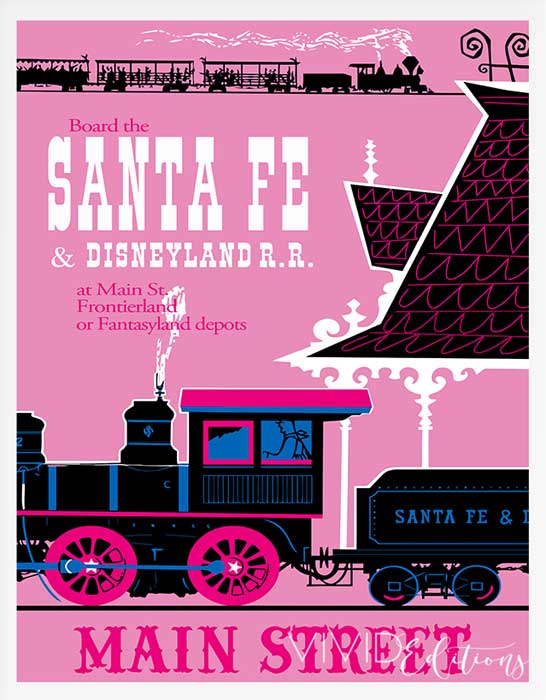
Santa Fe Disneyland Railroad.
After World War II, the nation began to travel more than ever, and the railroad stepped in to add even more lines. On March 29, 1955, the railway was one of many companies that sponsored attractions in Disneyland, with a five-year sponsorship of all Disneyland trains and stations that lasted until 1960.
The Atchison, Topeka & Santa Fe Railroad began discussing mergers in the 1980s and considered a proposed merger with the Southern Pacific. However, the Interstate Commerce Commission denied the merger on the grounds that it would create excessive duplication of routes. However, another merger followed when the AT&SF formally merged with the Burlington Northern Railroad to form the Burlington Northern & Santa Fe Railway in December 1996.
©Kathy Alexander/Legends of America, updated January 2026.
Also See:
A Century of Railroad Building
Linking the Oceans By Railroad
Railroads & Depots Photo Gallery

Santa Fe Railway Map, 1950
Sources:
Blackmar, Frank. W.; Kansas: A Cyclopedia of State History, Volume I, Standard Publishing Company, Chicago, IL, 1912.
National Park Service
Wikipedia