
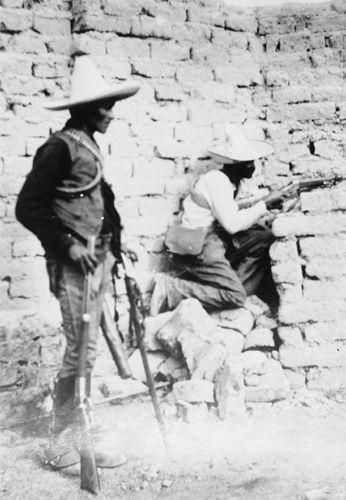
Vaqueros.
By Emerson Hough in 1905
The desert regions of the West seemed always to breed truculence and touchiness. Some of the most desperate outlaws have been those of western Texas, New Mexico, and Arizona. These have sometimes been Mexicans, sometimes half-breed Indians, and rarely full-blood or half-blood black men. Texas and the great arid regions west of Texas produced rather more than their full quota of bad white men who took naturally to the gun.
By all means, the most prominent figure in the general fighting along the Southwestern border, which found its climax in the Lincoln County War, was that historic and somewhat romantic character known as Billy the Kid. At the time of his death at the age of 21, he had more than a score of killings to his credit. His character may not be chosen as an exemplar for youth, but he affords an instance hardly to be surpassed by the typical bad man.
The true name of Billy the Kid was William H. Bonney, and he was born in New York City on November 23, 1859. His father moved to Coffeyville, on the border of the Indian Nations, in 1862, where, soon after, he died, leaving a widow and two sons. Mrs. Bonney moved to Colorado again, where she married her second husband, Antrim. All the time clinging to what was the wild border, these two now moved down to Santa Fe, New Mexico, where they remained until Billy was eight years of age. In 1868, the family made their home at Silver City, New Mexico, where they lived until 1871, when Billy was twelve years of age. His life until then had been one of shifting about in poverty or, at best, rude comfort. His mother seems to have been a wholesome Irishwoman of no great education but of good instincts. Of the boy’s father, nothing is known, and of his stepfather, little more, except that he was abusive to the stepchildren. Antrim survived his wife, who died about 1870. The Kid always said that his stepfather was the cause of his “getting off wrong.”
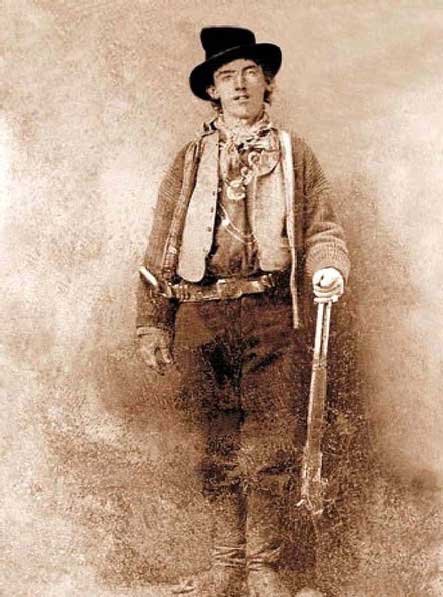
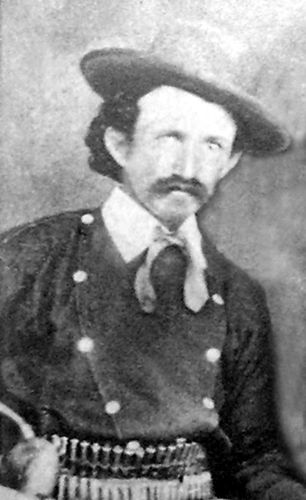
This photo taken of Billy the Kid shows him as left-handed. However, it was a tintype, which created a mirror image. He was actually right-handed.
The Kid was only twelve years old when, in a saloon row in which a friend of his was being beaten, he killed with a pocket-knife a man who had previously insulted him. Some say this was an insult to his mother; others deny it and say the man had attempted to horsewhip Billy. The boy turned up with a companion at Fort Bowie, Pima County, Arizona, and was around the reservation for a while.
At last, he and his associate, who appears to have been as well saturated with border doctrine as himself at tender years, stole some horses from a band of Apache and incidentally killed three of the latter in a night attack. They took their first step toward easy living in this enterprise and, young as they were, found means in this way to travel about Arizona. They presently turned up at Tucson, where Billy began to employ his precocious skill at cards and where, presently, in the inevitable gambler’s quarrel, he killed another man.
He fled across the line into old Mexico, where he set up as a youthful gambler in the state of Sonora. Here, he killed a gambler, Jose Martinez, over a Monte game on an “even break,” being the fraction of a second, the quicker on the draw. He was already showing his natural fitness as a weapons handler. He kept up his record by appearing next at Chihuahua and robbing a few Monte dealers there, killing one whom he waylaid with a new companion by the name of Segura.
The Kid was now old enough to be dangerous, and his life had been one of irresponsibility and lawlessness. He was nearly at his physical growth at this time, possibly five feet seven and a half inches in height and weighing a hundred and thirty-five pounds. He was always slight and lean, a hard rider all his life, and never old enough to begin to take on flesh. His hair was light brown, and his eyes were blue or blue-gray, with curious red-hazel spots. His face was rather long, his chin narrow but long, and his front teeth were a trifle prominent. He was always a pleasant-mannered youth, hopeful and buoyant, never glum or grim, and he nearly always smiled when talking.
The Southwestern border at this time offered but few opportunities for making an honest living. There were the mines, and there were the cow ranches. It was natural that the half-wild life of the cowpunchers would sooner or later appeal to the Kid. He and Jesse Evans met somewhere along the lower border a party of punchers, among whom were Billy Morton and Frank Baker, as well as James McDaniels, the last-named being the man who gave Billy his name of “The Kid,” which hung to him all his life.
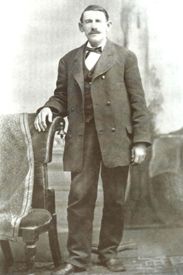
John Chisum.
The Kid arrived in the Seven Rivers country on foot. In his course east over the mountains from Mesilla to the Pecos Valley, he had been mixed up with a companion, Tom O’Keefe, in a fight with some more Apache, of whom the Kid is reported to have killed one or more. There is no doubt that the Guadalupe Mountains, which he crossed, were at that time a dangerous Indian country. That the Kid worked for a time for John Chisum on his ranch near Roswell is well known, as is the fact that he cherished a grudge against Chisum for years and was more than once upon the point of killing him for a real or fancied grievance. He left Chisum and served with John H. Tunstall on his Feliz ranch late in the winter of 1877, animated by what reason we may not know. In doing this, he may have acted out of pique, spite, or hatred. There was some quarrel between him and his late associates. The Murphy faction killed Tunstall on February 18, 1878. From that time, the path of the Kid is very plain, and his acts were well known and authenticated. He had by this time killed several men, certainly, at least two white men, and how many Mexicans and Indians he had killed by fair means or foul will never be really known. His reputation as a gunfighter was well-established.
Dick Brewer, Tunstall’s foreman, was now sworn in as a “special deputy” by McSween, and a war of reprisal was now on. The Kid was soon in the saddle with Brewer and, after his former friends, all Murphy’s allies. There were about a dozen in this posse. On March 6, 1878, these men discovered and captured a band of five men, including Frank Baker and Billy Morton, both old friends of the Kid, at the lower crossing of the Rio Penasco, some six miles from the Pecos. The prisoners were kept overnight at Chisum’s ranch. Then the posse started with them for Lincoln, not taking the Hondo-Bonito trail, but one via the Agua Negra, on the east side of the Capitans, proof enough that something bloody was in contemplation, for that was far from any settlements.
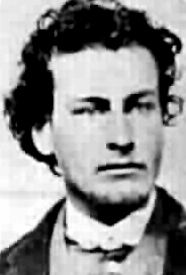
Richard “Dick” Brewer.
Apologists of the Kid say that Morton and Baker “tried to escape” and that the Kid followed and killed them. The truth, in all probability, is that the party, sullen and bloody-minded, rode on, waiting until wrath or whiskey should inflame them to give resolution for the act they all along intended. The Kid, youngest but most determined of the band, no doubt did the killing of Billy Morton and Frank Baker, and in all likelihood, there is truth in the assertion that they were on their knees and begging for their lives when he shot them. McClosky was killed by McNab on the principle that dead men tell no tales. This killing was on March 9, 1878. The murder of Sheriff William Brady and George Hindman by the Kid and his half-dozen companions occurred on April 1, 1878, and it is another act that can have no palliation whatever.
The Kid was now assuming prominence as a gunfighter and leader, despite his youth. After the big fight in Lincoln was over and the McSween house was in flames, the Kid was the leader of the sortie, which took him and a few of his companions to safety. The list of killings behind him was now steadily lengthening, and, indeed, one murder followed another so fast all over that country that it was hard to keep track of them all.
The killing of the Indian agency clerk, Bernstein, on August 5, 1878, on a horse-stealing expedition, was the next act of the Kid and his men, who thereafter fled northeast, out through the Capitan Gap, to certain old haunts around Fort Sumner, some 90 miles north of Roswell, up the Pecos Valley.
Here, a little band of outlaws, led by the Kid, lived as long as they could by stealing horses along the Bonito and around the Capitans and running them off north and east. The Kid, Charlie Bowdre, Doc Skurlock, Wayt, Tom O’Folliard, Hendry Brown, and Jack Middleton were in this band at the time. Some or all of these were in the march with stolen horses, which the Kid engineered that fall, going as far east as Atacosa, on the Canadian before the stock was all gotten rid of. Middleton, Wayt, and Hendry Brown left the Kid’s gang, telling him that he would get killed before long. The latter laughed at them and returned to his old grounds, alternating between Lincoln and Fort Sumner and stealing some cows from the Chisum herd now and then.
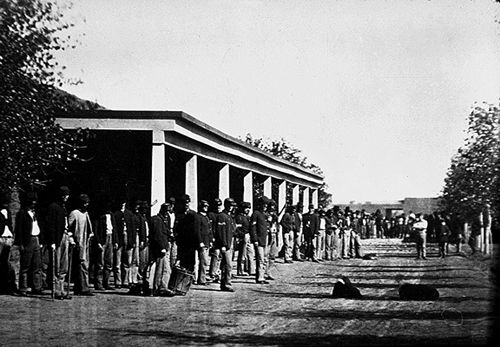
Historic Fort Sumner, New Mexico.
In January 1880, the Kid enlarged his list of victims by killing, in a very justifiable encounter, a bad man from the Panhandle by the name of Grant, who had been loafing around in his country and who, no doubt, intended to kill the Kid for the glory of it. The Kid had, a few moments before he shot Grant, taken the precaution to set the hammer of the latter’s revolver on an “empty” as he whirled it over in examination. They were apparently friends, but the Kid knew that Grant was drunk and bloodthirsty. He shot Grant twice through the throat as Grant snapped his pistol in his face. Nothing was done with the Kid for this, of course.
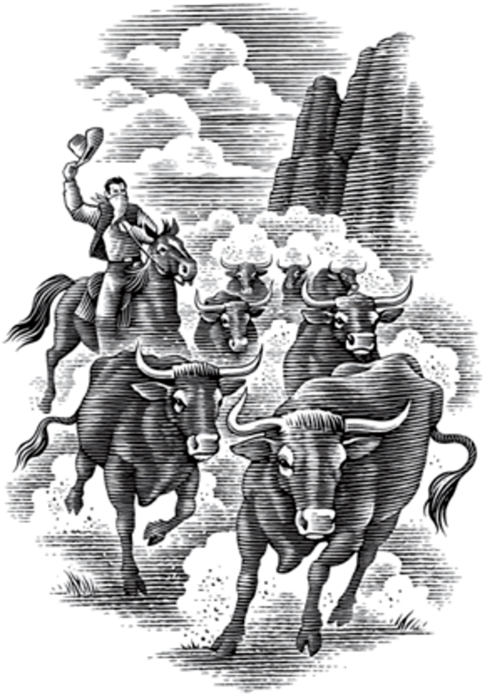
Cattle Rustling.
Birds of a feather now began to appear in the neighborhood of Fort Sumner, and the Kid’s gang was increased by the addition of Tom Pickett and later by Billy Wilson, Dave Rudabaugh, Buck Edwards, and one or two others. These men stole cattle now from ranges as far east as the Canadian and sold them to obliging butcher shops at the new mining camp of White Oaks, just coming into prominence; or, again, they took cattle from the lower Pecos herds and sold them north at Las Vegas; or perhaps they stole horses at the Indian reservation and distributed them along the Pecos Valley. Their operations covered a country more than 200 miles across in either direction. They had accomplices and friends in nearly every little place in the country. Sometimes they gave a man a horse as a present. If he took it, it meant that they could depend upon him to keep silent. Their influence was extended partly by friendliness and terrorizing, until they became a power over all that portion of the country, and their self-confidence had now risen to the point that they thought none dared to molest them. In general, they behaved in the high-handed fashion of true border bandits. This was the heyday of the Kid’s career.
On November 27, 1880, the Kid added to his list of killings. The men of White Oaks, headed by deputy sheriff William Hudgens, saloon-keeper of White Oaks, formed a posse after the fashion of the day and started out after the Kid, who had passed all bounds in impudence of late. In this posse were Hudgens and his brother, Johnny Hudgens, Jim Watts, John Mosby, Jim Brent, J.P. Langston, Ed Bonnell, W.G. Dorsey, J.W. Bell, J.P. Eaker, Charles Kelly, and Jimmy Carlyle. They bayed up the Kid and his gang in the Greathouse ranch, forty miles from White Oaks, and laid siege, although the weather was bitterly cold and the party had no supplies or blankets for a long stay.
Hudgens demanded the surrender of the Kid, and the latter said he could not be taken alive. Hudgens then sent word for Billy Wilson to come out and have a talk. The latter refused but said he would talk with Jimmy Carlyle if the latter would come into the house. Carlyle, against the advice of all, took off his pistol belt and stepped into the house. He was kept there for hours. At about two o’clock in the afternoon, they heard the window shatter and saw Carlyle break through it and run. Several shots followed, and Carlyle fell dead, the bullets that killed him cutting dust in the faces of Hudgens’ men as they lay across the road from the house.
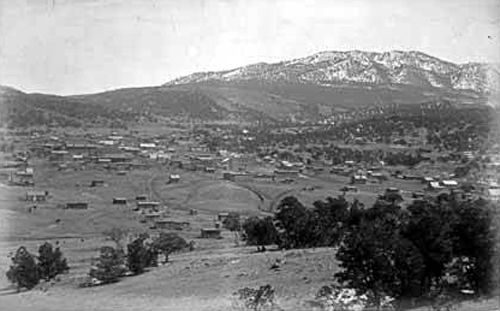
White Oaks, New Mexico.
This murder was a nail in the Kid’s coffin, for Carlyle was well-liked at White Oaks. By this time, the toils began to tighten in all directions. The United States Government had a detective, Azariah F. Wild, in Lincoln County. Pat Garrett had just been elected sheriff and was after the outlaws. Frank Stewart, a cattle detective with a party of several men, was also in from the Canadian country, looking for the Kid and his gang for thefts committed east of Lincoln County, across the lines of Texas and the Neutral Strip. The Kid at this time wrote to Captain J.C. Lea at Roswell that if the officers would leave him alone for a time until he could get his stuff together, he would pull up and leave the country, going to old Mexico, but that if he was crowded by Garrett or anyone else, he surely would start in and do some more killing. This did not deter Garrett, who, with a posse made up of Chambers, Barney Mason, Frank Stewart, Juan Roibal, Lee Halls, Jim East, “Poker Tom,” “Tenderfoot Bob,” and “The Animal,” with others, all more or less game, or at least game enough to go as far as Fort Sumner, at length rounded up the Kid, and took him, Billy Wilson, Tom Pickett and Dave Rudabaugh; Garrett killing O’Folliard and Bowdre.
Pickett was left in Las Vegas, where no United States warrant was issued against him. Rudabaugh was tried later for robbing the United States mail, later tried for killing his jailer, and was convicted and sentenced to be hanged, but once more escaped from the Las Vegas jail and got away for good. The Kid was not so fortunate. He was tried at Mesilla before Judge Warren H. Bristol, the same man whose life he was charged with attempting in 1879. Judge Bristol appointed Judge Ira E. Leonard of Lincoln to defend the prisoner, and Leonard got him acquitted of the charge of killing Bernstein on the reservation. He was next tried, at the same term of court, for the killing of Sheriff William Brady, and in March 1881, he was convicted under this charge and sentenced to be hanged at Lincoln on May 13, 1881. He was first placed under the guard of Deputies Bob Ollinger and Dave Woods and taken across the mountains in the custody of Sheriff Garrett, who received his prisoner at Fort Stanton on April 21.
Lincoln County was just beginning to emerge from savagery. There was no jail worth the name, and all the county could claim as a place for the house of law and order was the big store building lately owned by Murphy, Riley & Dolan. It was necessary to keep the Kid under guard for the three weeks or so before his execution. Sheriff Garrett chose as the best available material Bob Ollinger and J.W. Bell, a good, quiet man from White Oaks, to act as the deathwatch over this dangerous man, who seemed now to be nearly at the end of his day.
Against Bob Ollinger, the Kid cherished an undying hatred and longed to kill him. Ollinger hated him as much and wanted nothing so much as to kill the Kid. He was a friend of Bob Beckwith, whom the Kid had killed, and the two had always been on opposite sides of the Lincoln County fighting.
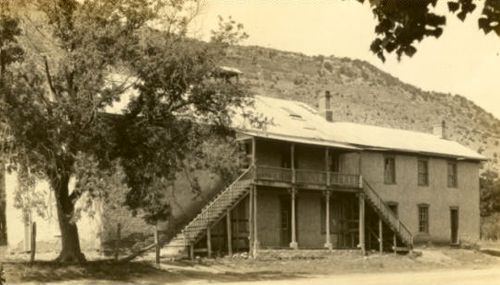
Murphy, Riley & Dolan’s store became the new courthouse in Lincoln, New Mexico. It now serves as a museum.
Ollinger taunted the Kid with his deeds and showed his own hatred in every way. There are many stories about what now took place in this old building at the side of bloody little Lincoln Street. A common report is that in the evening of April 28, 1881, the Kid was left alone in the room with Bell, Ollinger having gone across the street for supper; that the Kid slipped his hands out of his irons — as he was able to do when he liked, his hands being very small — struck Bell over the head with his shackles while Bell was reading or was looking out of the window, later drawing Bell’s revolver from its scabbard and killing him with it. This story is not correct.
The truth is that Bell took the Kid, at his request, into the yard back of the jail; returning, the Kid sprang quickly up the stairs to the guard-room door as Bell turned to say something to old man Goss, a cook, standing in the yard. The Kid pushed open the door, caught up a revolver from a table, and sprang to the head of the stairs just as Bell turned the angle and started up. He fired at Bell and missed him, the ball striking the left-hand side of the staircase. It glanced, however, and passed through Bell’s body, lodging in the wall at the angle of the stair. Bell staggered out into the yard and fell dead. This story is borne out by the reports of Goss and the Kid and by the bullet marks. The place is very familiar to the author, who, at that time, practiced law in the same building when it was used as the courthouse, and who has also talked with many men about the circumstances.
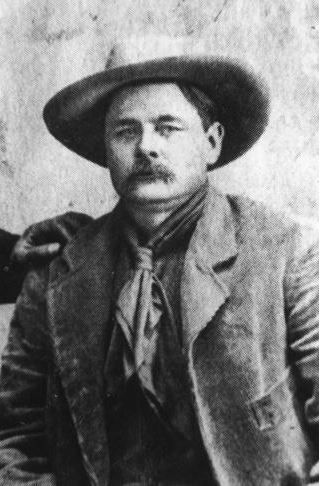
Bob Olinger.
The Kid now sprang into the next room and caught up Ollinger’s heavy shotgun, loaded with the very shells Ollinger had charged for him. He saw Ollinger coming across the street, and just as he got below the window at the corner of the building, the Kid leaned over and said, coolly and pleasantly, “Hello, old fellow!” The next instant, he fired and shot Ollinger dead. He then walked around through the room and out upon the porch, which at that time extended the full length of the building, and, coming again in view of Ollinger’s body, took a second deliberate shot at it. Then he broke the gun across the railing and threw the pieces down on Ollinger’s body. “Take that to hell with you,” he said coolly. Then, seeing himself free and once more king of Lincoln Street, he warned away all who would approach and, with a file which he compelled Goss to bring to him, started to file off one of his leg irons. He got one free, ordered a bystander to bring him a horse, and at length, mounting, rode away for the Capitans and so to a country with which he had long been familiar. At Las Tablas, he forced a Mexican blacksmith to free him of his irons. The following night, he sent the horse, which belonged to Billy Burt, back by some unknown friend.
He was now again on his native heath, a desperado and an outlaw indeed, and obliged to fight for his life at every turn. For now, he knew the country would turn against him, and, as he had been captured through information furnished through supposed friends, he knew that treachery was what he might expect. He also knew that Sheriff Garrett would never give him up now and that one of them must die.
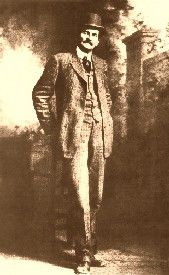
Sheriff Pat Garrett.
Yet, knowing all these things, the Kid, using stolen horses, broke back once more to his old stamping grounds around Fort Sumner. Garrett again got on his trail, and as the Kid, with incredible fatuity, still hung around his old haunts, he could at length close with him once more. With his deputies, John Poe and Thomas P. McKinney, he located the Kid in Sumner, although no one seemed explicit about his whereabouts. He went to Pete Maxwell’s house himself, and there, as his two deputies were sitting at the edge of the gallery in the moonlight, he killed the Kid at Maxwell’s bedside.
Billy the Kid had many actual friends whom he won by his pleasant and cheerful manners and his liberality when he had anything with which to be liberal, although that was not often. He was very popular among the Mexicans of the Pecos Valley. As to the men the Kid killed in his short 21 years, that is a matter of disagreement. The usual story is 21, and the Kid is said to have declared he wanted to kill two more — Bob Ollinger and ” Bonnie” Baca — before he died, to make it 23 in all.
Pat Garrett says the Kid had killed eleven men. Others say he had killed nine. Very few say that the Kid never killed any man without full justification and in self-defense. They regard the Kid as a scapegoat for others’ sins. Indeed, he was less fortunate than some others, but his deeds brought him his deserts at last, even as they left him an enduring reputation as one of the most desperate desperadoes ever known in the West.
Central and eastern New Mexico, from 1860 to 1880, probably held more desperate and dangerous men than any other corner of the West ever did. It was a region then more remote and less known than Africa is today, and no record exists of more than a small portion of its bloodshed. Nowhere in the world was human life ever held in such low regard, and no population was more lawless. There were no courts and no officers, and most of the scattered inhabitants of that time had come thither to escape courts and officers. This environment that produced Billy the Kid brought out others scarcely less dangerous, and of a few of these, there may be made passing mention.
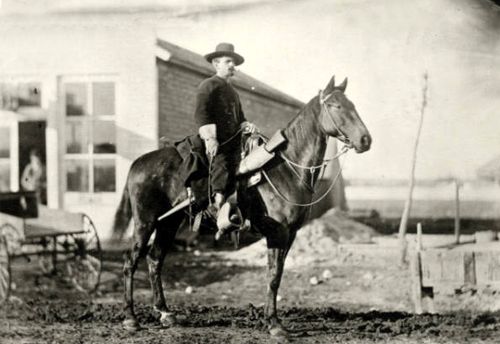
Joel Fowler was hanged in Socorro, New Mexico, in 1884.
Joel Fowler was long considered a dangerous man. He was a ranch owner and cowman, but he often came into the settlements, nearly always to get drunk immediately. In the latter condition, he was always bloodthirsty and quarrelsome, and none could tell what or whom he might make the object of his attack. He was very insulting and overbearing, very noisy and obnoxious, the sort of desperado who makes unarmed men beg and compels “tenderfeet” to dance for his amusement. His birth and early life seem hidden by his later career, during which, in about middle life, he lived in central New Mexico. He was credited with killing about 20 men, but there may have been the usual exaggeration regarding this.
His end came in 1884 at Socorro. He was arrested for killing his own ranch foreman, Jack Cale, a man who had befriended him and taken care of him in many a drunken orgy. He stabbed Cale as they stood at the bar in a saloon, and everyone thought he was unarmed. The law against carrying arms while in the settlements was then just beginning to be enforced. Although it was recognized as necessary for men to go armed while journeying across those wild and little-settled plains, the danger of allowing six-shooters and whiskey to operate simultaneously was also generally recognized. If a man did not lay aside his guns on reaching a town, he was apt to be invited to do so by the sheriff or town marshal, as Joel had already been asked that evening.
Fowler’s victim staggered to the door after he was stabbed and fell dead on the street, the act being seen by many. The law was allowed to take its course, and Fowler was tried and sentenced to be hanged. His lawyers appealed on a technicality and sent the case to the Supreme Court, where a long delay seemed inevitable. The jail was so bad that an expensive guard had to be maintained. At length, some citizens concluded that hanging Fowler was best for all concerned. They took him, mounted, to a spot some distance up the railroad, and there hanged him. Bill Howard, a Negro section hand, was permitted by his section boss to make a coffin and bury Fowler, a matter which the Committee had neglected; and he says that he knows Fowler was buried there and left there for several years, near the railway tracks. The usual story says that Fowler was hanged on a telegraph pole in town.
Jesse Evans was another bad man of this date, a young fellow in his early twenties when he first came to the Pecos country, but good enough at gun work to make his services desirable. He was one of the very few men who did not fear Billy the Kid. He always said that the Kid might beat him with the Winchester, but that he feared no man living with the six-shooter. Evans came very near, meeting an inglorious death. He and the notorious Tom Hill once held up an old German in a sheep camp near what is now Alamagordo, New Mexico. The old man did not know that they were bad men, and while they were looting his wagon, looking for the money he had in a box under the wagon seat, he slipped up and killed Tom Hill with his own gun, which had been left resting against a bush nearby, nearly shooting Hill’s spine out. Then he opened fire on Jesse, who was close by, shooting him twice, through the arm and through the lungs.
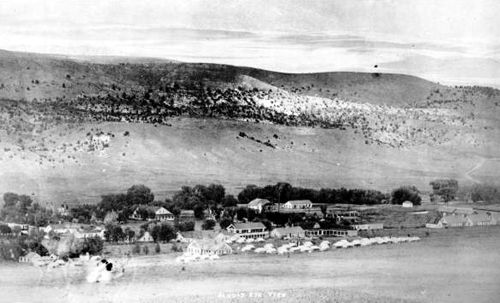
Fort Stanton, New Mexico.
The latter managed to get on his horse bareback and rode that night, wounded as he was and partly trailed by the blood from his lungs, sixty miles or more to the San Augustine mountains, where he holed up at a friendly ranch, later to be arrested by Constable Dave Wood, from the railway settlements. In default of a better jurisdiction, he was taken to Fort Stanton, where he lay in the hospital until he got ready to escape when he seemed to have walked away. Evans and his brother, who was known as George Davis — the latter being the true name of both — then went down toward Pecos City. They got into a fight with some rangers, who killed his brother on the spot and captured Jesse, who was confined in the Texas penitentiary for twenty years.
He escaped and was returned, yet in the year 1882, when he should have been in the Texas prison, he is said to have been seen and recognized on the streets of Lincoln. Evans, or Davis, is said to have been a Texarkana man and to have returned to his home soon after this, only to find his wife living with another man and supposing her first husband was dead. He did not tell the new husband of his presence, but took away with him his boy, whom he found now well grown. It was stated that he went to Arizona, and nothing more is known of him.
Tom Hill, the man mentioned above as killed by the sheepman, was a typical rough, dark, swarthy, low-browed, as loud-mouthed as he was ignorant. He was a braggart but nonetheless a killer.
Charlie Bowdre.
As was Tom Hill, Charlie Bowdre is supposed to have been a Texas boy. Bowdre had a little ranch on the Rio Ruidoso, 20 miles or so from Lincoln, but few of these restless characters did much farming. It was easier to steal cattle and to eat beef for free if one were hungry. Bowdre joined Billy the Kid’s gang and turned outlaw for a trade. It was all over with his chances of settling down after that. He was a man who liked to talk of what he could do and a very steady practice with the six-shooter, with which weapon he was a good shot or just good enough to get himself killed by Sheriff Pat Garrett.
Frank Baker, murdered by his former friend, Billy the Kid, at Agua Negra, near the Capitans, was part Cherokee in blood, a well-spoken and pleasant man, and a good cowhand. He was drawn into this fighting through his work as a hired man for Chisum. Baker was said to be connected with a good family in Virginia, who looked up the facts of his death.
Billy Morton, killed with Baker by the Kid, was a similar instance of a young man loving the saddle and six-shooter and finally getting tangled up with matters outside his proper sphere as a cowhand. He had often ridden with the Kid on the cow range. He was said to have been with the posse that killed Tunstall.
Hendry Brown was a crack gunfighter whose services were valued in the posse fighting. He went to Kansas and long served as marshal of Caldwell. He could not stand being good and was killed after robbing the bank and killing the cashier.
Johnny Hurley was a brave young man, as brave as a lion. Hurley was acting as deputy for Sheriff John Poe, together with Jim Brent, when the desperado Arragon was holed up in an adobe and refused to surrender. The Mexican shot Hurley as he carelessly crossed an open space directly in front of the door. Hurley was brown-haired and blue-eyed, a very pleasant fellow.
Andy Boyle, one of the rough and ruthless sorts of warriors, was an ex-British soldier, a drunkard, and a good deal of a ruffian. He drank himself to death after a decidedly mixed record.
John McKinney had a certain fame from the fact that in the fight at the McSween house, the Kid shot off half his mustache for him at close range when the latter broke out of cover and ran.
The tough buffalo hunter, Bill Campbell, who figured largely in bloody deeds in New Mexico, was arrested, escaped from Fort Stanton, and was never heard from afterward. He came from Texas, but little is known of him. His name, as earlier stated, is thought to have been Ed Richardson.
Captain Joseph C. Lea, the staunch friend of Pat Garrett and the man who first brought him forward as a candidate for sheriff of Lincoln County, died February 8, 1904, at Roswell, where he lived for a long time. Lea was said to have been a Quantrill man in the Lawrence Massacre. Much of the population of that region had a history that was never written. Lea was a good man and much respected, peaceable, courteous, and generous.
One more southwestern bad man found Texas congenial after the close of his active fighting, and he is a striking story. Billy Wilson was a gentlemanly and good-looking young fellow who ran with Billy the Kid’s gang. Wilson was arrested on a United States warrant and charged with passing counterfeit money, but he later escaped and disappeared. Several years after all these events had happened, and after the country had settled down into quiet, a certain ex-sheriff of Lincoln County chanced to be near Uvalde, Texas, for several months. There came to him, without invitation, a former merchant of White Oaks, New Mexico, who told the officer that Billy Wilson, under another name, was living below Uvalde, towards the Mexican frontier. He stated that Wilson had been a cowhand, a ranch foreman, and a cowman, but he was now doing well, had resigned from all his bad habits, and was a good citizen. He stated that Wilson had heard of the officer’s presence and asked whether the officer would forgo following up with a reformed man on the old charges of another and different day. The officer replied at once that if Wilson was indeed leading a right life and did not intend to go bad again, he would not only leave him alone but would endeavor to secure for him a pardon from the president of the United States. Less than six months from that time, this pardon, signed by President Grover Cleveland, was in the possession of this officer in his office in a Rio Grande town of New Mexico. A telegram was sent to Billy Wilson, and he was brave enough to come and take his chances. Without much speech, the officer went over to his safe, took out the signed pardon from the resident, and handed it to Wilson. The latter trembled and broke into tears as he took the paper. “If you ever need my life,” said he, “count on me. And I’ll never go back on this!” as he touched the executive pardon. He went back to Texas, where he lived as a good citizen.
Tom O’Folliard was another noted character. He was something of a gun expert, in his own belief, at least. He was a man of medium height, dark complexion, and of no very great mental capacity. He came into the lower range from somewhere east, probably from Texas, and little is known of him except that he was in some fighting and that he is buried at Sumner with Bowdre and the Kid. He got away with one or two bluffs and encounters and came to think that he was as good as the best of men or as bad as the worst, for he wanted a reputation as a bad man.
Tom Pickett was another person not far from the O’Folliard class, ambitious to be thought wild and woolly and hard to curry, which he was not when it came to real currying, as events proved. He was a very pretty gun handler and took pride in his skill with it. He seems to have behaved well after the arrest of the Kid’s gang near Sumner and is not known in connection with any further criminal acts, though he still, for a long time, wore two guns in the settlements. Once, a well-known sheriff happened, by mere chance, to be in his town, not knowing Pickett was there. The latter literally took to the woods, thinking something was afoot in which he was concerned. He was reminded that he had missed the chance to show how bad he was, so he explained, “I don’t want anything to do with those long legs.” Pickett, no doubt, settled down and became a useful man. Indeed, although it seems strange to say, it is true that much of that border’s old wildness was a matter of general custom, one might also say of habit. The surroundings were wild, and men got running wild. As times changed, some of them did as well, frequently showing they could settle down to work and lead decent lives. Lawlessness is sometimes less a matter of temperament than of surroundings.
Emerson Hough, 1907. Compiled and edited by Kathy Alexander/Legends of America, updated April 2024.
Go To the Next Chapter – The Fight Of Buckshot Roberts
About the Author: Excerpted from the book The Story of the Outlaw: A Study of the Western Desperado, by Emerson Hough; Outing Publishing Company, New York, 1907. This story is not verbatim, as it has been edited for clerical errors and updated for the modern reader. Emerson Hough (1857–1923).was an author and journalist who wrote factional accounts and historical novels of life in the American West. His works helped establish the Western as a popular genre in literature and motion pictures. For years, Hough wrote the feature “Out-of-Doors” for the Saturday Evening Post and contributed to other major magazines.
Other Works by Emerson Hough:
The Story of the Outlaw – A Study of the Western Desperado – Entire Text
Cowboys on the American Frontier
The Range of the American West