

Native Americans watch incoming explorers.
When white men first explored America, the regions that seemed most advanced were not necessarily the most developed overall. While none of the Indigenous inhabitants had moved beyond a barbaric state, some tribes were more advanced than others.
In North America, the Indigenous peoples reached their highest level of development in three regions, particularly in the valley of Mexico, where the Aztecs lived, and in the Pueblos of Arizona and New Mexico. A warm, dry climate with summer rains characterized this area. The Indigenous peoples here had a notable level of social organization and elaborate religious ceremonies. They were generally not warlike and offered little resistance to European conquest. Some tribes fought initially but surrendered within a few years, while others submitted to the Spaniards with little resistance. By this time, their civilization had already peaked and entered a period of decline.
A century after the Spaniards conquered the indigenous peoples of Mexico, Europeans—French, English, and Dutch—encountered a more resilient group of Native Americans, the Iroquois, or Five Nations, in central New York. This active society thrived in an environment marked by frequent cyclonic storms and dense deciduous forests.
Unlike the Mexicans, the Iroquois civilization was younger and had not yet developed permanent architecture or complex social structures. However, they excelled in political organization. By the 17th century, the Five Nations had formed a remarkable confederation aimed at ending internal conflict and ensuring that all members could peacefully enjoy their rights. This effective organization allowed the confederation to endure for at least 200 years, despite external wars.
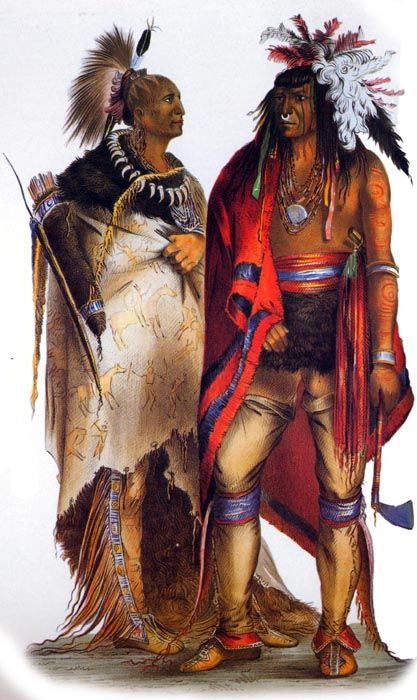
Iroquois Warriors.
One of the main characteristics of the Iroquois was their remarkable energy. They were so driven that they relentlessly pursued their enemies, much as people from New York to Chicago, Illinois, pursue their business ventures today.
This led the Iroquois to torture their prisoners with the utmost ingenuity and cruelty. Not only did the Indians burn and mutilate their captives, but they sometimes added the last refinement of torture by compelling the suffering captives to eat pieces of flesh cut from their own bodies. Energy may lead to high civilization, but it may also lead to excesses of evil.
The Haida, a prominent Aboriginal group from the coast of British Columbia, particularly the Queen Charlotte Islands, thrived in an environment characterized by a submerged coast, mild oceanic climate, and dense pine forests. Like the Iroquois, they advanced through their own ingenuity rather than inheriting a more developed past, as seen among the Mexicans.
While the Haida lacked the relentless energy of the Iroquois, they were not weak; they were likely more advanced in commerce than any North American tribe except those in Mexico. Their architectural capabilities were also impressive. Although often overshadowed by Mexican architecture, the Haida displayed true originality, using locally sourced wood to craft large beams. They built houses adorned with intricately carved totem poles and elegant façades, contributing significantly to the development of primitive architecture despite the limitations of their tools and materials.
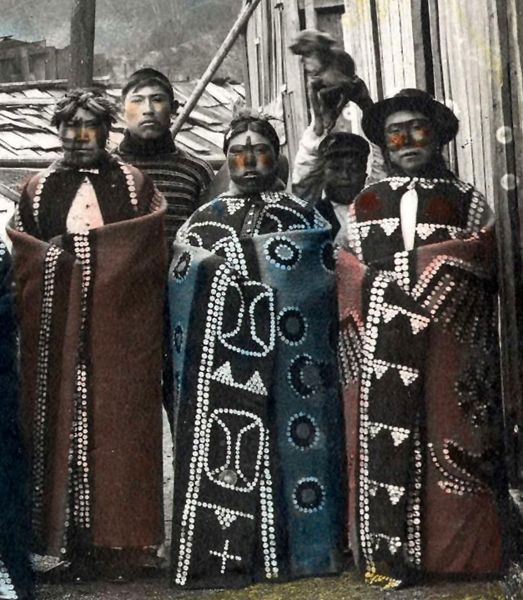
Haida Indians.
In addition to the three main types of Native Americans, there were many others, each shaped by their physical surroundings. Different tribes had varying innate abilities, with their habits and lifestyles influenced by the topography, climate, and local flora and fauna. Native Americans are often considered the race most closely tied to their environment. This raises questions about why the climate seemed to have less impact on them than on other races, and why the most advanced tribes weren’t located where white civilization is now most developed. Although earlier climatic changes may have played a role, evidence suggests that only minor fluctuations have occurred since European settlement. While racial inheritance may explain some differences among tribes, the primary factor appears to be agricultural conditions among groups lacking iron tools or labor animals. Civilization typically progresses with the development of permanent agriculture, as highlighted by the saying, “the history of agriculture is the history of man.” This examination will reveal how climate, agriculture, and geography influenced the diverse lifestyles of Native Americans across different regions.
In the far north, the living conditions of the inhabitants have changed little since the days of Christopher Columbus. The Eskimo people lack formal political or social organization beyond family units and typically move between seasonal camps in search of fish, game, and birds. Their simple lifestyle reflects their environment rather than a lack of ability.

Eskimo People.
Despite the crashing waves, hardly any water enters the craft as he navigates skillfully among the floating ice. The snow house, with its unique design, is a remarkable adaptation for those living in harsh, icy conditions, much like skyscrapers serve busy urban dwellers.
The Eskimos’ oil-burning soapstone lamps were among the only sources of artificial light in aboriginal America, highlighting their ingenuity. Their fire drill for quickly creating fire also showcases their inventive skills. The Eskimo remain nomadic, not due to a lack of creativity, but because the harsh climate limits their energy and prevents agriculture.
Further south, vast northern pine forests stretch from interior Alaska to the Canadian Rockies and beyond. A single form of primitive culture dominated this area, and only the arrival of European settlers significantly changed the habits of some Indigenous people in Alberta and Saskatchewan. The severe winters hindered these people’s ability to practice agriculture, and the forests offered little food beyond a few berries and lichens. As a result, they were primarily nomads, their movements dictated by food availability.

Athapascan Indian mother and children.
The Athapascan tribes of the northern pine forests made clothing from deerskins with the hair left on and built lodges from deer or caribou skins, sometimes using bark in southern areas. Their diet included caribou, deer, moose, musk ox, smaller animals like beavers and hares, and various birds and fish from local lakes and rivers. To hunt deer, they drove them into a corner formed by stakes, where hunters waited to ambush them.
In the Kawchodinne tribe near Great Bear Lake, hares were a primary source of food and clothing. During harsh winters when hare populations dwindled, they believed the animals ascended to the sky and would return. In 1841, many from this tribe starved due to a hare shortage, leading to reports of cannibalism. This low level of civilization also resulted in common practices like infanticide, particularly of female children, and women were often treated with little respect since their contributions to sustenance were minimal.
The funeral customs of the Takulli tribe highlight this low status: a widow had to remain on her husband’s funeral pyre until the flames reached her. Afterward, she collected his ashes in a basket and carried them during three years of servitude for his family, culminating in a feast that allowed her to remarry if desired.
Although the people of the northern forests faced poverty and hardship, they exhibited commendable qualities. The Kutchin of the Yukon and Lower Mackenzie regions were known for their hospitality, often hosting guests for months at a time. Each family head would take turns hosting feasts, requiring the host to fast until the guests departed. At these gatherings, wrestling contests were held, starting with the smallest boys and progressing to the strongest men, followed by similar competitions among girls and women.
The development of the northern pine forest people, like that of the Eskimo, was hindered by their inability to practice agriculture. Similarly, indigenous groups along the Pacific coast, from Alaska to Lower California, faced limitations. However, those in the northern regions achieved greater advancements than those in California. This suggests that the geographical environment significantly influences civilization.

Haida Indians.
The coast of British Columbia was one of the three chief centers of Aboriginal America. The Haida people constituted with little doubt the finest race and that most advanced in the arts of the entire west coast of North America. They and their almost equally advanced Tlingit and Tsimshian neighbors on the mainland displayed considerable mechanical skill, especially in canoe-building, wood carving, and working stone and copper, as well as in making blankets and baskets. To this day, they earn considerable income by selling their carved wooden and slate objects to traders and tourists. Their canoes were hollowed out of cedar logs and were often very large. Houses, sometimes 40 by 100 feet, were built of massive cedar beams and planks, first worked with stone and then assembled during great feasts. These correspond to the “raising bees” at which the neighbors gathered to erect the frames of houses in early New England. Each Haida house ordinarily had a single carved totem pole at the gable end, facing toward the beach. The end posts in front were often carved, and the whole house was painted. Another indication of the Haida’s fairly advanced state was their active commercial intercourse with regions hundreds of miles away. Traffic was vigorous at their “potlatches,” as the whites called the raising bees. Carved copper plates were among the articles they most highly esteemed. Standing in the tribe depended on the possession of property rather than on ability in war; in this respect, the Haida were more like today’s people than any other Indian tribe.
Slavery was common among the Haida. Even as late as 1861, 7800 Tlingit held 828 slaves. Slavery may not be a good institution, but it indicates that people are well-to-do, dwell in permanent abodes, and have a well-established social order. Among the more backward Iroquois, captives rarely became genuine slaves, for the social and economic organization was not sufficiently developed to admit this. The few captives who were retained after a fight were adopted into the tribe of the captors or else were allowed to live with them and shift for themselves, a practice very different from that of the Haida.

Haida Totem Pole, Alaska, 1902.
Another feature of the Haida’s life that showed comparative progress was the social distinctions that existed among them. One way individuals maintained their social position was by giving away goods of all kinds at the potlatches they organized. A man sometimes went so far as to strip himself of nearly every possession except his house. In return for this, however, he obtained what seemed to him an abundant reward in the respect with which his fellow tribesmen afterward regarded him. At subsequent potlatches, he received in his turn a measure of their goods in proportion to his own gifts so that he was sometimes richer than before. These potlatches were social and industrial functions, and dancing and singing were interspersed with feasting. One of the amusements was a musical contest in which singers from one tribe or band would contend with one another as to which could remember the most significant number of songs or accurately repeat a new song after hearing it for the first time. At the potlatches, the children of chiefs were initiated into secret societies. They had their noses, ears, and lips pierced for ornaments, and some were tattooed. This great respect for the Haida’s social position is doubtless far from ideal. Still, it at least indicates that a part of the tribe was sufficiently advanced to accumulate property and to pass it on to its descendants — a custom that is almost impossible among tribes that move from place to place.
The question asks why these coastal barbarians were far ahead of their neighbors, a few hundred miles away in the pine woods of the mountains. The climate was probably one reason for this superiority. Instead of being in a region like the center of British Columbia’s pine forests, where human energy is sapped by six or eight months of winter, the Haida enjoyed conditions like those of Scotland. Although snow fell occasionally, severe cold was unknown. Nor was there great heat in summer.
The Haida dwelt where both bodily strength and mental activity were stimulated. In addition to a favorable climate, these Indians had a significant, steady supply of food close at hand.
Most of their sustenance was obtained from the sea and rivers, in which the runs of salmon furnished abundant provisions, which rarely failed. In Hecate Strait, between the Queen Charlotte Islands and the mainland, there were wonderfully productive halibut fisheries, from which a supply of fish was dried and packed away for the winter so that there was always a store of provisions on hand. The forests, in turn, furnished berries and seeds, as well as bears, mountain goats, and other game.
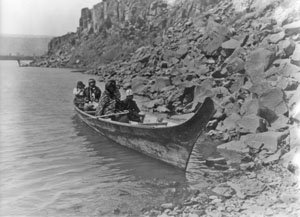
Chinook people in a canoe on the Columbia River.
Moreover, the people of the northwest coast could not be forced to move from place to place to follow the fish. They lived on a drowned shore where bays, straits, and sounds were extraordinarily numerous. The great waves of the Pacific are shut out by the islands, so that the waterways are almost always safe for canoes. Instead of moving their dwellings to follow the food supply, as the Eskimo and the people of the pine forest were forced to do, the Haida and their neighbors could bring their food home without difficulty. In all seasons, the canoes made it easy to transport ample supplies of fish from places even a hundred miles away. Having settled dwellings, the Haida could accumulate property and acquire that sense of permanence, one of the most essential conditions for the development of civilization. Doubtless, the Haida were intellectually superior to many other tribes. Still, even if they had not been significantly superior, their surroundings would probably have made them stand relatively high in the scale of civilization.
Southward from the Haida, around Puget Sound, and in Washington and Oregon, civilization gradually declined. The Chinook Indians of the lower Columbia River, beyond the limits of the great northern archipelago, had large communal houses occupied by three or four families of 20 or more individuals. Their villages were thus relatively permanent, although there was much moving about in summer owing to the nature of the food supply, which consisted chiefly of salmon, with roots and berries indigenous to the region. The people were noted as traders among themselves and the surrounding tribes. They were extremely skillful in handling their canoes, which were well-made, hollowed out of single logs, and often of great size. In disposition, they are described as treacherous and deceitful, especially when their cupidity is aroused. Slaves were obtained every day and were usually obtained by barter from surrounding tribes, though occasionally by successful raids. These Indians of Oregon by no means rivaled the Haida, for their food supply was less abundant, and they did not have the advantage of easy water communication, which did so much to raise the Haida to a high level of development.
Of the tribes farther south, an observer says: “In general rudeness of culture, the California Indians are scarcely above the Eskimo, and whereas the lack of development of the Eskimo on many sides of their nature is reasonably attributable in part to their difficult and limiting environment, the Indians of California inhabit a country nature ally as favorable, it would seem, as it might be. Suppose the degree of civilization attained by a people depends in any large measure on their habitat, as does not seem likely. In that case, it might be concluded from the case of the California Indians that natural advantages were an impediment rather than an incentive to progress.” In some tribes, such as the Hupa, there were no formal organizations or structures in village government. Formal councils were unknown, although the chief might and often did ask the advice of his men in a collective body. In general, the social structure of the California Indians was so loose and straightforward that it is hardly correct to speak of their tribes.

Maidu Dancers.
The solidarity among these people was partly due to family ties and partly to living in the same village and speaking the same dialect. Among the different groups of these Indians, the common bond was the similarity of language, frequent intercourse, and cordiality. In so primitive a condition of society, there was neither necessity nor opportunity for differences of rank. The influence of chiefs was small, and no distinct classes of slaves were known.
Extreme poverty led to the low social and political organization of these Indigenous peoples. The Maidu in the Sacramento Valley faced such dire conditions that they consumed nearly all available food, including badgers, skunks, wildcats, mountain lions, and even salmon bones and deer vertebrae.
To catch grasshoppers and locusts, they dug shallow pits and set fire to the surrounding grass, driving the insects into the pits. The Moquelumne tribe, one of central California’s largest, constructed homes of poles and brush, covered with earth in winter. During good years, they collected acorns, their primary food source, and stored them in elevated granaries, but poor crop yields often left them on the verge of starvation.
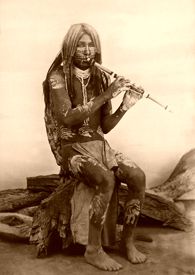
Yuma musician, by Isaiah West Taber, circa 1900.
Finally, in the far south, in the peninsula of Lower California, the tribes were “probably the lowest in the culture of any Indians in North America, for their inhospitable environment, which made them wanderers, was unfavorable to the foundation of government, even of the rude and unstable kind found elsewhere.” The Yuman tribes of the mountains east of Santiago wore sandals of maguey fiber. They descended from their territory among the mountains to eat calabash and other fruits growing beside the Colorado River.
They were described as “very dirty because of the large amount of mescal they consumed,” and others noted their filthy habits. To combat vermin, they coated their heads and bodies with mud and often wallowed in it like pigs. They lived in extreme poverty and had few possessions, with women wearing simple bark skirts and men often nearly unclothed. The sale of children was common, and their diet mainly consisted of fish, fruit, vegetables, and grass seeds, which led many tribes to suffer from scurvy.
In contrast, the more advanced Mohave tribe lived along the lower Colorado River. This highlights the environmental factors contributing to the impoverished condition of the California Indians. The Mohave tribe thrived in settled villages, practiced agriculture, and had better physical development than their California neighbors.
Interestingly, there is no evidence of corn or other crops being cultivated west of the Rio Colorado in California. While California is renowned for agriculture, its crops were of European origin. Europeans introduced staple foods such as wheat and barley. In pre-Columbian America, only corn was widely cultivated, along with beans and pumpkins, which required
While summer crops can be grown using irrigation, this process is complex. Adequate irrigation in California relies on larger streams rather than the small, nearly dry streams of summer. Modern technology can create canals and ditches, but those without agricultural knowledge or appropriate tools struggle to implement such systems. California lacks natural summer irrigation, which has been essential for agricultural development in other regions.
Conversely, the lower Colorado River floods areas each summer, leaving them moist and suitable for crop growth. This environment allowed the Mohave Indians to thrive agriculturally.
In the Rocky Mountain region, tribes experienced worsening conditions as they moved south. However, tribes living in areas with summer rainfall showed improvement, such as the Kutenai tribes near the borders of Idaho, Montana, and British Columbia. Notable for their morality and hospitality, they avoided excessive drinking and demonstrated higher mental abilities through skills in buffalo hunting and construction. Today, the lower Kutenai are recognized for their watertight baskets made from split roots.

Shoshone Camp in about 1900.
The use of local plants for food, medicine, and economic purposes was essential to these tribes, who also valued the beauty of various plants and flowers. Their climate, with ample summer rainfall, helped them avoid starvation, while proximity to buffalo herds provided a reliable food source—one buffalo yielding as much meat as one hundred rabbits.
In contrast, the Ute and other Shoshone tribes, located in eastern Oregon, southern Idaho, Nevada, and Utah, faced hardships due to limited winter rainfall. Long, dry summers made agriculture nearly impossible without irrigation. A traveler in 1850 described one Ute group as “the most miserable-looking set of human beings I ever saw,” as they relied on snakes, lizards, and roots for food. The poorest Ute tribes lived in sagebrush, building makeshift shelters to protect against harsh weather.
Despite their challenges, both the Ute and Shoshone shared similar traits, though their material conditions varied. Today, while the Ute are often stereotyped as slow, the Paiute are viewed as “peaceful,” “moral,” and “industrious.” They have become essential workers for white farmers, improving their conditions through contact with whites. Their previous struggles primarily resulted from environmental challenges faced by many Native Americans.
When comparing the less-advanced Ute people with the Hopi, who share a common ancestry, it’s clear that the Hopi exhibit a higher level of social organization and more complex religious ceremonies. Though the Hopi may not have significantly greater innate abilities than their neighbors, they achieved notable progress before European contact, especially in artistry. Their pottery, basketry, and weaving are widely admired.
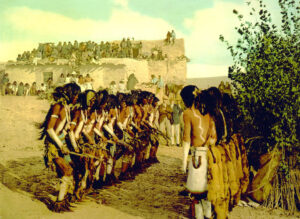
Hopi Antelope priests chanting at Kisi Moki snake dance, Image by Detroit Photographic Co., 1902.
The Hopi governance system is sophisticated, led by a council of hereditary elders and religious chiefs, including a speaker chief and a war chief. Each pueblo has a hereditary chief who manages communal tasks. Crimes are rare, as penalties are typically applied only to sorcery, with most offenses falling under this category.
A striking feature of Hopi life is its rich religious traditions, which recognize many supernatural beings and feature a wealth of fascinating mythological tales.
The Hopi people’s homes may initially appear less favorable to progress than those of their Ute cousins. However, the Hopi benefit from being the most northwesterly Native Americans living in areas with summer rainfall. Their arid region limits subsistence farming, compelling them to focus on agriculture, which has led to a relatively high standard of living.
Unlike Utah, the Hopi experience their heaviest rainfall in summer, which allows them to cultivate crops such as corn and beans. In this intensive agricultural system, women’s roles are as valuable as men’s, elevating their status in the community through their contributions to fieldwork, food preservation, and preparation.
From northern New Mexico and Arizona to Mexico City, summer rains and dry winters predominate, with sparse forests and extensive desert. Increased rainfall enables larger populations and greater wealth accumulation, thereby facilitating community engagement and advancing civilization. Additionally, altitude increases as one moves south, resulting in cooler, more invigorating climates in regions like Mexico City compared to those in the north.
Summer rains play a crucial role in promoting growth and supporting early agriculture. Sudden showers fill mountain valleys, creating broad, shallow sheets of water known as playas. These areas hold water briefly before it seeps into the ground or evaporates, providing excellent natural irrigation. Primitive farmers can easily plant corn seeds in holes made with a stick, relying on subsequent rains to nurture their crops while watching for wild animals.
Over time, these farmers learn to direct water to optimal spots and develop simple irrigation systems. In regions with favorable conditions, settled communities thrive, as their efforts in one year benefit the next. They experience fewer weed problems because grasses that grow alongside corn form small clumps that are easy to remove.
In drier parts of the summer-rain area, water conservation is essential. The Hopi favor sandy fields since loose sand prevents evaporation. During dry spells, they use techniques like burying seeds in saturated mud balls under sand to retain moisture, so they sprout by the time summer floods arrive.
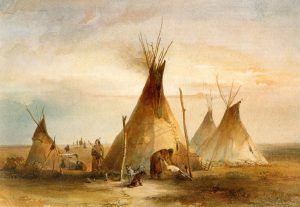
Plains Indians.
The Indigenous peoples of the Great Plains had lifestyles that differed significantly from those in the mountains or along the Pacific coast. In the far north, similar climatic conditions led to similar ways of life among various groups. However, the Plains Indians, living in the vast area from Lake Winnipeg to the Rio Grande, developed a unique culture. This was mainly due to the rich grasslands and the massive buffalo herds that provided a food source.
The abundance of grass hindered agriculture because Indigenous peoples lacked iron tools and draft animals to cultivate the land effectively. While some occasionally shaped meteoric iron into simple tools, it was scarce. They were familiar with copper but had no means to harden it. As a result, farming was nearly impossible. Even if they burned the prairie and planted seeds, the rapidly growing grass would choke the crops. While limited agriculture was sometimes practiced in certain river bottoms, this was the extent of their farming efforts on the plains.
The Indigenous peoples of the Americas could not engage in widespread agriculture on the plains due to a lack of iron tools and draft animals. The buffalo, while abundant, was too large and fierce to domesticate, and there were no suitable animals to replace horses, donkeys, or oxen. Llamas were too small for heavy loads and could only thrive in the Andean highlands. Even with iron plows, farming would have been difficult without animals to plow the tough sod and protect crops from buffalo.
Consequently, much of the fertile land in the Great Plains remained largely unused until European settlers introduced iron tools and domesticated animals necessary for agriculture. While farming was nearly impossible, the buffalo provided many resources. An early traveler who lived with the Tonkawa tribe in central Texas noted that the buffalo offered meat and various materials. The brains were softened, skins became spoons and cups, shoulder blades were used as digging tools, and hides were made into shields, tents, clothing, and blankets.
The buffalo is a surprisingly stupid animal. When a herd is feeding, a man can walk into its midst and shoot down an animal. Even when one of their companions dies, the buffaloes pay no attention to the hunter, provided he remains perfectly still. The wounded animals are not dangerous at first and seek to flee. Only when pursued and brought to bay do they turn on their pursuers. When the Indians of an encampment united their forces, as was their regular habit, they were able to slaughter hundreds of animals in a few days. They ate the more delicate parts of the meat first, often without cooking them. They dried and packed the rest for future use while preparing the hides as tent coverings or as rugs to sleep on.
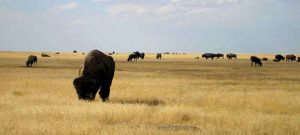
Buffalo in South Dakota, photo by Kathy Alexander.
Wherever buffalo were abundant, the habits of the Native Americans were broadly similar. They could not settle in permanent villages, as there was no certainty that buffalo would return to the same locations each year. As a result, the Plains tribes were highly nomadic, especially after horses were introduced. Their constant movement led to frequent, often friendly interactions with other tribes, which in turn led to the development of a sign language for communication. Initially resembling pictographs, these signs evolved into more conventional forms; for instance, a man was indicated by raising the hand with the index finger extended, while a woman was signified by a downward hand motion to denote long hair.
Among the Plains Indians, the Dakota, the leading tribe of the Sioux family, were seen as superior in physical stature and bravery. They successfully conquered or drove out nearly all rivals except for the Chippewas. Leadership among the Dakota was based on personal merit rather than heredity, with the Band Council limiting a chief’s authority. In the Teton tribes, village law enforcement was managed by a few officers appointed by the chief, who remained in their roles until replacements were chosen. Their authority was significant, and they faced no punishment for acting decisively, even against higher-ranking chiefs.
The Dakota, who lived in a region still named after them, thrived in the Great Plains, known for their vibrant way of life. They, alongside their neighboring tribes, are among the best-known plains tribes, with the Teton often called “the plundering Arabs of America.” Had their efforts been more focused, they might have achieved a more notable place in Indian history. Despite their nomadic lifestyle and limited resources, the Dakota excelled in the arts, particularly in pictography, rivaling only the Kiowa.
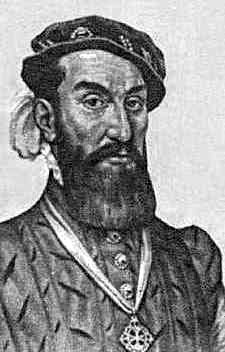
Alvar Nunez Cabeza de Vaca
On buffalo, deer, and antelope hides, they painted calendars representing each year or winter, demonstrating their creativity and adaptability. In contrast, southern Plains tribes, such as the Yguases in Texas, were less advanced. Cabeza de Vaca described their dire situation, relying on bitter roots, small amounts of game, and even insects and snakes to survive. During tough times, they encouraged him not to despair, promising that prickly pears would come soon. When the fruit finally ripened, they celebrated with feasts and dances. Still, in a tragic attempt to protect their community, they ended female infants’ lives, inadvertently increasing the number of their enemies.
The Iroquois were primarily sedentary agriculturalists, relying on hunting for only a small part of their sustenance. They were known for their impressive wooden structures, or “castles,” which featured interior platforms for defending against attackers. While primitive by today’s standards, these dwellings were a significant advancement over simpler shelters like those of the Ute. Further south, the Cherokee, another Iroquoian tribe, distinguished themselves through their intellectual achievements. Influenced by European settlers, they adopted a constitutional government and created laws in their language using an alphabet devised by Sequoyah. While they were more advanced in agriculture than the Iroquois, they lagged in government and social practices.
As one moves from north to south across the deciduous forest region, agriculture’s importance increases, leading to more sedentary lifestyles, though not always greater social progress. The Catawba in South Carolina were similar to their neighbors, exhibiting bravery and honesty but lacking energy. The Muskhogean tribes—Creek, Choctaw, Chickasaw, and Seminole—were also agricultural and lived in substantial villages. Their towns were fortified near frontiers, but more remote ones were unprotected. These tribes were generally brave but less aggressive than the Five Nations, with the Choctaw fighting only in self-defense. While their governance was somewhat advanced, their confederacies were looser than those of the Iroquois.
The Natchez of Mississippi exemplifies the life of tribes in the southern deciduous forest region. Primarily sedentary, they relied on agriculture for their livelihood and displayed artistic skills, weaving cloth from mulberry bark and creating pottery.
They constructed large earthen mounds for their homes and temples. Though they engaged in warfare when necessary, they were generally more peaceful than the Five Nations. Their sun worship was similar to that of Mexico, and their cultural practices mirrored those of tribes further south; for instance, when a chief died, his wives were often killed, and parents sometimes sacrificed their children in times of distress.
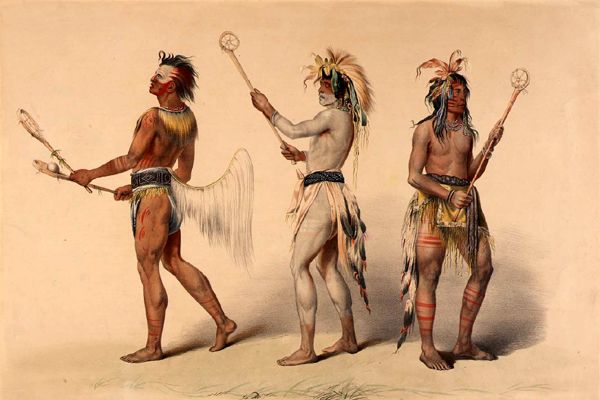
Natchez Men.
The Natchez and other southern tribes seem to have once possessed a more advanced civilization compared to what was observed when Europeans arrived. In contrast, the Five Nations were dynamic and appeared poised for further achievements. The mounds in the Gulf States were likely built in pre-Columbian times, and artifacts such as the wooden mortars from Key Marco and the embossed copper plates from Florida indicate a lost artistic sophistication.
It is interesting to note how climatic energy gave the Five Nations an advantage over southern tribes, while agriculture had the opposite effect. In Northeast America, corn, beans, and squashes were crucial to the diet of Indigenous peoples, while southern tribes relied on potatoes, sunflower seeds, and melons.
The New England tribes utilized fish and shells as fertilizer and crafted wooden mattocks and hoes from deer bones and shells. They employed stone hoes and short pickers to cultivate the soil, uproot weeds, and prepare fields. Each year, they practiced burning old patches before replanting, often simply placing seeds in holes or loosening the ground for each seed.
To create clearings, they girdled trees by cutting away the bark, which killed them, then cleared the underbrush by breaking it down and burning it when dry.
It is important not to confuse the agricultural practices of Indians after European contact with those before European contact. For instance, an article on agriculture in the Handbook of American Indians describes conditions in states south of the Great Lakes in 1794, assuming they were representative of aboriginal America. By then, iron tools had largely replaced stone ones, and the Iroquois had even begun breeding horses by 1736.
While agriculture became easier in the 18th century, Indians continued to cultivate the same fields for only a short time, often switching fields after 5 to 20 years.
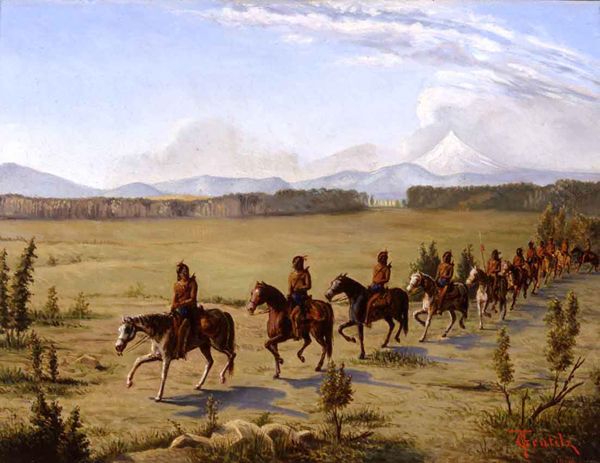
Cherokee horsemen of Texas
Grass posed significant challenges for agriculture, especially in the northern deciduous forests. Once established, it is difficult to eradicate, and it often worsens with hoeing. While soil exhaustion is commonly cited as a reason for this challenge, it seems unlikely that five to ten years of sporadic cultivation by Indigenous peoples would deplete the soil enough to warrant moving villages. Evidence from the Southern States shows that soil can be exhausted more quickly there due to lower humus content. Yet southern tribes like the Creek, Cherokee, and Natchez cultivated their land for more extended periods and were less likely to relocate than the more advanced Iroquois.
Before Christopher Columbus, North America’s civilization was vastly different. The major centers of civilization were located further south than they are today. Archaeological evidence suggests that the Indigenous peoples Europeans encountered were less advanced than their predecessors. The ruins in Arizona and New Mexico, along with their artistic pottery, indicate a more culturally sophisticated population in the past. In the Gulf States, while there is less evidence of dense populations, the quality of pre-Columbian handicrafts indicates that earlier civilizations were superior to those encountered by European explorers.
Most remarkable of all is the condition of Yucatan and Guatemala. In northern Yucatan, the Spaniards found a race of mild, decadent Mayas living among the relics of former grandeur. Although they used the old temples as shrines, they knew little of those who had built them and showed even less capacity to imitate the ancient architects. Farther south, in the forested region of southern Yucatán and northern Guatemala, the conditions are even more surprising, as these regions are now almost uninhabitable. They are occupied by only a few sickly, degraded natives who live mainly by the chase. Yet in the past, this region was the scene of by far the highest culture ever to develop in America. There alone in this great continent did men develop an architecture which, in massiveness but in the wealth of architectural detail and sculptural adornment, vies with that of early Egypt or Chaldea. There alone did the art of writing develop. Yet today, in those regions, the density of the forest, the prevalence of deadly fevers, the extremely enervating temperature, and the steady humidity were as hostile to civilization as are the cold of the far north and the dryness of the desert.

Aztec Pyramid courtesy Wikipedia
The Aztec played a significant role in Mexico’s exploration and conquest, but were primarily a warlike tribe that inherited a more advanced civilization from earlier cultures. Similarly, the ruins at Mitla in southern Mexico indicate a civilization far greater than what the Spaniards found.
In northern Yucatan, the Spaniards encountered gentle but declining Mayas living among the remnants of their once-great culture. Although they used ancient temples as shrines, they had little understanding of their builders or the ability to replicate such architecture. In southern Yucatan and northern Guatemala, the situation is even more surprising. These areas are now nearly uninhabitable, occupied by a few struggling natives who rely on hunting. In the past, this region hosted the pinnacle of American civilization, with architecture that rivals that of early Egyptian and Chaldean civilizations and the development of writing. Today, dense forests, deadly fevers, a harsh climate, and constant humidity pose challenges to civilization comparable to those posed by extremes of cold and desert dryness.
The anomaly in climate history suggests that the world’s climatic zones have shifted toward the equator at specific times in the past. Many geographers believe that, over the last two or three thousand years, climatic fluctuations have led areas like the dry Southwest to experience alternating centuries of increased moisture and decreased moisture.
During wetter centuries, the region benefited from increased storminess, creating a climate favorable to agriculture and raising the standard of living in the Southwest, the Gulf States, and Mexico. Conversely, when the arid Southwest was wet, the Maya region of Yucatan and Guatemala was relatively dry, likely due to a southward shift of the dry belt. This shift reduced forest density in Yucatán and Guatemala, making agriculture possible in areas that are now difficult to cultivate and lowering the incidence of diseases such as malaria.

Mojave Indians cremating the dead in Southern California, by the Milwaukee Public Museum.
The climate during the Maya’s peak was more conducive to civilization than that of many regions today. Throughout American history, civilization has been influenced by its physical environment, regardless of the racial or regional context. Factors such as terrain, available resources, and climate directly impact human life. In early America, agricultural potential may have been the primary factor in people’s lives, while at other times, domestic animals, iron, or waterways became more significant. The later history of the continent traces how these various elements shaped human progress.
Compiled and edited by Kathy Alexander/Legends of America, updated November 2025. Source: Johnson, Allen; The Chronicles of America Series; Yale University Press, 1921.
Also See:
Ancient Cities of Native Americans
Native American Archaeological Periods