
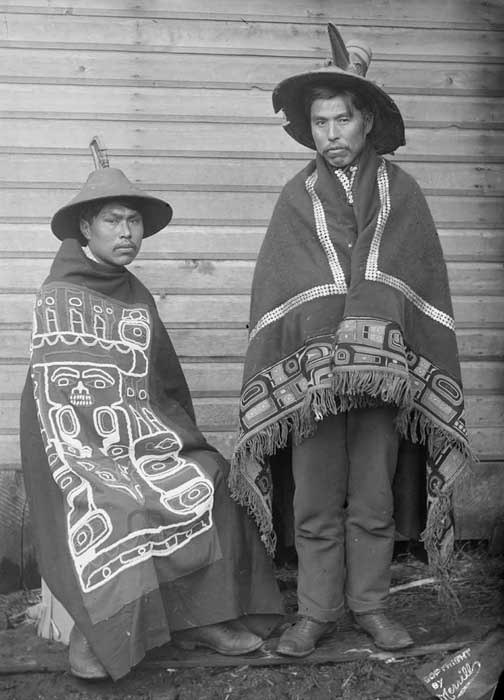
Tlingit Men in Regalia.
The Tlingit peoples once controlled all the land extending more than 500 miles from Yakutat Bay to the British Columbia border, south of present-day Ketchikan, Alaska. Their name for themselves is Lingít, meaning “people of the tides.”
The Tlingit, also spelled Tlinkit, speak the Tlingit language, a branch of the Na-Dene language family. Some historians allege the language appears to have spread northward from the Ketchikan–Saxman area towards the Chilkat region. The language shares features with the Eyak language, found around the Copper River Delta, and with Tongass Tlingit, near the Portland Canal.
There is limited written documentation before European contact around the 1790s. Afterward, documentation was sparse and irregular until the early 20th century. The Tlingit developed a complex hunter-gatherer culture in the temperate rainforest of the southeast Alaska coast. They also managed semi-sedentary fisheries. They built large houses using beams and wooden planks and fashioned totem poles.
The Tlingit have a matrilineal kinship system, with children considered born into the mother’s clan and property and hereditary roles passing through the mother’s line. Their society included slaves and performed the potlatch ceremony, in which possessions were given away or destroyed, to display wealth and generosity and enhance prestige. In war, the Tlingits used wooden slat armor and masks to terrorize their enemies. The Tlingit fought the Russians many times and sacked their greatest fort on Baraxou Island.
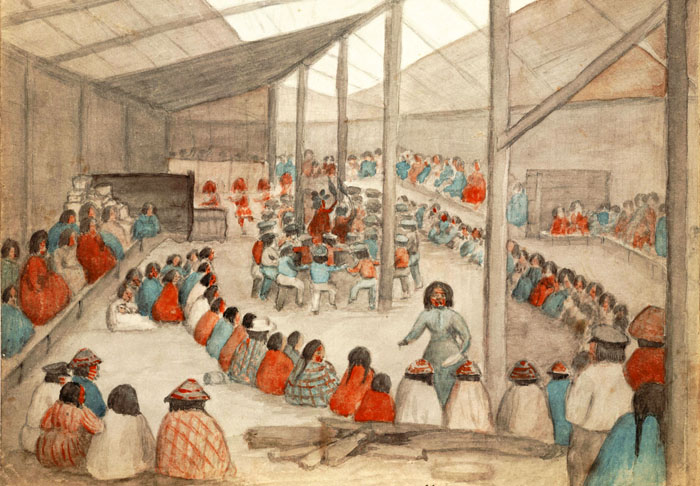
Potlatch Ceremony by James G. Swan
Today, the Yakutat Tlingit Clan is a federally recognized Indian tribe in Yakutat, Alaska, with over 450 tribal members. An inland group known as the Inland Tlingit inhabits the far northwestern part of British Columbia and the southern Yukon in Canada.
More information: Tlingit & Haida official website.
©Kathy Alexander/Legends of America, updated May 2026.
Also See:
Native American Photo Galleries
Native Americans – The First Owners of America
Native American Index of Tribes
See Sources.