

Frontier Exploration.
Colonel Hugh Glenn and Jacob Fowler led the Glenn-Fowler expedition to Santa Fe, New Mexico, from 1821 to 1822. They sought to establish trade with the tribes that inhabited the southern plains and determine whether trade with the Spanish in the region would be feasible.
In 1821, Glenn and Fowler agreed to form an overland expedition to travel to Santa Fe and try to establish a trading relationship. In August 1821, Colonel Glenn received a license at Fort Smith, Arkansas, to trade with Indians on the southern plains and beyond. They also planned to trap for beaver in the upper tributaries of the Arkansas.

Colonel Hugh Glenn.
Glenn, who was born in present West Virginia on January 7, 1788, moved with his family to Kentucky in 1796. Eager to escape the drudgery of frontier farming, he sought to advance his fortunes. By age 30, he was a successful bank director, merchant, and government contractor in Cincinnati, Ohio. However, by 1820, he faced court and government actions for his role in the failure of the Cincinnati branch of the Bank of the United States in Philadelphia, Pennsylvania, and for possible contract fraud in provisioning western forts. Glenn then fled and took up residence at a trading post 60 miles northwest of Fort Smith, Arkansas, at the mouth of the Verdigris River at the Three Forks in present-day northeastern Oklahoma. He had met Jacob Fowler while they both served under General Andrew Jackson in the U.S. Army during the War of 1812.
Jacob Fowler was born in Maryland on March 1, 1764. He had gained a wealth of frontier experiences as a soldier, scout, and hunter in the Ohio Valley. He fought in every major engagement against the Ohio Confederated tribes in the 1780s and 1790s. Working as a surveyor, he continued to serve the United States Army through its victory at Fallen Timbers in 1794. In 1796, he was appointed deputy sheriff for Campbell County, Kentucky. He met Hugh Glenn during the War of 1812, when Glenn served as an assistant quartermaster in the U.S. Army. At the war’s conclusion, Fowler became Glenn’s friend and business partner in numerous enterprises. Fowler’s reasons for joining the 1821 expedition are unclear but may reflect his friendship with Glenn and his passion for adventure. Fowler recorded the details of the expedition in a daily journal. He was the oldest participant in the expedition.
Jacob Fowler, with his slave Paul, left Fort Smith, Arkansas, on September 6, 1821, to go to Glenn’s trading post. They crossed the Arkansas River and went to the Neosho River, near where Fort Gibson was later built. Fowler’s party moved from the Neosho River to Glenn’s trading house on the Verdigris River, about a mile from its mouth.
The next weeks were spent making arrangements for the trip. A company of 20 men was formed, including African Americans, American Indians, French, and Spanish, including Jacob Fowler’s brother Robert and Nathaniel Pryor, who had been with Lewis and Clark.
Colonel Hugh Glenn led the expedition, which began on September 21, 1821, following the Verdigris River North to its confluence with the Caney River. On October 1, they camped near the present site of Bartlesville, Oklahoma. From there, they moved North through mixed prairie into the Kansas Territory.

Walnut River near Winfield, Kansas.
On October 9, they came upon the Walnut River somewhere between the present towns of Arkansas City and Winfield. They then turned West and, two days later, arrived at where Wichita now stands. The men encountered bison and antelope for the first time as they proceeded westward toward the Great Bend of the Arkansas River. By October 17, they were near the present town of Ellinwood in Barton County; the Pawnee Fork was crossed near Larned, then to Ford County, and the site of present-day Garden City.
The expedition found game plentiful on the open prairie, but their encounters with native tribes were somewhat strained. Glenn had secured a government license to trade with these western tribes in territory extending to the source of the Arkansas River. However, he had had little success establishing trade relationships with the Kiowa and Wichita tribes.

Purgatoire River in Purgatoire Canyon, Colorado by Carol Highsmith.
On October 27, the expedition crossed the South side of the Arkansas River and entered Spanish territory in present-day Colorado. The expedition members were the first Anglo-Americans to travel in the region around modern-day Pueblo. While camped at the mouth of the Purgatoire River, Lewis Dawson, one of the party, was killed in camp by a grizzly bear.
In early November, the group encountered snow and ice on the river. For many days, they stayed in camp because travel was too difficult in the winter weather conditions. On November 13, they saw the Spanish Peaks in southeastern Colorado. Within a week, they encountered lodges of thousands of Arapaho, Kiowa, and other Indians, where they trapped and traded with the Indians for much-needed horses.
On January 2, Glenn and a few of his companions left the party with several Spaniards for Taos, New Mexico. Upon their arrival, they met troops, who informed them that the area now belonged to Mexico, which had defeated Spain in the Mexican Revolution. Later, Fowler and the remainder of the party left the Arkansas River and joined Glenn at Taos. They then traveled to Santa Fe, New Mexico, to seek permission to trap and hunt. The new Mexican government was happy to promote trade between Mexico and the United States and approved. Members of his party began trapping along the Rio Grande, collecting more than 1,100 pounds of furs.
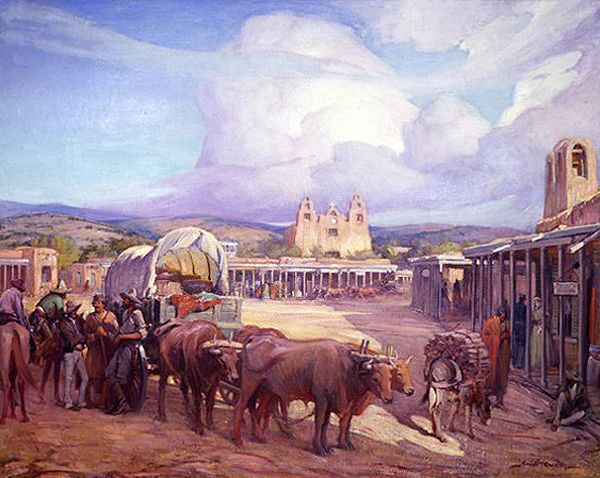
The End of the Santa Fe Trail by Gerald Cassidy, about 1910
They left the area on their return trip on June 1, 1822. By July 15, 1822, Glenn and his men had returned to St. Louis, Missouri.
Afterward, Hugh Glenn returned to Cincinnati, Ohio, where he died on May 28, 1833, at the age of 45. His expedition’s success had not solved his financial difficulties. Jacob Fowler went to Covington, Kentucky, where he lived until he was 85 and died on October 15, 1849.
The Glenn-Fowler expedition was considered successful. It met the original objective of proving the feasibility of trade between the United States and Spanish North America, and the new Mexican government was happy to promote it. It proved that trade with the Santa Fe area was feasible. Fowler’s daily journal of the expedition was the first detailed narrative of the southern plains region to appear after Zebulon Pike’s expedition of 1806-1807. The profitable trip and William Becknell’s earlier trip led to the establishment of the Santa Fe Trail.
©Kathy Alexander/Legends of America, updated July 2026.
Also See:
A Century Of Exploration – Legends of America
Expeditions & Exploration of America

Santa Fe Trail Wagon Sculpture in Santa Fe, New Mexico, courtesy of the National Park Service
Santa Fe Trail – Highway to the Southwest
Sources:
Access Genealogy
The Encyclopedia of Oklahoma History and Culture
Muskogee Phoenix
Northern Kentucky Tribune
Wikipedia