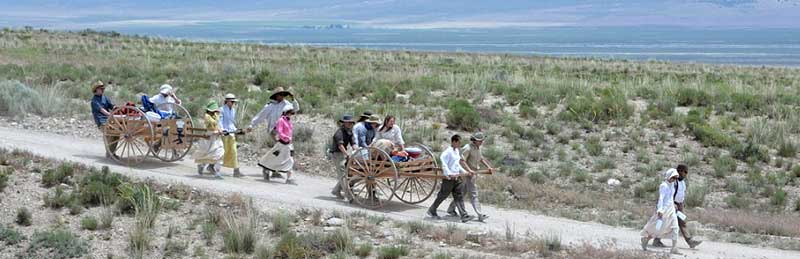
Mormons pulling handcarts, by Hannah Cowan, Bureau of Land Management.
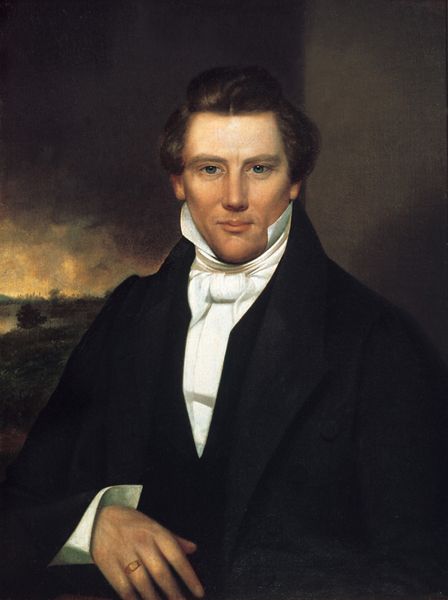
Joseph Smith, Mormon Church Founder.
The Mormon Church was founded in New York after Joseph Smith, Jr. claimed to have found a buried book of golden plates written by ancient American prophets in the late 1820s. Smith said the Angel Moroni, the guardian of these plates, had directed him to these writings and that his mission was to publish a translation of this book. Published in 1830 as the Book of Mormon, this work served as a foundation for Smith’s organization, first called the Church of Christ, established on April 6, 1830. It was later renamed the Church of Jesus Christ of Latter-day Saints.
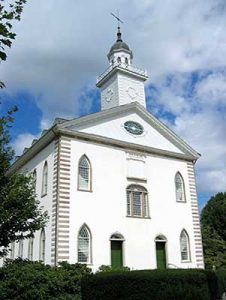
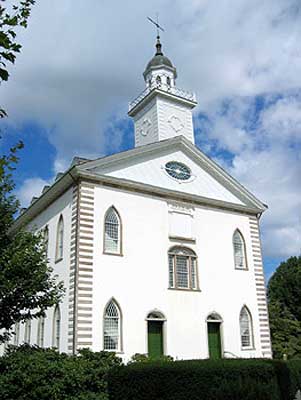
Kirkland, Ohio Mormon Temple, courtesy of Wikipedia.
For most of the 1830s, Smith lived with most of his church members in Kirtland, Ohio. As his numbers grew, Smith sent followers to Jackson County, Missouri, to establish a City of Zion as the biblical New Jerusalem. Situated near Independence, the Mormon settlers were driven out of the county in 1833 and settled in Clay and Caldwell Counties of Missouri. Smith’s paramilitary campaign to redeem the area was unsuccessful.
Smith then taught his followers that the church needed an endowment of heavenly power before redeeming Zion. He soon began constructing an expensive temple in Kirtland, where the endowment would occur. However, on January 12, 1838, after a financial scandal effectively caused the Ohio church to collapse, Smith fled an arrest warrant and joined his followers in Missouri.
When many Kirtland church members followed him to Missouri, tensions escalated with the old Missouri settlers, leading to what has become known as the Missouri Mormon War. Missouri’s “old settlers” characterized the Mormons as fanatics whose clannish behavior made a mockery of republican institutions by placing power in the hands of a single man.
Violence broke out again at an election riot in Gallatin on August 6, 1838, and before long, “old settler” mobs and Mormon paramilitary units roamed the countryside. When the Mormons attacked an authorized militia group, under the belief it was an anti-Mormon mob, Missouri’s governor, Lilburn Boggs, ordered them expelled from the state or “exterminated,” if necessary. Between August and November 1838, more than 20 Mormons were killed.
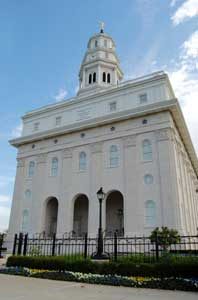
Mormon Temple in Nauvoo, Illinois, by Kathy Alexander.
Over the next year, an estimated 10,000 Mormons were forced to leave the state, most settling in or near the city of Nauvoo, Illinois. In 1839, Smith directed the construction of a second temple in Nauvoo and became mayor of the new town and commander of the Nauvoo Legion, a large, nearly autonomous branch of the Illinois militia. Publicly, while Smith was teaching religious doctrines, he was also secretly introducing the practice of polygamy among his members, as well as a symbolic Millennial Legislature that made him the king.
In 1844, Smith ran for President of the United States, but by then several church members had begun to question him. The first and only edition of the Nauvoo Expositor ran an article that claimed Smith was practicing polygamy and that he intended to set himself up as a theocratic king. The assertions, made by a group of Latter-Day Saint members, also charged that Smith was a fallen prophet and that he had acquired too much power. Smith, who was then serving as Nauvoo Mayor, responded by destroying the newspaper’s facilities and declaring martial law to quell the local outrage. Smith was then arrested and jailed in Carthage, Iowa, on charges of treason. While he was awaiting trial, an armed mob of men with painted faces stormed the jail and shot him and his brother Hyrum to death. Today, Latter-Day Saints view Joseph and Hyrum as martyrs. In a series of church-sanctioned essays released in October of 2014, the Mormon Church acknowledged for the first time that Smith had between 30 and 40 wives during his time as leader.
Broken over the deaths, the council chose Brigham Young as their leader and decided to move westward. They toiled across Iowa and Missouri during 1845-46, settling down again at points on the Missouri River. Trouble with the Indians caused them to build a town across the river near the present city of Council Bluffs, calling it “Kanesville.” Nearly 15,000 settled north of Omaha, near present-day Florence, Nebraska, calling it “The Winter Quarters.”
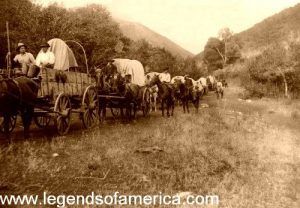
Wagon Train in Utah.
In the spring of 1846, Brigham Young sent out 80 wagons equipped to travel into the Rocky Mountains, where it was rumored that an inland sea, with fertile lands bordering it, awaited their arrival and where they could build an empire outside the jurisdiction of the United States.
The following year, Young led a large band of Mormons up the Platte Valley, across the plains and mountains, to the Great Salt Lake in present-day Utah. Other groups soon followed, and the Mormon towns of Florence and Kanesville, which, at their height, had long streets lined with stores and residences, were practically deserted by 1851-52.
The cholera scourge of 1850 followed the Mormons far out on the trail, with hundreds of them succumbing to its ravages in the first 400 miles of the journey.
While the Platte River was the main Mormon Trail to Fort Kearny, Nebraska, second in importance was the use of the original trail from Independence to Fort Kearny, especially by the thousands of Mormons who emigrated from England and by boats via New Orleans and St. Louis to Independence, Missouri, or by rail via New York. Mormon migration to the West continued in organized companies along the Mormon Trail until 1869. Afterward, they came by railroad, continuing the resettlement until 1890.
Upon arriving in the Salt Lake Valley, the Mormons publicly announced the practice of plural marriage, which Smith had instituted in secret some years earlier. Plural marriage would become the faith’s most famous characteristic during the 19th Century. However, the practice was vigorously opposed elsewhere in the United States, threatening the church’s existence as a legal institution.
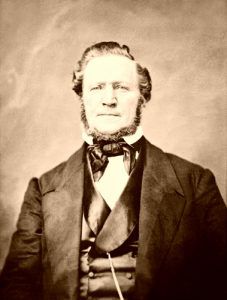
Brigham Young.
They also began building and laying out farms, creating irrigation systems, and constructing homes, churches, and schools. The first community established in the Salt Lake Valley in 1847 was called Bountiful. The following year, they purchased land in present-day Ogden, and in 1859, Tooele, Provo, and Manti were founded. Fillmore, Utah, intended to be the capital of the new territory, was established in 1851. Brigham Young immediately sent out scouting parties to identify and claim additional settlement sites, minerals, and other resources. Before long, new settlements spread as far South as Mexico, West into California, North into Idaho and Canada, and East into Wyoming. Missionary efforts led to outposts at Fort Lemhi, Idaho, Las Vegas, Nevada, and Elk Mountain in east-central Utah.
As the colonizer and founder of Salt Lake City, Brigham Young was appointed the territory’s first governor and superintendent of Indian affairs by President Millard Fillmore. Young quickly organized a militia, created Indian missions, directed road-building, and established businesses and services to make the territory self-sustaining. However, by the mid-1850s, federal officials received reports that Young was electing only Mormons to become government officials, and non-Mormon settlers frequently complained of harassment and abuse at the hands of the Latter-day Saints.
Others contended the Mormons were essentially in a state of rebellion against the United States. President James Buchanan’s concern that Brigham Young intended to make Utah an independent state led him to install a non-Mormon governor. This ignited what became known as the Utah War, which lasted from May 1857 until July 1858.

Salt Lake City, Utah, 1851.
Expecting the Mormons to resist, Buchanan ordered an expeditionary force of 2,500 soldiers to the territory. Under the command of General William S. Harney, the troops marched from Fort Leavenworth, Kansas, on July 18, 1857, hoping to occupy Utah by fall. Viewing the army as a hostile invasion force, Brigham Young mobilized the Utah Militia and began preparations for a guerrilla war. Although the campaign was bloodless, Mormon militiamen were successful in impeding the progress of U.S. forces, which were forced into a Winter encampment near Fort Bridger, Wyoming, in the fall of 1857.

Mountain Meadows Massacre, Utah.
However, it was at the height of the conflict that the members of the Fancher–Baker wagon train were slaughtered on September 11, 1857, in what became known as the Mountain Meadows Massacre. The extent of Young’s involvement in the massacre has been a subject of much controversy virtually since the day of the tragic event. Though John D. Lee, the only Mormon punished for the tragedy, would claim that he was acting under direct orders from Young, the church leader was later pardoned for any alleged role in the atrocity.
Unwilling to give up the territory, Young planned to burn Salt Lake City and move his followers to Mexico, but at the last minute he relented and agreed to step down as governor on April 12, 1858. Young and his followers were pardoned for acts of rebellion, and U.S. forces established Camp Floyd 40 miles Southwest of Salt Lake City.
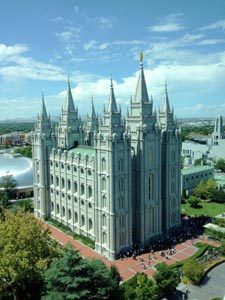
Mormon temple in Salt Lake City, Utah.
Ultimately, the Utah War started a slow decline in Mormon isolation and power in Utah. They soon lost control of the executive branch and the federal district courts but maintained political authority in the Territorial Legislature. In 1869, the Transcontinental Railroad was completed, and soon, large numbers of “Gentiles” arrived in Utah to stay.
Despite this, complete federal dominance took time. Brigham Young maintained a “shadow government” for years, and conflict between the Mormons and the federal government, particularly over the issue of polygamy, would continue for nearly 40 years. In 1890, church leader and Prophet Wilford Woodruff announced that he had received a revelation that officially discontinued the practice of plural marriage. Utah became a state in 1896.
Afterward, several smaller groups broke with the main Church of Latter-Day Saints over the issue of plural marriage, forming several denominations of Mormon fundamentalism. The main church distanced itself from these groups and began to promote the mainstream American view of monogamous families.
In November 1978, Congress established the Mormon Pioneer National Historic Trail as part of the National Trails System, commemorating the 1846-47 journey of the Mormon people from Nauvoo, Illinois, to the Valley of the Great Salt Lake.
The almost 1,300-mile trail is managed as a cooperative effort among private landowners, trail associations, state and local agencies, the National Park Service, the Bureau of Land Management, and the U.S. Forest Service. Though much of the trail is no longer visible, long stretches can still be seen in Wyoming, and several sites can still be visited.
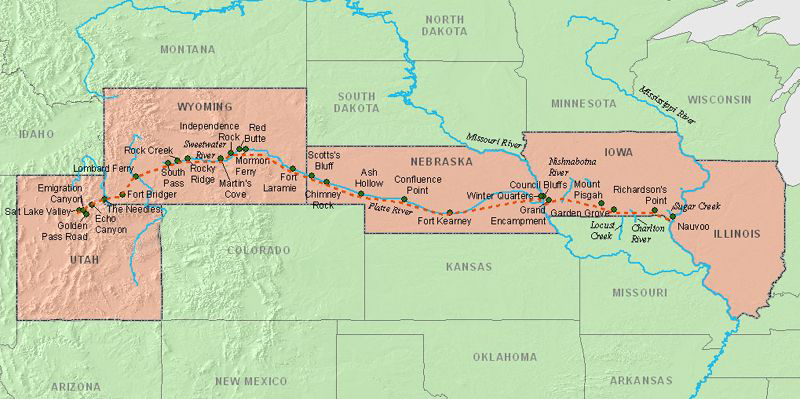
Mormon Trail Map.
©Kathy Alexander/Legends of America, updated October 2026.
Also See:
Adventures in the American West
American History
Byways & Historic Trails – Great Drives in America
Utah – The Beehive State
Sources:
Encyclopedia Britannica
Mormon Newsroom
Public Broadcasting System
Salt Lake Tribune
Wikipedia