
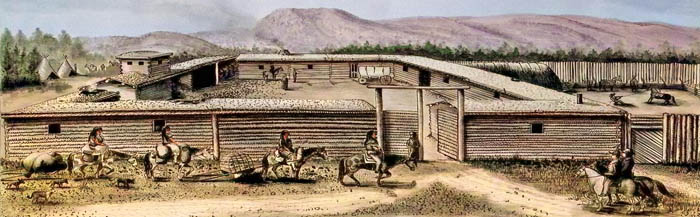
Fort Bridger, Wyoming, 1850, Merritt Dana Houghton.
Fort Bridger, Wyoming, was first established in 1843 as a trading post by Jim Bridger and his partner, Pierre Louis (Luis) Vasquez, on Black’s Fork of the Green River. Planning to trade with both the Indians and westward-bound emigrants, the first “fort” consisted of two double-log houses about 40 feet long, joined by a pen for horses, and a small blacksmith shop.
When they arrived at Fort Bridger, westward-bound emigrants who looked forward to the stop and a break from the long, monotonous days of traveling were often disappointed. Unlike Fort Laramie, a “civilized” outpost, Fort Bridger was, in their minds, little more than a crude collection of rough-hewn log buildings.
Emigrant Edwin Bryant would say of the fort, “The buildings are two or three miserable log cabins, rudely constructed and bearing but a faint resemblance to habitable houses.”
Another, Joel Palmer, remarked: “It is built of poles and dabbed with mud; it is a shabby concern. Here are about 25 lodges of Indians, or rather, white trappers’ lodges, occupied by their Indian wives. They have a good supply of skins, coats, moccasins, which they trade for flour, coffee, sugar, etc.”
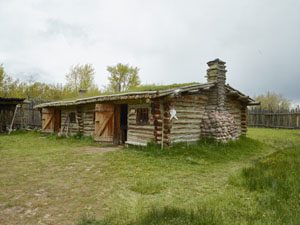
Fort Bridger Trading Post today by Carol Highsmith.
When the Mormon Pioneer Company reached the fort on July 7, 1847, they spent a day there but found the supplies too expensive at the remote trading post. When a group of Mormons settled near Fort Bridger, tensions arose between Bridger and the new settlers. The following year, the Mormon settlers reported to Brigham Young in Salt Lake City that Bridger was selling liquor and ammunition to the Indians, violating federal law.
Young, who was a federal Indian agent, determined to stop the practice, and on August 26, 1853, a Mormon militia of forty-eight men started for Fort Bridger from Salt Lake City. However, Jim Bridger was warned and escaped minutes before the Mormons arrived. When the Mormons arrived, they discovered plenty of liquor, which they destroyed, but found no ammunition.
That same year, the Mormons established Fort Supply, about 12 miles South of Fort Bridger, specifically for Mormon emigrants.

Fort Supply, Wyoming by Merritt D. Houghton.
In retaliation, Bridger wrote a letter to General B.F. Butler, a U.S. Senator, in October 1853, claimed he was “robbed and threatened with death by the Mormons” and that over $100,000 of his goods and supplies had been stolen.
The following spring, Brigham Young sent 15 well-armed men to take control of Fort Bridger and the Green River ferries, which would become an integral part of the Mormon settlement plan. The men built a large stone wall around the fort and several stone buildings.
The Mormons controlled the fort for the next year until Jim Bridger returned in July 1855. When he noticed the improvements, the Mormons asked him to sell, but he refused. The following month, under pressure from the Mormon militia, he finally agreed to the sale. He agreed to a sale price of $8,000, with $4,000 paid immediately. The balance was to be paid in November 1856, fifteen months later.
In the meantime, tensions continued to broil between the Mormons and other settlers of the area. In the Presidential Election of 1856, the Republicans attacked polygamy and slavery, and though Democrat James Buchanan was elected, he too opposed the practice of polygamy. More importantly, he opposed the dominance of Utah Territory by the Church of Jesus Christ of Latter-day Saints (the Mormons), seeing it as a violation of American principles. These tensions soon led to the “Utah War” of 1857- 58. Meanwhile, Jim Bridger never received the $4,000 owed him for his fort.
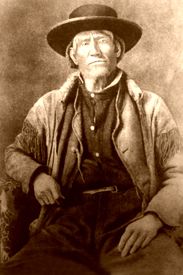
James Bridger.
The fort became a point of contention in the fall of 1857 when the U.S. Army, under General Albert Sidney Johnston, marched across the high plains, planning to use the fort as a base to enter Utah Territory. However, before the Army arrived, “Wild Bill” Hickman and his brother burned both Fort Bridger and Fort Supply on the night of October 7 to keep them from falling into the hands of the approaching United States Army. As a result, Johnston’s Army, with little shelter and inadequate food supplies, endured an insufferable Winter awaiting the spring thaw.
Though the “Utah War” did not involve battles between the Army and the Mormon militia, property was significantly destroyed. At the height of the conflict, more than 100 California-bound settlers from Arkansas were killed by Mormon militia and local Paiute in the Mountain Meadows Massacre in September 1857.
At the end of hostilities, Brigham Young paid the remaining $4,000 owed on the fort during the peace negotiations and thought he owned it. Though the government accepted the payment, they rejected Brigham Young’s claim to the fort and refused to recognize Jim Bridger’s continuing claims.
Instead, William Alexander Carter ran the fort profitably, having come with Johnston’s Army as a sutler or storekeeper. He stayed there with his family, rebuilt and restocked the fort, and eventually became wealthy. Highly respected, he soon became known as “Mr. Fort Bridger,” Wyoming’s first millionaire.
During the Civil War, the garrison dwindled in numbers as soldiers were sent back East. However, regular troops returned in 1866 and used the fort as a base of operations for southwestern Wyoming and northeastern Utah. The post guarded stage routes and the transcontinental telegraph line, hosted a Pony Express station, patrolled emigrant trails, took action against Indian raids, guarded miners moving into the South Pass and Sweetwater region, and protected and supplied workers building the Union Pacific Railroad not far to the North.
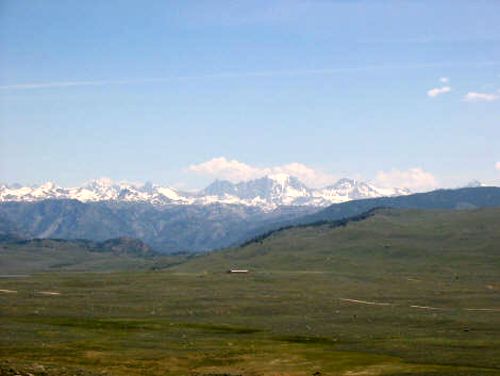
Wind River Valley, Wyoming.
The fort signed treaties with the friendly Shoshone in 1863 and 1868; the second created a reservation East of the Wind River Mountains. Although strategically located, the fort never served as a base for any of the significant military expeditions of the 1870s against the Indians in the region. Still, some garrisons were reassigned for combat. Temporarily abandoned in 1878, the post was reactivated in 1880. A decade later, the military abandoned it.
Meanwhile, Jim Bridger continued to press his payment claim, but it went unresolved when he died in July 1881. Only after almost two decades of effort by his descendants was the matter finally settled when Congress appropriated $6,000 for the family.
Successful sutlers, William Carter’s family continued to live at the fort until 1928, when it was sold to the Wyoming Historical Landmark Commission for preservation.
Today, the fort is a Wyoming State Park with well-preserved, well-maintained structures. Some restoration has been accomplished, including the 1884 barracks building, which now houses a museum. Crumbling ruins of the commissary building and the old guardhouse, built in 1858, are visible. The 1884 “new” guardhouse, the 1858 sentry box, and the officer’s quarters are in better condition. Also standing are the sutler’s store, Pony Express stables, post office, a group of lesser buildings, and a portion of the wall constructed by the Mormons. The foundations of other buildings are marked. The cemetery contains Bridger’s daughter and Judge W.A. Carter, a pioneer rancher in the area. Portions of the original fort grounds and some buildings are located on privately owned property outside the State-owned area.
Fort Bridger is South of I-80 at Exit 34.
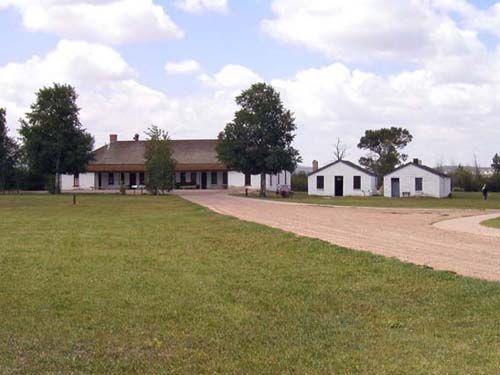
Fort Bridger, Wyoming.
Contact Information:
Fort Bridger State Historic Site
PO Box 112
Fort Bridger, Wyoming 82933
307-782-3842
©Kathy Alexander/Legends of America, updated September 2026.
Also See:
Trading Posts of the Fur Trade
See Sources.