
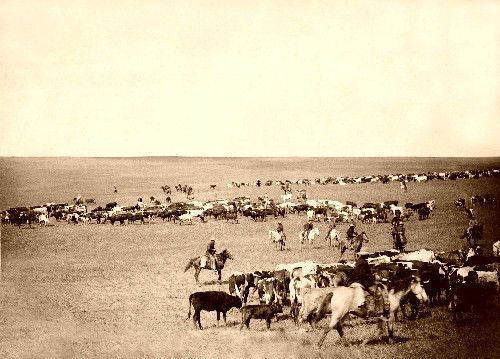
Round Up at Belle Forche, South Dakota, by John C. H. Grabill, 1887.
By Charles Moreau Harger in 1892.
In 1860, Texas, as it had been for many years before, was the chief producer of livestock in the Western States. Across its widespread ranges, herds fed by the thousand, and no other industry approached cattle-raising in importance or extent. The few hundred thousand cattle of Spanish blood placed there during the state’s life as a Mexican province were multiplied until three and a half million heads were estimated as Texas’ belongings. They had been somewhat improved in the breed but were still wiry, nervous, long-limbed creatures with slender, branching horns and restless eyes. They could run like deer and were almost as wild.
Texas’s peculiarly favorable climate gave the state almost a monopoly on the business. The pastures were green year-round, and the proximity to market, either at points on the Mississippi River, to which herds from the eastern part of the state could easily be driven, or by water from points on the Gulf, gave a distinct advantage.
In times past, Mexico had been a valuable consumer but was now nearly deserted, and the nearer selling places could handle the supply. The fine, hair-like “buffalo grass” that covers the prairies for 400 miles East of the mountains, and wherever found, is as nourishing in Winter as in summer, flourished in abundance, and the mesquite was not to be despised as a change of diet for the herds.
The outbreak of the Civil War brought upon the ranch owners a peculiar embarrassment of riches. With the Northern market cut off and Southern business life demoralized, no disposition could be made of the rapidly increasing herds. Occasional fugitive sales along the Mississippi River became almost the only markets. Prices declined, and for a time, two to four dollars a head would purchase the best animals on the ranges. Driving northward had not been much practiced, and now, with the sharp skirmishing along the Kansas and Missouri frontier, there was no opportunity to begin it. The stock was neglected as valueless. Men were “cattle-poor,” and it was a time of discouragement for those who had looked for fortunes in their enterprises.
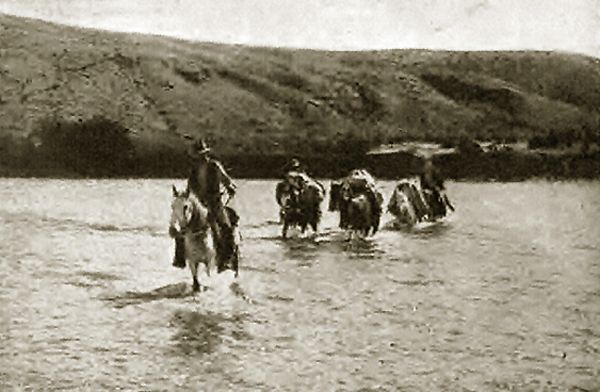
Rocky Bluffs Ford of the Red River.
In 1865 and 1866, the ranch owners determined to seek Northern markets at any cost, and thousands of animals were massed in the northeast portion of the state, preparing to be driven to Missouri railroad stations. This movement began in the summer of 1866. Fully 270,000 heads were pushed northward. The courses taken were irregular. The Rocky Bluffs Ford on the Red River was the starting place for many. Up the Kinishi Valley, across the plains to Fort Smith, Arkansas, then, with a circuitous route among the Ozarks, across southeastern Missouri – that was the line most followed.
But a new danger threatened. They had ensconced themselves among the wilder regions of the southern Missouri River and northern Arkansas River, bands of outlaws, legitimate successors to the guerrillas of Civil War days, who by mere force of advantageous position, levied unmerciful tribute upon all drovers passing through their territory. The tax was oppressive, and no matter how shrewd the herders’ movements, the unwieldy masses of animals were sure to be detected. If the outlaws’ demands were not met, the drover was often subjected to bodily punishment. At the same time, one of the persecutors would ride furiously at the herd, swinging a colored blanket. The timed beeves, bewildered by the unwanted sight, would scurry in every direction, growing more frightened as they ran until the herd was scattered over miles of territory. Days and weeks of searching by the cowboys, as the herders who assisted the drover were called, would secure only a portion of the lot.
Fear of Spanish fever was made the pretext for other delays. At the same time, the hostility of the Cherokee Indians in the northeastern part of the Indian Territory shut off a more westerly route to avoid the bandits. Many heads of cattle were lost along the toilsome track through the Ozark Mountains, and the remainder reached markets in St. Louis and Sedalia in poor condition and at low prices. The year’s drive was discouraging and unprofitable to the Texas cattle barons, and many plans were considered to dispose of the constantly growing surplus. Northern prices for good stock were flattering; the capital was ready for investment in the businesses; nothing was needed but an outlet for the abundance of beef.
The solution to the problem confronting the cattle raisers came through the construction of the railroads across Kansas. In 1867, the old Kansas Pacific Railroad, now the Kansas Division of the Union Pacific, was being built from Kansas City along the valley of the Kansas River due West across the state.
It had reached halfway from the Missouri River to the mountains before its potential became apparent. The country traversed was sparsely settled; the towns consisted, for the most part, of a few rude cabins, including the inevitable saloon. But the tide of emigration was pushing westward, and a magnificent empire awaited conquest.
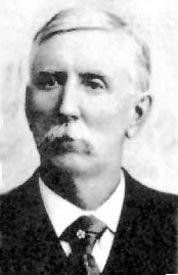
Joseph G. McCoy.
One of the firstcomers was an Illinois stock dealer, Joseph G. McCoy, to whom the honor of originating the Kansas and Texas cattle trails is due. He was familiar with the situation in the Lone Star State and conceived the idea of forming a great shipping point on the new railroad. Officials encouraged him, and arrangements were made to locate the proper yards at Abilene, Kansas, a station 165 miles from Kansas City, situated in the midst of a richly grassed prairie section, admirably adapted for grazing incoming herds. The town had fewer than a dozen houses and was within less than 30 miles of the end of the road, as then completed. Yards were built, and steps were taken to induce the cattlemen to make this a point from which to ship their herds.
A single horseman was dispatched on a lonely ride across Indian-infested prairies to send every herd he could encounter to the new shipping place. He went Southwest, crossing the Arkansas River near the site of the present city of Wichita, Kansas, and then into the Indian Territory. It was some time before he found any of the straggling herds, and when he did, he could with difficulty induce the drovers to believe that they would be treated with respect and fairness, so used were they to the violence of the old course. However, many were convinced, and a herd of nearly 2000 head, belonging to some Californians, was the first to break the northern end of a trail over which so many millions of restless hoofs were destined to travel. About 36,000 cattle, one percent of Texas’ supply, reached Abilene that season, and every drover returned well pleased with the facilities afforded. The first shipment from Abilene was made September 5, 1867, and was celebrated by an excursion of Illinois stock dealers coming in a special train to see the start. However, money was lost on the year’s business, both from damage to the droves by floods and Indian raids and because of the prejudice in the East against Texas beef, which was then considered by many to be too wild for use.
The movement was started, and 1868 saw general friendliness for the new market among Texas stock owners and a northward drive that exceeded 75,000 head. But the next year, 1869, saw an even greater increase, and 160,000 cattle came tramping up like a horned army from the ranches of the South.
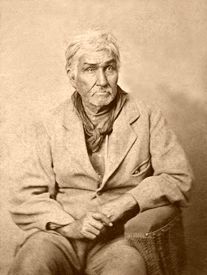
Jesse Chisholm.
By this time, well-defined trails had been located, and for two decades, those trunk lines connecting the remarkable producing and consuming points held their supremacy. The most famous of these was the “Chisholm Trail.” It was named after Jesse Chisholm, an eccentric frontier stockman, who was the first to drive over it. Chisholm lived in Paris, Texas, was a bachelor, and had many thousands of head of cattle on the ranges in the southern part of the State.
There was, through Texas, reaching down from the Red River, the irregular “Southern Texas Trail,” ending at the North near Cooke County. From the Red River, Chisholm broke the way to Kansas, riding ahead of his herd and selecting what seemed the most favorable route. He forded the Red River near the mouth of Mud Creek, followed the stream to its head, kept northwest to Wild Horse Creek, west of Signal Mountains, and crossed the Washita at Elm Spring. Due North took him to the Canadian River, where he soon struck the Kingfisher Creek Valley after leaving. This led to the Cimarron River. Touching the head of Black Bear and Bluff Creeks, its next considerable stream was the Salt Fork of the Arkansas River, which was crossed at Sewell’s Ranch. Sewell was a Government post-trader who was a favorite with the Indians and had two large ranches in the Territory.
Coming into Kansas near Caldwell, the course was a little East of North, crossing the Arkansas River near Wichita. Here was the famous “First and Last Chance saloon, with its signboard facing two ways to attract the cowboys coming up across the Territory and those returning from market. Then the trail turned northeasterly, striking Newton and so on over the divide between the Smoky Hill River and the Arkansas River to the prairies South of Abilene. Thousands of herds followed Chisholm’s track, and the trail became a notable course.
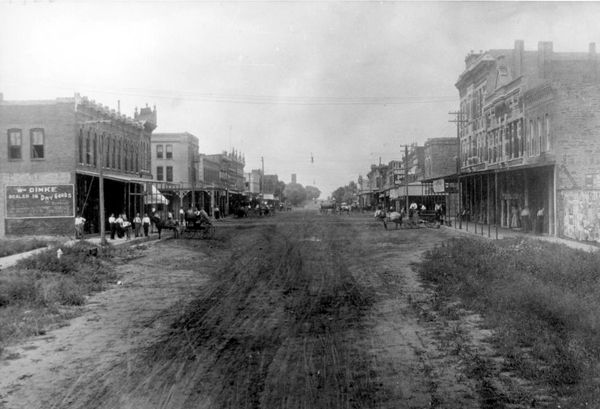
Caldwell, Kansas.
From 200 to 400, beaten into the bare earth, it reached over the hill and through the valley for over 600 miles (including its southern extension), a chocolate band amid the green prairies, uniting the North and South.
As marching hoofs wore it down, the wind blew, and the waters washed the earth away, it sank below the surrounding country and was flanked by little sand banks, drifted by the wind. Bleaching skulls and skeletons of weary brutes who had perished on the journey gleamed along its borders, and here and there was a low mound showing where some cowboy had literally “died with his boots on.” Occasionally, a dilapidated wagon frame told of a breakdown, and spotting the emerald reaches on either side were the barren, circle-like “bedding grounds,” each a record that a great herd had spent a night there. The wealth of an empire passed over the trail, leaving its mark for decades.
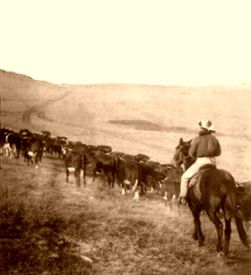
Cattle Trail.
Dividing honors with the Chisholm Trail was the “Old Shawnee Trail.” This led to the lesser Northern shipping point, which opened about the same time as Abilene—Baxter Springs. This city was on the then-just-completed Fort Scott & Gulf Railroad and was located in the southeastern corner of Kansas. The trail left the Red River near Snivel’s Bend, about 40 miles East of the older course’s starting point, and ran nearly parallel with its rival for about 100 miles.
A connecting trail ran into the Chisholm at Elm Spring. The Shawnee Trail then bore northeasterly on the North side of the Shawnee Hills, crossed the Canadian and North Canadian Rivers near the Sac and Fox Agency, then passed through the Creek reservation and forded the Arkansas River West of Forts Davis and Gibson. Turning more easterly, it passed West of Vinita, Oklahoma, to Baxter Springs, Kansas. Named for its passage through the Shawnee Indian country, this trail became as well-worn as the older one and equally well known. Both were barren as city streets and were marked by the whitening bones of four-footed travelers who had died on their weary journey.
Between the two main trails was the “Middle” or “West Shawnee Trail,” leaving its namesake near the Canadian River and going nearly due North until it struck the Arkansas River, up which valley it followed into Kansas. It then ran up the Whitewater Valley North and East, crossing the Cottonwood River and along the Neosho and Clark’s Creek valleys, ending at Junction City, Kansas, 25 miles East of Abilene. In later years, the Chisholm Trail gave off a western shoot that left it near Elm Spring and, passing near Fort Reno, Oklahoma, went northwest into western Kansas, striking Dodge City on the Arkansas River and also northeast to Ellsworth on the Smoky Hill River. As the country settled, cattle were driven farther and farther west until this “Western Chisholm Trail” became the chief thoroughfare for herds detained either for market directly or for maturing in the bracing air and pastures of Wyoming and Montana. Individual drovers often varied their course from the beaten roads, but for the most part, the traffic of the cattle days followed the greater lines as the bulk of commercial shipments was made over a few prominent railroads.
Along the trails, ranches were started, where lands suitable for the purpose could be secured on either side. Northern Texas, southern and western Kansas, and later, portions of the Indian Territory rivaled the Gulf region in producing marketable animals.
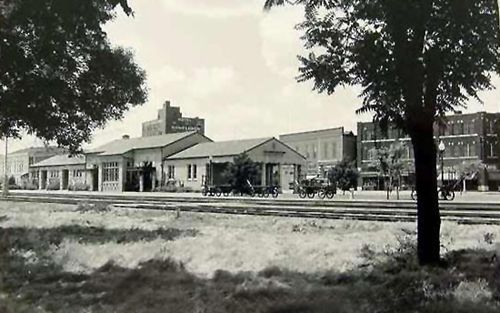
Abilene, Kansas.
In 1870, 300,000 cattle reached Abilene, and almost a continuous line of bovine travelers poured over the Chisholm Trail. To facilitate the herds’ movements, surveyors were sent out to straighten the trail from the point where it entered Kansas to the shipping station. Fresh mounds of earth were thrown up to mark the route, and the drovers found considerable savings in the distance. They spread the news of the efforts being made to accommodate the cattlemen and the Texas ranch owners, appreciating these advantages and the rapidly increasing prices of stock in the Eastern markets. They were prepared to send forward still greater supplies.
The ranches mainly were in southern and southwestern Texas, and the hundreds of young men who, at the close of the Civil War, had sought fortune in the far Southwest were coming into a position to put some of their salable stock on the market. In 1871, nearly a million cattle were driven North. Six hundred thousand came to Abilene alone, while Baxter Springs and Junction City received half as many. The stock was herded for miles around the chief shipping points, awaiting a chance to sell or ship. From any knoll, thousands of sleek beeves could be seen, their branching horns glistening in the sunlight and their herders watchfully riding in the distance. Several counties of central Kansas were practically turned into cattle yards, and it seemed that the industry would soon absorb the energies of the entire state.
But the wave was at its height. Prices fell, wet weather and cold winds injured the cattle’s condition, and the so-called Spanish fever, always a terror to the Northerners and seemingly ineradicable from the Texas cattle’s blood, caused more trouble than usual. The herds were held on the grazing grounds until fall, hoping for better prices, but to no purpose. Finally, shipping was stopped entirely, and over 300,000 cattle were unsold. Some had carried over every year, either because they could not be sold or, as has been so general in late years, to fatten on the Northern corn, but this number was unprecedented. The drovers took their stock westward to the buffalo grass region, making it impossible to procure hay and corn in central Kansas for the great throng.
At the beginning of the Winter of 1871-72 came a storm of sleet, putting an icy coat over the sod, and thousands of cattle and hundreds of horses died of cold and starvation. Some carcasses were skinned, but most were left for the wolves to eat. After the storm, about 100,000 hides were shipped from three stations. The Winter was severe throughout, and it is estimated that fewer than 50,000 cattle survived it. From herds of 60,000-70,000, only a few hundred survived. Like other booms in which the West has overreached itself, this one collapsed.
Abilene’s prestige was gone. Ellsworth, forty miles further West, became the shipping point on the Kansas Pacific. The Atchison, Topeka & Santa Fe Railroad, being nearly completed through the southern portion of the state, began to compete for the trade. Newton, where the road crossed the trail to Abilene, stopped many herds and, with Ellsworth, divided the claim to the title Abilene had held for several years: “The wickedest town in the West.”
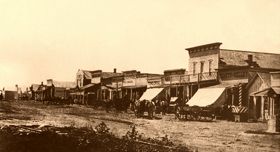
Dodge City, Kansas, 1876.
Dodge City later appropriated this description and, with the opening of the mining regions of Colorado, passed from the state and became the property of Leadville and Deadwood, South Dakota. At the new shipping point, another picturesque saying became popular: “There is no Sunday West of Newton and no God West of Pueblo.” Wichita, too, drew drovers’ attention, and 80,000 heads went from there in 1872, while three times as many were shipped from the other towns combined. In 1873, 450,000 heads were shipped from Kansas. However, prices and weather conditions then took a hit, though not as severe as in the previous two years.
Soon after, Dodge City, on the Chisholm Trail’s western offshoot to Ellsworth and reached by the Santa Fe Railroad, took the northern station’s trade as Newton had absorbed Abilene’s and, for 12 years, was the acknowledged shipping center for Texas cattle in the state. While the drives never reached the proportions of 1871, they remained extensive until railroads were built across the Indian Territory and shipping points were established in Texas itself. Even then, they did not wholly cease, and many thousand heads came straggling across the line each year, being marketed for Dodge City, Wichita, or other railroad points.
The opening of Oklahoma in 1890 made another barrier, however. The 1891 season saw the last of the bovine exodus that, over two decades, had furnished employment and profit for many of the West’s workers. Neither advantage nor convenience was now found in that method of marketing, and henceforth, the only herds to wind their slow length over the once populous thoroughfares would be the young stock taken leisurely through the season from the warm climate of the Gulf region up northwesterly, skirting the foothills of the Rocky Mountains, to reach, after a six months’ journey, the highland feeding grounds of Wyoming and Montana. A year or two later, they would go to market, sturdy and hard–fleshed beeves, ready for the export trade.
The drover and his assistant cowboys had to get the herds from the Southern ranches to the Northern shipping points, a task that required both skill and daring. Only a man of unflinching courage and quick movement could handle animals whose characteristics were more those of the wild beast than of the creature bred for the sustenance of man. The Texas steer is no respecter of persons. For the man on horseback, he had a wholesome fear; he seemed to have something of the savage’s conceit that the combination is irresistible. Separately, neither man nor horse has any more chance in a herd fresh from the range than among so many wolves or jackals. With their long, sharp-pointed horns, these steers easily rendered an enemy, and the fights among themselves have all the ferociousness of contests in the jungle.
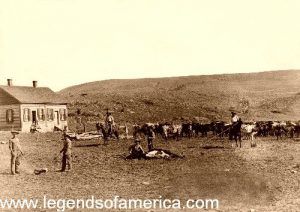
Branding Cattle, 1891.
The first contact between cowboys and cattle occurred at the annual round-up, when the entire territory, including the owner’s herd range, was gathered for branding. The offspring were given the mother’s mark, and the ranch owner possessed a brand exclusively as a manufacturer’s trademark. After the young have been lassoed, held, and had their flesh burned with the red-hot branding-iron, leaving a scar in the form of a letter, figure, or combination design that will last for life, they are turned loose. No human hand is laid on them until they become “beeves,” four years old and ready for market. The cowboys lived in cabins near the water courses and watched the stock daily, sometimes having the herds 10 or 20 miles away. Should any “mavericks,” that is, unbranded stock over one year old, get with the herd, they become the property of the person branding them; hence, no inconsiderable addition was frequently made to a herd by this means.
The cattle barons in the palmy days of the cattle trade lived like princes. They did not live on the ranch but in some Texas cities, or they spent their time traveling luxuriously while their wealth grew faster than they could spend it. Many of them did not know how many cattle they owned.
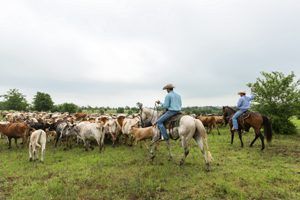
Texas Longhorns.
Their careers were marked by extravagance and display. Diamonds, carriages, and banquets made their life brilliant while it lasted. In the late 1870s and the early part of the decade that followed, when their power and wealth were at their highest, they practically owned the Lone Star State. From No Man’s Land (present-day Oklahoma Panhandle) to El Paso, Texas, their cattle grazed; prices were high, and capital flowed in. But the agriculturist came, too, and farms drove out the ranches.
The first owners did not always send the cattle to market. Drovers made a business of going from ranch to ranch and purchasing the marketable beeves. “Dogies,” “sea-lions,” and “longhorns” were favorite nicknames for the cattle, and size, as well as title, depended on the latitude. Southern Texas stock was smaller, with 4000 to 6000 being driven at a time. Of northern Texas stock, 1500 to 3000 made a good-sized “drive.”
The drover secured, besides camp equipage and eatables, about eight men to 1,000 cattle as drivers and six to ten horses per man, depending on the quality of the equines. After 1883-84, when Indians were less dangerous, and fewer herds were on the trails, four to six men to 1000 head were considered sufficient. Having “cut out” the cattle one by one with lassoes (long rawhide ropes attached to the cowboys’ saddles and thrown with great accuracy by the riders), the steers and cows all received a “road brand,” a supplementary mark to prevent confusion on the way to market. Then all was ready for the long march.
Spring was the usual starting time, and during the seasons of the large drives—May, June, July, and August —almost a solid procession passed over the great trails. The herds were so near that the drivers could hear one another urging along the stock, and frequently even the utmost care could not prevent two companies from stampeding together, entailing a loss of much time and labor in separating them.
Once started, it was remarkable how orderly a herd took its way across the plains. A herd of a thousand beeves would string out to a length of two miles and a larger one still longer. It made a picturesque sight. The leaders were flanked by cowboys on wiry Texas ponies, riding at ease in great saddles with high backs and pommels. At regular distances were other riders, and the cavalcade’s progress was not unlike that of an army on a march. The cattle’s movements had an army-like regularity, too. The leaders always seemed specially fitted for the place, and the same ones stayed in the front rank throughout the trip, while others kept their relative positions in the herd day after day.
There was hard driving at the start, 20-30 miles a day until the animals were thoroughly wearied. After that, 12-15 miles was considered a good day’s drive, thus extending the journey over 40 to 100 days. The daily program was as regular as a regiment’s on the march. From morning until noon, the cattle were allowed to graze toward their destination, watched by the cowboys in relays. By then, the cattle were uneasy and were turned onto the trail. They walked steadily forward eight or ten miles when, at early twilight, they were halted for another graze. As darkness came on, the cowboys gathered them closer and closer into a compact mass, riding steadily in ever-smaller circles around them until, at last, the brutes lay down, chewing their cud and resting from the day’s trip. Near midnight, they usually got up, stood a while, and then lay down again, having changed sides. At this time, they needed extra care to keep them from wandering in the darkness. Sitting on their ponies or riding slowly around their reclining charges, the cowboys passed the night on sentinel duty, relieving one another at stated hours.
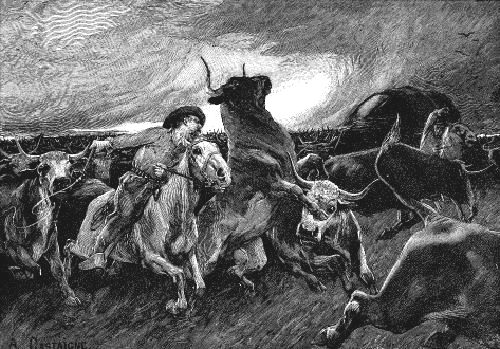
A stampeded herd.
When skies were clear and the air bracing, cattle driving was a pleasant and healthful task. But rainy days came when the cattle were restless, and riding through the steady downpour was anything but enjoyable. Then, especially, the nights were wearisome, and the cattle were ready at any time to stampede.
No one could tell what caused a stampede, any more than one can tell the reason for the strange panics that sometimes attack human gatherings. A flash of lightning, a crackling stick, a wolf’s howl, little things in themselves, but in a moment, every horned head was lifted, and the mass of hair and horns, with fierce, frightened eyes gleaming like thousands of emeralds, was off. Recklessly, blindly, in whatever direction fancy led them, they went, over a bluff or into a morass, it mattered not, and fleet were the horses that could keep abreast of the leaders. But some could do it, and lashing their ponies to their best gait, the cowboys followed at breakneck speed. On one side of the leaders, the effort was to turn them a little at first, then more and more, until the circumference of a great circle was being described.
The cattle behind followed blindly, and soon the front and rear joined, and “milling” commenced. Like a mighty millstone, the bewildered creatures raced round and round until they were wearied out or recovered from their fright.
Stopping the herd from milling after a stampede, or in the cattle yards at the end of the trip, was necessary but difficult. As in a stampede, it was death to an animal who failed to keep up with his comrades, for in a moment, thousands of trampling hoofs would flatten his carcass. The human voice seemed the most powerful influence that could be used to affect the brutes, force being entirely out of the question. The cowboys began singing as soon as the “milling” began. It mattered not what, as long as there was music. It was not uncommon to hear some profane and heartless bully doling out camp-meeting hymns to soothe the ruffled spirits of a herd of Texas steers, a use that might have astonished the fathers and mothers of the churches “back in God’s country,” if they had known of it.
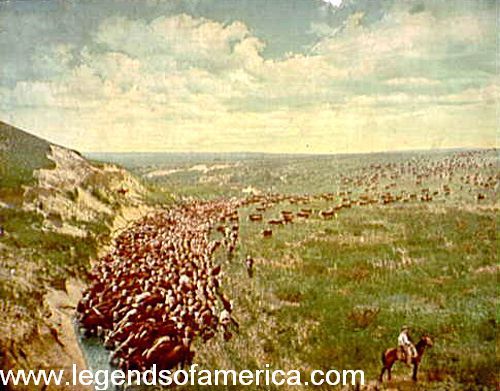
Rounding up cattle.
A stampede always meant a loss and made the herd more likely to panic again. Certain hysterical leaders were frequently shot because they influenced the remainder of the column. Another danger was the mingling of two herds; in the earlier days, the presence of buffalo was a decided peril. A herd of buffalo roaring and tearing its way across the plain was almost sure to cause a panic if within hearing, and outriders were necessary to watch for these enemies and turn their course from the trail. Besides, marauding Indians were always to be feared, and many a skirmish was had between the cowboys and the Native Americans. However, an understanding with the chiefs was usually sufficient to ensure safety. Thus, accompanied by incidents that brought into play all the strength and strategy of their guards, the horned host moved on. Rivers were crossed by swimming in the same order that had been followed on land.
Reaching the outskirts of the shipping station, the herd was held on the plains until the drover effected a sale or secured cars for shipment. Then, the animals were driven into the stockades, dragged or coaxed into the cars, and sent off to meet their fate in the great packing houses. The journey had been strange to them, often accompanied by savage cruelties and the hands of heartless drivers, and the end of the trip with close confinement of yard and car, the first they had ever known, was strangest of all.
With the cattle loading came the “paying off” and the cowboy’s brief vacation before returning to another year’s round of hard work and coarse fare. It was not to be expected that after nearly twelve months of life on the prairies, he should spend his outing in quiet and dignity. And seldom did he. The cattle towns catered to his worst passions, and saloons and dance houses flourished with startling exuberance. Gambling ran riot, and quarrels ending in murder were frequent occurrences. During the height of the season, might was the only law. If occasionally a marshal was found, like William Hickok, the original Wild Bill, who could rule Abilene in its rudest period, it was because he was quicker with the revolver and more daring than even the cowboys themselves.
Much glamour and romance have been thrown around the figure of the cowboy. He was not the dashing and chivalric hero of the burlesque stage, in a gorgeous sombrero and sash, nor was he the drunken, fighting terror his business induced. The cowboy lived a hard life. He had never seen a bed or slept beneath a roof for months. He seldom had access to a newspaper or book and had none of society’s advantages to lift him to higher things. The roughest of the West’s immigrants, as well as many Mexicans, drifted into the business because of its excitement and good wages, and this class, by its excesses, gave the world its standard for all. With the influences of actual contact with bucking bronco ponies and ferocious Texas steers, themselves by no means elevating, added to the temptations of the cattle towns, all the worst in the herder’s nature was sure to be brought out. But hundreds of cowboys were sons of Christian parents, and when they had made a start in life, settled down at last as good citizens of the great West, they had helped to develop.
The cowboy with his white, wide-brimmed hat, long leather cattle whip, lariat, and clanking spurs is a thing of the past. The great Texas ranches are enclosed with barbed wire fences, and a genuine Texas steer would attract almost as much attention in the old cattle towns as a llama. Abilene, Ellsworth, Newton, and Dodge City are busy little cities surrounded by affluent farming communities and with churches, schools, electric lights, and other evidence of modern civilization. No trace of the old life remains, except some weather-stained and dilapidated buildings, pointed out to the stranger as having been saloons where Wild Tom, Texas Sam, or other strangely named characters killed men unnumbered “during the cattle days.”
The cattle trails were, in a measure, educative. They brought the North and South of the Mississippi Valley into close business relations, to both their advantage. But the life that surrounded them could not endure. The homes of thousands of settlers have preempted the grazing grounds. Railroads are ten times more numerous than were the trails, and like the cavalier, the troubadour, the Puritan, and the “Forty-niner,” the cowboy and his attendant life have become but figures in history.
By Charles Moreau Harger, 1892. Compiled and edited by Kathy Alexander/Legends of America, updated October 2026.
Author and Notes: Cattle Trails of the Prairies, written by Charles Moreau Harger in 1892, appeared in Scribner’s Magazine, Volume 11, Issue 6, June 1892; Charles Scribner’s Sons; New York, NY. The article is not verbatim, as it has been edited for clarification, corrections, and ease for the modern reader.
Also See:
The Chuck Wagon – The Real Queen of the Cattle Trail
List of Trail Blazers, Riders, & Cowboys
Cowboys on the American Frontier
The Range of the American West
Tales & Trails of the American West