
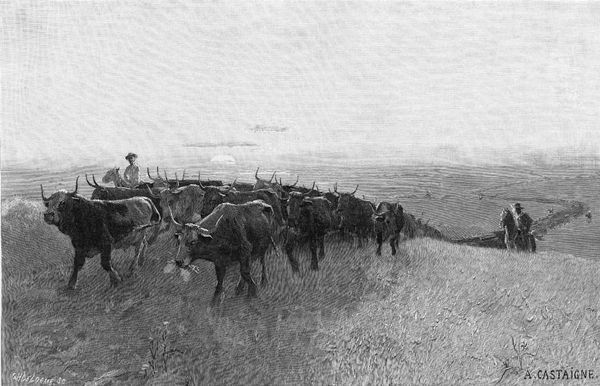
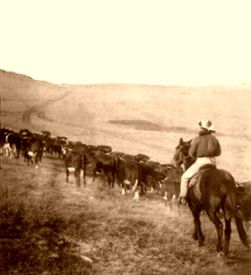
Cattle Trail.
Also known as the Texas Road, the Sedalia Trail, or the Kansas Trail, the Shawnee Trail was a major trade and emigrant route from Texas through Oklahoma, Kansas, and Missouri. Blazed along old Indian trails and military roads, the trail saw Texas cattle driven up it as early as the 1840s.
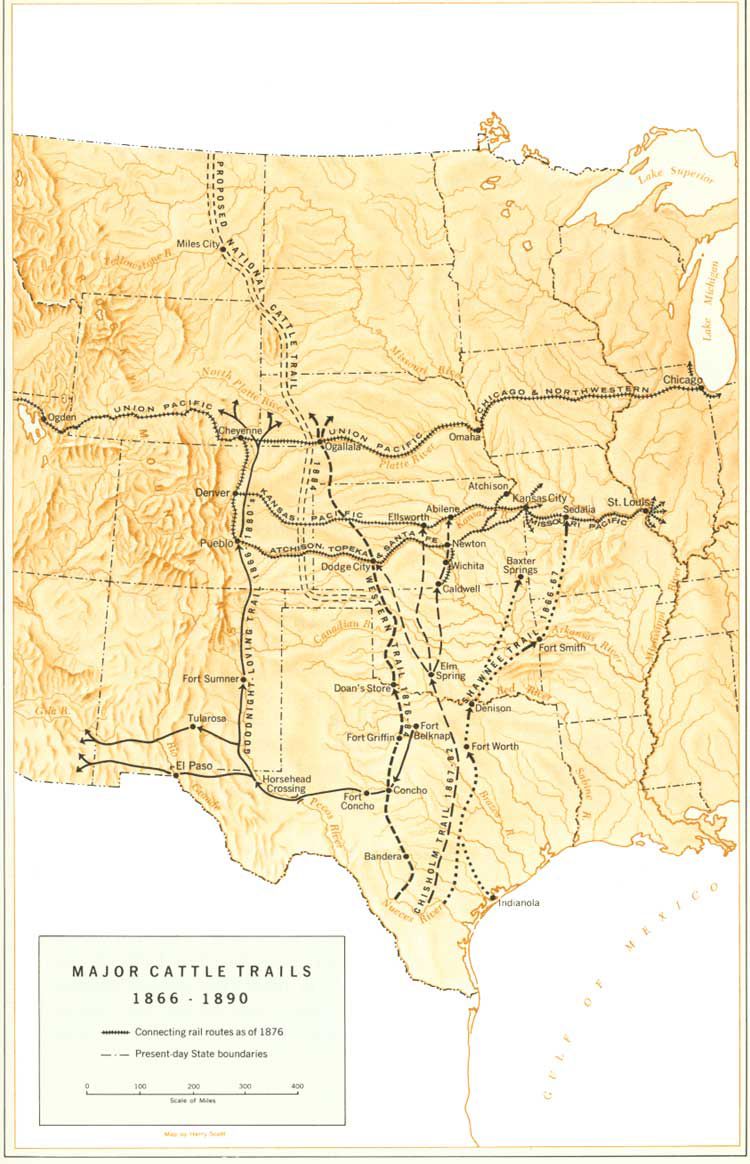
Cattle Trails Map.
In fact, it was the earliest and easternmost route by which Texas Longhorn cattle were taken north from Austin, Waco, and Dallas, Texas, crossing the Red River near Preston, Texas, before following the Grand River in present-day Oklahoma to Fort Gibson. From there, the trail split into several branches ending in Baxter Springs, Kansas, and St. Louis, Sedalia, Independence, and Westport, Missouri. It is unknown why it was called the Shawnee Trail, but some suggest it was named for a Shawnee Indian village on the Red River.
Use of the Shawnee Trail gradually increased, but as more cattle moved northward, so did a cattle disease soon called “Texas Fever.” The longhorn cattle appeared perfectly healthy, but Midwestern cattle allowed to mix with them or use a pasture recently vacated by the longhorns sometimes became ill and often died. This was determined in 1853 after Texas cattle had been sold in Sarcoxie County, Missouri, in the Winter of 1852. Also called Spanish Fever, it was later determined that ticks spread the disease to local cattle, but the longhorns were immune. As a result, in June 1853, when some 3,000 longhorns were being driven up the Shawnee Trail in Missouri, local farmers blocked their passage and forced them back the way they came.
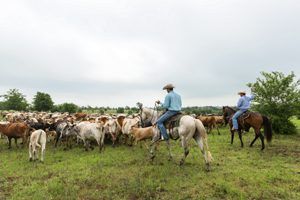
Texas Longhorns.
Although the trail remained in use, many drovers avoided the blockades, which led to stronger, more effective means of blocking them, including vigilance committees and political wrangling. By December 1855, the Missouri Legislature banned diseased cattle from entering or passing through the state. However, the ban was ineffective because the longhorn cattle were not themselves diseased. Farmers once again took matters into their own hands, often turning the herds back. Others began to drive their cattle through eastern Kansas, but soon met the same opposition, and the Sunflower State passed its own protective law.
Parts of the trail also served stagecoach lines, most significantly Butterfield’s Overland Mail between 1857 and 1861. When the Civil War erupted in 1861, Texas cattle were no longer allowed to be shipped northward, effectively cutting off the income and much of the economy of the Confederate state of Texas. At that time, little traveled the Shawnee Trail, except as a military road for both the Union and Confederate Armies. In addition to moving supplies and troops along the pathway, two battles were fought along the route, including the Battle of Honey Springs northeast of present-day Checotah, Oklahoma, and the Battle of Baxter Springs in Kansas.
When the war was finally over, a large abundance of Texas cattle—some five million head—roamed the ranches of the Lone Star State. With no railroads to ship them to market, the cattle were worth only $3 to $4 a head. Meanwhile, there was pent-up demand for beef in the northern and eastern states, where the going rate was 10 times that amount. Realizing the immense profits, Texas cattlemen began searching for the nearest railheads. However, this would not be as easy as it might seem.
In the spring of 1866, drovers were wrangling an estimated 200,000 to 260,000 longhorns northward from Texas. While many were turned back or severely delayed by Texas Fever, some drovers diverted their herds around hostile settlements, got their cattle to market, and made large profits. One of those caught in the vigilantes’ net was a young man named James M. Daugherty.
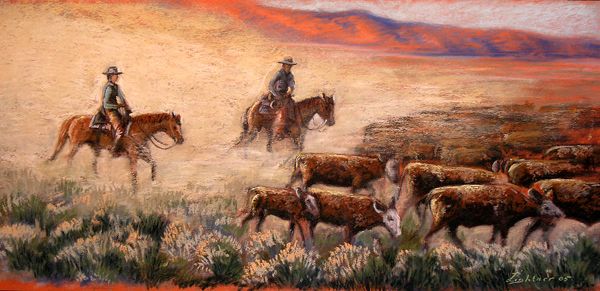
Cattle Drive by Barbara Lightner.
In 1865, when Daugherty was just 15, he went to work for a man named James Adams, one of the most extensive cattle raisers in Southwestern Texas. In the Spring of 1866, he was tasked with driving a herd of 500 head from his employer up to Sedalia, Missouri, then the terminus of the Missouri Pacific Railroad.
It was a particularly dangerous undertaking in the country’s unsettled condition. Still, the cattle needed to reach a market, and Mr. Adams had faith in young Daugherty’s ability to carry them through if anyone could do so. Daugherty’s account of the drive shows the difficulties Texas cattlemen faced in marketing their cattle in an era when unscrupulous people often used fear of the introduction of Texas Fever as an excuse for their own lawless actions.
Driving his slow-moving herd northward, Daugherty crossed the Red River and picked his way through the Arkansas Mountains to Fort Smith to avoid paying the exorbitant taxes the Indians assessed on herds passing through their Territory. This part of the trip was accomplished safely, and the southern Kansas-Missouri border was reached. But he and the other drovers were far from safe. Before long, they were attacked by a band of Jayhawkers dressed in buckskin and wearing coonskin caps, and all armed, who told them the cattle could go no further North. The attackers stampeded the herd, killed one of the drovers, and tied Daugherty to a tree. In the end, Daugherty recovered about 350 head of cattle and sold them in Fort Scott, Kansas, for a profit.
But the days of cattle blazing the Shawnee Trail were virtually over. In the first half of 1867, six states enacted laws against trailing, and Texas cattlemen knew they had to do something else. Around this time, a young livestock dealer named Joseph G. McCoy conceived the idea of establishing a shipping depot for cattle in the West, and he knew the railroad companies were interested in expanding their freight operations. He soon selected Abilene, Kansas, and opened the Abilene Trail through Indian Territory from Texas.
As the developing railheads moved westward, more cowtowns were born, including Ellsworth, Caldwell, Wichita, and Dodge City. Most of these towns developed reputations as wild and woolly frontier towns.
©Kathy Alexander/Legends of America, updated October 2026.
Cattle Trail.
Also See:
List of Trail Blazers, Riders, & Cowboys
Cowboys on the American Frontier
The Range of the American West
Tales & Trails of the American West
Sources:
Handbook of Texas
Red River Historian
The Shawnee Trail
Wikipedia