
Jump to: Links to Full Articles
Jump to: Outlaw Summaries (name begins with) A B C D E F G H I J K L M N O P Q R S T U V W X Y Z
Much like today, outlaws have never been uncommon in history; however, few criminals are recognized as those who lived in America’s Old West.
After the Civil War, many men who had become accustomed to violence and had often lost their lands or fortunes quickly turned to the other side of the law.
As these many outlaw tales were taking place on the American Frontier, those Puritan folks in the East, longing for adventure and entertainment, greedily absorbed every word of the shocking newspaper headlines and the exaggerated tales in “dime novels” that were often published before an outlaw even had time to escape, was jailed, or was killed in a shoot-out.
Still, today, those tales of gunfighters, outlaws, and lawmen remain popular more than a century after their deaths.
Outlaw List:
Carl Adamson – Adamson rode with Jim Miller and was allegedly involved in the killing of Pat Garrett in New Mexico on February 28, 1908.
Epeminto Aguelari – An outlaw who killed Jose A. Samora at Wallace, New Mexico, on April 20, 1884.
Ceberiano Aguilar – An outlaw who fought and died in the Horrell War of Lincoln County, New Mexico, in 1874.
Donaciano Aguilar – An outlaw sentenced to life imprisonment in New Mexico on November 24, 1909.
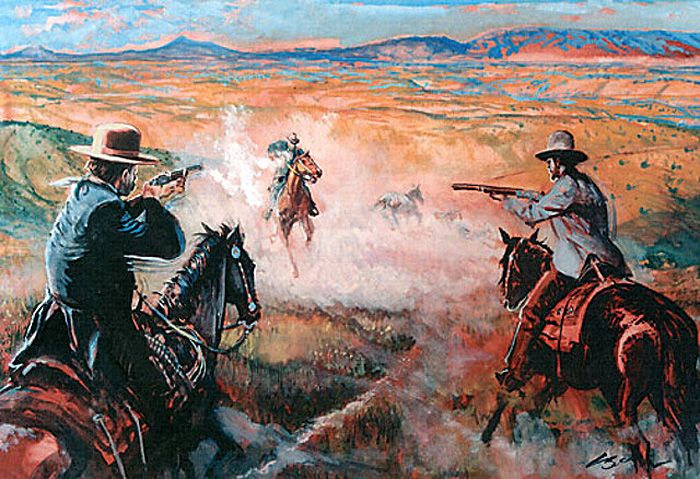
Lincoln County War in New Mexico.
Reymundo Aguilar – An outlaw who fought and died in the Lincoln County War in 1874.
Felix Aguillan – Outlaw member of the Castillo Gang.
Jermin Aguirre (18??-1875) – A member of the Mes Gang, which competed with the John Kinney Gang in New Mexico. On August 8, 1875, Aguirre, Jesus Mes, Pas Mes, and Tomas Madril were ambushed and killed by the John Kinney Gang and Jesse Evans near the San Augustin Ranch.
Alamosa Bill – An outlaw who was allegedly involved with Billy the Kid sometimes, who was killed in El Paso, Texas, in April 1888.
Eugenio Alarid – A crooked lawman and outlaw, Alarid was a member of the Las Vegas, New Mexico, police force and of Vicente Silva’s White Caps Gang. At the request of Silva, Alarid, along with two more crooked lawmen, Jose Chavez y Chavez and Julian Trujillo, lynched Patricio Maes on October 22, 1892. All three men were eventually arrested for the murder of Maes and sentenced to life in prison.
Nasario Alarid – A New Mexico outlaw, he was finally captured and sentenced to 99 years in prison on September 17, 1906.
John Alexander (18??-1874) – An outlaw and horse thief, Alexander was shot and killed by a mob in Belton, Texas, when they caught him trying to steal horses on May 25, 1874.
William Alexander (18??-??) – A Mexican-American convicted of murdering his business partner on October 21, 1889. He hired a shrewd lawyer and, though found guilty, was one of few spared from the hanging gallows at Fort Smith, Arkansas. He ended up walking free. Bill Allen – A Texas outlaw and robber, Allen occasionally rode with the Jesse Evans Gang.
“Bladder” Allen – An outlaw in Lincoln County, New Mexico, Allen was jailed for stabbing a man in White Oaks, New Mexico.
Charles Allen – An outlaw, Allen robbed and killed a group of people in Virginia City, Montana, and was hanged by vigilantes.
Charles Allen, aka Big Time Charlie – After the turn of the century, Big Time Charlie ran one of the most illicit prostitution rings in Denver, Colorado.
James Allen – An outlaw, Allen killed James Moorehead in Las Vegas, New Mexico, allegedly over a dispute about eggs on March 2, 1880. He was sent to prison but escaped and was later killed by a pursuing posse.
Joseph Allen (18??-1909) – A gunfighter involved in a bitter feud in Ada, Oklahoma, was later arrested for the murder of Gus Bobbitt. On April 19, 1909, a vigilante mob of 150-200 men stormed the jail and dragged out Allen, along with Jim Miller, Jesse West, and D.B. Burrell. The four were hanged in an abandoned barn behind the jail.
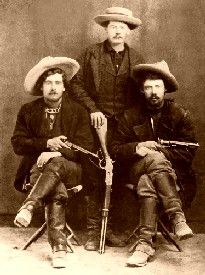
Gunfighters in the 1870s.
Malachi Allen (18??-1889) – Wanted for gunning down two men in July 1888 in the Chickasaw Nation, Indian Territory; Allen was involved in a vicious gunfight with Deputy Marshal McAlester and his posse. Wounded in the arm, he was taken back to Fort Smith, Arkansas, where the arm was amputated shortly before he was hanged on April 19, 1889.
Charles Allison – A lawman turned outlaw, Allison was appointed deputy sheriff of Conjos County, Colorado, but soon organized a band of outlaws. Robbing stages between Colorado and New Mexico, he was captured in 1881 by Sheriff Matt Kyle and sent to prison. He was released in 1890.
Jack “Red Jack” Almer, aka Jack Averill (18??-1883) – Almer was the leader of the Red Jack Gang, who preyed on Arizona stagecoaches during the early 1880s. After robbing a stage near Globe, Arizona, on August 10, 1883, he was pursued and killed in a gunfight.
Wade Alsup – A Texas outlaw, Alsup was lynched by 15 masked men in Blue, Texas, on June 27, 1877.
Juan Alvarid – A vicious Mexican outlaw, Juan was lynched in Socorro, New Mexico, on August 16, 1882, for raping an 8-year-old girl.
Leonard Alverson – A thief and smuggler, Alverson was accused, with two other men, of robbing a post office at Steins Pass, New Mexico, on December 9, 1897. Though he was guilty of other crimes, this one he had not committed. He and the other men were imprisoned, but in 1899, Thomas Black Jack Ketchum confessed to the crime, and the three men were freed.
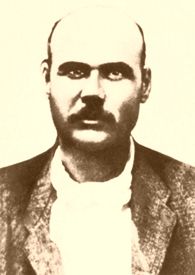
Burton Alvord – Lawman and Outlaw
Burton Alvord (1866-1910) – An Arizona lawman who turned outlaw in the 1890s when he began to drink too much.
Martin Amador – A New Mexico outlaw, Amador was hanged for murder in Deming on January 13, 1908.
Fred Amos – An outlaw and highwayman in California in the late 1860s, Amos was captured and sentenced to ten years in prison for a holdup. One story says that after sentencing, he asked the judge to play a game of seven-up with him, double-or-nothing. Fred lost and got 20 years in San Quentin.
David L. Anderson, aka William “Billy” Wilson, Buffalo Bill (1862-1918) – Most commonly known as “Billy Wilson,” he was a member of Billy the Kid’s Gang of rustlers and later the sheriff of Terrell County, New Mexico.
James “Jim” Anderson – Brother to William “Bloody Bill” Anderson, Jim rode with Quantrill’s Raiders during the Civil War and with the James-Younger Gang afterward.
Hank Andrews – A New Mexico outlaw, Andrews was lynched by vigilantes in February 1884 near Tularosa.
Justin Anjo – A California outlaw, Anjo was lynched for shooting a man to death on July 12, 1877.
Ernest Anthony – Outlaw horse thief Anthony was jailed in Springer, New Mexico, in March 1885, was pardoned, and then captured again twice more, escaping both times. He then changed his name and moved to Wyoming.
Henry Antrim – See William Bonney, aka Billy the Kid
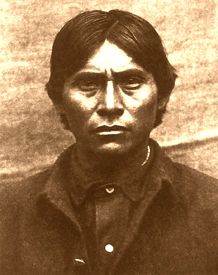
Apache Kid.
Apache Kid (1867-1894?) – Accused of a murder he didn’t commit, the Apache Kid fled and was soon blamed for virtually every unsolved crime in Arizona.
Maximo Apodaca (18??-1885) – An outlaw and murderer, Apodaca was convicted of murdering the Nesmith family in White Sands, New Mexico. Sent to prison, and he committed suicide in prison in 1885.
Bill Applegate – Applegate led a gang of rustlers in New Mexico during the 1870s.
Nicholas Aragon – An outlaw who sometimes rode with Billy the Kid, Aragon was a cattle rustler and murderer. Aragon shot him when Lincoln County Deputy Sheriff Jasper Corn tracked him on October 26, 1884. When he was tracked down once again by Lincoln County Sheriff John Poe and a posse on January 27, 1885, the killer shot down Deputy Sheriff John Hurley. Only after he was shot and wounded did he finally surrender. Convicted of murder, he was sentenced to life in prison.
Doroteo Arango Arámbula, aka Francisco “Pancho” Villa (1877-1923) – Outlaw, cattle rustler, and Mexican revolutionist. Pancho made numerous successful raids along the U.S. border. He was assassinated in Parral, Chihuahua, Mexico, in 1923.
James Arcine (or Arcene) (18??-1885) – Cherokee Indians, Arcine, and William Parchmeal killed a traveler named Henry Feigel as he made his way through Indian Territory in 1872. Thirteen years later, they were arrested, convicted, and hanged at Fort Smith, Arkansas, on June 26, 1885.
Thomas Archer (18??-1886) – The leader of the Archer Brothers Gang, who terrorized Indiana in the mid-1880s, he and three of his brothers were hanged when they were finally caught.
William Arnett (18??-1862) – Arnett showed up in Goldcreek, Montana, on August 21, 1862, along with two other men, C.W. Spillman and B.F. Jermagin. The men had six excellent horses with them but little or no supplies, which seemed odd to the locals. Four days later, on August 25, two men from Elk City, Idaho, also arrived in Goldcreek, saying that they had trailed the three men from the Idaho gold camps, where the horses had been stolen. Arnett was playing in a local saloon when confronted, but, choosing to shoot it out, he was killed. According to legend, he clutched his cards so tightly in one hand that he was buried with them.
David Arguello – Convicted of murdering Colorado peace officer Francisco Garcia on October 19, 1905, Arguello was legally hanged in Raton, New Mexico, on May 25, 1906.
“Arizona Jack” – A gunman and teamster was lynched at Wagon Bed Springs, Kansas Territory, for shooting another teamster to death.
 Jack Armstrong – An outlaw of Las Vegas, New Mexico, who killed a bartender over the price of a drink.
Willis Arrington – A Texas outlaw, Arrington was charged with rustling cattle in 1881.
George Ashby – A horse thief who operated in Texas and Montana, Ashby killed a sheriff near the Powder River in Montana.
Joe Asque (18??-1877?) – When an outlaw cattle rustler was captured near Hillsboro, New Mexico, he was lynched around 1877. However, the outlaw was able to cut himself down from the hangman’s noose and escape.
David Atkins (18??-1964) – An outlaw and member of the Black Jack Ketchum gang, Atkins robbed trains throughout New Mexico, West Texas, and Arizona. He broke with the gang in 1898. Two years later, he was arrested in Montana for a Texas murder and was extradited. Out on bail, he escaped and would not be recaptured until 1911. Convicted of murder, it is incredible that he only received five years in prison. He died in 1964, having spent his last 32 years in a mental institution.
Harris Austin (18??-1890) – A murderer in the Chickasaw Nation of Indian Territory, Austin was captured by U.S. Deputy William Carr and executed at Fort Smith, Arkansas, on January 16, 1890.
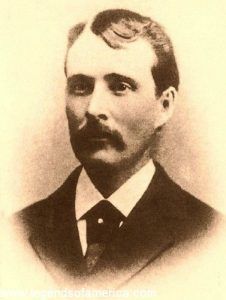
James Averill.
James Averell or (Averill) (1851-1889) – An alleged Wyoming cattle rustler who was not guilty, Averell was hanged, along with “Cattle Kate” Watson, by a cattle baron faction in 1889, just one of the many incidents that led to the Johnson County War.
Genovevo Avila – A Mexican native who was a member of Vicente Silva’s White Caps Gang.
Jesus Avott(a) – Convicted of horse theft in October 1889, Avott was sentenced to a year in the Arizona Territorial Prison in Yuma. He and several others, including the Apache Kid, were to be transported by stagecoach from Globe to Casa Grande before being taken by train to Yuma. However, the stagecoach wouldn’t make it. On the second day of the trip, November 2, 1889, all but two prisoners set out to walk up a steep ascent. However, the walking prisoners overpowered their guard and the driver, killing them both and wounding another. The Apache Kid and the others quickly fled, leaving Avott behind. The young horse thief cut loose one of the team horses and rode to the Riverside stage station near Kelvin, Arizona. After reporting what had happened, Avott was pardoned by Governor Lewis Wolfley and spent no time in prison. Afterward, he disappeared into history.
©Kathy Alexander/Legends of America, updated February 2026.
Jump to: Links to Full Articles
Jump to: Outlaw Summaries (name begins with) A B C D E F G H I J K L M N O P Q R S T U V W X Y Z
Also See:
Outlaw & Scoundrel Photo Galleries
Story of the Outlaw – Study of the Western Desperado
See Sources.