
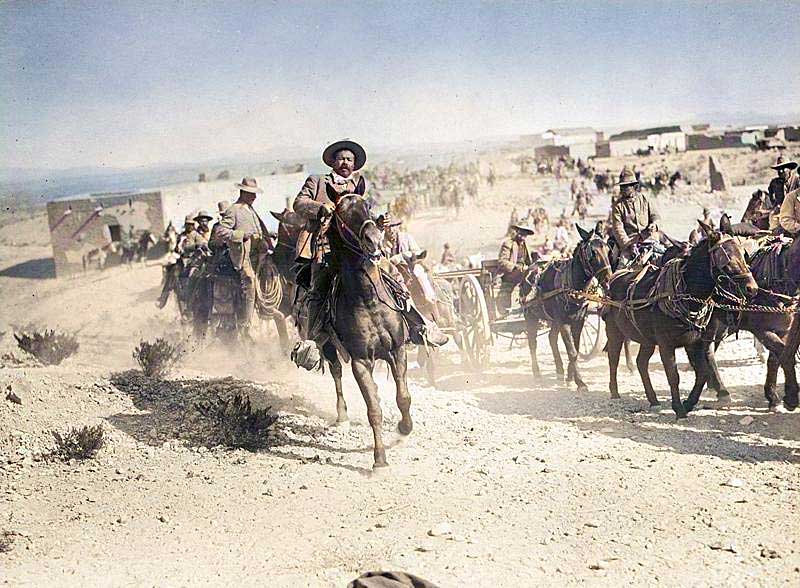
Pancho Villa at Columbus, New Mexico.
By Jesse Wolf Hardin.
The story of Pancho Villa’s inglorious raid on Columbus, New Mexico, on March 9, 1916, has been recounted many times… but usually from a single or biased perspective. The following presents a comprehensive account of the events in dramatic fashion, encompassing the perspectives from both sides of the battle and from both sides of the border. It may be that Pancho was neither wholly a butcher nor wholly a hero, but both a fallible human and an extraordinary person. The least honorable of all may have been the American, Mexican, and German politicians who conspired and plotted for the sake of expedience, power, or profit, at the expense of the ordinary people of both aspiring nations. The raid on Columbus 90 years ago this month marked the last organized Indian raid on U.S. soil, as well as the last invasion by foreign troops, the transition into the technological age, and the end of what, for better or worse, was a uniquely Wild West.
It gets cold at 3:00 a.m. in March, even in the tail end of the New Mexico desert. If there were enough moon to see more clearly, you’d notice a small sleepy town intersected by railroad tracks. The landscape is primarily “tortilla flat…” and with only a few seductive hillocks. Just to the South of town, there stands a five-strand barbed wire fence stretching all the way from one side of the state to the other.
It would be hard enough to see it from the high ground where you sit, even in the middle of the day. The ground on either side of the fence looks the same: white sands speckled with cholla, prickly pear, and golden snake brush. Sticker-laden coyotes chase jackrabbits back and forth beneath the wire, and a desert eagle high in the sky crosses over on its way North. And yet permeable as it may be, its cedar posts and taut strands were erected as a barrier, a border: where one government’s dominion ends and where another country begins.
The town was founded as a border crossing and rail stop on the El Paso & Southwestern Railroad. It was named after Columbus, the very same Italian explorer who, in 1492, first laid eyes on the American continent, mistakenly believing he was in India. The word “Columbus” has since come to be synonymous with discovery, and it was no doubt the hope of the town promoters and developers that an increasing number of folks would “discover” the benefits of moving to such a fine little town.
“Town property in Columbus is one of the best possible investments,” asserted a McClughlan & Dexter Realty ad. “See Columbus before going elsewhere!”
“Elsewhere,” in the first two decades of the 20th Century, is a world apart. While you sit under the stars, surrounded by what appears to be a vast and incorruptible emptiness, greater society is remaking itself faster than ever before. Cultural traditions and technological innovations that once took hundreds of years are now transformed in a single generation. This is the year kids nostalgic for the disappearing frontier got to play with a new toy called “Lincoln Logs,” and when some guy named Albert Einstein published what he called his “Theory of Relativity.” Jazz is hot in New Orleans, back East, Margaret Sanger has been jailed for distributing pamphlets on birth control, and race driver Gil Anderson has just set a new automobile speed record by reaching an amazing 102.6 m.p.h. in a souped-up Stutz. In Europe, Germany is using helium-filled Zeppelins from which to firebomb historic French cities. America’s involvement in World War I is only a year away. General John Taliaferro Thompson has just invented a handheld, fully automatic weapon that will in time be called the “Tommy Gun…” but in out-of-the-way places like Arizona and New Mexico, the Old West lives on.
You’re part of a Southwestern subculture, wherein folks still pack around “Western” arms and are more likely to settle disagreements personally rather than resort to the insular objectivity of the law. In the 1920s, there would still be more horses than cars in the borderlands where you were born, more cowboys than tourists, more deer than registered voters. Outside of trendy Phoenix or Albuquerque, folks still dress much as their grandparents had, in wide-brimmed hats and dusty chaps. They continue to believe in the same standards of hard work and hearty play, of necessity and right. They’ve flourished like cacti in even the harshest environments, unconcerned with modernity and generally seeking no one’s help but their own. Some are resilient “whites,” homesteading land and working on huge lowland ranches. Many are Mexican or Mexican-American, recent immigrants seeking better-paying work. Other Latinos are descendants of families that have lived in the area for centuries.
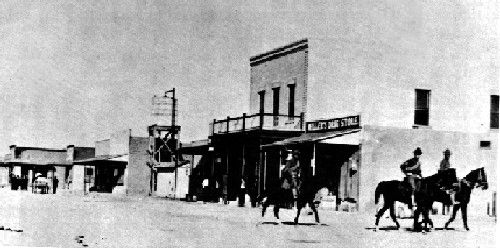
Columbus, New Mexico, in the early 1900s.
If people in this part of the country were anything, it was scarce. Columbus never had more than a few hundred permanent and temporary civilian residents, and most of the 600-man army detachment was likely on leave in El Paso at any given time. Tonight, only a handful of electric lights or oil lamps are burning. The only sign of activity in the army camp is a single small campfire in one of the ditches, around which a few sleepy sentries huddle to stay warm.
It’s then that you see what first appear to be shadows, weaving through the brush below. The whippoorwills are quiet all of a sudden, as you hear what you figure are a bunch of spike-jawed javelinas spooked by the unexpected passage of serape-clad men.
You know immediately who they are, and you’ve had reason to expect them for a while now. For weeks, you’ve been hearing rumors of impending trouble from the Mexican side, and a mere 35 miles away, you had yourself ridden within rifle range of a camp of what could have been 500 or more Villistas: the soldiers of that fabled renegade revolutionary, Pancho Villa! Word is he’s muy pissed off. The U.S. has continued to supply rounds to General Carranza, that other self-serving contender in the ongoing Mexican Revolution, but not to him. And then they really set him off by transporting Carrancista troops on a U.S. rail line. Politicians felt they had to put all their money on one or the other of the contenders, and they’d placed their bet on the probable winner.
More than once, you’d tried to warn the camp commander– “that fool Slocum” as you put it– but he dismissed you with a wave of his hand like you were some wet-behind-the-ears pup! Others had warned him about the recent influx of suspiciously behaving Mexicans that no one had ever seen before. Some Latino patriarchs had even moved their families to other towns in anticipation of what they called the “big trouble.”
Quickly, you slip back to where your horse is saddled and tied, intent on giving the alarm. But you’ve barely started to slip your boot into the stirrup when you hear the first shots being exchanged below. A flurry of rounds follows, mostly random and ineffective. One stray bullet strikes directly above the 6:00 on the wall clock in the Columbus train station, stopping its hands forever and fixing the exact time of the attack at 4:11 a.m. The albazo (surprise attack) is at least temporarily successful. For the first time since the British sacked the White House during the War of 1812, the United States of America has been invaded.
“Pancho was a bandit.
His horse was as fast as polished steel.
He wore his gun outside his pants
for all the honest world to feel.”
-Towns Van Zandt, “Pancho & Lefty”
The last skirmish with Indians in the Southwest is said to have been instigated by a small band of incorrigible Apache, back in 1886… and the battles for the Great Plains were essentially over by 1878 unless one wanted to count that one-sided affair at Wounded Knee in 1890. But for the millions of indigenous and mixed-blood people of what is now known as Mexico, the Indian wars never really ended. With no foreign support, no sustaining treasury, or arms factories, the natives nevertheless continued their fight– first against the Spanish, their colonial financiers, and intruding allies. And then, once United States policies and actions had sufficiently sacrificed their position and wounded their pride, they grabbed their treasured Winchesters and smoothbore cannon and moved against us. Like the Cheyenne in at least one documented skirmish, they were beaten partly because they lingered too long looting the material goods of those they attacked. Indeed, the last time that a force of Indians confronted the U.S. Army was neither Geronimo’s final hurrah nor Wounded Knee… but instead, it was the raid on Columbus in 1916.
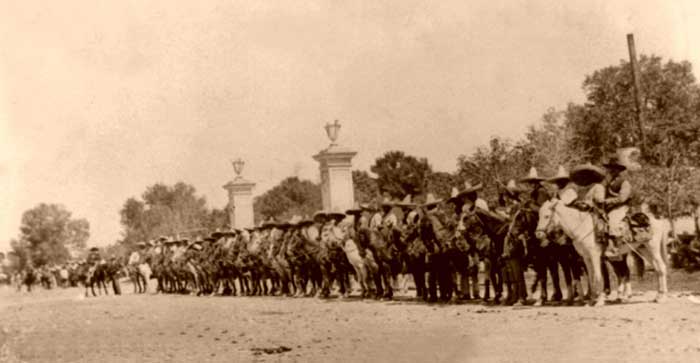
Carranza’s forces ready to charge, 1914.
During the Mexican Revolution, over 80% of the population had a preponderance of native Indian blood. And the raid is, in nearly every way, a Western affair. The raiders wear roughly woven pullovers and vests, with reddened faces and glossy black hair. Feathers and bandannas. Villa’s men arrive on horseback and then retreat the same way, at times turning to fire at their pursuers from the saddle. Their women remain back at camp, wrapped in blankets decorated with symbols that could represent an eagle, a phoenix, or the magical thunderbird born of Earth and sky. At this point, the “modern” army they are attacking has only a few motorized vehicles and still relies heavily on horses and wagons for deployment. The word “cavalry” still indicates an ability to ride and ride well, and most of the soldiers have had prior experience either as horsemen or as working cowboys.
Their boots are made of mule hide just as they were in the days of Custer and Crazy Horse, and the troopers’ skin is darkened and hardened as it always had been, by a relentless Western sun. As with the men facing Sioux and Cheyenne 40 or 50 years earlier, they will stand against a variety of antagonists displaying generally poor marksmanship… but who nonetheless come with the passion needed to propel them towards a distant dream, the courage to take unreasonable risks, the resolve to kill, and the willingness to die for what they believe is “the good fight.” A few of the raiders carry 7mm bolt-action Mausers, either plundered from the centralist forces they’d long been fighting in Mexico or else purchased from the same German agents who sold arms to their enemies.
Most attackers, however, are carrying guns that evoke Western hunts and shootouts with cattle rustlers more than the killing fields of Europe. The majority of their rifles weren’t bolt-actions, but lever guns —mostly Winchester Model 1894s, along with a lesser number of Model 1892s, and even some obsolete 1873s. This led one Official to chide the Winchester company for being the preferred arms manufacturer of Villa’s troublesome bandits. Villa’s personal favorite was the Model 1895 with its distinctive box magazine, a model he said he liked even more than the fabled ’94.
Twice as many people were killed during the long and convoluted Mexican Revolution as died as a result of our own Civil War. In one way, the raid on Columbus was a predictable outgrowth of this internecine conflict, rooted in its original high-minded principles of egalitarianism and peasant rights. Rather than a manic, uninformed terrorist striking back blindly that cold March night, Pancho Villa had a well-defined strategy, shaped by harsh international realities. Among the papers found on a slain Villista after the attack was a letter to his revolutionary cohort and sometime ally in the South, Emiliano Zapata, clearly and intelligently articulating both his reasoning and his goals. He intended to continue the war against the corrupt and “counterrevolutionary” Carranza, despite Carranza having won the United States’ financial and logistical support.
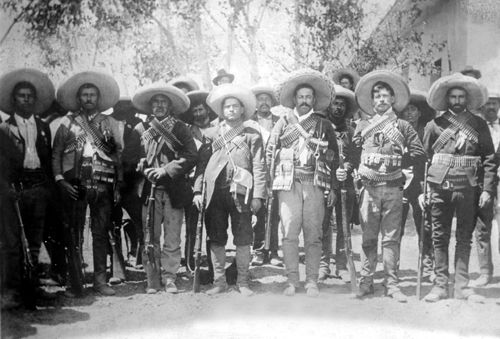
Pancho Villa and staff, Bain News Service.
To accomplish his goals, Villa intended to consolidate control of Chihuahua and then join with Zapata in a grand battle for the state of Sonora. After dragging 42 cannons over the rutted burro trails of the Sierra Madre, they arrived at Agua Prieta to discover that a fresh reinforcement of 5,000 Carrancista troops had been transported ahead of them through U.S. territory, by American rails. It required “an excessive stroke of delicacy and dignity,” Villa writes, “preventing my forces from attacking American territory like they wanted to do with all justification: to punish the ones who made fun of our sacrifices with the right of force.”
Pride and “machismo” are neither archaic nor something new. The U.S. backing of Carranza, wise or not, guaranteed more reprisals against American interests South of the border. And now, with this latest turn of events, they would have no choice but to seek recompense for their humiliation and defeat.
“You’re an honored Mexican patriot… and Indian blood runs in your veins, like ours,” he continues, “I’m sure that you will never permit that our land be sold and will join the defense of our country.”
“We can only do it by the North,” Villa explained, “as we don’t have boots.” Nor– we might point out– trucks, nor planes, nor gas, nor either a floating navy nor a rail line not firmly in the control of the enemy.
A hundred or more years of unequal financial and political relations with various corporations and different Washington administrations had coupled with recent events to lead “all the generals and structures… who are in my leadership, [to] become convinced that the [common] enemy against Mexico is actually the U.S. and that the integrity and independence of our country is about to be lost if [we don’t] join together with weapons in our hands to prevent the sale of our native land.”
He said “sale,” as in a real estate transaction or treaty agreement, not “selling out,” as in compromising or betraying. Mexican property was already being marketed wholesale to foreign interests, and rumors circulated that there were plans to sell a hundred-year lease on the Baja to the United States… to explore what many on both sides believed would prove to be an exploitable oil reserve. Earlier, the U.S. had fanned Mexican paranoia when Marines briefly occupied the oil-sovereign petroleum fields of Veracruz. Already, oil, and even the mere possibility of oil, was fueling not only buses and automobiles but also regional and international conflict.
We might recall how, in the 1700s, the brazen citizens of the American colonies discovered a fresh identity and new reason for pride as heroic underdogs, valiantly opposing the economic and military manipulations of the then much more prosperous and more powerful country of Great Britain. In much the same way, the Mexican identity has been cast and formed under the pressure of thousands of years of domination by the Aztecs, the Mayan kings, and the Spanish conquistadores. And to this day, they largely define themselves in resistance to both the threat of globalization and America’s incomparable economic might.
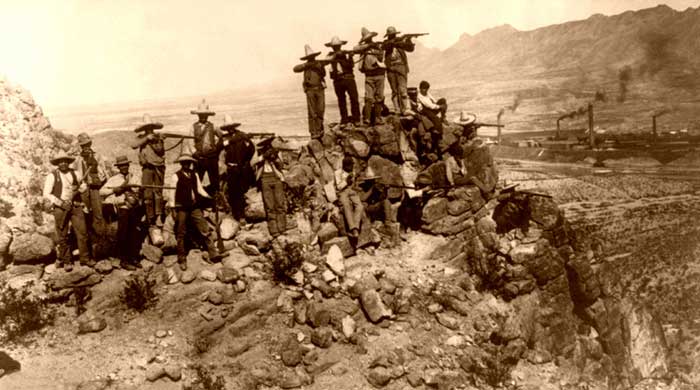
Mexicans aiming rifles from the mountain during the Mexican Revolution, American Press Association, 1911.
Let there be no mistake; Villa was an unapologetic glory-hound and blatant economic opportunist– always as much the “bandito” as the patriot… but his steady stream of volunteers was both inspired and steeled by far more than money. It was only by riding the heated winds of their political idealism and emotional fervor that this desert eagle could have ever risen to power.
Like Jesse James at the close of the Civil War, like those pirates of the 17th and 18th Centuries who handily mixed patriotism and profiteering, Villa is perhaps best described as a ruthless outlaw with vision and ideals. Not that Pancho was what you would call a “Robin Hood,” despite having been dubbed that by American filmmaker John Reed… but then neither were those lusty English brigands and bowmen who first collectively wore that name! Even the most generous or politically inspired robbers have historically kept most of the spoils for themselves, and the only equitable distribution is usually among their loyal men. Be that as it may, Villa and the various original Robin Hoods shared a similar vision of a redistribution of the wealth. And the inequality that precipitated so much anger and bloodletting was much the same in medieval England as in Mexico during Villa’s time, with the vast bulk of the country’s wealth lining the banks and pockets of a tiny fraction of its population.
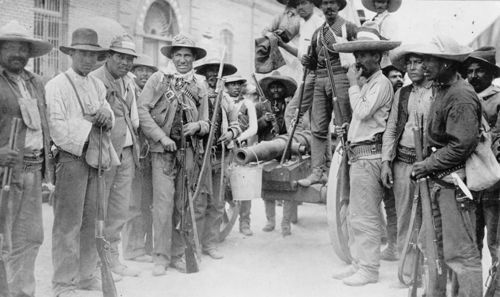
Mexican insurrectos in Juarez, 1911.
To make matters worse, the often-starving English peasants had to witness property and titles being handed out to privileged nobles from other nations and lands. Similarly, Mexican peasants increasingly found themselves paid a pittance to work the ranches of haughty Spanish lords or dying, pick in hand, in underground gold mines owned and operated by gigantic American conglomerates. The green-robed Robin Hoods of antiquity responded not only to a hunger for adventure, riches, or risk… but also to the humiliation of watching empty-bellied as royal hunters harvested the forests’ deer and fowl for the castle’s extravagant feasts. Some of the most “pacified” of Yaqui bean farmers found it unbearable to watch their country’s natural resources being extracted and shipped beyond their borders for the enrichment of people with no connection to their traditional lands. Increasingly, the revolution in Chihuahua was being financed by the extorting and robbing of foreign-born mine owners in Mexico, making a dollar while expressing a particular view.
On both sides, the perceived enemy was often reduced to a one-dimensional, repugnant caricature. Anglos were typecast as the greedy “gringo,” since a high percentage of the few Americans who came to their country seemed to be there to profit and exploit. As a result, they were seen as arrogant and affluent, even though most Americans living just North of the border were as humble, caring, and sometimes as impoverished as they were. From their limited perspective, our country represented not a cornucopia so much as an open maw, poised to render and consume. The odds were impossible beyond belief, and there could be only one outcome in any battle between the potent U.S. army and the vaqueros of sentiment and vice… but Pancho remained undaunted and defiant. He’d survived dozens of battles, always leading his men from the front, always braving the thick of battle. His was the strategy of a true cavalryman: when in doubt, charge!
If “they want to swallow Mexico,” Villa was reported as saying, then “let’s give them something to choke on.”
Back on your perch above town, you watch the night light up with red flashes of rifle fire. As it turns out, some of the watchmen had been knifed, and at least two of the fellows at the campfire were stalked and clubbed before you heard those first ominous shots. The initial half dozen rounds, it turns out, involved an exchange between the guard at Post 3 at the regimental headquarters and some Villistas that he had challenged. Before crumpling and dying, he dropped at least two of them, and then, almost immediately, the firing in town had become general.
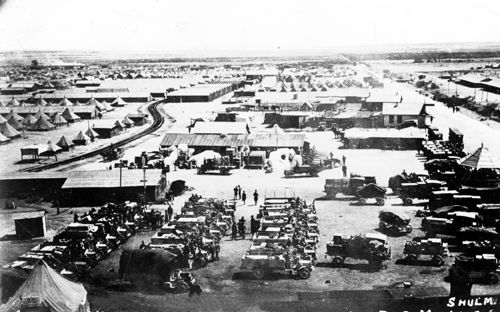
Army camp, Columbus, New Mexico, 1916.
As you find out later, many of the men and most of the officers are out of town on leave, and Colonel Slocum himself had just returned from an event in Deming. Most of the soldiers’ weapons are under lock, and no one seems to have the keys. The majority of the camp buildings are thin clapboard, offering no protection from the incoming bullets… and terrified medics won’t let anyone else into the only safe structure, their adobe-walled hospital. Meanwhile, Mrs. Parks, the wife of the editor of the Columbus Courier, was busy telling the world what was happening there even as the bullets and glass flew… on her town’s proud new telephone switchboard!
One of the first to respond was Lieutenant James P. Castleman. Stepping out of his quarters, he was surprised by a raider who fired at him from only a few feet away, amazingly missing. The Villista wasn’t nearly as lucky, with Castleman killing him with a single round from his pistol.
Rallying about 30 riflemen, they quickly broke into the arms lockers and began moving against the Mexicans, looting what were later determined to have been previously targeted businesses. Their Westward flanking movement diverted the scattered raiders from the military installations and gave them charge of the main thoroughfare. At one point, raiders busted into an army kitchen, only to have boiling water poured on them by one cook, and another killed with a kindling ax. The chefs then grabbed shotguns that were kept for hunting small game near the camp and sent the rest of the group running.
Shopkeeper James T. Dean was shot 17 times while racing to put out the fire spreading to his store, and nearby, Charles Miller was killed trying to protect his little drugstore. Bessie James, several months pregnant, took what was probably a stray bullet through her side, and both she and her unborn child died. The home of the schoolteacher, Mary Field Page, was hit with more rounds than any other structure, putting some 40 or 50 holes in her piano alone. The Mexicans started portions of her house afire repeatedly, and each time her husband, Mr. Page, would run the risk of being shot to take a bucket of water and put the flames out. Residents speculated it may have been that she was believed to dish out stiffer punishments to her Mexican students than their Anglo counterparts. Both she and her husband miraculously survived.
Young Lieutenant John Lucas had always hated his posting, in charge of a machine gun troop in such a “podunk” town… but tonight, he would get some of the excitement he so sorely seemed to miss. Only just returned from an El Paso polo game on the railway’s “drummers and drunkards” special, he was nonetheless one of the few men to rouse and engage in the desperate fight. He set up and fired first near the railroad tracks, and then from a point downtown opposite Castleman that subjected the raiders to a withering fire. One Villista decided to empty a spool of rope by grabbing the end and then walking out into the street with it. The gunners handily shot him down, as well as the three other unfortunates who took turns trying the same stunt. The French-made Benet-Mercié 7mm machine guns repeatedly jammed, but Lucas and his men cleared them each time.
Some reported the raiders set fire to the Commercial Hotel; others said that they torched the Lemon & Romney Store, and then an exploding drum of gasoline on the porch spread flame across the street. Either way, their arson turned out to be not such a great idea, given what great targets the now silhouetted figures made. Each of Lucas’ four full-automatic weapons burned an average of 5,000 rounds in the 1 1/2 hours they were up and in action, and together with Castleman’s riflemen, accounted for nearly all the Villista losses. Colonel Slocum later insisted there were “over 2,000” men in the attacking force, but it is doubtful there were more than 400 Villistas at or near Columbus at that time. Between the initial fight and the immediate pursuit, over 100 raiders were killed and an unknown number wounded… likely half of the Villa forces, not counting those who were held in reserve and never actually saw action that chilling March night.
Following their early victories over the federalist North, one rueful Confederate General remarked that “I fear we have but awakened the sleeping giant.” So indeed had Villa, with this daring if insensible and despicable incursion.
And America would have none of that.
“And all the federales say,
‘We could have had him any day.’
They only let him get away,
out of kindness, I suppose.”
-Townes Van Zandt
Colonel Slocum appeared on the scene at 5:30, after most of the raiders had already been driven from town. Rumors immediately flew that the commander had “lain low,” and it didn’t help that he then took a safe position on a nearby hill to direct fire on the retreating Villistas. By 7:30, the withdrawal was complete, although there were four more separate engagements as Major Tompkins led the pursuit a few miles into Mexico proper. They scattered the rearguard so fast that it wasn’t long before they stood facing both the Columbus survivors and what must have been their posted reserves– possibly 300 soldiers in all. Tompkins withdrew 400 yards, and when the expected counterattack never occurred, he and his troopers returned to headquarters. Another 50 to 100 raiders had been killed, with American soldiers receiving only two minor wounds.
Speculation was rife that Villa and his men might not only be quickly captured but summarily tried in Santa Fe under U.S. laws. In the first week after the raid, newspaper headlines remained naively optimistic, beginning with “Colonel Slocum and the 13th Cavalry to follow bandits until all are taken…” “The President orders the army to get Villa dead or alive.”
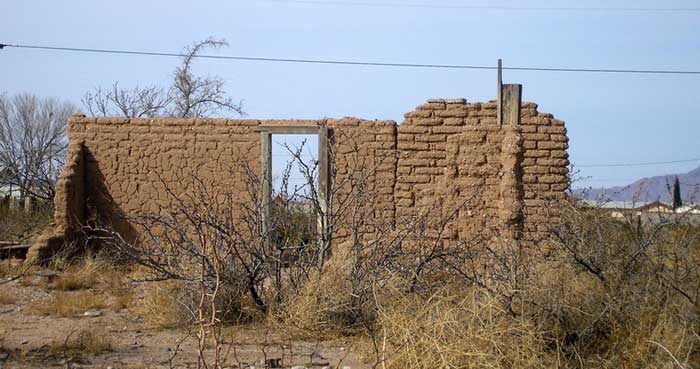
Ruins in Columbus, New Mexico still attest to the long-ago battle, photo by Kathy Alexander.
“Commanders say chance of escape slim.” President Wilson authorized General Pershing to launch a “punitive expedition” over the international border as quickly as he could gather his divisions, whether Carranza and other Mexican authorities liked it or not. Rather than a quick capture and return, Pershing’s army marched and drove around the Sierra Madre for months without a single decisive battle. There were even calls in Congress for turning the search into a full-scale war with Mexico. On March 13, Senator Borah was urging his colleagues to prepare for the possibility, while detailing just how many American boys he thought it would take to pacify and then occupy the entire country successfully.
The Anglo population of Columbus and the surrounding area was generally forgiving and tolerant of the Mexican and Mexican American communities after the raid, not only because of long-standing friendships, relationships, and intermarriage but also because the locals increasingly vented their umbrage at Colonel Slocum instead. General Scott, the Army Chief of Staff, told journalists that the Colonel had had no reason to be on alert, despite recent alarming intelligence reports. The civilians, on the other hand, tended to hold him responsible for failing to heed and react to earlier warnings or to post an early lookout outside of town.
They were especially irate that he apparently hadn’t dared come out of hiding until the battle was well underway, and according to survivor Edward Carson of Columbus, “the fact that his military superiors turned a deaf ear to our demands for punitive action against the Colonel served only to elevate our anger toward Slocum, which appeared to be exceeded only by our hatred of Villa.”
Immediately after the raid, the wire services included a boast by Slocum that if Pancho “comes again, we will give him a worse whipping than we gave him yesterday.” That goes without saying, especially since American soldiers were previously able to repel an attack for which no preparations had been made, with their weapons under lock and key and their commanding officer slow to respond.
The Carranza government released a report claiming that Villa intended to force U.S. intervention by invading Mexico, although it’s hard to imagine any real advantage to that. At around the same time, a Carrancista informant claimed Villa had decided ahead of time that their rallying cry would be “Death to Americans.” Accounts of the Villista battle cry that night contradict each other. Some said that besides the usual “Viva Villa!” they also heard “Muerte a los gringos!” But if inflicting casualties had really been their primary intention, there probably would have been a lot more deaths in Columbus than ten civilians and eight soldiers. Their primary interest was in obtaining horses, small arms, and machine guns from the U.S. Army, which they were more than happy to antagonize and humiliate. More than anything else, they were an army in need of “boots,” and newspapers reported that Villa’s men wasted valuable time trying on stolen footwear. They hoped to go home having avenged the Wilson government’s support for their enemies, the Carrancistas… and having struck yet another symbolic blow against what they deemed mammoth colonial business interests “colonizing” or “meddling” with their beloved country.
As for their treatment of the civilians of Columbus, none of the Hispanic population was bothered, not so much because they shared a common race as because they were all fundamentally impoverished with little or nothing to take. The raiders paid scant attention to residential homes, including those owned by Anglos. Their top target was Sam Ravel, a shrewd businessman and owner of the largest hotel and store. The buildings headline reports were heinously burned to the ground were those adjoining his Commercial Hotel. Legend has it that Ravel may have been the mysterious “Anglo-Saxon” from Columbus whom Villa suspected of “hoodwinking” his men in a shady business deal. It’s said that the man sold ammunition to both Villa’s buyers and Carranza’s right-hand man, General Alvaro Obregon, but that the cartridges delivered to Villa were deliberately underloaded, resulting in Obregon’s recent victory at Celaya.
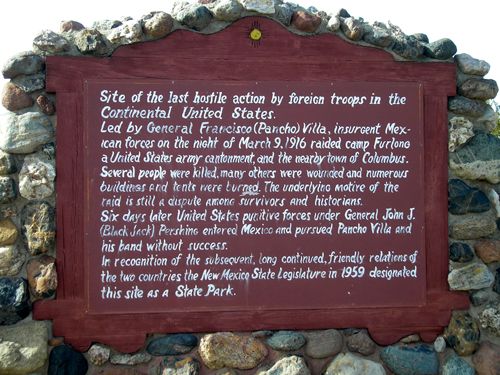
The site of the old military post and battlegrounds is now a New Mexico State Park, photo by Kathy Alexander.
According to local historian Richard Dean, Sam told his son that Pancho was mad and would only accept payments in gold, rather than the previously accepted Villista currency notes. The Ravels may have been scapegoated, with prejudices being what they were in those days, and the Ravels being the only Jewish merchants in town at the time. But whether the accusations and rumors were true or not, their store was sure to be singled out —the most obvious prize for any aspiring land pirate.
Villa was never the worst of villains, nor was he anything approaching a “white knight.” He dealt savagely with his own people and eliminated his enemies at every opportunity… although wars – and revolutions in particular– have invariably necessitated a degree of “animal” brutality and disregard for life. Pancho was unquestionably despotic, but doubtless that was what was required to hold together his ragtag army made up of contentious generals and Indian troops drawn from competing regions and tribes.
For all Villa’s past barbarity, the fact is that no children were hurt, and only one woman was killed in Columbus, and her death was believed to be unintentional. When the retreat got going in earnest, Villista guards released their captive, the negro cowboy Bunk Spencer. Hours earlier, Bunk’s fellow captive– Mrs. Maude Hawk Wright– was told she was free to go by Pancho himself. Held hostage since the killing of her husband 9 days before, she at first didn’t believe the smiling bandit was serious. She made it to a friend’s house, and only one week later, she got her baby back. The revolutionaries first cared for it tenderly, then gave it to a local Mexican family for safe return. Near Santa Isabel, before the Columbus raid, a band of Villa’s men had pulled 15 U.S. citizens off a train and summarily shot them down. However, even then, apparently, Villa had previously warned them not to work for the Cusi Mining Company and to stay away from its properties. Carranza tried to appease Washington by sending a “rescue” column to what they believed was a threatened colony of expatriate American Mormons, only to discover they were fine as yet and had in fact been recently trading with the Villistas. Pancho and his men could be called thieves. Still, they operated in a country ravaged by war, with food production nearly at a standstill, and no jobs for the people except working for the wealthy rancheros or joining one of the competing armies. In this way, they were little different from the “foragers” of the Union and Confederate forces, or the Vikings or Macedonians who came before them: taking what they needed from the resident peoples and their lands to resupply their soldiers and further their aims.
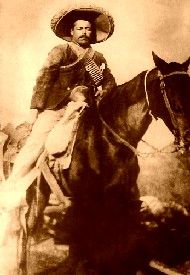
Pancho Villa in the Mexican Revolution.
The raid itself has been referred to as a “cowardly act” by some. But stealth and surprise are internationally respected military strategies. Removing the sentries silently with knives, before they could give an alarm, was as prudent as it was vicious. If anything, the Villistas were markedly courageous, marching with archaic arms and little training against one of the world’s most powerful countries. Courage is a matter of willingness rather than ability or skill. These impassioned peons, in their sugarloaf sombreros, had certainly proven they were willing, if unable.
And the 30 or 40 American soldiers who did the vast majority of the fighting were unquestionably heroes. Without their spirited efforts, the raid could have turned into a true scene of death, destruction, and rapine. They rallied, prevailed, and killed over 100 of the enemy with only eight losses. They accomplished this despite many of the men and officers being on recreational leave, their guns kept under lock and key, and their commander possibly embroiled in internal struggles.
To justify and come to peace with the terrible things one must do in times of war, it is only normal for adversaries to at least temporarily deny the humanity of those who have harmed them. History, psychology, personal and national trauma hardly matter to those who have been shot at, watched their homes being fired at the touch of a torch, or lost their friends or loved ones to untoward and hostile action. To Columbus residents who lived through the terrifying raid, Villa had no credible motivation or redeeming qualities. To Ed Carson, he was a “cattle rustler, horse thief, bank robber, polygamist, bandit and sadistic murderer…” and no more; likewise, to Richard Dean, grandson of the slain James. T., the General was “anything but a hero,” and no New Mexico Park should ever have been allowed to bear his name.
Likewise, for many Mexicans, then and now, Pancho is a symbol of resistance and racial and cultural pride. To them, his personal faults and violent excesses were simply regrettable aspects of a noble and necessary struggle, much as we accept the firebombing of Germany’s historical landmarks or the “collateral” deaths of civilians during what we consider to be essential engagements in Afghanistan, Vietnam, and battle zones to come. A tourist visiting the Pancho Villa museum in Ciudad Chihuahua can still stand, awed, before a large bronze “Centaur Of The North” striking an eternally proud pose atop one of his smartly charging horses.
“Pancho met his match, you know,
in the deserts down in Mexico.
Nobody heard his dying words,
oh, but that’s the way it goes.”
-Towns Van Zandt
Villa’s raid signals the beginning of the unraveling of President Woodrow Wilson’s unrealistically pacifist policies. On a side note, it also hastened the passage of legislation that federalized the National Guard, meaning that what had once been state militias could now be called out by Washington politicians to serve the federal government’s aims. And the press was censored like never before, with war correspondents facing severe repercussions for filing even the most innocuous battlefield reports. To quote Major W. R. Sample, acting commander of the Columbus camp, “The man who gets a scoop is an arch-criminal.”
While the 11-month, $140 million “punitive expedition” pursuing Villa may have been largely ineffective, it served as a training ground for the tools and techniques of a new kind of war… and a new kind of world. Pershing’s 1916 incursion was the last time American soldiers went into battle without helmets, and the first time motorized vehicles were used as the primary means of transport for troop insertion and evacuation, ordnance, and resupply. Companies such as Kelly-Springfield, Dodge, and White manufactured hundreds of 1 1/2-ton trucks and dozens of motor ambulances, and they made the long trip South. Orders were sent not by courier, heliograph, or telegraph but via two-way radio and the rapidly expanding stateside telephone system. The deadly machine-gun spray that cleared the street of fire-lit Villistas was an ominous precursor to the never-before-seen carnage of wartime Europe. Some Rebel yells and Indian whoops would still be heard ringing out from our trench lines in Belgium and France. A country boy like pacifist Alvin York would use a Springfield rifle to take out German machine gun nests and single-handedly round up scores of war-weary Huns. But soon the battlefield would belong to the depersonalized weapons of mass destruction: The yellow fog of poisonous mustard gas blowing back and forth between the lines, killing unmasked soldiers on both sides. Wheezing and clanking tanks blowing up targets too far away for positive recognition, their sweltering crews oblivious to what’s crushed beneath their tracks, the roar of their engines drowning out not only the crunch of men’s bones but the screams of their dying. The JN-3 planes that flew during the Punitive Expedition signaled the militarization of the air, and conflicts would no longer be fought solely on land and at sea. What began with observers firing pistols at one another like cowboy shootists at 5,000 feet evolved quickly enough into bombers obliterating entire neighborhoods below. Truck drivers who used to drive horses and wagons often embarrassed themselves by yelling “Giddy-up!” or “Whoa, Mule, Whoa!”
For all his sins, Villa could take pride in having successfully eluded the combined strength of two armies, Mexican and American. U.S. agents reportedly hired Japanese agents to poison him shortly after the Columbus raid, but failed. He’d escaped execution several times and was finally brought to bay not by force but through appeasement. To get him to leave them alone, the new federalist government awarded him a ranch and a rich bounty in gold, and even agreed to pay the wages of his hand-picked bodyguard! But though he remained uncaught, now he too looked into the mirror and found himself a settled man… not unlike those other gents with money and haciendas that he’d so long fought.
By 1923, things had calmed down considerably in Mexico, with most of the population being less revolutionary than resigned. Indeed, Villa had reason to hope that short memories and lengthy pardons could guarantee him something like a normal life, but it just wasn’t to be. He was driving with his friends and bodyguards on the afternoon of July 23 when several assailants opened fire from their places of ambush. Villa’s Dodge convertible ran over the curb and into a tree, as 16 rounds tore through his abdomen and chest. Even as he drew his last breath, he rested his revolver on the car door for one last act of bravado… dropping one of his assassins, Roman Guerra, with a perfect shot to the heart.
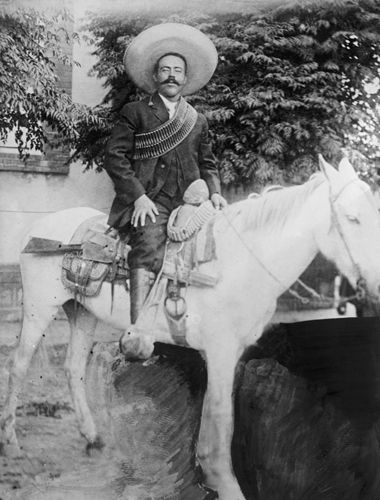
Pancho Villa, early 1900s.
The death of Pancho Villa marked one of the closing chapters of the Western frontier. In many ways, he was a quintessential Western character: self-reliant, self-assured, and confident. True to a cause, whether right or wrong. Relentless and unapologetic. A man capable of good-natured humor as well as unspeakable violence. And a masterful horseman with the bravado we’d expect from a Wild Bunch outlaw or a 1960s John Wayne character. His Dorados (“Golden Ones”) were known to hang informers from the nearest tree in the style of Montana and Arizona vigilantes, and on more than one occasion roped and dragged their victims, cowboy style, behind galloping Spanish horses. When it came his time to perish, he still managed to shoot one of the enemy as he went down.
On May 16, the wounded Pablo Lopez, one of Villa’s top men, stood before a Carranza firing squad. He wrote a deposition right before signaling them to shoot by tossing his crutches to the side: “Yes, sir, Pancho Villa is a man, a real man. I know he has not died. He is peacefully resting in the mountains waiting for the time to come back and act… and all of Mexico will be on his side.”
The raid on Columbus stands as far more than a bold but minor invasion of our country’s hard-won borders, as more than just another example of our citizenry bravely passing the test. March 9, 1916, marks the true end of an era —and the last organized armed conflict of the American West.
©Jesse L. “Wolf” Hardin, 2006, updated September 2026.
About the Author: Pancho Villa Attacks Columbus is adapted from Jesse L. “Wolf” Hardin’s popular book, Old Guns & Whispering Ghosts, which includes several fascinating stories about the colorful characters and firearms of the Wild West, along with dozens of previously unpublished historical photos. Hardin is a lifelong student of Western history and antique firearms, as well as a prolific artist, entertaining Old West presenter, and storyteller. In addition to Old Guns & Whispering Ghosts, he has published other books and numerous articles in over 100 magazines. Hardin, who lives in an isolated canyon in the Gila Mountains of Southwest New Mexico, also tends to a wildlife sanctuary.
Also See:
Columbus, New Mexico, and the Pancho Villa Raid
New Mexico – Land of Enchantment
More by Jesse Wolf Hardin:
Ben Lilly: Bears, Blades & Contradictions
John Wesley Hardin & The Shootist Archetype
El Fego Baca & The “Frisco War”