
By Charles Henry Meyerholz, 1912.
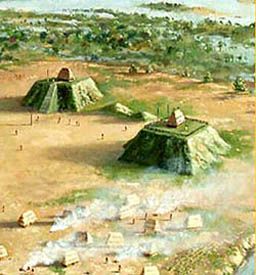
Indian Mound.
[Editor’s Note: **This article, written in 1912, was written before research found that the earliest inhabitants of what is now Iowa were the Clovis people. For more information, see Native American Archaeological Periods.]
**[Some of] The earliest known inhabitants of Iowa were the Mound Builders, who have been shown throughout the years by an abundance of historical evidence. However, crude implements, human skulls, and other human remains have given evidence of a people who inhabited this section of the great Mississippi Valley even before the Mound Builders came. Though little is known about these earlier peoples, many believe they were less advanced than the Mound Builders.
The Mound Builders left material remains from which we have learned much about their civilization and way of life. They are called Mound Builders because, in many parts of the Mississippi and Ohio Valleys, they erected great mounds of earth to mark the burial places of their dead. These mounds, many of which are located on the bluffs along the Mississippi River, were found to contain human skeletons, axes and other stone implements, copper vessels, stone knives, and often stone carvings representing birds and animals. The greatest number of these mounds in Iowa is found along the Mississippi River from Dubuque South as far as Des Moines County, but similar mounds of earth have been found in the Des Moines Valley and as far West as the Little Sioux River. All these remains prove the Mound Builders were a people much superior in civilization and life to the Indians who seem to have come later. It is not known how long these early people resisted the invaders who drove them out.
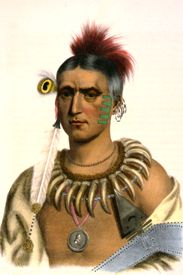
Ma-Has-Kah or White Cloud, an Ioway chief, by Charles King, 1837.
The American Indians were the next inhabitants of Iowa. The Indians who formerly occupied the soil of Iowa were not as warlike as many tribes found in other parts of the United States. If they were cruel and treacherous as enemies, they were also brave warriors and loyal friends to many white people with whom they soon began to trade. The Indians claimed the soil by right of conquest and occupation, and next to the Mound Builders, they are recognized as the second owners of the soil of Iowa. European countries held the theory that lands discovered or found in the possession of uncivilized peoples were subject to seizure and settlement by any Christian nation. These European nations recognized Indians’ rights as occupants but asserted that discovery and settlement by Christian nations gave them the right to extinguish Indian title of occupancy.
European Claims:
Europeans began to explore North America in the 15th Century. In the early 16th Century, France made extensive settlements in the St. Lawrence Valley. It later pushed farther West and established trading posts along the Mississippi and Ohio Rivers. In the spring of 1673, Father Jacques Marquette, a French Jesuit missionary, and Louis Joliet, a French-Canadian fur trader, crossed the Great Lakes and followed the Wisconsin River down to the Mississippi River. They then floated down the Mississippi River and were probably the first white men to see Iowa. They made a landing on soil on June 25, 1673, at the mouth of the Des Moines River. In 1682, Robert de La Salle, a French explorer, descended the Illinois River, then passed down the Mississippi River to the Gulf of Mexico. Based on these two expeditions, France claimed the territory drained by the Ohio and Mississippi Rivers and called it Louisiana after King Louis XIV. Now, France has become another claimant to the soil of Iowa.
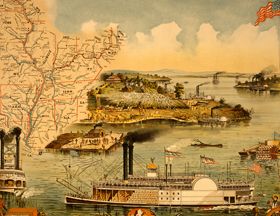
Mississippi River steamboat.
Soon, however, a dispute arose between England and France over the ownership of the territory in the valleys of the St. Lawrence and Ohio Rivers. The trouble increased when English and French inhabitants began settling in the Ohio Valley. War broke out in 1755, and by the Treaty of Paris, which closed the conflict in 1763, France ceded to England all of Canada, except three small islands near Newfoundland, and her possessions East of the Mississippi River, except New Orleans. France then ceded its possessions West of the Mississippi River and New Orleans to Spain. This gave Spain undisputed ownership of Iowa.
With the close of the French Revolution, in about 1799, Napoleon Bonaparte became the leading ruler in Europe. He quickly made new alliance treaties with the leading nations on the continent. By the secret treaty of San Ildefonso on October 1, 1800, Spain ceded the territory West of the Mississippi River to France. So, France again became the owner of the territory, which included what would later become Iowa. But France found a great rival in England and was anxious to destroy its power and reduce its territory. Napoleon feared England would seize Louisiana and annex it to the territory it already owned. At about the same time, the United States was having great difficulty over the navigation of the lower Mississippi River. While Spain still owned the Louisiana Territory and the land on both sides of the mouth of the Mississippi River, Spanish authorities often charged exorbitant duties on goods shipped up the river to towns in the United States. These troubles continued after France received the territory from Spain in 1800. Congress decided to make a new treaty with France and, if possible, purchase the territory on either side of the river mouth. President Thomas Jefferson instructed Robert Livingston, then minister to France, to negotiate a treaty and later sent James Monroe to assist in the negotiations. France negotiated and signed a treaty on April 30, 1803, under which it sold the Louisiana Territory to the United States. By this treaty, Iowa came into the possession of the United States.
Territorial Organization:
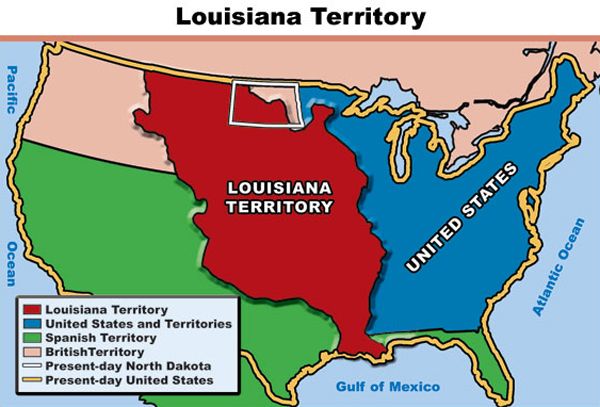
Louisiana Territory.
On October 31, 1803, Congress passed an act placing the Louisiana Territory under the direct control of the President, who was to exercise all military, civil, and judicial power through such officers as he would appoint. On March 26, 1804, Congress passed an act dividing the Louisiana Territory on the thirty-third parallel and called the southern part the Territory of Orleans and the northern part the District of Louisiana. Later, Congress changed the northern portion’s name to the Territory of Louisiana, which included Iowa.
On June 4, 1812, Congress passed an act changing the name of the Territory of Louisiana to the Territory of Missouri and gave it an organized form of government. Iowa existed as a part of the Territory of Missouri until Missouri was admitted as a state on August 10, 1821. Afterward, the Missouri Territory remained without a government until it was included in the Territory of Michigan in 1834. On April 20, 1836, Michigan was reduced to its present size, and the remainder of the territory was organized as Wisconsin. From 1836 until June 12, 1838, Iowa was a part of Wisconsin Territory. Still, it was on that date that Wisconsin was separated from Wisconsin Territory, and all that part of Wisconsin Territory lying West of the Mississippi was organized under the Territory of Iowa.
Iowa Territory was initially bounded on the South by the State of Missouri, on the West by the Missouri and White Earth Rivers, on the North by Canada, and on the East by the Mississippi River and a line due North from the headwaters of that river to the Canadian line. Thus, Iowa Territory included the present State and parts of what would become the states of Minnesota, North Dakota, and South Dakota. Iowa remained a territory until December 28, 1846, when it was admitted into the Union as a State.
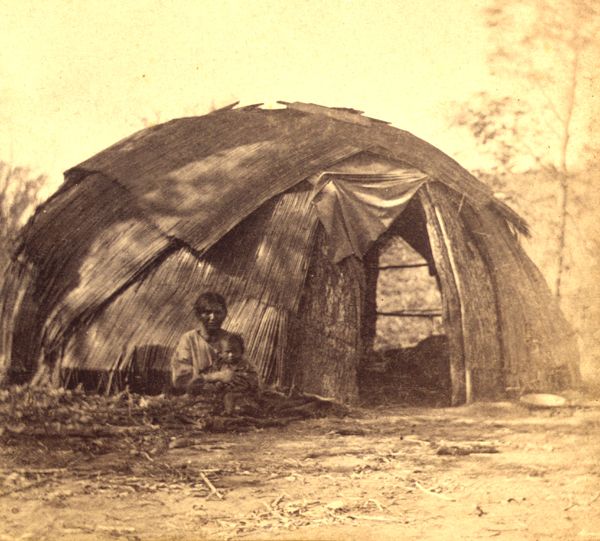
Indian Wigwam.
Early Settlements in Iowa:
When the first white men of Europe explored the lands West of the Mississippi River, they found American Indians living in wigwams clustered in villages along the hillsides and streams. They made their living by hunting and fishing, and by a crude form of agriculture by which they stirred the soil with sharp sticks and raised maize and other grains. Iowa was an ideal land for the Indians. On the hills and in the valleys were deer, and on the prairies were found the buffalo. Wild turkeys, prairie chickens, grouse, and other wild game were to be found on the meadows and in the thickets. Plums, grapes, and other wild fruits were in abundance.
The Indians found predecessors in the Mound Builders, a race of people who differed from them in stature and in their way of life. The numerous great mounds of earth found on the high bluffs along the Mississippi River tell a long story of the life and habits of these interesting people. Their departure was doubtless hastened by the bands of warlike Indians who came into the Mississippi Valley from both the East and the West. Some of the most noted tribes of Iowa Indians were the Sioux, who held the regions in the North of Iowa and Minnesota and penetrated Dakota. The Sac and Fox, who roamed the plains of Iowa, Illinois, and Wisconsin, were members of the Algonquin tribe from the eastern Middle States. The Iowa tribe was in the southern part of the State, and the Dakota came from the Northwest. Many other tribes lived there, including the Winnebago, Potawatomi, Chippewa, Ottawa, and Illinois. Many counties, cities, and towns derived their names from Indian tribes and chiefs.
The transfers of lands from the Indians to the whites were made through numerous treaties with delegates representing the United States and the Indians. The Government paid for the territory, and the amount and other details were put into writing. The Indians were often unable to cope with the white man’s shrewdness and generally were badly cheated. Bright colored blankets, firearms, and whiskey were often purchased for more than their value in lands. The most noted treaty securing Iowa lands from the Indians was in 1830, when the United States bought from the Sac, Sioux, Omaha, Otoe, and Missouri a large portion of the western part of the state by paying a small sum to each tribe. Another large area was secured by the Black Hawk Purchase in 1833, and in 1836, the whites secured more than 400 square miles reserved for the Sac and Fox, comprising Louisa County.
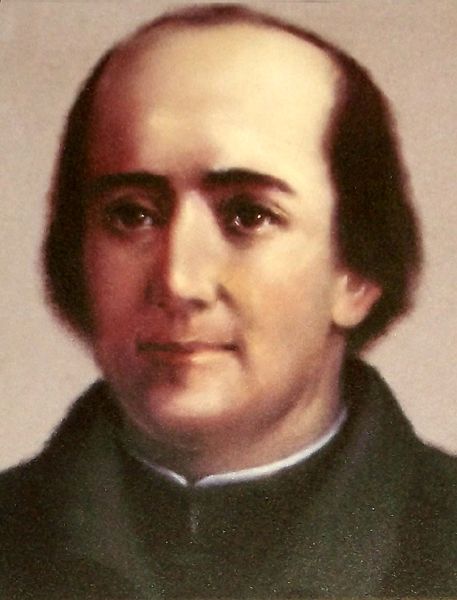
Father Jacques Marquette.
More than a hundred years after Father Jacques Marquette and Joliet first landed on Iowa soil, the first white settlers came to establish homes on the West side of the Mississippi River. The first white man to settle in Iowa and to earn a living from the products of its soil was Julien Dubuque, a Frenchman, who came to what is now the city of Dubuque in 1788. He learned from the Indians what rich deposits of lead were found on the banks of the river, and he obtained from the Indians the sole right to work the lead mines. He took ten French-Canadians with him, and by a treaty signed with the Fox tribe on September 22, 1788, at Prairie du Chien, he acquired the desired lands and immediately began operations. Dubuque built a log house, planted corn and other grains, and soon made his men comfortable in the little village. In March 1810, Dubuque died and was buried on the bluffs near the village. A wooden cross above the grave contained the inscription, “Julien Dubuque, Miner of the mines of Spain.”
In 1795, or seven years after the first settlement in Iowa, another Frenchman, Basil Gaillard, sometimes referred to as Giard, settled a little farther North along the river on the present site of McGregor in Clayton County. He was reported as having known Dubuque, and the two men sometimes traded together. Several years later, after Gaillard’s death, his heirs sold the immense tract of land for the small sum of $300.00.
A third settler on Iowa soil was Louis Honori, who settled near Montrose in Lea County. He obtained a title to his lands from the Lieutenant-Governor of the Louisiana Territory in 1799. In 1839, the United States issued a title to some of this land, and it is said to be the earliest title to any soil in Iowa. A little later came Dr. Muir, a Scotch surgeon in the army, who was, at first, stationed in a frontier fort in Illinois and who later built a house on the present site of the city of Keokuk. Another early settler was Antoine LeClaire, who was among the first to settle at Davenport. A little later came Colonel George Davenport, a trader and army contractor, who settled in Davenport about 1820. After him, the city of Davenport took its name.

Zebulon Pike.
Two expeditions sent out for exploration deserve mention in Iowa’s early history. The first was the Lewis and Clark Expedition, sent out by President Thomas Jefferson, and starting from St. Louis in 1804. The second was led by Lieutenant Zebulon Montgomery Pike, who was sent out by the army from St. Louis a year later. Pike was to explore the Mississippi River to its source and to select suitable places for the erection of forts to secure the newly purchased territory. Lewis and Clark were instructed to follow the Mississippi River to its source and, if possible, explore the country to the Pacific Coast. Like Pike, they were instructed to meet the Indians, explain their mission, and cultivate their friendship by giving them presents. They held a council at a point along the great bluffs on the Missouri River, opposite the present site of Council Bluffs. The same expedition visited other places, including Sioux City, in August 1805.
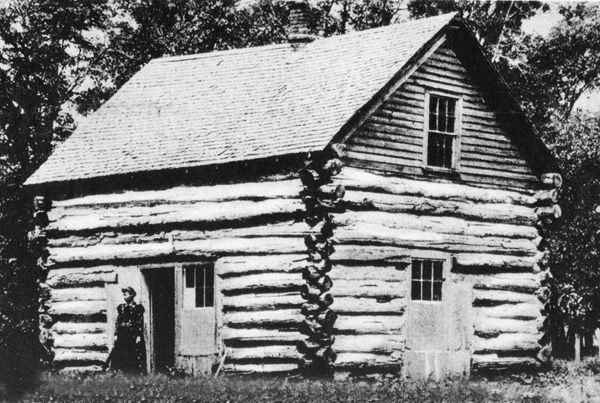
Early Iowa Settler.
Other settlements were later established in the state’s interior along the Des Moines, Iowa, and Cedar Rivers. Many of these earliest settlements were made by fur trading companies, among which were the American, the Green Bay, and the stations controlled by the Chouteaus of St. Louis. Pierre Chouteau, Sr., established a trading post where Ottumwa now stands. In 1838, the agency for the Sac and Fox Indians was located where Agency City now stands, and General Joseph M. Street was placed in charge. Settlements gradually spread north, and in 1843, a fort was built on the site of present-day Des Moines. The fort was at first called Fort Raccoon and was under the command of Captain James Allen; later, the name was changed to Des Moines. Fort Clark was another early settlement, made in 1850, and later became Fort Dodge at the suggestion of General Winfield Scott. Such forts were established across the central and western parts of the territory to protect pioneer settlers as they gradually claimed the soil from the Indians. Most of them continued as forts only long enough to assure a peaceful settlement by the whites.
Territorial Government:
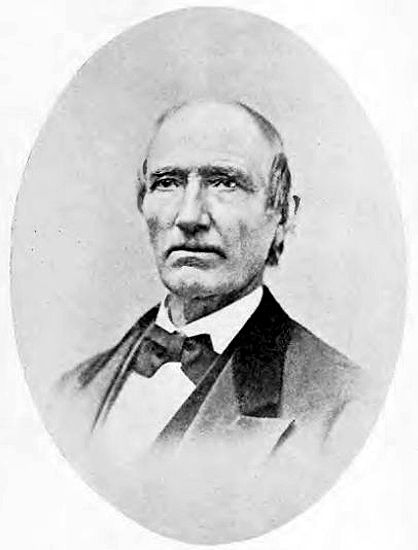
Ansel Briggs, First Iowa Governor
When the colonies won their independence from England with the close of the Revolutionary War, they also won the title to the country lying between their western boundaries and the Mississippi River. Seven states—Massachusetts, Connecticut, New York, Virginia, North Carolina, South Carolina, and Georgia—claimed these western lands as part of their colonial areas. Six of the states had no western lands, and they declared that these lands lying to the West ought to be ceded to the Federal Government and owned by the states in common, as they had all fought for a common cause during the war, and all ought to share equally in the lands taken from England. The states without lands won their demands by refusing to adopt the Articles of Confederation until the other states consented to give up their western land claims.

Mississippi River at Lansing, Iowa by Kathy Alexander.
As early as 1780, it was evident that the Federal Government would eventually become the owner of this great area commonly known as the Northwest. Three years later, Congress began considering the government’s plans for the people rapidly settling in this region. On April 23, 1784, Congress passed an ordinance providing for a temporary government. Still, many people found the provisions of that first Ordinance unsatisfactory, and no settlements were made under it. Congress debated the issue for four more years before taking definite action. Finally, on July 13, 1787, another Act, known as the Northwest Ordinance, was passed by the Congress of the Confederation and provided a territorial government for the territory northwest of the Ohio River.
An act making Iowa a separate territory was passed by Congress on June 12, 1838, which included the present State of Iowa and parts of Minnesota, North Dakota, and South Dakota. Congress reserved the right to divide the territory into two or more territories at its own discretion. The act also vested executive power and authority in a governor, appointed by the President of the United States with the consent of the Senate, who would hold office for three years unless the President removed him sooner. It also provided for other territorial officers.
The boundary line between the Territory of Iowa and the State of Missouri soon became a matter of dispute, and Congress was called upon to settle the question. On June 18, 1838, Congress passed an act creating a commission to determine the proper division line and mark it.
On December 28, 1846, Iowa was admitted to the Union as the 29th state.

First State Capitol in Iowa.
Iowa, as both a territory and a state, has had three capital cities. When Wisconsin was first organized as a separate territory in 1836, the Mississippi River towns fought over the seat of government. A vote of the people finally decided the matter in favor of Madison, which is now the state capital of Wisconsin.
The provisional law accepting the people’s choice provided a temporary capital at Burlington until a suitable building could be provided at Madison. The capital was to remain at Burlington until March 4, 1839. The first territorial Legislature decided to locate the permanent capital farther West and provided for a commission to select a site. The commission finally decided on a site on the banks of the Iowa River in Johnson County, now occupied by Iowa City. On April 3, 1841, Robert Lucas, as governor, issued a proclamation changing the capital from Burlington to Iowa City, where it remained throughout the territorial period. Iowa City remained the capital after it became a state. Still, as settlements extended westward, the feeling grew that the capital ought to be located nearer the center of the state.

The Iowa Capitol in Des Moines, by Carol Highsmith.
Des Moines was then the only town in the central portion of the state of any considerable size, and it was selected as the permanent capital. In November 1857, the capital was moved to Des Moines, and the records, furniture, and equipment of the state offices were drawn across the country on bobsleds and placed in the new building in that city. “The Capitol building was in the midst of heavy woods, with squirrels, quail, and grouse abundant. Along Four Mile Creek, to the East, were wild turkeys, and an occasional elk and deer. There were no sidewalks near the Capitol. Hazel brush was dense. Not far off was a pond containing muskrats. The only bridge across the river was a pontoon structure. The East Side, the side on which the capital then, as well as today, was located, had about 30 houses. Muddy lowlands stretched between the capital and the river. The temporary capital building at Des Moines was a three-story structure and resembled a modern school building rather than a state capitol. The present beautiful Capitol began in 1873 and was finished 12 years later at a cost of more than three million dollars.
By Charles Henry Meyerholz, 1912. Compiled and edited by Kathy Alexander/Legends of America, updated September 2026.
About This Article: The Early History of Iowa was excerpted from the book History and Government of Iowa, by Charles Henry Meyerholz, Educational Publishing Company, 1912. However, the text is not verbatim, as it has been heavily edited and truncated.
Also See:
Alexander MacGregor & The Historic Rivertowns of McGregor and Marquette