
By Ella M. Sexton, Stories of California, The Macmillan Company, New York, 1903.
When the Spanish and English first landed on California’s coast, they found the Indians who dwelt inland almost naked, living like wild animals on roots, seeds, and acorns. The tribes along the seashore, however, were good hunters and fishermen, and the Indians along the Santa Barbara Channel and the nearby islands were tall, fine-looking, and the most intelligent of the race. They had large houses and canoes, and clothed themselves in sealskins.
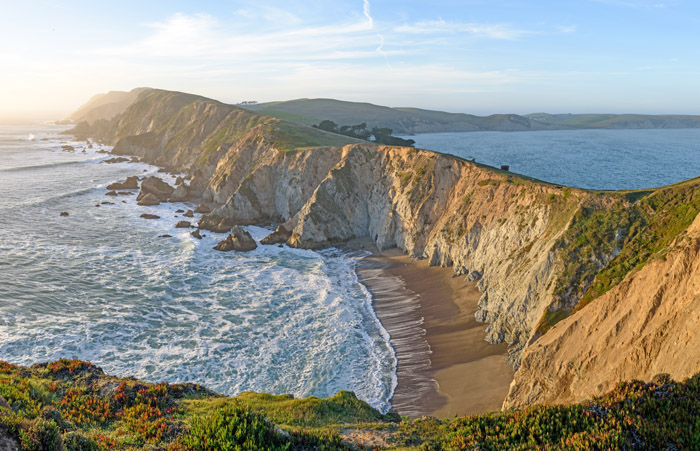
Point Reyes, California, courtesy of Wikipedia.
The Indians that Francis Drake saw near Point Reyes had fur coats, or cloaks, but no other clothes. They brought him presents of shell money or wampum, feather headdresses, and baskets. With their bows and arrows they killed fish or deer or squirrels, and being very strong ran swiftly after game. They seemed gentle and peaceable with the white men and each other, and were sorry when Drake sailed away.
In later years the Indians who lived here when the Mission Padres came were stupid and brutish, because they knew nothing better. They were lazy, dirty, and at first would not work. But the patient Padres taught them to raise grain and fruit, build their fine churches, weave cloth and blankets, and tan leather for shoes, saddles, or harness. Although the Indians learned to be good workmen, they liked idleness, dancing, and feasting much better, and when the Missions were abandoned, the Indians soon returned to their former habits.
No distinct tribes existed among these Indians, and they had no laws. No king or chief ruled many natives. They lived in small villages or rancherias, each having a name and ruled by a captain. Each rancheria had its own place to hunt or fish and had to fight its own battles with other Indian families.
The men hunted and fished, or made bows, stone arrowheads, nets, and traps for game. The women not only gathered grass seeds, acorns, nuts, and berries, but also did all the fieldwork and carried the heavy burdens, usually with a baby strapped in a basket above the load. To prepare food, these women put seeds or acorns in a stone mortar and pounded them into a coarse meal or paste. Sometimes they filled a grass-woven basket with water and threw in hot stones until the water began to boil. Then they put in acorn or seed meal and cooked it into mush. They also mixed this meal, or that from wild oats, into a dough and baked it on hot stones into bread. They ate game or fish raw, or broiled them a little over the campfire coals.
The Indians got many deer, and one way of hunting them was to put a deer’s head and hide over the hunter’s head. The make-believe then crept along in the high grass until it was close enough to the quietly feeding animals to put an arrow through one or more. All the streams were full of fish then, and salmon swarmed in rivers that ran to the ocean. The Indians speared these salmon or shot them with arrows. They also built runways, or fish-weirs, so the fish would crowd into a narrow passage and could be easily scooped out with nets or baskets.
When the Americans came, they called these Indians “Diggers,” because they lived on what they could dig or root out of the ground. They were very fond of grasshoppers and ate them dried or raw, or made them into a soup with acorn or nut-meal. Fat grubworms and the flesh of any animal found dead were a great treat. If a whale or sea-lion washed ashore, the Indians gathered round it for a feast and soon left only the bones.
But they had no idea how to save food, so they fattened when there was plenty and starved when dry years made the acorns or nuts scarce. Having no salt, they did not try to dry or smoke the meat of deer or other wild animals. Nor did they at first lay up nuts and seeds, as even the squirrels or woodpeckers do, for Winter use. But wandering from place to place, they camped in the summer along the rivers, where fish was plenty, and the wild oats gave them grain. In the fall they hunted pine-nuts and berries in the mountains, till snow drove them down into the valleys.
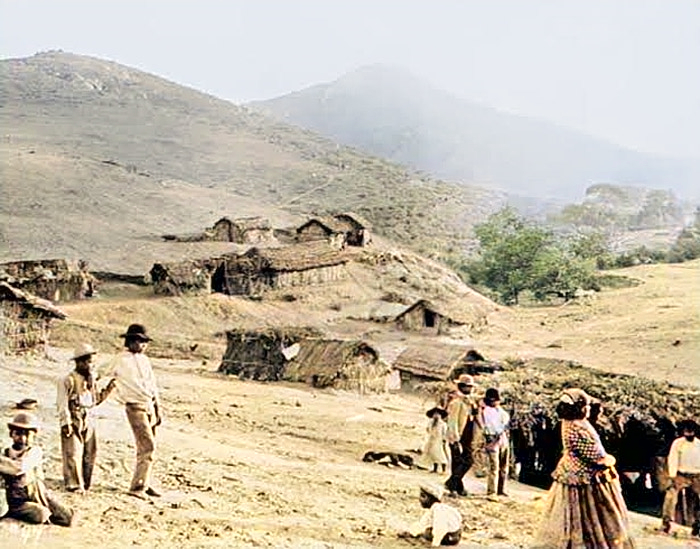
Indian Rancheria.
Each Indian town, or rancheria, had a name, and many of these names are still in use. In the North lived the Klamath, Siskiyou, Shasta, and the savage Modoc, whose months of fighting in the lava beds killed General Canby and many soldiers. The Porno tribes of Lake County, Yreka, Hoopa, and Ukiah are well known today. Tehama, Colusa, Tuolumne, Yosemite, and other places remember the Indians who gave them their names. The San Diego Indians are still known as Diegueños and live on a reserve, or lands set aside for them.
Almost all the natives had Indian money, called wampum, which they made from abalone or clam shells by cutting out round pieces like buttons or small, hollow beads. They also used small shells, and strung the wampum on grass or deer sinew. The Pomos still make thousands of pieces of this money, and so many strings of it will buy whatever the buck, or Indian man, and his mahala, or squaw, wish to get.
General John Bidwell, who came to California in 1841 and surveyed the land for many ranches, said of the Indians at that time:
“They were almost as wild as deer, and wore no clothes at all except the women, who had tule aprons fastened to a belt round their waists. In the rough work of surveying among brush and briars I gave the men shoes, pantaloons, and shirts, which they took off when work was done, carried home in their hands, and put on in time to go to work again. But they soon learned to sleep in their new things to save trouble, and would wear them day and night till a suit dropped to pieces. They were quick to do as the whites did, and when paid in calico and cloth Saturday night, by Monday they had on their new skirts or shirts all made up like ours. Yet every Indian would choose beads for their wages, and go almost naked and hungry till the next pay-day.”
General Bidwell treated the Indians honestly and kindly, and in return they were his friends and helped him greatly. In 1847 he settled on the great Rancho Chico, and part of his land he gave to the Mechoopdas, as the Indian rancheria there was called. They worked to plant orchards and did all his farm work, and he treated them so fairly that old men still live on this ranch who, as boys, helped the general with tree-planting and road-building. A whole village of these Mechoopdas live on the Bidwell place owning their houses, while Mrs. Bidwell is their best friend and helps them in sickness and trouble. The men work in the hop fields and fruit orchards, and the women make baskets.
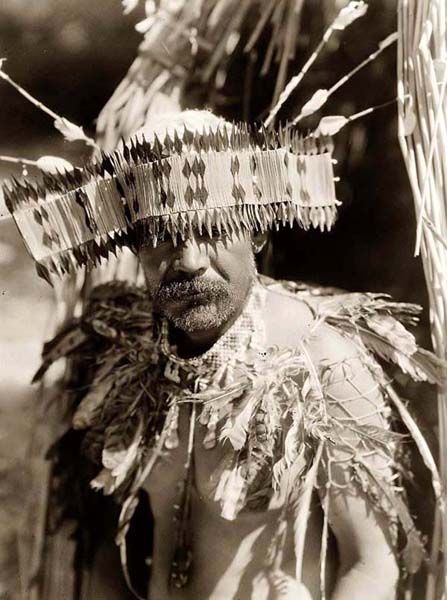
Pomo Indian in headdress.
All the California Indians are basket-makers, and their work is so well done and so beautiful that it is much prized. The Pomos of Lake and Mendocino Counties make especially fine baskets for every purpose. Indeed, the Indian papoose, or baby, is cradled in a basket on his mother’s back; he drinks and eats from cup- or bowl-shaped baskets, and the whole family sleeps under a great wicker tent basket thatched with grass or tules. All Pomo baskets are woven on a frame of willow shoots, and through it the mahala draws tough grasses or fine tree roots dyed in different colors, in the pattern she chooses. Sometimes she works the quail’s crest, small red or yellow feathers from the woodpecker, green from the head of the mallard duck, or beads into the baskets. She also hangs wampum or bits of abalone shell on the finest ones. The storage baskets are four or five feet high to hold grain or acorns, and the baskets to fit the back and carry a load are like half a cone in shape, with straps to hold the burden in place. Their smaller berry baskets hold just a quart. Some are water-tight and are used to cook mush in. They also made fish-traps and long, narrow basket-traps for quail from this willow-work.
On the Bidwell ranch is an old Indian “temescal,” or sweat-house. It is an underground hut, or cave dug out of a hillside, with a hole in the top for smoke to reach the air. The Indians used to build a big fire in this cave and then lie round it till dripping with sweat. A cold plunge into the creek nearby finished the bath—Turkish, we call it. Nowadays the Indians use this place for a meeting-room and for dances.
The older Indians still dance and rig out in all their finery of feathers and beads, though the young people are ashamed of their tribal customs and wish to be like the white folks. Some of their dances are named for a bird or animal, and the Indians must imitate, in their dress and cries, the chosen animal. In the bear dance, the dancer crawls about the fire on all fours with a bear’s skin about him. He wears a chain of oak-balls round his neck, and as he shakes his head, they rattle like a bear’s teeth snapping shut, while he growls the whole time savagely. The feather-dancer, with a skirt and cap of eagles’ feathers, will whirl on his toes like a top for hours, while the other Indians sing and the master of the dance shakes a large rattle.
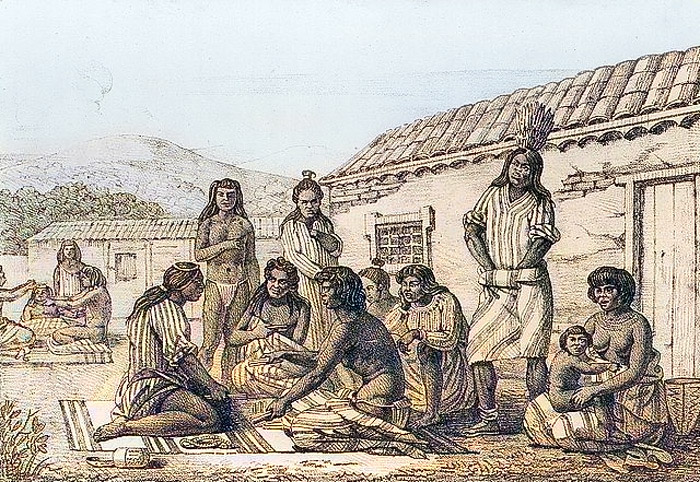
California Indians.
The California Indians are slowly passing away, and though all over the state there are still rancherias, the land that was once their very own will soon know them no more.
By Sexton, Ella M.; Stories of California, The Macmillan Company, New York, 1903. Updated September 25, 2026.
Also See: