
By James Cox, 1903.

Puebloans.
The Puebloans, a unique group of people, inhabit New Mexico, situated between the Rio Grande and Colorado Rivers. When the renowned explorer Francisco Coronado traveled through this region 450 years ago, he discovered the Pueblos living in a relatively advanced state of civilization. They resided in large, solidly constructed houses that could accommodate several families. Despite nearby bands of robbers, the Pueblos defended themselves effectively and lived contentedly and prosperously. Their weapons, though primitive, were scientifically designed and used with considerable skill and bravery.
For two years, they resisted the Spanish invaders in their “casas grandes.” Spanish commanders were informed that several hundred miles to the North lay a great empire called Cibola, said to contain seven large cities. These cities featured long streets inhabited only by gold and silversmiths. Imposing palaces rose in the suburbs, adorned with doors and columns made of pure turquoise, while the windows were crafted from brilliantly polished precious stones. At lavish feasts held by the land’s prince, enchanting servants presented the most delicate dishes on golden plates. Mountains of opal towered above valleys filled with jewels, and crystal-clear streams flowed over beds of pure silver sand.
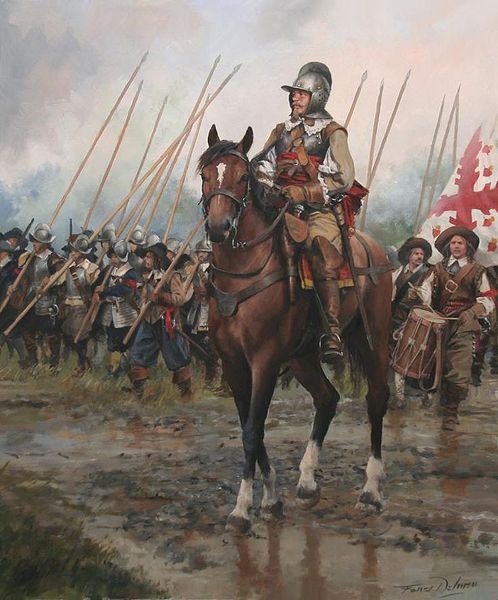
Spanish Conquistadors.
The Spaniards were significantly disappointed. They discovered several large Indian villages, where inhabitants relied on a primitive form of agriculture. The Pueblos’ frugality and thrift intrigued the lavish Spaniards. Additionally, the villages’ unique architecture captivated their admiration. Overall, the house arrangements resembled the cells of a wasp’s nest, with the upper stories accessible only by a crude ladder. They entered through a small opening in the roof rather than through street-facing doors. A few heavily grated windows acted as portholes for arrows. These distinctive baked-clay constructions remain popular in historic towns like Suni, Taos, and others.
Because the Hopi villages and Acoma were situated atop an inaccessible rock, the Spaniards despaired of conquering them. Because the supposed Cibola did not pan out as expected, they did not seek reinforcement and left the Pueblos in peace. Only near the end of the 16th Century Did the Pueblos submit to Spanish rule, under which they remained until 1848, when the territory embracing New Mexico and Arizona was ceded to the United States.
In some respects, the Spanish supremacy proved beneficial to the Indians. They virtually maintained their independence. Many innovations in their life and customs can be traced from this period. The only domestic creatures in their villages were large turkeys, whose feathers served as head ornaments for the warriors. Still, horses, cows, sheep, goats, dogs, and last but not least, the indispensable burros, were added to their domestic stock.
The most important change in their communistic way of life came with the annexation of New Mexico to the United States and the introduction of railroads. Their unfriendly neighbors, the Apache, Comanche, Kiowa, and Navajo, were restricted to their own reservations.
Feeling secure under the government’s strong protection, these peaceful people have started to move away from their traditional communal lifestyle in their unique homes. Until recently, large families lived together in one house, sharing numerous apartments that could only be accessed through a small opening in the roof. Now, more modern cottages are being constructed for individual families. Farming is also being conducted on a larger scale, and in some areas, grape and fruit cultivation is being attempted with positive results.
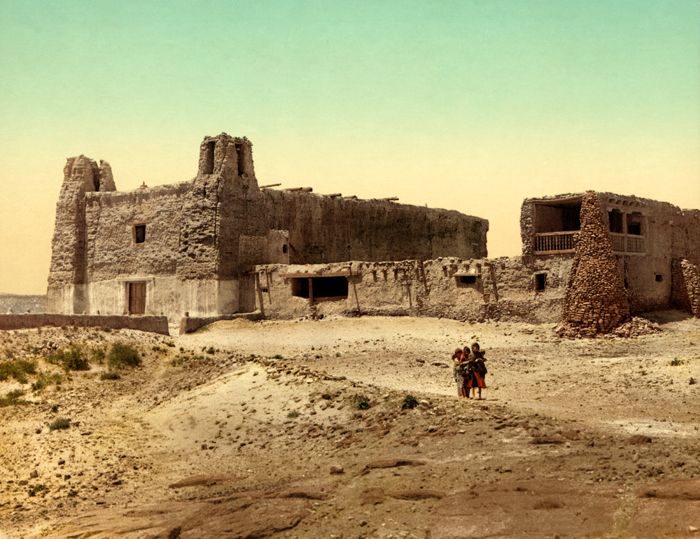
San Estévan del Rey Mission at Acoma Pueblo by Detroit Publishing, 1902.
Each village is characterized by specific industrial monopolies. In one village, for example, pottery is manufactured for all the Pueblos; in others, such as the Hopi villages, everyone is involved in making finely woven goat hair blankets, where many are skilled artisans. While many individuals sell blankets and other Indian goods in the southwestern United States, at the gold diggings in California, in Mormon settlements, and at small railroad stations in Arizona, the average Pueblo Indian prefers a settled lifestyle. He is domestic in his habits and cherishes his family, cattle, farm, and neighbors as much as his white counterparts do. And does he not have good reason to feel joyful and content with his life? Does he not have a devoted and charming wife? Among the Pueblo Indians, especially in the Tigua villages, there are some strikingly beautiful girls. Are not his cheerful children, who are joyfully playing on the large sand hills, obedient and respectful in his presence? The impudent spirit of young America has not yet imposed its negative influence here.
Pueblo women’s houses are very clean. Floors are always carefully swept; along the walls of the spacious rooms, seats and couches are covered with finely variegated rugs; the walls are tastefully decorated with pictures and mirrors, and the large cupboards are filled with luxurious fruits, meats, pastry, and jellies. Thousands of white bread-winners in the large cities would envy these Indians if they could behold their comparative affluence and their obviously contented state. Nor do they obtain all this without fatiguing toil. The land is barren and dry, which compels them to bring in irrigation through long canals from distant streams, and the men never fear work.

Pueblo pottery maker.
Pueblo pottery today is quite similar to that of the 16th Century. In the pottery villages, men primarily handle the work, sitting on broad, shaded platforms as they shape their large vessels in the likeness of human figures and various animal forms. The oddly shaped mouths of these vessels are typically designed to serve as openings for pouring water, soup, or milk.
Women increasingly take on the roles of modern housewives, even as they still use traditional methods such as grinding corn in stone troughs used for hundreds of years and baking bread in thin layers on hot, glowing stones. Dressmakers and tailors remain in demand among the Pueblo people, who pay little attention to Parisian fashion. Pueblo women cut, fit, and sew all the family’s clothing, which was once made primarily of leather. The typical husband’s wardrobe now consists of a few multi-colored shirts, one or two pairs of leather pantaloons with silver buttons, moccasins, and a shoulder blanket.
When worn, the headgear often consists of a large colored handkerchief. Girls typically dress like the daughters of Southern farmers but have not discarded their bloomers. Instead, they wear petticoats that fall just below the knees. These leather pantalettes are essential in a region where poisonous snakes and insects are prevalent in gardens and fields.
To truly appreciate a Pueblo girl at her best, one must catch her in the midst of animated gossip with her friends or in peals of laughter while working. At those moments, her expressive deep black eyes sparkle, and her white teeth provide a striking contrast to her lush black hair, eyes, and eyebrows. The Pueblo Indians deserve commendation for two significant reasons: they embraced moral improvement through the efforts of black-frocked missionaries and school teachers who came from the East, and they are one of the few tribes that resisted the unscrupulous individuals who sought to damage their communities through alcohol and gambling.
Many ancient, large, multi-storied, multi-chambered communal houses are scattered across New Mexico. Three of the most significant of these are Isleta, Laguna, and Acoma. Isleta and Laguna are located near the railroad, with Isleta about ten miles and Laguna approximately 66 miles from Albuquerque. Acoma can be reached from either Laguna or Bubero via a drive of around 12 miles.
Taos, New Mexico Pueblo, by Kathy Alexander
The original inhabitants of these pueblos are an intelligent, complex, industrious, and independent people, distinct among North American natives. They still reside in the same structures that their ancestors occupied, and over three and a half centuries of contact with Europeans have not significantly changed their way of life.
The Indian tribes that once roamed the mountains and plains have become wards of the government, stripped of the dignity they once held, regardless of the reasons attributed to their current situation. In contrast, the Pueblo Indian has maintained the integrity of his individuality and is both self-respecting and self-sufficient. While he adopted the religion practiced by his Spanish conquerors, he did so without abandoning his own beliefs. This is practically the only concession that his steadfast conservatism has made to outside influences.

Ancestral Puebloans, courtesy of the National Park Service.
Significant efforts have been made to understand the reserved inner life of this unique child of the desert. Yet it remains shrouded like a vast, dark continent behind a faintly visible shore, existing at the edge of a shadowy night that reveals nothing about its origins. He is a true pagan, enveloped in thick clouds of superstition, rich in imaginative legends, and deeply dedicated to ceremonial practices in his religion. His deities are countless. Clearly, he embodies paganism, yet the purity and well-being of his communities can be favorably compared to those of the enlightened world.
He is brave, honest, and enterprising within the limited scope of his small community. His wife is virtuous, and his children are well-behaved. Even if the entire world were to be stripped of all living things, except for a few leagues surrounding his tribal home, his life would remain unchanged. He might never even learn of such an insignificant event. He would continue to alternate between labor and festive games, still honor his gods, and raise his children with the values of hard work and contentment. So peculiar is his existence, and so firmly established is his absolute independence.
Pueblo architecture is distinct from the elaborate ornamentation seen in the Aztec ruins of Mexico. The exterior of these houses is quite plain. They can be as tall as seven stories and may contain over 1,000 rooms. In some cases, they are built from adobe, a mixture of mud and straw dried in the sun; in other cases, they are made of stone covered with mud plaster. Access to the homes is typically through a ladder, which is pulled up once inside, indicating that the latch string has been withdrawn.
The pueblo of pueblos is Acoma, a city unlike any other. It is situated on the summit of a table-rock, with steep, eroded sides that rise 350 feet above the plains below, which are 7,000 feet above sea level. According to Queres tradition, Acoma was originally located on the crest of the magnificent Haunted Mesa, three miles away and about 300 feet higher. However, its only access was destroyed one day when a cliff collapsed. Tragically, three women, who happened to be the only residents at the time—while the rest of the population was working in the fields below—perished due to starvation. They died in view of the hundreds of their people who surrounded the unclimbable mesa for many days, looking up with desperate, anguished faces.

Acoma Pueblo, New Mexico by Detroit Photographic Co., about 1900
The current Acoma village was discovered by the Spaniards; however, the original pueblo on the Mesa Encantada was already an ancient tradition at that time. The village measures 1,000 feet in length and stands 40 feet high. It features a remarkably large church. Until recently, access to Acoma was available only via a steep stairway carved into the rock, up which residents carried every material needed to build the village on their backs.
The graveyard took 40 years to build because the soil had to be transported from the plain below. Similarly, the church must have required the labor of many generations, as its walls reach 60 feet and are 10 feet thick, with timbers measuring 40 feet long and 14 inches square.
The Acoma people initially welcomed Coronado’s soldiers with great respect, believing they had celestial origins. However, once they realized that the Spaniards were just ordinary humans, they pledged their allegiance but later killed a dozen of Zaldibar’s men. In retaliation, Zaldibar led 60 soldiers in an attempt to capture the sky-citadel by force. This incident is unique in American history, reminiscent only of Cortez’s famous attack on the great Aztec pyramid.
After a three-day hand-to-hand struggle, the Spaniards stood victors upon that seemingly impregnable fortress. They received the submission of the Queres, who thereafter remained tractable for three-quarters of a century. In that interval, the priests came to Acoma. They held footing for 50 years, until the bloody uprising of 1680 occurred, in which priests, soldiers, and settlers were massacred or driven from the land. Every vestige of their occupation was extirpated. After De Vargas’s resubjection of the natives, the present church was constructed, and the Pueblos have not since rebelled against the white man’s presence.

Catholic Priests.
Numerous Mexican communities in the Territory include members of the Penitentes order, known for their extreme acts of self-flagellation driven by intense religious zeal. Unlike similar practices in India, the Penitentes do not engage in self-torture for extended periods; instead, they observe this ritual only once a year. On this day, the participants, stripped to the waist, chant somber hymns while beating themselves mercilessly on the back with sharp-spined cactus or soapweed, resulting in a gruesome sight. Many of them often collapse from exhaustion due to prolonged suffering and blood loss.
One noteworthy ceremony involves carrying a large, heavy wooden cross over long distances. Devoted participants, sometimes considered martyrs for their faith, carry these immense crosses for miles, drawing excited crowds. The individual who endures the burden of the cross the longest is celebrated as the hero of the day and is appointed as Chief of the Ceremonies for the following year.
Ceremonies like these point to the people’s extreme antiquity and suggest they must have descended from tribes prominent in biblical narrative. According to many historians, people have resided in this part of the world for at least 1,200 years. In other words, when Christopher Columbus and Americus Vespucius discovered and explored the New World, or portions of it, these people had been living on the then-mysterious continent for most of 1,000 years.
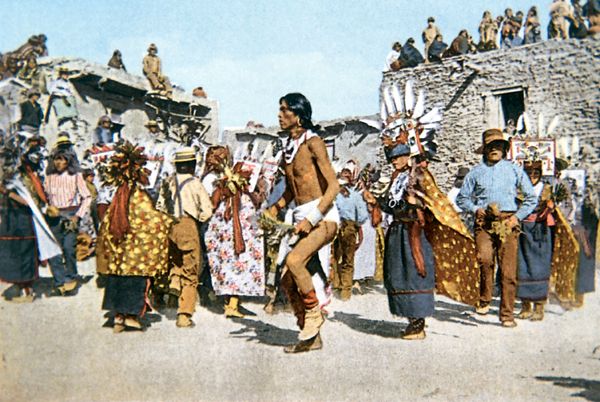
Hopi Ceremony.
Some authorities claim that these people are aboriginal, while others argue that they migrated from a distant land. The ancient history of China is well established, and compelling evidence suggests that the Hopi and Zuni may have descended from Chinese voyagers, or possibly pirates shipwrecked on America’s western shores hundreds of years ago. Another theory proposes that during one of the many expulsions or migrations from China, a group of Mongolians traveled northward and reached America by crossing the Bering Strait.
Some antiquarians believe that Morocco, rather than China, was the original homeland of certain races. Travelers often notice striking similarities between the habits and customs of the Moors and some long-established tribes in New Mexico. Moorish design influences both dress and architecture. For instance, the white toga and the vibrant red turban are significant elements of this resemblance. Additionally, the jugs used for carrying water have a distinct Moorish style, and women carry them on their heads in the characteristic manner that reflects Moorish traditions and customs.

Spanish Explorers.
Spanish explorers provided one of the earliest accounts of the Acoma people. A writer who accompanied one of the first expeditions from Spain described their experience: “We found a large town called Acoma, which had about 5,000 inhabitants and was situated atop a rock about 50 paces high. There was only one entrance, a pair of stairs hewn into the rock, which amazed our men. The leaders of this town came to visit us peacefully, bringing many well-made mantles and chamois skins, as well as a great abundance of food. Their cornfields were located two leagues away, and they fetched water from a small river to irrigate them. Along the riverbanks, we saw beautiful rose bushes similar to those in Castile. The surrounding mountains were rich in minerals. Our men stayed in the area for three days, during which the inhabitants performed a solemn dance for us, dressed in splendid attire and engaging in clever performances that greatly delighted our men.”
Among the ruins found here, the early use of stone for architectural purposes is clearly manifested, and there are innumerable relics of ingenuity from periods we are apt to look upon with great contempt. Arrowheads made of flint, quartz, agate, and jasper can easily be found by the relic hunter. Stone hatchets, sharpenuniquelyner, are also common, and the ancestors of the Pueblos undoubtedly used stone knives hundreds of years ago.
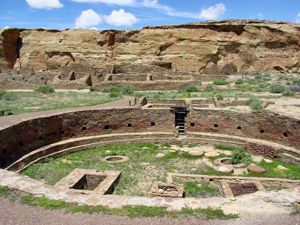
Chaco Canyon National Park. Photo by the National Park Service.
One of the most interesting ancient houses is in Chaco Canyon. This building was probably once 300 feet long, about half as wide, and three stories high. From the nature of the rooms, it is evident that the walls were built in terrace-form out of sandstone. There were about 150 rooms, and judging from the people’s present habits, at least 500 people lived in this mammoth boarding-house. Another very interesting structure of a similar character is found on the Upper Rio Grande River, about two hours’ drive from Santa Fe. It was originally about 300 feet square, and most of the foundations are still in fairly good condition, though much of the exposed stone has yielded by degrees to the friction caused by continual sandstorms. More than 1,000 people are believed to have lived in this one house.
In recent years, there has been much discussion about the potential for significant savings when large numbers of families share a single house. Many of these ideas have been ridiculed, as experience shows that families often struggle to live comfortably in crowded spaces. However, the tribes we are discussing challenge the common criticisms of communal living that emerged in the 19th Century. In their unique homes or colonies, several families coexist in perfect harmony. No recorded disputes occur, unlike those often seen in white-run boarding houses. The Pueblo tribes offer a noteworthy lesson in this regard.
The people are generally calm and peaceable, and one key to their successful communal living is the absence of jealousy. This characteristic seems to be absent among those who inhabit the cliff dwellings. Moreover, living in these communal houses requires great skill and agility to enter and exit, as these structures lack a traditional door from a “civilized” perspective.
Visitors hear many legends about the houses and their inhabitants, with Montezuma’s arrival being a central theme. It is said he left Mexico long ago in a canoe made of serpent skins to civilize the East and end human sacrifice, communicating through intricate knots tied in cords that messengers carried from pueblo to pueblo.
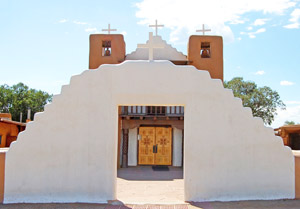
A “new” San Geronimo Mission was built in 1850. Photo by Kathy Alexander.
Among these tales is the Pueblo de Taos, about 20 miles from Embudo, considered a prime example of a Pueblo Indian fortress. It features two five-story communal houses and a nearby ruined Roman Catholic church. Surrounding the fortress are seven circular mounds, which are actually sweating chambers, or Turkish baths. The largest serves as a council room and a mystic hall for secret tribal rites.
The Pueblo Indians delight to adorn themselves in gay colors and form very interesting and picturesque subjects for the artist, especially when set against their quaint surroundings. They are skilled in pottery, basket-making, and beadwork. The grand annual festival of these Indians occurs on September 30, and the ceremonies are peculiarly interesting.
Jesuitism has blended its beliefs with the Montezumas’ superstitions, creating a unique mix of traditions. The mystic rites of the Pueblo Indians, performed at Pueblo de Taos in honor of San Geronimo (St. Jerome) on September 30 each year, attract large crowds and captivate ethnologists, religious leaders, and tourists alike. A brief description can only provide a glimpse of these ceremonies, but it may spark interest in the topic.
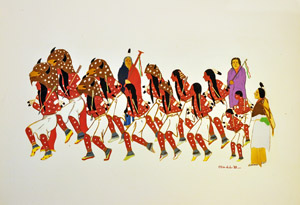
Taos Buffalo Dancers by Vincente Mirabal.
In the early morning of St. Jerome’s Day, a black-robed Indian stands atop the pueblo and recites prayers to the crowd below. In the plaza, a 50-foot-tall pine pole is erected. From a cross-piece at the top of the pole hangs a live sheep, with its legs tied together and its back facing downward. A garland of the valley’s fruits and vegetables, along with a basket of bread and grain, adorns the pole. The bell from the little adobe chapel rings, prompting a few of the Indians to enter for Mass.
A unique service takes place, led by a ruddy Mexican priest serving as the celebrant. Two elderly Mexicans in modern attire, along with a Pueblo Indian wrapped in a red blanket, serve as acolytes. When the host is elevated, an Indian at the entrance beats a menacing drum, and four musket shots are fired. After the service concludes, a procession is formed and marches to the race track, which is 300 yards long.
Fifty runners, who have prepared themselves in the estufas, or underground council chambers, soon emerge. They are all naked except for a breech-clout and are painted in unique designs. Another fifty runners arrive from the opposing pueblo to compete against them. The two groups line up on either side of the course, and a slow, graceful dance ensues.
Suddenly, 300 spirited young Mexicans rush through the crowd on their wild ponies, with the leader swinging a rooster (gallo) by its neck. The races then begin, with two runners from each side sprinting down the track, cheered on by their companions. As soon as they reach the finish line, two other runners take their place, continuing this pattern for two hours until the number of victories claimed by individuals allows one party to declare victory.
Once the race is concluded, the runners line up in two facing lines and, preceded by the drum, begin a slow zigzag march.
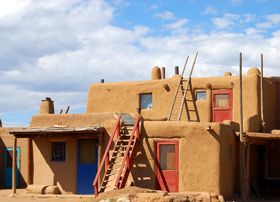
Taos Pueblo Houses by Kathy Alexander.
Excitement runs rampant now. The dancers chant strange songs, break ranks, and compete with one another in their antics and peculiarities. They push through the crowd of spectators, disregarding any consequences. The women, who had previously participated little in the excitement, now step forward and throw cakes and rolls of bread from the pueblo terraces. Everyone rushes headlong after these prizes, causing even greater confusion.
An adjournment is taken for dinner, and in the afternoon, six brightly painted and strikingly decorated clowns come forward to perform a series of antics aimed more at disgust than amusement. The unfortunate sheep, still hanging from the pole, is finally dropped to the ground after several failed attempts to climb it. The clowns grab the fruits and other products, rush off with them, and everyone involved with the tribe appears very satisfied with the day’s events and the spectacle’s conclusion.
Compiled & edited by Kathy Alexander/Legends of America, November 2026.
Also See:
Ancient & Modern Pueblos – Oldest Cities in the U.S.
Ancient Puebloans of the Southwest
Pueblo Indians – Oldest Communities in the United States
Source: Cox, James; My Native Land, Blair Publishing Co., Philadelphia, PA, 1903