
Lawman Summaries (name begins with) A B C D E F G H I J K L M N O P Q R S T U V W X Y Z
“The execution of the laws is more important than the making of them.”
— Thomas Jefferson
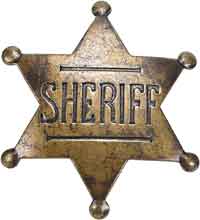
Sheriff Badge
The Old West was often lawless, where outlaws frequently reigned supreme. However, as more and more families, women, and working pioneers headed westward, they demanded law and order. Marshals and sheriffs were in high demand in some of the most lawless settlements, such as Dodge City, Kansas, and Las Vegas, New Mexico, as well as the numerous mining camps that dotted the West, such as Deadwood, South Dakota; Coloma, California; and Leadville, Colorado.
Men initially populated many wild and rowdy places and often attracted seedier elements of society to their saloons, dance halls, gambling parlors, and brothels. But in any burgeoning community, lawful businessmen and hard-working pioneers also craved stability, demanded law and order, and tried to hire peacekeepers. When that was impossible, or the lawmen were ineffective, vigilante groups invariably formed.
Though most Old West lawmen were honorable and heroic, many rode both sides of the fence and appear on both our Lawmen List and our Outlaw List.
Old West Lawmen, produced by Legends of America, music by Scott Buckley
A
Agapito Abeyta – A lawman in Mora County, New Mexico, Abeyta was implicated in the murder of John Doherty.
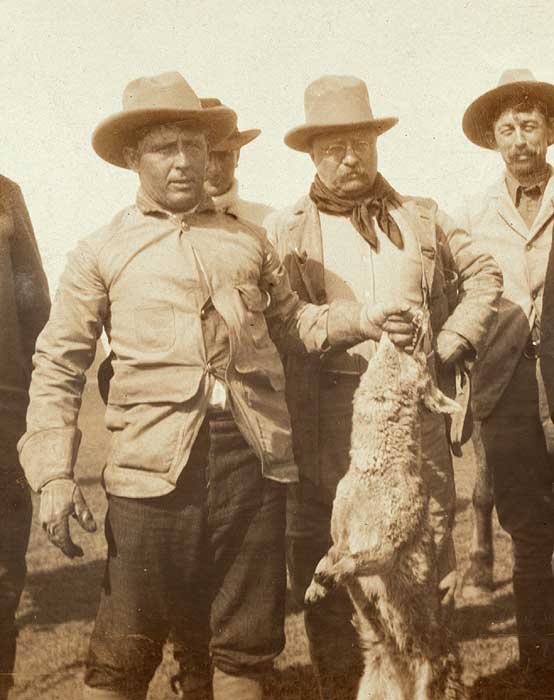
Jack Abernathy holding wolf, standing next to President Theodore Roosevelt.
John R. Abernathy, aka Wolf Catcher, Catch ‘Em Alive Jack (1876–1941), was the last U.S. Deputy Marshal in the Oklahoma Territory, serving from 1906 to 1910. He was also known for catching hundreds of wolves.
David Adams – U.S. Deputy Marshal, Muskogee, Indian Territory.
John Adams – Deputy Sheriff of Oklahoma County, Oklahoma.
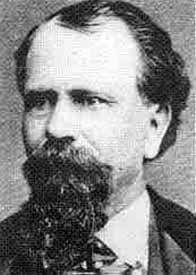
John Hicks Adams.
John Hicks “J.H.” Adams (18??-1878) – Santa Clara County, California Sheriff, and U.S. Deputy Marshal. He was killed in the line of duty with Marshal Cornelius Finley in 1878.
Tom Adams – Special Officer in Carter County, Oklahoma.
W.E. Agee – Deputy Sheriff of Oklahoma County, Oklahoma.
Eugenio Alarid – A lawman and outlaw, Alarid was an officer in Las Vegas, New Mexico, in the 1890s while belonging to Silva’s White Caps gang.
Alfred Y. Allee (1855-1896) – A Texas Ranger, Allee was appointed Deputy Sheriff of Karnes County, Texas, in 1882 and was later made Deputy Sheriff of Frio County, Texas. He shot and killed robber Brack Cornett in 1888. He was stabbed to death in a barroom brawl in Laredo, Texas, in 1896.
Abe Allen – A U.S. Deputy Marshal for the Indian Nations working out of Judge Isaac Parker’s court in the 1880s and 1890s.
John Allen – U.S. Deputy Marshal, working out of Fort Smith, Arkansas.
John Oliver Allen (1850-1928) – A cowboy and Texas Ranger, Allen was wounded four times in Indian skirmishes. Allen was born in Kaufman County, Texas, on June 22, 1850. Raised on the frontier, he became a cowboy as a young man and enlisted in Rufus Perry’s Company D of the Texas Rangers in early 1874. Though he served less than a year in the Rangers, he was wounded four times in Indian skirmishes and would later say that every ranger other than himself had been killed in one battle. After leaving the Texas Rangers, he later settled at Cookville, Texas, and became a chaplain for the Texas Ex-Rangers’ Association. He died in Edinburg, Texas, on June 7, 1928.
Andrew C. Alexander – U.S. Deputy Marshal in Arizona Territory, commissioned on July 1, 1896.
Oscar William Alexander – A lawman in Oklahoma, he was killed near Hoxbar by the Love Brothers in Carter County.
Charles Allison – A lawman turned outlaw, Allison was appointed deputy sheriff of Conejos County, Colorado, but soon organized a band of outlaws. Robbing stages between Colorado and New Mexico, he was captured in 1881 by Sheriff Matt Kyle and sent to prison. He was released in 1890.
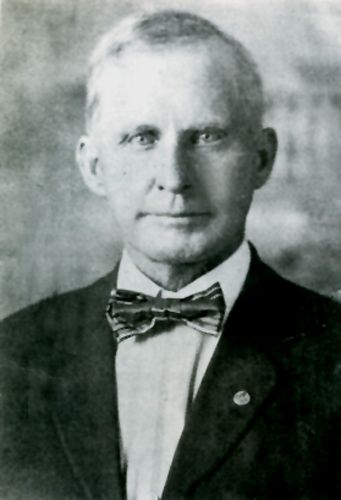
William Davis Allison.
William David “Dave” Allison (1861-1923) – A career lawman, Allison served as a six-time elected sheriff in Midland, Texas; an Arizona Ranger; a Texas Ranger; and various other positions in Texas and New Mexico. Two cattle rustlers killed him in 1923.
Fielding Alston – Texas lawman Alston served as a lieutenant in the Texas Rangers in 1847.
Burton “Burt” Alvord (1866-1910) – A lawman and outlaw who was a deputy sheriff in Cochise County, Arizona, under Sheriff John Slaughter in 1886. Alvord later led a band of train robbers.
Thomas Amos – While serving as sheriff in McCurtain County, Oklahoma, in 1887, he tracked down and killed an Indian man named Pero, for whom he had a “dead or alive” warrant in April 1887. In November, Amos and his brother-in-law, Washington Hudson, were ambushed and killed by two Indians avenging Pero’s death.
Bernard Anderson – Deputy marshal in the New Mexico Territory.
David L. Anderson, aka William “Billy” Wilson, Buffalo Bill (1862-1918)—Most commonly known as Billy Wilson, Anderson was part of Billy the Kid’s Gang of Rustlers. After serving time, he went to Texas, becoming a U.S. customs inspector and the Terrell County Sheriff in 1905. He was killed in the line of duty in 1918.
Frank Anderson – U.S. Deputy Marshal in Indian Territory.
John E. Anderson – U.S. Deputy Marshal in Arizona Territory, commissioned on August 17, 1878.
John P. Anderson – Policeman in Perry, Oklahoma Territory.
Peter Anderson (1845?-1890) – A full-blooded Potawatomi Indian, Peter Anderson was deputized for an Oklahoma County, Oklahoma posse to help officers apprehend a cattle rustler. He was killed in the line of duty.
William H. Anderson (18??-1878) – A U.S. Deputy Marshal in Dallas after the Civil War, Anderson tracked Bill Collins, a wanted train robber, to Pembina in Dakota Territory (North Dakota), where they shot and killed each other in a gunfight.
Robert Andrew – A deputy sheriff in Oklahoma, he arrested Ragged Bill and discovered the Doolin Gang Hideout.
Elias Andrews – U.S. Deputy Marshal in the Creek and Cherokee Nations of Indian Territory.
Captain Micah Andrews – Commanded the Texas Rangers in 1837.
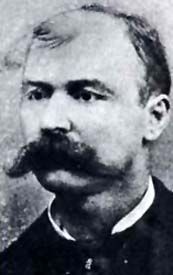
William “Red” Angus.
William “Red” Angus (1849-1922) – Johnson County, Wyoming Sheriff. Involved in the Johnson County War that arose between the owners of large and small ranches in the area.
Orr William Annis (1859-1931) – A cattleman, businessman, and U.S. Deputy Marshal in Indian Territory and Sheriff of Payne County, Oklahoma, from 1897-1901.
Arizona Rangers (1901-1909) – Organized in 1901 to protect the Arizona Territory from outlaws and rustlers. After accomplishing their goals, they were disbanded in 1909.
William Edward Armorer – U.S. Deputy Marshal, working out of Fort Smith, Arkansas, assigned to the Indian Territory.
Charles Armstrong – A Texas lawman, Armstrong served as a Texas Ranger and fought Mexicans on the border during WWI.
Henry Clay Armstrong, Jr. – U.S. Deputy Marshal working out of Fort Smith, Arkansas.
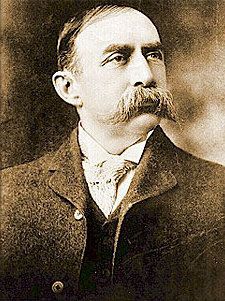
John B. Armstrong.
John Barclay Armstrong (1850-1913) – John B. Armstrong, III was a soldier, rancher, Texas Ranger, and U.S. Deputy Marshal.
William “Bill” Arnold (18??-1898) – William “Bill” Arnold was deputized as a posseman by U.S. Deputy Marshal Hess Bussey on the evening of March 17, 1898, and was killed in the line of duty.
George Washington Arrington, aka John C. Orrick (1844-1923) – Texas Ranger and Wheeler County, Texas Sheriff.
Guadalupe Ascarate – A sheriff in New Mexico Territory; he was eventually replaced by Pat Garrett.
Albert S. Ashby – U.S. Deputy Marshal in Arizona Territory, commissioned on February 23, 1881.
Charles Askins – An American lawman, U.S. Army officer, and writer known for his skills as a gunman and his work in the American Border Patrol. (Read more in this article submitted by Concealment Express)
Edwin Aten – Edwin joined the Texas Rangers after his brother Ira Aten and was assigned to Company D.
Ira Aten (1862–1953) – Ira Aten was a Texas Ranger who was inducted into the Texas Rangers Hall of Fame.
Lee Atkins (1860- 1894) – A newly appointed U.S. Deputy Marshal in Oklahoma, Lee Atkins, a Creek Indian, had not even seen service when Amos McIntosh killed him.
Christopher Columbus Ayers – U.S. Deputy Marshal and jailer, working out of Fort Smith, Arkansas.
Jacob T. Ayers – U.S. Deputy Marshal, based in Fort Smith, Arkansas.
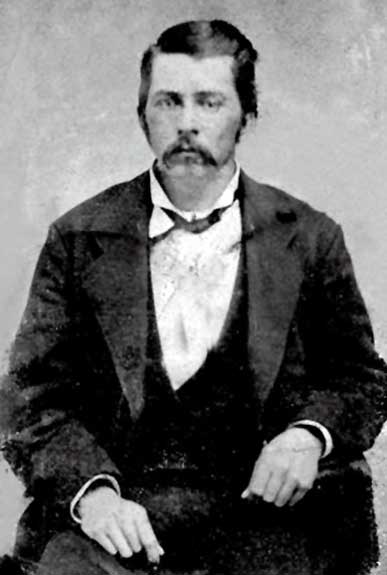
Willard R. Ayers.
Willard R. Ayers (1847-1880) – Willard Rufus Ayers was a U.S. Deputy Marshal based in Fort Smith, Arkansas. He was killed in the line of duty.