
By Emerson Hough in 1905.
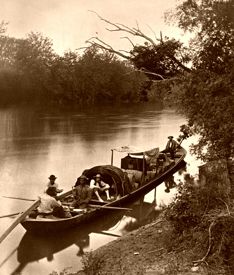
Keelboat, by Jedediah Hotchkiss, 1872.
Before passing to the review of the more modern days of wildlife on the Western frontier, we shall find it interesting to note a period less known but quite as wild and desperate as any of later times. Indeed, we might also say that our own desperados could take lessons from their ancestors of the past generation who lived in the forests of the Mississippi Valley.
Those were the days when the South was breaking over the Appalachians and exploring the middle and lower West. Adventurers were dropping down the old river roads and “traces” across Kentucky, Tennessee, and Mississippi into Louisiana and Texas. The flatboat and keelboat days of the great rivers were at their height, and the population was largely transient, migratory, and bold, perhaps holding a larger percentage of criminals than any Western population could claim.
There were no organized systems of common carriers, no accepted roads, and no highways. The great National Road, from Wheeling west across Ohio, paused midway through Indiana. The wilderness stretched for hundreds of miles in each direction, wherein man had always been obliged to fend for himself.
And, as ever, the wilderness had its own wild deeds. Flatboats were halted and robbed; caravans of travelers were attacked; lonely wayfarers plodding on horseback were waylaid and murdered. In short, the story of that early day shows our first frontiersman, no novice in crime.
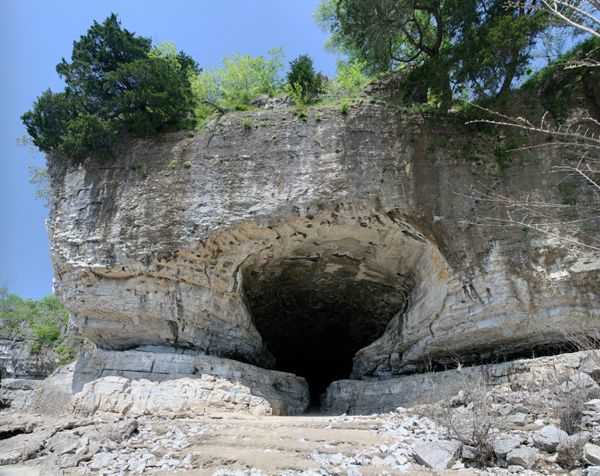
Cave In the Rock, Illinois.
About 20 miles below the mouth of the Wabash River in present-day Illinois, there was a resort of robbers that might belong to the most lurid dime novel list—the famous Cave-in-the-Rock, on the bank of the Ohio River. This cavern was about 25 feet high at its visible opening and extended back into the bluff for 200 feet, with a width of 80 feet. The floor of this natural cavern was fairly flat so that it could be used as a habitation. From this lower cave, a sort of aperture led up to a second one, immediately above it in the bluff wall, and these two natural retreats of wild animals offered attractions to wild men that were not unaccepted.
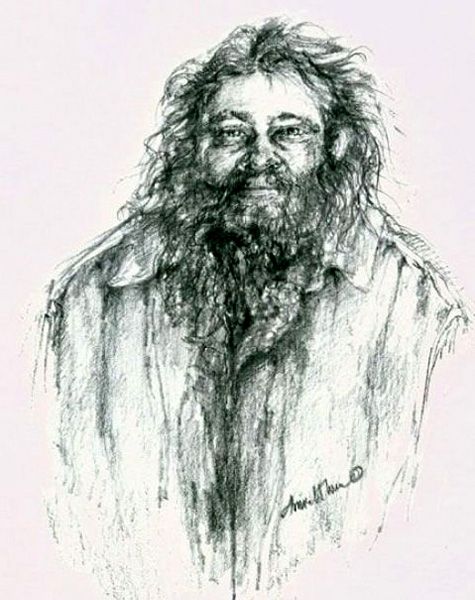
Samuel Mason, an early outlaw.
Here, there dwelt for some time the famous robber Samuel Mason, who terrorized the flatboat trade of the Ohio River around 1800. Mason was a robber king, a giant in stature, and a man of no ordinary brains. He had associated with him his two sons and a few other hard characters, who together made a band sufficiently strong to attack any party of the size usually making up the boat companies of that time or the average family traveling, mounted or on foot, through the forest-covered country of the Ohio Valley. Mason killed and pillaged pretty much as he liked for several years. Still, as travel became too general along the Ohio River, he moved to the wilder country south of that stream. He began operating on the old “Natchez and Nashville Trace,” one of the roadways of the South at that time, when Indian lands were just opening to early settlers. Lower Tennessee and almost all of Mississippi made up his stamping grounds, and his name became a terror there, as it had been along the Ohio River earlier. The governor of the State of Mississippi offered a reward for his capture, dead or alive, but for a long time, he escaped all efforts at apprehension. Treachery did the work, as it usually does, in bringing such bold and dangerous men to book. Two members of his gang proved traitors to their chief. Seizing an opportunity, they crept behind him and drove a tomahawk into his brain. They cut off the head and took it along as proof, but as they were displaying this at the seat of government, the town of Washington, they themselves were recognized and arrested. They were later tried and executed, which ended the Mason Gang, one of the early and once-famous desperado bands.
From the earliest days, coin counterfeiters have been on the border. One of the first and most remarkable was the noted Sturdivant, who lived in lower Illinois, near the Ohio River, in the first quarter of the 1800s. Sturdivant was also something of a robber king, for he could wind his horn and summon 100 armed men to his side. He was ostensibly a steady farmer and lived comfortably, with a good corps of servants and tenants about him, but his ablest assistants did not dwell so close to him. He had an army of confederates throughout the Middle West and the South and issued more counterfeit money than any man before. He always exacted a regular price for his money—$16 for $100 in counterfeit—and such was the looseness of currency matters at that time that he found many willing to take a chance in his trade.
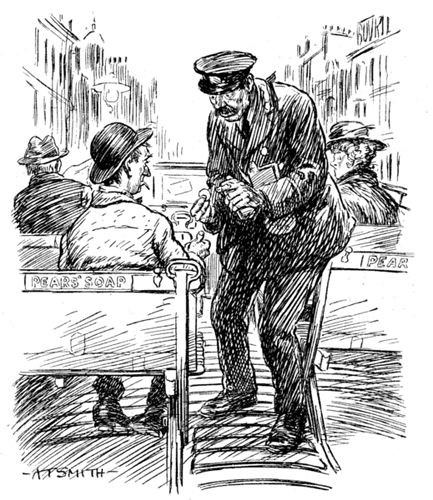
Passing a counterfeit coin
He never allowed any confederate to pass a counterfeit bill in his own state or in any other way to bring himself under the surveillance of local law, and they were all obliged to be especially circumspect in the county where they lived. He was a very smug sort of villain, in the trade strictly for revenue, and he was so careful that he was never caught by the law, even though it was known that his farm was the source of a flood of spurious money. He was finally “regulated” by the citizens, who rose and forced him to leave the country. This was one of the early applications of lynch law in the West. Its results were, as usual, salutary. There was no more counterfeiting in that region.
A very noted desperado of these early days was Big Harpe, as he was called, to distinguish him from his brother and associate, Little Harpe. Big Harpe made a wide region of the Ohio Valley dangerous to travelers. The events connected with his vicious life are thus given by that always interesting old-time chronicler, Henry Howe:
“In the fall of the year 1801 or 1802, a company consisting of two men and three women arrived in Lincoln County, Kentucky, and encamped about a mile from the present town of Stanford. The appearance of the individuals composing this party was wild and rude in the extreme. The one who seemed to be the band’s leader was of above-average stature. His frame was bony and muscular, his chest broad, his limbs gigantic. His clothing was uncouth and shabby, his exterior weather-beaten and dirty, indicating continual exposure to the elements and designating him as one who dwelt far from the habitations of men and mingled not in the courtesies of civilized life. His countenance was bold, ferocious, and exceedingly repulsive from its strongly marked expression of villainy. His face, which was larger than ordinary, exhibited the lines of ungovernable passion, and the complexion announced that the human breast’s ordinary feelings were extinguished in him. Instead of the healthy hue indicating social emotions, there was a livid, unnatural redness resembling dried, lifeless skin. His eye was fearless, steady but also artful, and audacious, glaring upon the beholder with unpleasant fixedness and brilliance, like that of a ravenous animal gloating on its prey. He wore no covering on his head, and the natural protection of thick, coarse hair of a fiery redness, uncombed and matted, gave evidence of long exposure to the rudest visitations of the sunbeam and the tempest. He was armed with a rifle and a broad leather belt, drawn closely around his waist, supported by a knife and a tomahawk. He seemed, in short, an outlaw, destitute of all the nobler sympathies of human nature and prepared at all points of assault or defense. The other man, who led the party, was smaller than him but similarly armed, with the same suspicious exterior and a countenance equally fierce and sinister. The females were coarse and wretchedly attired.
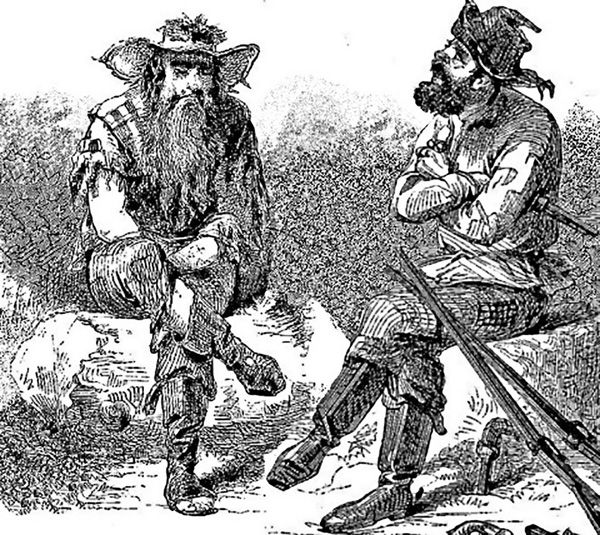
Notorious Harpe Brothers.
“These men stated, in answer to the inquiry of the inhabitants, that their name was Harpe and that they were emigrants from North Carolina. They remained at their encampment for the greater part of two days and a night, spending the time in rioting, drunkenness, and debauchery. When they left, they took the road leading to Green River. The day succeeding their departure, a report reached the neighborhood that a young gentleman of wealth from Virginia named Lankford had been robbed and murdered on what was then called and is still known as the “Wilderness Road,” which runs through the Rockcastle Hills. Suspicion immediately fixed upon the Harpes as the perpetrators, and Captain Ballenger, at the head of a few bold and resolute men, started in pursuit.
“They experienced great difficulty in following their trail, owing to a heavy fall of snow, which obliterated most of their tracks, but finally came upon them while encamped in a bottom on Green River, near the spot where the town of Liberty now stands. At first, they made a show of resistance, but upon being informed that if they did not immediately surrender, they would be shot down, they yielded themselves, prisoners. They were brought back to Stanford and there examined. Among their effects were found some fine linen shirts marked with the initials of Lankford. One had been pierced by a bullet and was stained with blood. They also had a considerable sum of money in gold. It was afterward ascertained that this was the kind of money Lankford had with him. The evidence against them was thus conclusive: they were confined in the Stanford jail but were sent to Danville for trial, where the district court was in session. Here, they broke out of jail and made their escape.
“They were next heard of in Adair County, near Columbia. In passing through the country, they met a small boy, the son of Colonel Trabue, with a pillowcase of meal or flour, an article they probably needed. This boy, it is supposed they robbed and then murdered, as he was never afterward heard of. Many years afterward, human bones answering the size of Colonel Trabue’s son at the time of his disappearance were found in a sinkhole near the place where he was said to have been murdered.
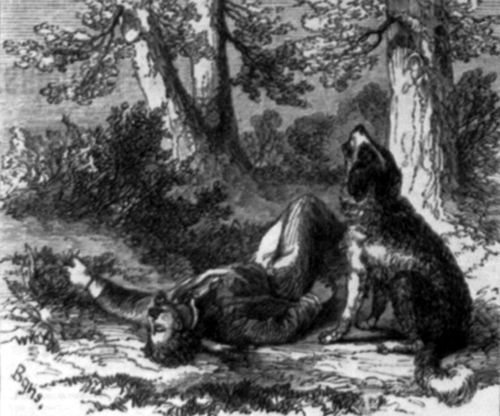
Murdered Man.
“The Harpes still shaped their course toward the mouth of Green River, marking their path by murders and robberies of the most horrible and brutal character. The district of the country through which they passed was very thinly settled at that time, so their outrages went unpunished. They seemed inspired by the deadliest hatred against the whole human race, and such was their implacable misanthropy that they were known to kill where there was no temptation to rob. One of their victims was a little girl, found at some distance from her home, whose tender age and helplessness would have been protected against any but incarnate fiends. The last dreadful act of barbarity, which led to their punishment and expulsion from the country, exceeded in atrocity all the others.
“Assuming the guise of Methodist preachers, they obtained lodgings one night at a solitary house on the road. Mr. Stagall, the master of the house, was absent, but they found his wife and children and a stranger, who had stopped for the night like themselves. Here, they conversed and inquired about the two noted Harpes, who were reported to be prowling about the country.
“When they retired to rest, they managed to secure an ax, which they carried into their chamber. In the dead of night, they crept softly downstairs and assassinated the whole family, together with the stranger, in their sleep, and then set fire to the house and made their escape. When Stagall returned, he found no wife to welcome him, no home to receive him. Distracted with grief and rage, he turned his horse’s head from the smoldering ruins and repaired to the house of Captain John Leeper. Leeper was one of the most powerful men in his day and as fearless as powerful. Collecting four or five well-armed men, they mounted and set out to pursue vengeance. It was agreed that Leeper should attack ‘Big Harpe,’ leaving ‘Little Harpe’ to be disposed of by Stagall. The others were to hold themselves in readiness to assist Leeper and Stagall, as circumstances might require.
“This party found the women belonging to the Harpes, attending to their little camp by the roadside; the men having gone aside into the woods to shoot an unfortunate traveler, of the name of Smith, who had fallen into their hands, and whom the women had begged might not be dispatched before their eyes. It was this halt that enabled the pursuers to overtake them. The women immediately raised the alarm, and the miscreants, mounting their large, fleet, and powerful horses, fled in different directions. Leeper singled out the ‘Big Harpe’ and soon left them far behind, being better mounted than his companions. ‘Little Harpe’ succeeded in escaping from Stagall, and he, with the rest of his companions, turned and followed on the track of Leeper and the ‘Big Harpe.’ After a chase of about nine miles, Leeper came within gunshot of the latter and fired.”
The ball entered his thigh, passed through it, and penetrated his horse, and both fell. Harpe’s gun escaped from his hand and rolled some eight or ten feet down the bank. Reloading his rifle, Leeper ran to where the wounded outlaw lay weltering in his blood and found him with one thigh broken and the other crushed beneath his horse. Leeper rolled the horse away and set Harpe in an easier position. The robber begged that he might not be killed. Leeper told him that he had nothing to fear from him, but that Stagall was coming up and could probably not be restrained. Harpe appeared very much frightened at hearing this and implored Leeper to protect him. In a few moments, Stagall appeared and, without uttering a word, raised his rifle and shot Harpe through the head. They then severed the head from the body and stuck it upon a pole where the road crosses the creek, from which the place was then named and is yet called Harpe’s Head. Thus perished one of the boldest and most noted freebooters ever appearing in America.
Save courage, he was without one redeeming quality, and his death freed the country from a terror that had long paralyzed its boldest spirits.
“The ‘Little Harpe’ afterward joined the band of Samuel Mason and became one of his most valuable assistants in the dreadful trade of robbery and murder. He was one of the two bandits who, tempted by the reward for their leader’s head, murdered him and eventually suffered the penalty of the law as previously related.
Thus, it would seem that the first quarter of the 19th Century on the frontier was not without its own interest. The next decade, or that ending about 1840, offered a still greater instance of outlawry, one of the most famous in American history, although little known today. This had to do with that genius in crime, John A. Murrell, long known as the great Western land pirate, and surely no pirate of the seas was ever more enterprising or more dangerous.
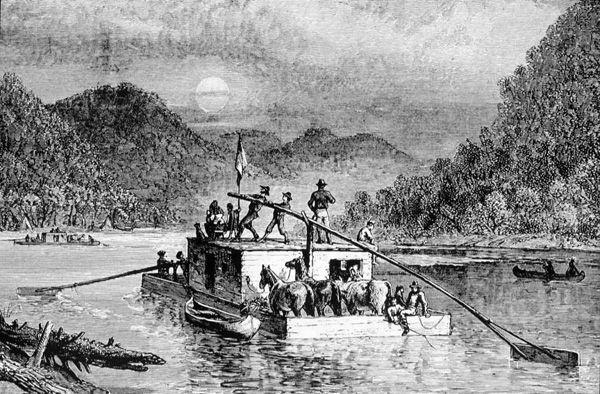
Flatboat on the Ohio River about 1788.
Murrell was another man who would have been called great in a decent walk of life. He had more than ordinary energy and intellect. He was not a mere brute but a shrewd, cunning, scheming man, hesitating at no crime on earth yet animated by a mind so bold that mere personal crime was not enough for him. When it is added that he had a gang of robbers and murderers associated with him who were said to number nearly 2,000 men and who were scattered over the entire South below the Ohio River, it may be seen how bold his plans were. His ability may further be shown in the fact that these men lived among and mingled with their fellows in civil life for years, unknown and unsuspected. Some of them were said to have been of the best families of the land, and even yet, there come to light strange and romantic tales, perhaps not wholly true, of death-bed confessions of men prominent in the South who admitted that once they belonged to Murrell’s gang, but had later repented and reformed. A prominent Kentucky lawyer was one of these. Murrell and his confederates would steal horses and mules, or at least the common class, or division, known as the “strikers,” would do so, although the members of the Grand Council would hardly stoop to so petty a crime. For them was reserved the murdering of travelers or settlers who were supposed to have money and the larger operations of slave stealing.
The theft of slaves, the claiming of the runaway rewards, the later re-stealing and re-selling, and the final killing of the slaves to destroy the evidence are matters that Murrell reduced to a system that has no parallel in the criminal records of the country. But even here, this daring outlaw did not pause. It was not enough to steal a slave here and there and to make a few thousand dollars out of each one. The whole state of organized society was to be overthrown using this same black population. So, at least goes one story of his life. We know of several so-called black insurrections that were planned at one time or another in the South, such as the Turner Insurrection in Virginia, but this Murrell enterprise was the biggest of them all.
The plan was to have the uprising occur across the South on the same day, Christmas 1835. The blacks were to band together and march on the settlements after killing all the whites on the farms where they worked. There, they were to fall under the leadership of Murrell’s lieutenants, who were to show them how to sack the stores, kill the white merchants, and take the white women. The banks of all the Southern towns were to become the property of Murrell and his associates. In short, at one stroke, the entire system of government, which had been established after such hard effort in that fierce wilderness along the old Southern “traces,” was to be wiped out absolutely. The land was indeed to be left without law. The entire fruits of organized society were to belong to a band of outlaws. This was probably the best and boldest instance ever seen of the narrowness of the line dividing society and savagery.
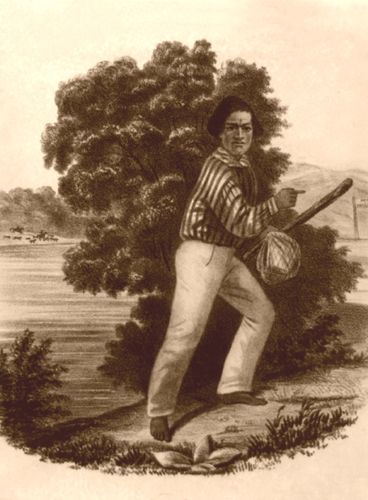
Fugitive Slave.
Murrell was finally brought to book by his supposed confederate, Virgil A. Stewart, the spy, who went under the name of Hues, whose evidence, after many difficulties, no doubt resulted in the breaking up of this, the largest and most dangerous band of outlaws this country ever saw. However, Stewart himself was a vain and ambitious notoriety seeker. Supposing himself safe, Murrell gave Stewart a detailed story of his life. This was later used in evidence against him, and although Stewart’s account needs qualification, it is the best and fullest record obtainable today.*
“I was born in Middle Tennessee,” Murrell personally stated. “My parents did not have much property, but they were intelligent people, and my father was an honest man. I expected and tried to raise myself honestly, but I think no better of him for that. My mother was of pure grit; she taught all her children and me to steal as soon as we could walk and would hide for us whenever she could. At ten years old, I was not a bad hand. The first good haul I made was from a peddler who lodged at my father’s house one night.
“I began to look after larger spoils and ran several fine horses. By the time I was 20, I had begun to acquire considerable character. I had decided to go off and pursue my speculation on a larger scale where I was not known, so I began to see the value of having friends in this business. I made several associates; I had been acquainted with some old hands for a long time, who had given me the names of some royal fellows between Nashville and Tuscaloosa and between Nashville and Savannah in the state of Georgia, and many other places. A fellow named Crenshaw and I gathered four good horses and started for Georgia. We got into the company with a young South Carolinian just before we reached Cumberland Mountain, and Crenshaw soon knew all about his business. He had been to Tennessee to buy a drove of hogs, but when he got there, pork was dearer than he had calculated, and he declined to purchase. We concluded he was a prize. Crenshaw winked at me; I understood his idea. Crenshaw had traveled the road before, but I never had; we had traveled several miles on the mountain when we passed near a great precipice; just before we passed it, Crenshaw asked me for my whip, which had a pound of lead in the butt; I handed it to him, and he rode up by the side of the South Carolinian, and gave him a blow on the side of the head, and tumbled him from his horse; we lit from our horses and fingered his pockets; we got $1,262. Crenshaw said he knew of a place to hide him, gathered him under the arms and I by his feet, conveyed him to a deep crevice in the brow of the precipice, and tumbled him into it; he went out of sight. We then tumbled into his saddle and took his horse with us, which was worth $200. We turned our course for South Alabama and sold our horse for a good price. We frolicked for a week or more and were the highest larks you ever saw. We commenced sporting and gambling and lost every cent of our money.
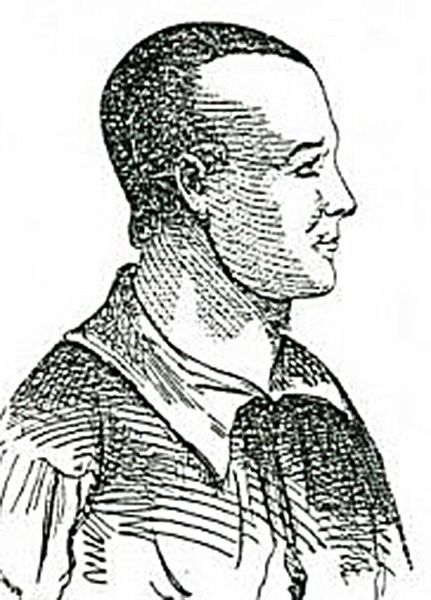
John West Murrell.
“We were forced to resort to our profession for a second raise. We stole a black man and pushed for Mississippi. We had promised him that we would conduct him to a free state if he would let us sell him once as we went on our way; we also agreed to give him part of the money. We sold him for $600, but when we went to start, the man seemed very uneasy and doubted we would come back for him as we had promised. We lay in a creek bottom, not far from the place where we had sold the slave, all the next day, and after dark, we went to the china tree in the lane where we were to meet Tom; he had been waiting for some time. He mounted his horse, and we pushed with him a second time. We rode twenty miles that night to the house of a friendly speculator.
I had seen him in Tennessee and had given him several lifts. He gave me his address so that I might find him when I was passing by. He is quite rich and one of the best kinds of fellows. Our horses were fed as much as they would eat, and two of them were foundered the next morning.
We were detained for a few days, and during that time, our friend went to a little village in the neighborhood and saw the slave advertised, with a description of the two men of whom he had been purchased and with mention of them as suspicious personages. It was rather squally times, but any port in a storm; we took the slave that night to the bank of a creek that runs by the farm of our friend, and Crenshaw shot him through the head. We took out his entrails and sunk him in the creek; our friend furnished us with one fine horse, and we left him our foundered horses. We went through the Choctaw and Chickasaw Nations and then to Williamson County in this state. We should have made a fine trip if we had cared for all we got.
“I had become a considerable libertine, and when I returned home, I spent a few months rioting in all the luxuries of forbidden pleasures with the girls of my acquaintance. My cash supply was soon gone, and I put in for more. I commenced with horses and ran several from the adjoining counties. I had associated with a young man who had professed to be a preacher among the Methodists, and a sharper he was; he was as slick on the tongue as goose-grease. I took my first lessons in divinity from this young preacher. He was highly respected by all who knew him and was well calculated to please; he first put me in the notion of preaching to aid me in my speculations.
“I got into difficulty about a mare that I had taken and was imprisoned for nearly three years. I shifted it from court to court but was at last found guilty and whipped. During my confinement, I read the scriptures and became a good judge of theology. I had not neglected the criminal laws for many years before that time. When they turned me loose, I was prepared for anything; I wanted to kill all but those of my own grit, and I will die by the side of one of them before I will desert.
“My next speculation was in the Choctaw region; my brother and I stole two fine horses and made our way into this country. We got in with an old black man and his wife and three sons to go off with us to Texas, and promised them that if they would work for us one year after we got there, we would let them go free and told them many fine stories. The old man grew suspicious that we were going to sell him and became quite contrary, so we landed one day by the side of an island, and I asked him to go with me around the point of the island to hunt for a good place to catch some fish. After we were hidden from our company, I shot him through the head and then ripped open his belly and threw him into the river. I returned to my company and told them that the black man had fallen into the river and that he never came up after he went under. We landed 50 miles above New Orleans and went into the country and sold our black captives to a Frenchman for $1,900.

John Murrell, Western Land Pirate
“We went from where we sold the blacks to New Orleans and dressed ourselves like young lords. I mixed with the loose characters in the swamp every night. One night, as I was returning to the tavern where I boarded, I was stopped by two armed men who demanded my money. I handed them my pocketbook and observed that I was very happy to meet with them, as we were all in the same profession. One of them observed, ‘D—d if I ever rob a brother chip. We have had our eyes on you and the man that has generally come with you for several nights; we saw so much rigging and glittering jewelry that we concluded you must be some wealthy dandy with a surplus of cash and had determined to rid you of the trouble of some of it; but, if you are a robber, here is your pocketbook, and you must go with us tonight, and we will give you an introduction to several fine fellows of the block, but stop, do you understand this motion?’ I answered it and thanked them for their kindness, and turned with them.
“We went to old Mother Surgick’s and had a real frolic with her girls. That night was the commencement of my greatness in what the world calls villainy. The two fellows who robbed me were named Haines and Phelps; they made me known to all the speculators who visited New Orleans and gave me the name of every fellow who would speculate that lived on the Mississippi River and many of its tributary streams from New Orleans up to all the large Western cities.
“I had become acquainted with a Kentuckian, who boarded at the same tavern I did, and I suspected he had a large sum of money; I felt an inclination to count it for him before I left the city, so I made my notions known to Phelps and my other new comrades and concerted our plan. I was to get him off to the swamp with me on a spree, and when we were returning to our lodgings, my friends were to meet us and rob us both. I had got very intimate with the Kentuckian, and he thought me one of the best fellows in the world. He was very fond of wine, and I had him well fumed with good wine before I made the proposition for a frolic. He readily accepted the invitation when I invited him to walk with me. We cut a few shines with the girls and started for the tavern. We were met by a band of robbers and robbed of all our money. The Kentuckian was so mad that he cursed the whole city and wished it would all be deluged in a flood of water as soon as he left it. I went to my friends the next morning and got my share of the spoil money, and my pocketbook that I had been robbed of. We got $750 of the bold Kentuckian, which was divided among 13 of us.
“I commenced traveling and making all the acquaintances among the speculators that I could. I went from New Orleans to Cincinnati, and from there I visited Lexington, Kentucky. I found a speculator about four miles from Newport, who furnished me with a fine horse the second night after I arrived at his house. I went from Lexington to Richmond, in Virginia, and from there, I visited Charleston, in the State of South Carolina, and from there to Milledgeville by way of Savannah and Augusta, in the State of Georgia. I went from Milledgeville to Williamson County, the old stamping ground. I only robbed eleven men in all the route, but I preached some fine sermons and scattered some counterfeit United States paper among my brethren.
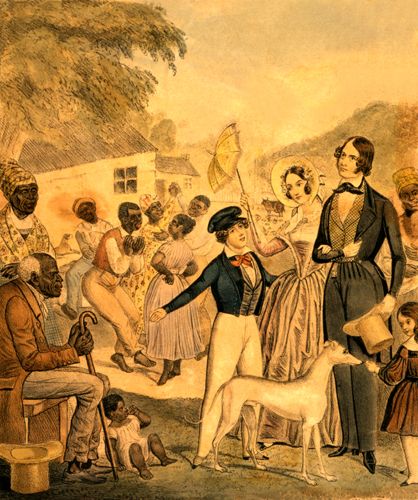
American Slavery, Edward Williams Clay, 1841.
“After I returned home from the first grand circuit I made among my speculators, I remained there briefly, as I could not rest when my mind was not actively engaged in some speculation. I commenced the foundation of this mystic clan on that tour. I suggested the plan of exciting a rebellion among the blacks as the sure road to an inexhaustible fortune to all who would engage in the expedition. The first mystic sign that was used by this clan was used by robbers before I was born. The second originated from me, Phelps, Haines, Cooper, Doris, Bolton, Harris, Doddridge, Celly, Morris, Walton, Depont, and one of my brothers on the second night after my acquaintance with them in New Orleans. We needed a higher order to carry on our designs. We adopted our sign, and called it the sign of the Grand Council of the Mystic Clan, and practiced ourselves to give and receive the new sign to a fraction before we parted; and, in addition to this improvement, we invented and formed a mode of corresponding, by means of ten characters, mixed with other matter, which has been very convenient on many occasions, and especially when any of us get into difficulties. I was encouraged in my new undertaking, and my heart began to beat high with the hope of being able one day to visit the pomp of the Southern and Western people in my vengeance and of seeing their cities and towns one common scene of devastation, smoked walls and fragments.
“I decoyed a black man from his master in Middle Tennessee and sent him to Mill’s Point by a young man, and I waited to see the owner’s movements. He thought his slave had run off. So I started to take possession of my prize. I got another friend at Mill’s Point to take my slave in a skiff and convey him to the mouth of Red River while I took passage on a steamboat. I then went through the country by land and sold the black man for $900, and the second night after I sold him, I stole him again, and my friend ran him to the Irish Bayou in Texas; I followed on after him and sold him in Texas for $500. I then resolved to visit South America and see if there was an opening for speculation there. I had also concluded that I could get some strong friends in that quarter to aid me in my designs relative to a black rebellion, but of all people in the world, the Spaniards are the most treacherous and cowardly; I never want them concerned in any matter with me; I would rather take the blacks in this country to fight than a Spaniard. I stopped in a village, passed as a doctor, and commenced practicing medicine. I could ape the doctor first-rate, having read Ewel and several other works on primitive medicine. I became a great favorite of an old Catholic; he adopted me as his son in the faith and introduced me to all the best families as a young doctor from North America. I had been with the old Catholic but a very short time before I was a great Roman Catholic, and bowed to the cross, and attended regularly to all the ceremonies of that persuasion; and, to tell you the fact, Hues, all the Catholic religion needs to be universally received, is to be correctly represented; but you know I care nothing for religion. I had been with the old Catholic about three months and was getting a heavy practice when an opportunity offered to rob the good man’s secretary of $960 in gold, and I could have gotten as much more in silver if I could have carried it. I was soon on the road home again; I stopped three weeks in New Orleans on my way home and had some great fun with old Mother Surgick’s girls.
“I collected all my associates in New Orleans at one of my friend’s houses in that place, and we sat in council three days before we got all our plans to our notion; we then determined to undertake the rebellion at every hazard, and make as many friends as we could for that purpose. Every man’s business was assigned to him, and I started for Natchez on foot. Having sold my horse in New Orleans, intending to steal another after I started, I walked four days, and no opportunity was offered for me to get a horse. On the fifth day, at about twelve o’clock, I became very tired and stopped at a creek to get some water and rest a little. While I was sitting on a log, looking down the road I had come, a man came in sight riding a good-looking horse. The very moment I saw him, I determined to have his horse if he was in the garb of a traveler. He rode up, and I saw from his equipage that he was a traveler. I arose from my seat, drew an elegant rifle pistol, and ordered him to dismount. He did so, and I took his horse by the bridle, pointed down the creek, and ordered him to walk before me. We went a few hundred yards and stopped. I hitched his horse, then made him undress, all to his shirt and drawers, and ordered him to turn his back to me. He asked me if I was going to shoot him. I ordered him the second time to turn his back to me. He said, ‘If you are determined to kill me, let me have time to pray before I die.’ I told him I had no time to hear him pray. He turned around and dropped to his knees, and I shot him through the back of the head. I ripped open his belly, took out his entrails, and sank him in the creek. I then searched his pockets and found $401.37 and several papers that I did not take the time to examine. I sank the pocketbook, papers, and his hat in the creek. His boots were brand new and fitted me very genteelly, and I put them on and sank my old shoes in the creek to atone for them. I rolled up his clothes and put them into his portmanteau, as they were quite new clothes of the best quality. I mounted as fine a horse as ever. I straddled and directed my course to Natchez in a much better style than I had been for the last five days.
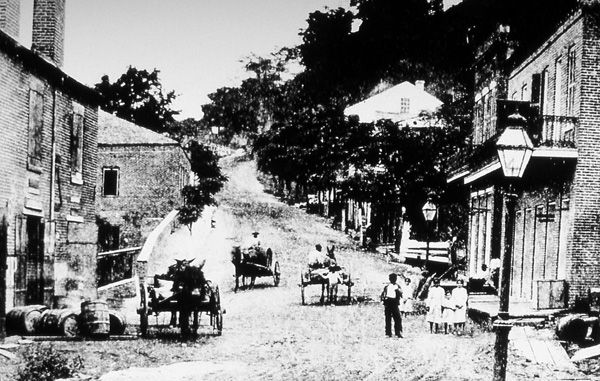
Natchez, Mississippi.
“I reached Natchez and spent two days with my friends at that place and the girls under the Hill together. I then left Natchez for the Choctaw Nation, intending to give some of them a chance for their property. As I was riding between Benton and Rankin, planning for my designs, I was overtaken by a tall and good-looking young man riding an elegant horse, splendidly rigged out. The young gentleman’s apparel was of the gayest that could be had, and his watch chain and other jewelry were of the richest and best. I was anxious to know whether he intended to travel through the Choctaw nation, and soon learned. He said he had been to the lower country with a drove of blacks and was returning home to Kentucky. We rode on and soon got very intimate with strangers and agreed to be company through the Indian nation. We were two fine-looking men, and, to hear us talk, we were very rich. I felt him on the subject of speculation. Still, he cursed the speculators and said he was in a bad condition to fall into the hands of such villains, as he had the cash with him that twenty blacks had sold for, and that he was very happy that he happened to get in company with me through the nation. I concluded he was a noble prize and longed to be counting his cash.
“At length, we came into one of those long stretches in the Nation, where there was no house for twenty miles, on the third day after we had been in company with each other. The country was high, hilly, and broken, and there was no water; just about the time I reached the place where I intended to count my companion’s cash, I became very thirsty and insisted on turning down a deep hollow, or dale, that headed near the road, to hunt for some water. We had followed down the dale for nearly 400 yards when I drew my pistol and shot him through. He fell dead; I commenced hunting for his cash and opened his large pocketbook, which was stuffed very full, and when I began to open it, I thought it was a treasure indeed, but oh! the contents of that book! It was richly filled with copies of love songs, the forms of love letters, and some of his compositions, but no cash. I began to cut off his clothes with my knife and examine them for his money. I found $4.50 in his pockets and no more. And is this the amount for which twenty blacks sold? thought I. I recollected his watch and jewelry and gathered them in; his chain was rich and good, but it swung around an old brass watch. He was a puff for truth, and I thought all such fools ought to die as soon as possible. I took his horse and swapped him for four ponies with a native Indian, and sold them on the way home. I reached home and spent a few weeks among the girls of my acquaintance, in all the enjoyments that money could afford.
“My next trip was through Georgia, South Carolina, North Carolina, Virginia, and Maryland, and then back to South Carolina, and from there, around by Florida and Alabama. I began to track the progress of my operations and to establish my emissaries throughout the country in every direction.
“I have been going ever since from one place to another, directing and managing, but I have others now as good as myself to manage. This fellow, Phelps, that I was telling you of before, he is a noble chap among the blacks, and he wants them all free; he knows how to excite them as well as any person, but he will not do for a robber, as he cannot kill a man unless he has received an injury from him first. He is now in jail at Vicksburg, and I fear he will hang. I went to see him not long since, but he is so strictly watched that nothing can be done. He has been in the habit of stopping men on the highway, robbing them, and letting them go on, but that will never do for a robber; after I rob a man, he will never give evidence against me, and there is but one safe plan in the business, and that is to kill—if I could not afford to kill a man, I would not rob.
“The great object that we have in contemplation is to excite a rebellion among the blacks throughout the slave-holding states. We plan to have it commence at the same hour everywhere. We have set December 25, 1835, as the time to commence our operations. We design our companies to be stationed all over the country, in the vicinity of the banks and large cities, so that when the blacks commence their carnage and slaughter, we will have detachments to fire the towns and rob the banks while all is confusion and dismay. The rebellion is taking place everywhere at the same time; every part of the country will be engaged in its own defense, and one part of the country can afford no relief to another until the blacks entirely overrun many places and our pockets are replenished from the banks and the desks of rich merchants’ houses.
It is true that in many places in the slave states, the black population is not strong and would be easily overpowered, but, back them with a few resolute leaders from our clan, they will murder thousands and huddle the remainder into large bodies of stationary defense for their own preservation; and then, in many other places, the black population is much the strongest, and under a leader would overrun the country before any steps could be taken to suppress them.
“We do not go to every black we see and tell him that the blacks intend to rebel on the night of December 25, 1835. We find the most vicious and wickedly disposed on large farms and poison their minds by telling them how they are mistreated. When we are convinced that we have found a blood-thirsty devil, we swear him to secrecy and disclose to him the secret, and convince him that every other state and section of the country where there are any blacks intend to rebel and slay all the whites, they can on the night of December 25th, 1835, and assure him that there are thousands of white men engaged in trying to free them, who will die by their sides in battle. We have a long ceremony for the oath, which is administered in the presence of a terrific picture painted for that purpose, representing the monster who is to deal with him should he prove unfaithful in the engagements he has entered into. This picture is highly calculated to make a black true to his trust, for he is disposed to be superstitious at best.
“Our black emissaries have the promise of a share in the spoils we may gain, and we promise to conduct them to Texas should we be defeated, where they will be free, but we never talk of being defeated. We always talk to them about victory and wealth. There is no danger in any man if you can ever get him once implicated or engaged in a matter. That is the way we employ our strikers in all things; we have them implicated before we trust them out of our sight.
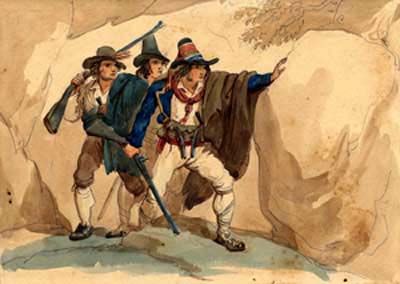
Banditti.
“This may seem too bold, but that is what I glory in. All the crimes I have ever committed have been the most daring, and I have succeeded in every attempt. I am confident that I will be victorious in this matter, as in the robberies which I have in contemplation. I will have the pleasure and honor of seeing and knowing that by my management, I have glutted the earth with more human gore and destroyed more property than any other robber who has ever lived in America or the known world. I look at the American people as my common enemy. My clan is strong, brave, and experienced, rapidly increasing in strength daily. I should not be surprised if we were to be two thousand strong by the 25th of December, 1835; and, in addition to this, I have the advantage of any other leader of banditti that has ever preceded me, for at least one-half of my Grand Council are men of high standing and many of them in honorable and lucrative offices.”
The number of men, more or less prominent, in the different states included 61 from Tennessee, 47 from Mississippi, 46 from Arkansas, 23 from Kentucky, 27 from Missouri, 28 from Alabama, 33 from Georgia, 35 from South Carolina, 32 from North Carolina, 21 from Virginia, 27 from Maryland, 16 from Florida, 32 from Louisiana. The transient members who habitually traveled from place to place numbered 22; Murrell said there was a list of 2,000 men in his band, including all classes.
To the foregoing sketch of Murrell’s life, Mr. Alexander Hynds, historian of Tennessee, adds some facts and comments which will enable the reader more fully to make his own estimate as to this singular man:
“The central meeting place of Murrell’s band was near an enormous cottonwood tree in Mississippi County. It was standing in 1890 and is perhaps still standing in the wilderness, shortly above Memphis. His widely scattered bands had a system of signs and passwords. Murrell himself was married to the sister of one of his gang. He bought a good farm near Denmark, Madison County, Tennessee, where he lived as a plain farmer while he conducted the most fearful schemes of rapine and murder from New Orleans up to Memphis, St. Louis, and Cincinnati.
“Nature had done much for Murrell. He had a quick mind, a fine natural address, and great adaptability, and he was as much at ease among the refined and cultured as with his own gang. He did a special study of criminal law and knew something about medicine. He often palmed himself off as a preacher and preached in large camp meetings — and some were converted under his ministry! He often used his clerical garb to pass counterfeit money. With a clear head, cool, fine judgment, and a nature utterly without fear, moral or physical, his power over his men never waned. To them, he was just, fair, and amiable. He was a kind husband and brother and a faithful friend. He took great pride in his position and in his gang’s operations. This conceit was the only weak spot in his nature and led to his downfall.
“Stewart, who purports to be Murrell’s biographer, made Murrell’s acquaintance, pretended to join his gang, and, playing on his vanity, attended a gang meeting at the rendezvous at the Big Cottonwood and saw the meeting of the Grand Council. He had Murrell arrested, and he was tried, convicted, and sent to the Tennessee penitentiary in 1834 for ten years. There, he worked in the blacksmith shops, but by the time he got out, he was broken down in mind and body, emerging as an imbecile and an invalid to live less than a year.
“Stewart’s account holds inconsistencies and inaccuracies, such as that many men high in social and official life belonged to Murrell’s gang, which his published lists do not show. He had perhaps 440 to 450 men scattered from New Orleans to Cincinnati, but his downfall spread fear and distrust among them.
“At Vicksburg, on July 4, 1835, a drunken member of the gang threatened to attack the authorities and was tarred and feathered. Others of the gang, or at least several well-known gamblers, collected and defied the citizens and killed the good and brave Dr. Bodley. Five men were hanged: Hullams, Dutch Bill, North, Smith, and McCall. The news swept like wildfire through the Mississippi Valley and gave heart to the lovers of law and order. At one or two other places, some were shot, some were hanged, and now and then, one or two were sent to prison; thus, an end was put to organized crime in the Southwest forever, and this closed out the reign of the river cutthroats, pirates, and gamblers as well.”
Thus, as in the case of Sturdivant, lynch law put an effective end to outlawry that the law itself could not control.
Go To the Next Chapter – The Vigilantes Of California
Compiled and edited by Kathy Alexander/Legends of America, updated April 2026.
About the Author: Excerpted from the book The Story of the Outlaw: A Study of the Western Desperado, by Emerson Hough; Outing Publishing Company, New York, 1907. This story is not verbatim, as it has been edited for clerical errors and updated for the modern reader. Emerson Hough (1857–1923).was an author and journalist who wrote fictional accounts and historical novels of life in the American West. His works helped establish the Western as a popular genre in literature and motion pictures. For years, Hough wrote the feature “Out-of-Doors” for the Saturday Evening Post and contributed to other major magazines.
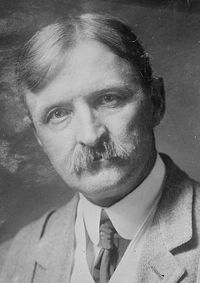
Emerson Hough.
Other Works by Emerson Hough:
The Story of the Outlaw – A Study of the Western Desperado – Entire Text