
Jump to: Links to Full Articles
Jump to: Outlaw Summaries (name begins with) A B C D E F G H I J K L M N O P Q R S T U V W X Y Z
Outlaws.
Seaborn Kalijah (18??-1887) – An Oklahoma outlaw, Kalijah was arrested by U.S. Deputy Marshal John Phillips. He left his prisoner in the care of his posse overnight, to return the next morning to find Mark Kuykendall, Henry Smith, and William Kelly murdered and Kalijah gone. The killer was later rearrested, found guilty, and hanged at Fort Smith, Arkansas, on January 17, 1887.
Jim Kay – A New Mexico outlaw, he rustled cattle near Socorro and was killed by Joel Fowler.
Frank Kearney – An outlaw who escaped from the Las Vegas, New Mexico jail on December 3, 1881, with outlaws Dave Rudabaugh and John Joshua Webb.
Pierce Keaton – A Texas cowboy and outlaw, he attempted to hold up a train on June 9, 1898, at Coleman Junction, and was captured in Sutton County. He was imprisoned, paroled in 1916, and died in 1931.
Bill Kelly – A Texas outlaw, he broke out of jail, killed a deputy, and was charged with murder in 1885 in Brazos County, Texas.
Curtis Kelly – An Oklahoma outlaw who rode with Al Spencer and Jelly Nash.
Dan “Yorky” Kelly – An outlaw; he raided Bisbee, Arizona, with a gang in December 1883, killing several people. Kelly was tried, convicted of murder, and hanged on March 8, 1884.
Edward O. Kelly – See Edward O’Kelley
Jack Kelly – An outlaw who escaped from the Las Vegas, New Mexico jail on December 3, 1881, with outlaws Dave Rudabaugh and John Joshua Webb.
Dave Kemp – While still in his youth, Kemp was sentenced to hang for killing a man in Hamilton, Texas. While awaiting his execution, he attempted to escape by jumping from the second story of the courthouse. Breaking both ankles, he was quickly recaptured. His sentence was commuted to life, but later he received a pardon. Afterward, he moved to Eddy (now Carlsbad), New Mexico, where he opened a butcher shop and became Eddy County sheriff in 1889. He was also a co-owner of a casino in Phoenix, Arizona, and as sheriff, he tended to cater to gamblers’ interests. But this was the least of his crookedness. When U.S. Deputy Marshal Dee Harkey caught him stealing cattle, he forced Kemp to leave the county. The crooked lawman then went to Arizona but returned when Les Dow, his bitter enemy, replaced him as sheriff in Eddy. In April 1896, Kemp shot Dow to death. After a quick arrest, Kemp was acquitted on a plea of self-defense. However, he allegedly had forced the only eyewitness to leave town. Kemp then returned to Texas, where he resumed cattle rustling. He was shot to death by his sister in the 1930s.
Charles Kennedy (18??-1870) – A mountain man who lived near Eagle Nest, New Mexico, Kennedy robbed and killed several passing travelers as they made their way to Taos. He’s one of the first known serial killers in the Southwest.
Hobbs Kerry – Recruited into the James-Younger Gang late in its history in 1875, he was involved in only one robbery: the heist of the Missouri Pacific train in Otterville, Missouri, on July 7, 1876. Described as somewhat of a simpleton, his only job was to hold the horses while the other gang members robbed the train. After the robbery, he made his way to Joplin, Missouri, where he bragged about the robbery and was soon arrested. He named and gave detailed descriptions of the participants in the robbery before serving two years in prison.
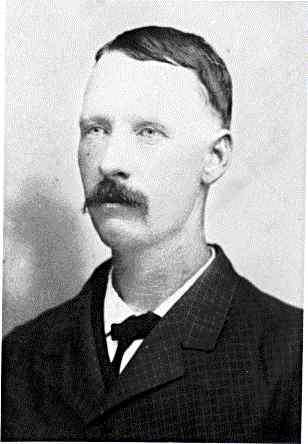
Sam Ketchum.
Samuel “Sam” Ketchum (18??-1899) – From San Saba County, Texas, Sam grew up working with his younger brother, Thomas “Black Jack” Ketchum, as a cowboy and an outlaw.
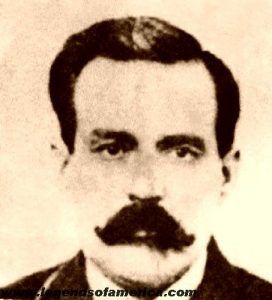
Black Jack Ketchum, train robber.
Thomas E. “Black Jack” Ketchum (1862-1901) – Outlaw leader of the Ketchum Gang; they robbed trains in New Mexico, West Texas, and Arizona. He was finally captured and hanged at Clayton, New Mexico, on April 25, 1901.
Jack Kettle (18??-1889) – According to an article in the New York Times in 1889, Kettle was an outlaw who led a gang in the Bighorn Mountains of Wyoming until the gang was captured by a vigilante group in 1889. Kettle Jack, however, got away. After publication, several Wyoming papers said the reporter created the story out of thin air.
John Kinney (18??-1819) – Leader of the John Kinney Gang of New Mexico, Kinney was known as the “Kingpin of Cattle Rustlers.” After the gang was captured in 1893 and sentenced to prison, it broke up. He died in Arizona in 1919.
Ben Kilpatrick, aka The Tall Texan, Benjamin Arnold (1874-1912) – An outlaw and member of the Wild Bunch, he robbed trains and banks in Nevada, Montana, and Texas. He was killed on March 13, 1912, while robbing a Southern Pacific Railroad train stopped at Sanderson Draw, Texas.
Luther King – An Arizona outlaw, he was accused by the Earps of robbing the Benson stage and killing the driver, Bud Philpot.
Sandy King (18??-1881) – Rustler and thief in Arizona and New Mexico, King was hanged along with William “Russian Bill” Tattenbaum in Shakespeare, New Mexico.
Jack Kingsbury – An Arizona cowboy and outlaw, he killed another cowboy at Calabasas, Arizona, in 1882 and fled to Mexico, where lawmen killed him.
Andrew Kirby – An Arizona outlaw, he was implicated in the Wickenburg stagecoach robbery on April 19, 1878.
George Kirk – A Nevada outlaw, he was lynched on July 13, 1881, at Virginia City, Nevada.
Jim Knight – A Texas outlaw, he robbed the Longview, Texas bank with his brother Jourdan on February 6, 1897. He was captured by a posse and received a life sentence.
Jourdan Knight – A Texas outlaw, he robbed the Longview, Texas bank with his brother Jim on February 6, 1897, and was killed in Bear Creek, Texas, by a lawman.
Ben E. Kuhl (1884-19??) – Kuhl’s claim to fame is that he was the last known stage robber in the United States. On December 5, 1916, he stopped the mail stage traveling from Three Creek, Idaho, to Jarbidge, Nevada, where he took an estimated $4,000 and killed the stage driver, Fred M. Searcy. Though his occupation was listed as a baker, he was better known in the area as a drifter who had been living around Jarbidge for a few months. Before the robbery, he also had earned a reputation as a troublemaker and was awaiting trial after being arrested on trespassing charges. When he was arrested for the stagecoach robbery, a background check showed he had served four months in the Marysville, California, jail for petty larceny in 1903 and had spent time in the Oregon State Prison for horse theft. After his arrest, he was convicted of murder and sentenced to death. His sentence was later commuted to life imprisonment. After serving more than 27 years, he was granted parole on May 16, 1945. He had served longer than anyone else in the Nevada State Prison up until that time. Afterward, he settled in San Francisco, California, where he died of tuberculosis a year later. Kuhl’s case has one other distinction—it was the first time palm prints were entered into evidence in a court trial.
Marvin Kuhns, aka: J.W. Wilson (1865-??) – Thief and bank robber, Marvin Kuhns, was not very good at his “job.” After his first robbery, he was wounded five times when lawmen shot at him. He survived and ended up in a Fort Wayne, Indiana, jail in December 1890. His initial bad luck didn’t stop him; however, when he was released, he was right back at it with his brother, Walter. The pair robbed several small-town banks in Indiana and Illinois before Marshal Elmer Laird captured them in 1901. Kuhns was known to sleep with two pistols, so when the marshal and his men snuck into the hotel room where the brothers were sleeping, Laird put a gun to Marvin’s head before shaking him awake and ordering him not to reach for his pistols. The outlaw ignored him, and when he went for his guns, Laird shot him in the head. Unbelievably, Kuhns survived and was sent to prison. Years later, after his release, he was shot and killed by an Illinois farmer when caught red-handed rustling livestock.
©Kathy Alexander/Legends of America, updated October 2026.
Jump to: Links to Full Articles
Jump to: Outlaw Summaries (name begins with) A B C D E F G H I J K L M N O P Q R S T U V W X Y Z
Also See:
Adventures in the American West
Lawmen of the Old West (main page)
Lawmen & Gunfighter Photo Gallery
See Sources.