
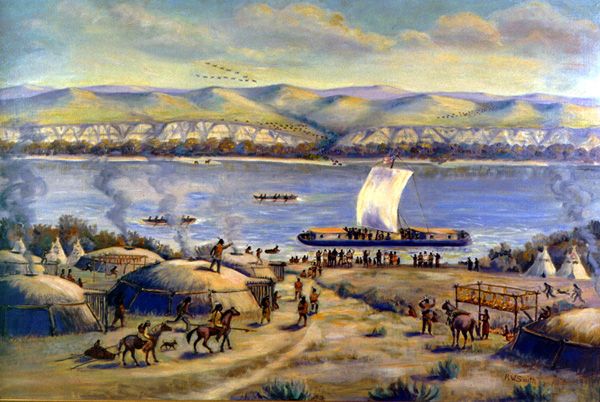
Lewis and Clark on the Upper Missouri River.
By Emerson Hough in 1918
When, in 1803, those two immortal youths, Meriwether Lewis and William Clark, were about to go forth on their incredible journey across the continent, they were admonished by President Thomas Jefferson that they would, in all likelihood, encounter in their travels, living and stalking about, the mammoth or the mastodon, whose bones had been found in the great salt-licks of Kentucky. We smile now at such a supposition, yet it was not unreasonable then. No man knew that tremendous country that lay beyond the mouth of the Missouri River.
The explorers crossed one portion of a vast land that was like nothing they had ever seen—the region that would later become the great cattle range of America.
Although they could know nothing of that, it reached from the Spanish possessions on the South across a thousand miles of short grasslands to the present Canadian boundary line, which certain obdurate American souls still say ought to have been at 54 degrees 40 minutes, not where it is!
From the Rio Grande to “Fifty-four forty,” indeed, would have made nice measurements for the Saxon cattle range.
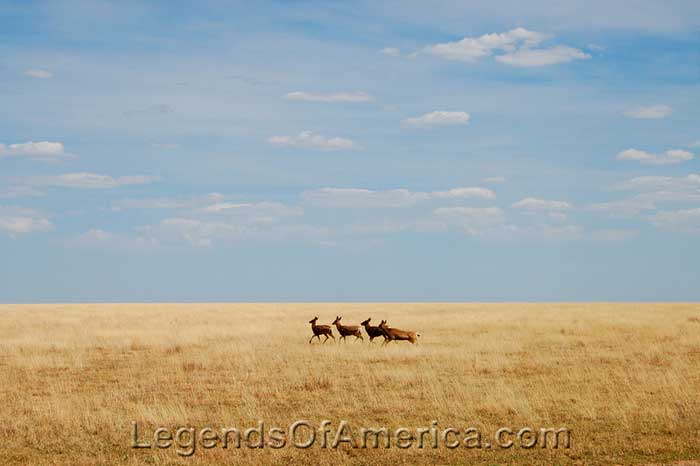
Mule Deer near Manter, Kansas.
Little, however, was the value of this land understood by the explorers. For more than half a century afterward, it was commonly supposed to be useless for white men’s occupation and suitable only as a hunting ground for the tribes. Most of us can remember the school maps of our youth, showing a vast region marked, vaguely, “The Great American Desert,” which was considered hopeless for any human industry but much of which has since proved as rich as any land anywhere on the globe.
Perhaps it was the treeless nature of the vast Plains that gave rise to the first idea of their infertility. When the first settlers of Illinois and Indiana came from South of the Ohio River, they had their choice of timber and prairie lands. Thinking the prairies worthless — since land which could not raise a tree certainly could not raise crops–these first occupants of the Middle West spent a generation or more, ax in hand, along the heavily timbered river-bottoms. The prairies were long in settling. No one then could have predicted that farmlands in that region would be worth $300 an acre or better and that these prairies of the Mississippi Valley would, in a few generations, be studded with great towns and form a part of the world’s granary.
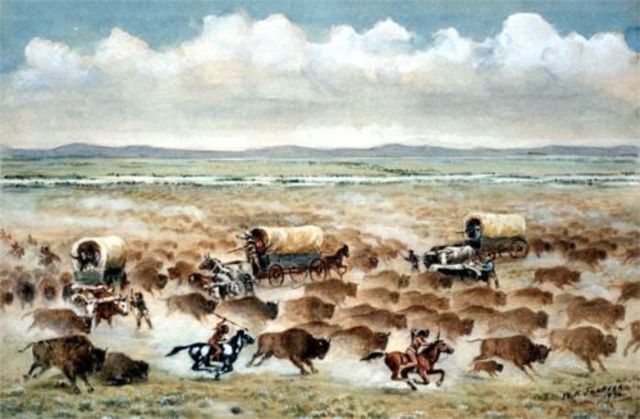
Buffalo along the Oregon Trail.
However, if our early explorers, passing beyond the valley of the Missouri River, found the region of the Plains and the foothills valueless, that was not the case with the wild creatures or the Indians who had lived there longer than science records. The buffalo then ranged from the Rio Grande to the Athabaska, from the Missouri River to the Rockies, and beyond. No one seems to have concluded in those days that there was, after all, a slight difference between the buffalo and the domestic ox. The native cattle, however, in untold thousands and millions, had even then proved beyond peradventure the sustaining and strengthening nature of the grasses of the Plains.
Now, each creature, including humans, must adjust to its environment. Having done so, it is common to love that environment. The Eskimo and the Zulu each think he has the world’s best land. So the American Indian, supported by the vast herds of buffalo, ranged all over that tremendous country, which was later given to the white man with his domestic cattle. No freer life ever was lived by any savages than by the Horse Indians of the Plains in the buffalo days, and never has the world known a physically higher type of savage.
On the buffalo range—that is, on the cattle range that was to be—Lewis and Clark met several bands of the Sioux—the Mandan, the Assiniboine, the Blackfeet, and the Shoshone.
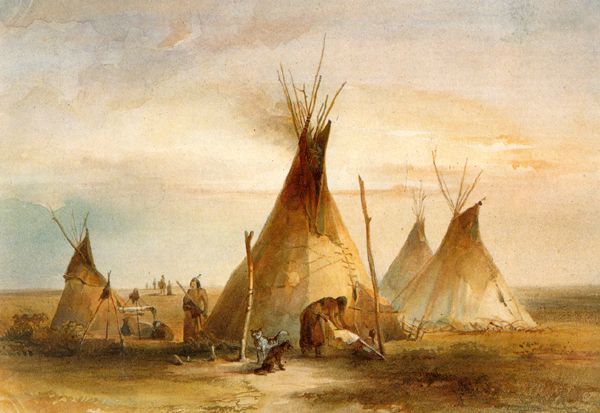
Plains Indians.
Further south were the Pawnee, the Kaw, the Otoe, and the Osage, most of whom depended in part upon the buffalo for their living, though the Otoe, the Pawnee, the Mandan, and others now and then raised a little corn or a few squashes to help out their bill of fare. Still farther south dwelt the Kiowa, the Comanche, and others. The Arapaho, the Cheyenne, the Crow, and the Ute, all hunters, were soon to come into the ken of the white man. As these tribes met, the youthful captains made accounting gravely and with extraordinary accuracy, but without discovering much of the future for Americans in this region. They were explorers and not industrial investigators.
Nearly half a century after the journey of Lewis and Clark, the Forty-Niners were crossing the Plains, while the Mormons had trekked in search of a country where they might live as they liked. Still, the wealth of the Plains remained untouched. California was in the eyes of the world. The great cow range was overleaped. But, in the early 1850s, when the placer fields of California began to be less numerous and less wealthy, the half-savage population of the mines roared on northward, even across our northern line. Soon it was to roll back. Next, it worked east and southeast and northeast over the great dry plains of Washington and Oregon so that, as readily may be seen, the cow range proper was not settled as most of the West was, by a directly westbound thrust of an eastern population; but, on the contrary, it was approached from several different angles–from the north, from the east, from the West and northwest, and finally from the South.
The early, turbulent population of miners and adventurers was crude, lawless, and aggressive. It cared nothing whatever for the Indian tribes. War, instant and ruthless, where it meant murder, for the most part, was set on foot as soon as white touched red in that far western region.
All these new white men who had crowded into the unknown country of the Plains, the Rockies, the Sierras, and the Cascades had to be fed. They could not employ and remain content with how the Red Man had continuously fed himself. Hence, a new industry emerged in the United States, making a significant history in that land. The business of freighting supplies to the West, whether by bull train or by pack train, was an industry sui generis, highly specialized, and pursued by men of excellent business ability, hardihood, and daring.
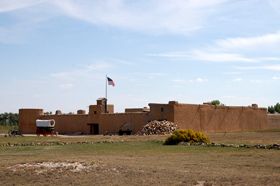
Bent’s Fort, Colorado by Kathy Alexander.
Each of these freight trains that went West carried more and more of the white men hanging on its flank. As the trains returned, more and more was learned in the States of the new country, which lay between the Missouri River and the Rocky Mountains, which ran no man knew how far north, and no man could guess how far south. Now appears in history Fort Benton, Montana, on the Missouri River, the great northern supply post — just as at an earlier date there had appeared Fort Hall, Idaho, one of the old fur-trading posts beyond the Rockies, Bent’s Fort on the Arkansas River in Colorado, and many other outposts of the new Saxon civilization in the West.
Later came the Pony Express and the stagecoach, making history and romance for generations to come. Feverishly, boisterously, a strong, rugged, womanless population crowded westward and formed the wavering, advancing, now receding line of the great frontier of the American story.
But for long, there was no sign of permanent settlement on the Plains, and no one thought of this region as the frontier. The men there who were prospecting and exploiting were classified as no more than adventurers. No one seems to have learned from the Indians and the buffalo. The reports of Fremont long since had called attention to the nourishing quality of those grasses of the high country, but the day of the cowboy had not yet dawned. A somewhat feeble story runs to the effect that in 1866, one of the great wagon trains, caught by the early snows of winter, was obliged to abandon its oxen on the range. It was supposed that, of course, the oxen must perish during the winter.
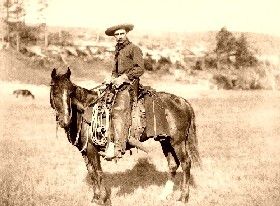
The Cow Boy, circa 1887, by John C. H. Grabill, Sturgis, Dakota Territory.
But, next spring, the owners were surprised to find that the oxen, so far from perishing, had flourished very much–indeed, were fat and in good condition. So runs the story, which is often repeated.
It may be true, but to attribute the beginnings of the cattle industry in Indian country to this incident would surely be going too far. The truth is that the cow industry was not a Saxon discovery. It was a Latin enterprise that had been flourishing in Mexico long before the first of these miners and adventurers arrived on the scene.
Something was known of the Spanish lands to the South through the explorations of Zebulon Pike, but more through the commerce of the prairies–the old wagon trade from the Missouri River to the Spanish cities of Santa Fe, New Mexico, and Chihuahua. Now, the cow business, south of the Rio Grande, was already well-differentiated and developed when the first adventurers from the United States entered Texas and began to crowd their Latin neighbors for more room. It was there that our Saxon frontiersmen first discovered the cattle industry. But these southern and northern riflemen–ruthless and savage, yet strangely statesmanlike–though they might betimes drive away the owners of the herds, troubled little about the herds themselves. There was a particular fascination to these rude strangers in the slow and easy civilization of Old Spain, which they encountered in the land below them. Little by little, and then essentially and yet more largely, the warriors of San Jacinto reached out and began to claim lands for themselves–leagues and uncounted leagues of land, which had no market value. Well, within the memory of the present generation, large tracts of good land were bought in Texas for six cents an acre; some were bought for half that price in a time not much earlier. Today, much of that land produces wealth, but land then was worthless–and so were cows.
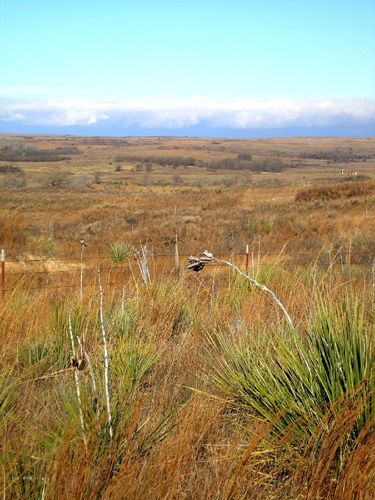
Texas Panhandle Plains.
This civilization of the Southwest, of the new Republic of Texas, may be regarded as the first enduring American result of contact with the Spanish industry. The men who won Texas mainly came from Kentucky, Tennessee, or southern Ohio, and the first colonizer of Texas was a Virginian, Stephen F. Austin. They came along the old Natchez Trace from Nashville, Tennessee, to the Mississippi River — that highway with so much history of its own. Down this old winding trail into the most outstanding valley of all the world and beyond that valley out into the Spanish country, the adventurers whose fathers had but recently crossed the Appalachians moved steadily. One of the most vigorous thrusts of the American civilization thus entered the cattle range at its lower end, between the Rio Grande and the Red River.
In all the activities, mining, freighting, scouting, soldiering, riding the Pony Express, or even sheer adventuring for what might come, there was always trading back and forth between home-staying men and adventuring men. Thus, there was an interchange of knowledge and customs between East and West, between our old country and our new. There was also an interchange in the South, where our Saxon civilization came into contact with that of Mexico.
We have now to note some fundamental facts and principles of the cattle industry, which our American cattlemen took over ready-made from the hands of Mexico.
The Mexicans in Texas had an abundance of small, hardy horses of African and Spanish descent, which Spain had brought into the New World — the same horses that the Moors had introduced into Spain—a breed naturally hardy and able to subsist on dry food. Without such horses, there could have been no cattle industry. Running wild in herds, these horses had crossed to the upper Plains. La Verendrye, and later Lewis and Clark, had found the Indians using horses in the north. The Indians, as we have seen, had learned to manage the horse. Formerly, they used dogs to drag the travois, but now they use the “elk-dog,” which they first called the horse.
In the original cow country, that is, in Mexico and Texas, countless herds of cattle were held in a loose sort of ownership over vast and unknown plains. Like all wild animals in that warm country, they bred in extraordinary numbers. The southern range, indeed, has always been called the breeding range. The cattle had little value. He who wanted beef killed beef. He who wanted leather killed cattle for their hides. But beyond these scant and infrequent uses, cattle had no definite value.
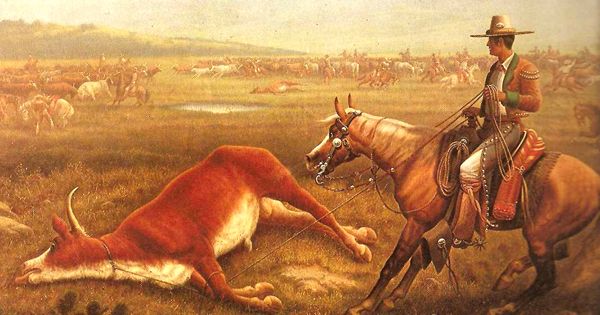
Mexican Cowboy.
The Mexican, however, knew how to handle cows. He could ride a horse and rope cattle, and brand them. Most of the cattle of a wide range would go to certain water holes more or less regularly, where they might be roughly collected or estimated. The arrival of cattle at watering places made it unnecessary for cattle owners to acquire ranch land. It was enough to secure the waterfront where the cows must go to drink. That gave the owner all the title he needed. His right to the increase could be proven by another phenomenon of nature, just as inevitable and invariable as that of thirst. The maternal instinct of a cow and the dependence of the calf upon its mother gave the old rancher of immemorial times sufficient proof of ownership in the increase of his herd. The calf would run with its own mother and with no other cow through its first season. So that if an old Mexican ranchero saw a certain number of cows at his watering places and with their calves, he knew that all before him were his property–or, at least, he claimed them as such and used them.
Still, this was loose-footed property. It might stray away after all, or it might be driven away. Hence, in some forgotten time, our shrewd Spaniard invented a system of proof of ownership that has always lain at the very foundation of the organized cattle industry; he invented the branding method. This meant his sign, name, trademark, and proof of ownership. The animal could not shake it off. It would not burn off in the sun or wash off in the rain. It went with the animal and could not be eradicated from its hide. Wherever the bearer was seen, the brand upon its hide provided specific owner identification.
All these fundamental ideas of the cow industry were old on the lower range in Texas when our white men first drifted thither. The cattle industry, although in its infancy and supposedly with no great future, was developed long before Texas became a republic. It remained essentially unchanged from that time until the end of its career.
One great principle was accepted religiously, even in those early and crude days. A man’s cow was HIS cow. A man’s brand was HIS brand. There must be no interference with his ownership. Hence, certain other phases of the industry followed inevitably. Despite all precautions, these cattle and calves, each branded by the owner’s iron, began to mingle as settlers became more numerous; hence came the idea that the roundup country was warm and lazy. If a hundred or a thousand cows were not collected, very well. If a calf were separated from its mother, it would do very well. The old ranchers never quarreled among themselves. They would never have made anything like a cattle association in the South. It was left for the Yankees to do that at a time when cows had come to have far greater value. There were a few arguments in the first rodeos of the lower range. One rancher would vie with his neighbor in generosity when it came to unbranded calves. Haggling would have been held contemptible. No one cared much about a cow in the lower range in the old times. Why should one do so? There was no market for cows–no one who wished to buy them. If one tendered a Mexican cinquo pesos for a yearling or a two-year-old, the owner might offer the animal as a gift or smile and say “Con mucho gusto” as he was handed a few pieces of silver. There were plenty of cows everywhere in the world!
Therefore, let us give the old Spaniard full credit for picturesque romance and the organized cow industry. The westbound thrust, which came upon the upper part of the range in the days of more shrewd and exacting business methods, was simply the best-known and most published phase of frontier life in the cow country; hence, we have usually accepted it as typical. It would not be accurate to say that the cattle industry was significantly influenced or governed by men from the north or east. In practically all of its extraordinary phenomena, the frontier of the old cow range was southern by birth and growth.
There lay, then, so long unused, that vast and splendid land so soon to write the romantic history of its own, so soon to come into the admiration or the wonder of a significant portion of the earth—a land of fascinating interest to the youth of every country, and a region whose story holds a charm for young and old alike even today.
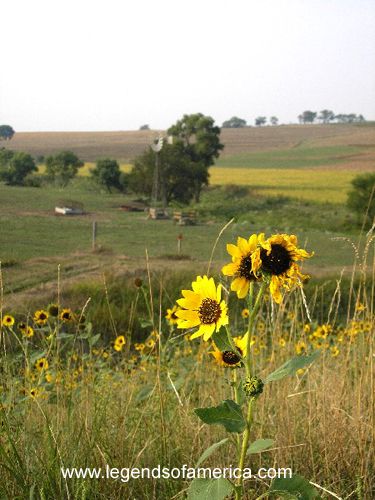
Kansas Sunflowers.
It was a region royal in its dimensions. Far on the West, it was hedged by the gray-sided and white-topped mountains, the Rockies. The cattle were to live where the buffalo once lived, high up in the foothills of this great mountain range, which ran from the Rio Grande to Canada. On the east, where lay the Prairies rather than the Plains, it was a country waving with high native grasses, with many brilliant flowers hiding among them, the sweet-William, the wild rose, and often great masses of the yellow sunflower.
From the Rio Grande to the Athabaska, for the greater part, the frontier sky was blue and cloudless during most of the year. The rainfall was not significant. The atmosphere was dry. It was a cheerful country, one of optimism and not of gloom. In the extreme South along the Rio Grande, the climate was moister, warmer, and more enervating; but on the high steppes of the middle range in Colorado, Wyoming, Montana, and western Nebraska lay the finest out-of-doors country, man’s country, the finest of the earth.
But for the time, busy with more accustomed things, mining, freighting, fighting, hunting, trading, and trapping, we Americans who had arrived upon the range cared little for cows. The upper thrust of the great herds from the South into the north had not begun. It was after the Civil War that the first great drives of cattle from the South toward the north began, and after men had learned in the State of Texas that cattle moved from the Rio Grande to the upper portions of the State and fed on the mesquite grass would attain greater stature than in the hot coast country. Then swiftly, somewhat luridly, there leaped into our comprehension and our interest in that strange country long loosely held under our flag, the region of the Plains, the region which we now call the Old West.
In great bands, in long lines, slowly, towheaded, sore-footed, the vast gatherings of the prolific lower range moved north, each cow with its title indelibly marked upon its hide. These cattle would now replace those on which the Indians had depended for their living for many years. A new day in American history had dawned.
Emerson Hough, 1918. Compiled and edited by Kathy Alexander/Legends of America, updated April 2025.
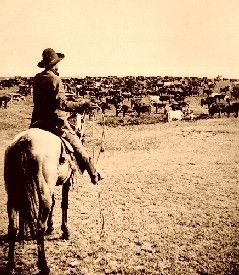
Cattle RounRoundupKansas.
Excerpted from the book The Passing of the Frontier, A Chronicle of the Old West, by Emerson Hough, Yale University Press, 1918. Emerson Hough (1857–1923) was an author and journalist who wrote fictional accounts and historical novels of life in the American West. His works helped establish the Western as a popular genre in literature and motion pictures. For years, Hough wrote the feature “Out-of-Doors” for the Saturday Evening Post and contributed to other major magazines.
Also See:
List of Trail Blazers, Riders, & Cowboys