
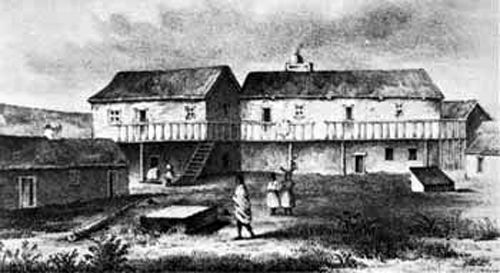
Fort Hall, Idaho, 1849.
The Fort Hall fur trading post in Idaho was particularly noteworthy for its role in the fur trade, transportation, communications, and overland emigration. However, the post was also associated with military-Indian affairs.
Nathaniel J. Wyeth, an opportunistic New England businessman, founded the post and dreamed of exploiting the natural resources of the Oregon country. After an exploratory expedition in 1832-33, he returned the following year. Near the confluence of the Snake and Portneuf Rivers in southeastern Idaho, he built Fort Hall, a stockade of cottonwood logs with two blockhouses. But he found he could not compete with the powerful Hudson’s Bay Company, which the same year built a rival post, Old Fort Boise (Snake Fort), Idaho, 260 miles to the West at the confluence of the Boise and Snake Rivers.
Around 1837, the Hudson’s Bay Company purchased Fort Hall from Wyeth, reconstructed it with adobe, and enlarged it considerably. It became a center of the Rocky Mountain fur trade. The enterprise was so lucrative that the Hudson’s Bay Company maintained it until about 1856, a decade after the United States acquired full rights to the Oregon Country from Great Britain. The post served an acculturative role among intermountain tribes, similar to Fort Union Trading Post, North Dakota; Fort Laramie, Wyoming; and Bent’s Old Fort, Colorado, among the Plains Indians.
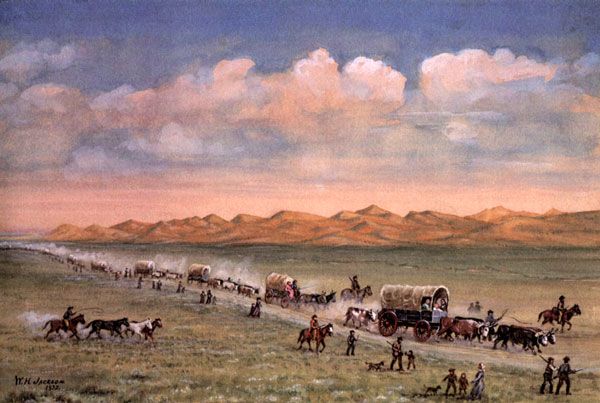
Oregon Trail pioneers pass through the sandhills, painting by William Henry Jackson.
Occupying a prime location only 50 miles northeast of where the Oregon-California Trail forked to Oregon and California, Fort Hall in 1842-43 became a significant way station and supply point for emigrants and travelers. Dr. Marcus Whitman, Reverend Henry H. Spalding, and Father Pierre Jean De Smet stopped there at various times. So did the explorer John C. Fremont in 1843 while probing the Far West. He recommended the establishment of a permanent military post at the spot to supply emigrants and protect them from the Indians. The Army never acted on his proposal, but troops later frequently camped at the fur post site or its vicinity.
In 1849, the Loring Expedition of Mounted Riflemen from Fort Leavenworth, Kansas, established posts along the Oregon Trail and founded Cantonment Loring, often incorrectly known as Fort Hall, about three miles up the Snake River from the fur trading post. Loring left two companies to erect a permanent post and proceeded to Fort Vancouver, Washington. However, a shortage of forage and provisions caused the abandonment of the cantonment the following May.
A decline in trade and increasing Indian hostilities led the Hudson’s Bay Company to discontinue operations at Fort Hall sometime around 1856. For a few years, itinerant traders sometimes lived in the crumbling buildings. In 1859-60 and 1863, Regulars and Oregon Volunteers camped there while patrolling the trail. A flood that year destroyed much of the fort. During the 1860s and 1870s, overland stage and mail lines used the site, a key road junction, as a base. Freighters hauling supplies to mining camps in Oregon, Washington, Idaho, and Montana also used it.
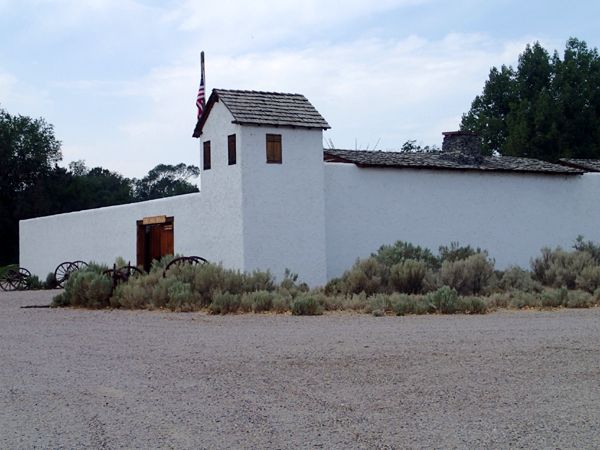
Replica Fort Hall in Pocatello, Idaho, courtesy of Wikipedia.
In 1865-66, slightly north of the Fort Hall site, Oregon Volunteers protecting the Oregon Trail maintained a temporary Camp Lander. They may have used log and adobe scraps from the old fort as building materials. Federal troops returned to the area in 1870, but they established a new post, also named Fort Hall, 25 miles to the northeast.
The fur post site is on the Fort Hall Indian Reservation. A small monument stands about 50 yards from the edge of the American Falls Reservoir. The only surface remains are low earth mounds outlining the fort’s walls. Aside from the reservoir’s waters, the natural scene is largely unchanged. The sites of the nearby posts of Cantonment Loring and Camp Lander, often confused with Fort Hall, have not been ascertained.
The old fort site is located in Bannock County, Idaho, just off an unimproved road, about 11 miles West of Fort Hall.
Although no remains remain at the original site of Fort Hall, a replica fort was built in Pocatello, Idaho, in the 1960s. The Fort Hall Replica reproduces the original Hudson’s Bay Fort, based on plans obtained from the Hudson’s Bay Company and extensive research into early descriptions of the Fort from people who lived at or visited Fort Hall.
Contact Information:
Fort Hall
3002 Alvord Loop
Pocatello, Idaho 83201
208-234-1795
Fort Hall, Idaho
Compiled and edited by Kathy Alexander/Legends of America, updated September 2026.
Also See:
Forts & Presidios Across America
Primary Source: National Park Service