|
 
Legends Home
Site Map
What's New!!
Content Categories:
American History
Destinations-States
Ghost Stories
Ghost Towns
Historic People
Legends &
Myths
Native Americans
Old West
Photo Galleries
Route 66
Travel Center
Treasure Tales
About Us
Advertising
Article/Photo
Use
Copyright
Information
Blog
Facebook Page
Guestbook
Links
Newsletter
Privacy Policy
Site Map
Writing Credits
We welcome corrections
and feedback!
Contact Us

Old West Mercantile
Route 66 Emporium
TeePee Trading Post
Book Shelf
History Tech
Postcard Rack
Wall Art
Custom
Products
and
Much More!
Legends' Photo Prints

Ghost Town Prints
Native American
Prints
Old West Prints
Route 66 Prints
and
Much More!!
| |
|
|
|
Carbon County Ghost Towns - Page 3 |
|
|
|
<< Previous 1
2 3 4
5 6
Next >> |
|
Spring Canyon Road:

|
|
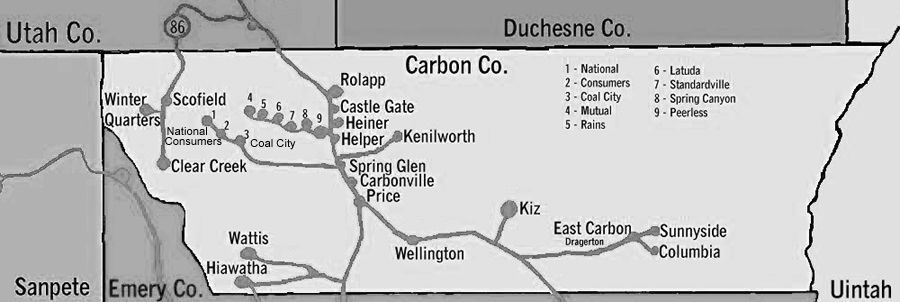
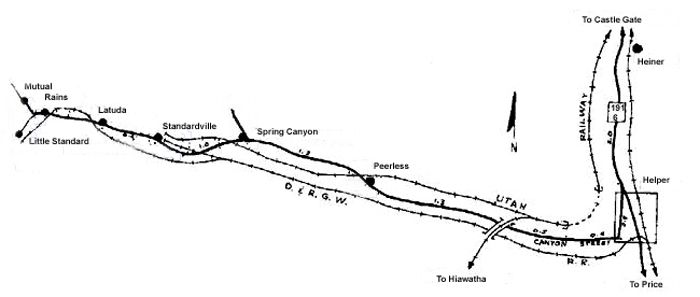
Due west of Helper,
Utah
is Spring Canyon Road, where numerous coal mining camps once stood.
Today, this old road still displays many remnants of those more
prosperous times and the ghost towns of
Standardville,
Rains,
Peerless, Mutual,
Latuda and Storrs. Traveling this vintage path, it is
difficult to know where one townsite began and another ended, as
remnants and crumbling buildings dot the road for miles and numerous
foundations and mining remains poke up from the hills.
Peerless -
Just three miles west of Helper,
Utah, Peerless was
the first coal camp developed in the Spring Canyon District. In
1916, 440 acres were purchased by
William H. and Charles N. Sweet, who began to develop
coal operations, including a gravity tramway and a tipple on the
canyon floor at the railroad spur.
However, in 1917, the Sweets sold the property to the Peerless Coal
Company, which had been organized by James Murdoch and Ezra Thompson of
Salt Lake City. |

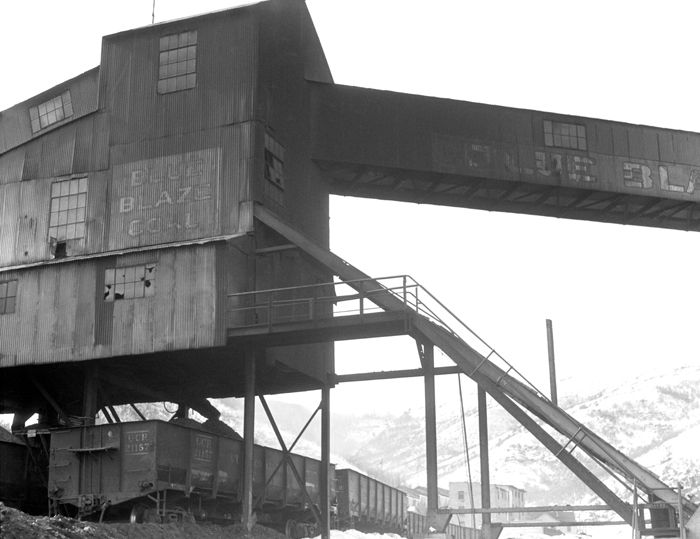
Mining ruins in Spring Canyon in the 1960's.
|
|
|
The
first superintendent was Robert Howard, a former state coal mine
inspector, who managed the wresting the coal from the ground, a difficult
task as the coal seam was split and included burned portions. However, he
was successful and shipments began over the D&RG Railroad in 1918. For the
next couple of years, the town boomed, as the mine paid for itself,
completely paying off its debt by 1920.
The community of
Peerless included about thirty houses, a
store, a school, the company mine office, a post office, and a clubhouse
for company officials. At its peak production, the mine employed about 150
men.
But, like other mining
operations in the area, it would have its difficulties and its
profitability varied over the years. More burned coal was later
encountered and the estimates of minable ore in the already thin seams was
reduced sharply.
In July, 1930, the
Peerless Coal company discontinued operations at the Peerless Mine due to
low production and the following year was bankrupt. The railroad removed
its tracks to the mine. In August, 1931, the mine was leased to
Howard & Turner who utilized new mining technology
that reduced the operational costs and began to ship coal over the
Utah
Railway beginning in September, 1931. However, less than a year later, the
mine taken over by the Peerless Sales Company in May, 1932, who began to
ship the coal by trucks.
Mining
operations continued on a small scale until March, 1953, at which time the
mine was completely closed and all its assets were sold.
Today, there is nothing left of Peerless but a few foundations.
Spring Canyon/Storrs
- Though the area where the Spring Canyon Coal Company would develop a
mine had been known for years as having a rich coal seam, it would be
decades before commercial operations would be established. In the late
1800’s, Helper residents were often known to haul coal by wagons from an
opening on the side of the mountain. A small mine was worked in Sowbelly
Gulch by Teancum Pratt in 1895 when
he built a wagon road and began to haul coal back to Helper. Around 1897,
bought the acreage, operating his small coal mining venture until 1912. At
that time, Jesse Knight and other investors in Provo,
Utah
purchased the land and organized the Spring Canyon Coal Company.
|
|
|

Spring Canyon Coal Company, 1925, William
Shipler.
This image available for
photographic prints and downloads
HERE!
|
The company began to develop
some 2,000 acres of coal land and made plans to build a railroad to
connect the mine in Spring Canyon with the D&RG Railroad at nearby Helper.
Starting with just about a half dozen miners, supervised by Provo
ex-sheriff George Storrs, coal was first shipped to Helper via wagons.
However, when the railroad was
completed in October, 1912, the mine began to make its first shipments on
the train, which sported a brand new locomotive. Storrs also was the
superintendent of the railroad, as well as the mine.
Coal was delivered from the
mine to the canyon floor by way of an aerial tramway. Expanding quickly,
a new steel tipple began to be built in March, 1913, which had a capacity
to handle some 2,000 tons of coal per day. By may, it was operational and
was shipping about 600 tons per day with expectations of quick growth.
That same year, the private railroad was bought by the Denver & Rio Grande
Railroad.
|
|
As the
mine expanded the camp that supported it was also growing, taking on the
name of Storrs, for the mine superintendent. The company also built a
number of four room cottages for the miners which included hot and cold
running water, a store, a hotel, and a hospital. By the end of 1914, the
mine was producing about 1,000 tons of coal per day.
In 1919,
a new surface tramway to replaced the mine’s aerial tramway.
Jesse
Knight died on March 14, 1921 and the following year, the company was sold
to James B. Smith and his associates of San Francisco, California.
In 1924
the Town of Storrs changed its name to Spring Canyon, perhaps because its
first superintendent, George Storrs, who had moved on and started his own
company, had been indicted on mail fraud charges in connection with
promotion of his Great Western Coal Company in Gordon Creek Canyon.
Though Storrs would later be cleared of the charges, the town would
forever be known as Spring Canyon. By that time, the town boasted a
population of approximately 1,100 people.
By 1940 the Spring Canyon mine
was ranked as the fourth largest producer in the state. Ever expanding, by
1948, the Spring Canyon Coal Company was also operating the Standard and
Royal Mines.
|
|
However,
the prosperity couldn’t last forever, and by 1954, much of the coal had
been depleted and the Spring Canyon Coal shut down the vast majority of
its operations, operating with just a skeleton crew. Most of the residents
left town, but the mine continued to operate until 1969, when it was
closed forever.
Unfortunately, six years later, in 1975, the entire town was raised,
leaving only parts of the tipple trestle.
Continued Next Page |

Remains of the once busy railroad that ran
through Spring Canyon can still be seen today, April, 2008, Kathy Weiser.
|
|
|
<< Previous 1
2 3 4
5 6
Next >> |
|
From Legends' Photo Shop
Vintage
Photographs of the Old West - From Legends'
Photo Print Shop, you'll
find hundreds of
vintage images
of the Old West
that can be ordered in prints or downloaded for commercial use. Providing
dramatic glimpses into the rich heritage of the
American
West, see
famous characters including notorious
outlaws
and
lawmen, cowboys
and trailblazers, and more;
transportation
including covered wagons and stagecoaches;
Saloons, Gambling &
Women;
Westward Expansion, and everything in between.
 |
| |
|