|
Legends Home
Site
Map
What's New!!

American History
Ghost Towns
Ghostly Legends
Historic People
Native Americans
The Old West
Photo
Galleries
Roadside
Attractions
Rocky Mtn Store
Route 66
Travel
Destinations
Treasure Tales
Legends Blog
Free E-Newsletter

P.O. Box 19423
Lenexa,
KS 66285
913-708-5119
Please report
broken links, missing pictures, or other problems online by clicking
HERE or send us an
email. Thanks!
| |
|
|
|
Montana Forts of the Old West |
|

|
|
<<
Previous 1 2
3 Next >>
|
|
Fort Keogh (1876-1908) - After
the Battle of the Little Bighorn, on June 25, 1876,
General Nelson A. Miles was sent to the area of
present-day Miles City,
Montana with orders to establish a fort. Choosing
a
strategic site where the Yellowstone and Tongue Rivers met, Miles
established the fort on
July 22, 1876 and it was first known as Cantonment on Tongue River. The
fort was later moved to a site a mile west, and was renamed
Fort Keogh in November, 1878, in honor of Captain Myles Keogh,
an adjutant to General
George Armstrong Custer, who was also killed in
the Battle of the Little Big Horn. The settlement that grew up
around the fort was named for General
Miles.
|

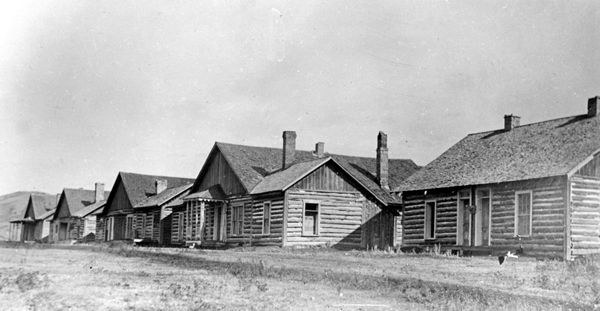
Vintage Fort Keogh |
|
The fort included officer's
quarters, enlisted barracks, multiple outbuildings and a
diamond shaped parade ground. The fort's
purpose was to continue to subdue the
Indians, a task that was
achieved by the early 1880s. By then most
of the tribes had surrendered and were moved onto
reservations.
In 1907, all troops were removed from the site and two years
later Fort Keogh became a Remount Station and supplied
thousands of horses for World War I. In 1924, the station was turned over to USDA,
which continues to utilize the site to this day.
Of the some 100 buildings that
stood at the fort in the late 1800's, only four survive,
including officers' quarters and an brick structure that was
used as a barn. The Range Riders' Museum is housed in one of
the officer quarters buildings.
More Information:
Fort Keogh
243 Fort Keogh Road
Miles City
Montana 59301
406-874-8206
Fort Logan (1869-1880) - Located in
Meagher County,
Montana, the fort was first established by the
U.S. Army on November 1, 1869 and called Camp Baker for Major E.M. Baker of
Fort Ellis. Its objective was
to
the protect the Fort Benton
to Helena freight road, as well as
the area miners and settlers. The provided troops for many of the
campaigns in western
Montana, including the Nez Perce War in
1877.
In 1878, the post was
renamed Fort Logan in honor of
Captain William Logan who was killed at the Battle of the Big
Hole. The fort was abandoned in 1880. There are still remains
of the fort including a deteriorating adobe storehouse, two
officers' quarters building, and the blockhouse.
The site is located in Meagher County, on an unimproved road, about 20
miles northwest of the town of White Sulphur Springs,
Montana.
|
|
|
|

Fort Maginnis |
Fort Maginnis (1880-1890) -
Located on the east side of
the Judith Mountains, the fort was established in 1880 by
Captain Dangerfield Park to protect cattlemen from raiding
Blackfeet and
Sioux . It was named
for Major Martin Maginnis,
Montana's
territorial
delegate to congress. By 1885, the fort, under the command of
James W. Forsyth, was responsible for monitoring the
Crow, Cree,
and the Gros Ventre
Indians. The fort was abandoned April 10, 1890.Today
there is only ruins left of this once sizable frontier post.
Near the fort site, an old cemetery remains intact. The fort
is located about 20 miles from Lewiston,
Montana.
Take Highway 87 west of Lewistown, turn left toward Gilt Edge
and follow the signs.
|
|
Fort McKenzie (1832-1844) - The fort was
established by the
American Fur
Company to trade with the
Blackfeet
Indians.
Located on the Missouri
River near the Mouth of the Marias River, the fort was built
by Kenneth McKnzie, a Missouri fur
trader. In 1833, the fort was visited by
Alexander Philip Maximilian, Prince of Wied-Neuwied, a
noted German scientist and explorer. Staying for several
months, he studied the local
Indians
and
collected plant and and animal specimens. He was accompanied
by Karl Bodmer, an artist who sketched and made paintings of
the
Indians
and scenes in the surrounding countryside.
In 1844, the fort was managed by a fur trader named Chardon,
who withdrew from the fort when hostilities with the
Blackfeet
were renewed.
He soon
established the short-lived post, Fort Chardon, opposite the
mouth of the Judith River. This lasted one season when another
party was sent from
Fort Union
to recover the
Blackfeet
trade
and established a new post about three miles upriver from
present-day
Fort Benton. The site is located
on the north bank of the Missouri River, six
miles above the mouth of the Marias River, near Loma,
Montana.
Fort Missoula (1877- 1947)
- Fort Missoula was established as a
permanent military post in 1877 and built in response to
requests of local townspeople and settlers for protection in
the event of conflict with western
Montana
Indian tribes.
Founded on the Bitterroot River, its garrison took part in only one engagement of
consequence -- the Battle of the Big Hole in August, 1877, 90
miles to the south, in the Nez Perce War. The captives were
incarcerated at Fort Missoula. During the next 2 years, when
they were not countering minor
Indian harassments, the troops
restored a stretch of the Mullan Road, running from Fort Benton,
Montana to Fort Walla Walla, Washington. In
post-frontier days the fort was not continuously active or
garrisoned.
In 1904, funds were
appropriated to remodel Fort Missoula and a complex of
concrete buildings with red tile roofs was constructed between
1908 and 1914, including a new Officer's Row, barracks, and
Post Hospital. During World War I, the fort was used as a
military training center but by 1921 it was nearly abandoned.
In 1933, it became the
Northwest
Regional Headquarters
Civilian Conservation Corps.
In 1941, the fort was turned over to the
Department of Immigration and Naturalization for use as
an alien detention center for non-military Italian and
Japanese-American men. Its last official function was to serve
as a prison for military personnel accused of military crimes
and other personnel awaiting court-martial. When the post was
decommissioned in 1947, many of the buildings were sold,
dismantled, and removed from the site. The majority of the
land is now in the hands of non-military agencies, including
the U.S. Forest Service, the Bureau of Land Management, and
Missoula County. However, a portion of the military
reservation continues to serve as an Army and Navy training facility and
reserve center.
|
|
The Historical Museum at Fort Missoula
features a 13 historic structures and a large array of
historical artifacts.
More Information:
Building 322
Fort Missoula
Missoula,
Montana 59804
406-728-3476
Continued Next Page |

Fort Missoula,
Montana,
1886.
This image available for
photographic prints and
downloads
HERE! |
|
<<
Previous 1 2
3 Next >>
|
|
From the Rocky Mountain General Store
People
Postcards - We have
collected a wide variety of people postcards from couples
serenading, to wanton women of the early 1900's, to famous figures.
Each one of these is unique and, in many cases, we have only one
available, so don't wait. To see them all, click
HERE!
 |
| |
|