
“Jesse James (partly) turned to crime to exact revenge on all things Yankee.”
— Time-Life Books The Wild West
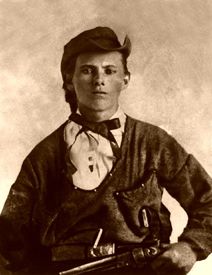
Jesse James in 1864.
Jesse James was an outlaw, bank and train robber, Confederate guerrilla during the Civil War, and leader of the James-Younger Gang.
When Jesse James was still alive, America already loved him, for, in him, there was an adventure in an otherwise dull, slowly turning scientific age. Late in America’s second century, the man rebelled against a society he didn’t like and became a folk hero. In the mid-1860s, journalists, eager to entertain Easterners with tales of the Wild West, exaggerated and romanticized the gang’s heists. Jesse James was touted as the modern-day Robin Hood because he was said to have robbed the rich and helped the poor.
At the time, his exploits were relished by those who could do no more than fantasize about living such an adventurous life. This remains true today, as thousands of people are intrigued by Jesse James and the many outlaws who carved out the western frontier.
However, while Jesse was many things, including being a sometimes kind man, a dapper dresser, and a prankish charmer, he was also a cold-blooded murderer, robber, horse thief, and terrorist. He and his gang were very dangerous men.
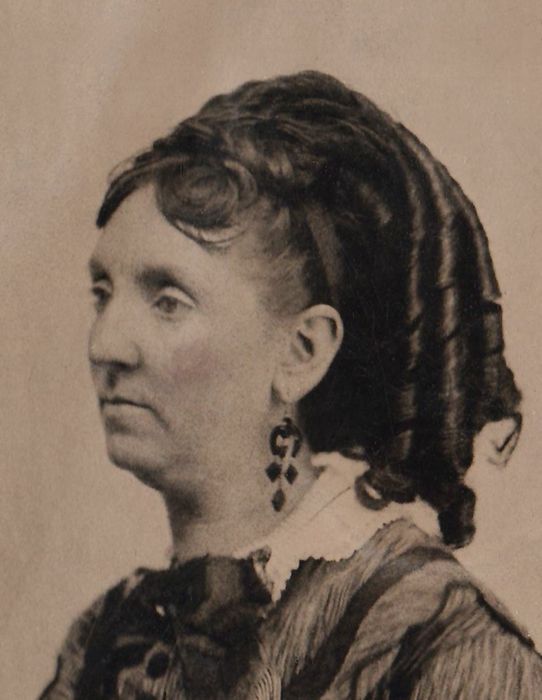
Zerelda James, Jesse James’ Mother.
Jesse James’ parents, Robert Sallee James and Zerelda Elizabeth Cole James, were originally from Stamping Ground, Kentucky, where they met at a revival meeting. They married on December 28, 1841. Robert James continued his schooling and graduated from Georgetown College. After Robert’s graduation, the young family relocated to the Centerville area of Clay County, Missouri. Centerville would later be known as Kearney.
With the help of neighbors Robert and Zerelda, “Zee,” as she was more commonly known, built a log cabin in the wilderness and began to carve out a farm. Robert became the pastor of a small Baptist Church outside of Kearney. Reverend James was a well-liked and respected man in the community who helped found William Jewel College in Liberty, Missouri. Zee stood six feet tall and was known as a hard-working, strong-willed farm woman. Their first son, Alexander Franklin “Frank” James, was born at the family farm on January 10, 1843. Three more children quickly followed. Robert James, Jr. was born at the farm on July 19, 1845, but died 33 days later. Jesse Woodson James was born on September 5, 1847, and Susan Lavenia James was born on November 25, 1849.
In early 1850, the Reverend James was asked to serve as chaplain on a wagon train of local men headed west to California in search of gold. On April 12, he left the farm in Zee’s care and headed west to preach to the crowds of gold miners who had gathered there. The minister never made it back to Missouri.
Shortly after arriving in California on August 1, 1850, the Reverend contracted a fever from drinking contaminated water. On August 18, 1850, the minister died of cholera at a Placerville, California, gold camp and was buried in an unmarked grave.
Years later, Jesse unsuccessfully searched for his father’s resting place. Zerelda inherited the farm, which she owned until her death years later. But for the moment, she was a widow, left with three young children. Frank, the oldest one, was seven years old when his father died.

Benjamin Simms and Zerelda James Simms
Zerelda married Benjamin Simms, a neighboring farmer, a second time, but the marriage proved unhappy, mainly because of Simms’ behavior towards the two boys. His lack of affection for them and his use of corporal punishment, which Zerelda did not approve of, failed the marriage. Zee was a woman of strong opinions who fiercely guarded her sons against criticism. After a series of arguments between the couple, Zerelda initiated divorce proceedings, an unusual move at the time. This was unnecessary since Simms was killed in a horse accident on January 2, 1854.
A third marriage to Dr. Archie Reuben Samuel took place in 1855. The physician was well-to-do and docile, allowing his wife to make important family decisions. When it came to the children, Zee made all the decisions. Dr. Samuels purchased additional adjoining property, and James’ holdings grew. The family purchased slaves to help them run the farm.
In his youth, Frank was said to be a taciturn, withdrawn Bible-reading boy. He developed an interest in his late father’s sizeable library, particularly the works of William Shakespeare. Frank reportedly wanted to become a school teacher. Quite to the contrary, Jesse was described as generous, noble-hearted, assertive, and with a prankish charm. Dr. Samuel taught both boys horse-riding and shooting skills. Both boys worked on the farm through their teenage years, enjoying everyday family life.
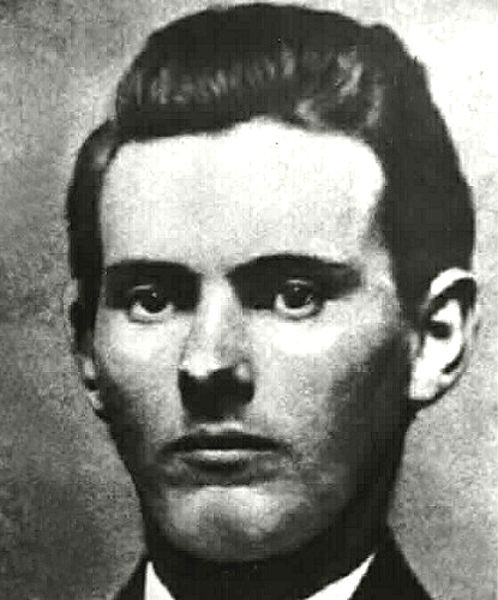
Frank James as a Young Man.
In 1861, when Frank turned 18, any thoughts of pursuing a higher education ended when Missouri became rife with the conflict and violence of the Civil War. Missouri was torn in two directions – most of the state’s settlers came from the south, yet its economy was linked directly to the north.
Though Missouri voted against secession from the Union, there were a significant number of people with Confederate sympathies in the state, which led to the formation of two separate governments with different allegiances. The James family, on both the paternal and maternal sides, had been slave owners for years, which formed their allegiance. Missourians would serve in the armies of both sides of the war until its end in 1865; Frank joined the Missouri State Guard on May 4, 1861, fighting for the Confederacy.
In 1862, the illegitimate son of Dr. Archie Reuban Samuel was born out of wedlock to one of the slaves. The mulatto boy was raised as part of the Samuel family.
While in the Missouri State Guard, Frank served in the Battle of Lexington, where an estimated 1,774 Union troops lost their lives. A significant victory for the State Guard, the Confederates took control of Southwestern Missouri in October 1861.
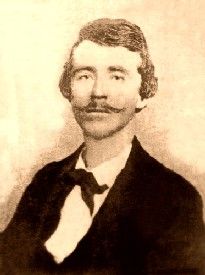
William Quantrill.
At some point after the battle, Frank returned home, presumably because of injury or illness. There, he was arrested by a local militia of Union supporters. He was released when he signed a statement of allegiance to the Union. But by July 1862, he had instead joined the Missouri Partisan Rangers of William Clark Quantrill. Quantrill’s Raiders were Confederate supporters who used Guerrilla tactics. They were active in the Border War between Missouri and Kansas, attacking the regular Union Army and various Union-supporting militias in both states.
Quantrill’s raids gained the attention of other desperados. By 1863, Quantrill had recruited others to join his company, including “Bloody” Bill Anderson, the James brothers, and the Younger Brothers. In the summer of 1863, Quantrill set his sights on Lawrence, Kansas – the location of his most infamous destruction.
Early on the morning of August 21, 1863, Quantrill, along with his murderous force of about 300, descended on the still-sleeping town of Lawrence. Incensed by the free-state headquarters town, Quantrill set out to exact revenge on the Jayhawker community.
In this carefully orchestrated early morning raid, he and his band, in four terrible hours, turned the town into a bloody and blazing inferno unparalleled in its brutality. Quantrill and his bushwhacker mob of raiders began their reign of terror at 5:00 a.m., looting and burning as they went, bent on the destruction of the town, with fewer than 3,000 residents.
By the time it was over, they had killed approximately 180 men and left Lawrence nothing but smoldering ruins. Frank James and Cole Younger were with Quantrill during the raid. Though there is no evidence that Jesse was with the murderous party, he was said to have bragged about it later. The conflict is known as the Lawrence Massacre.
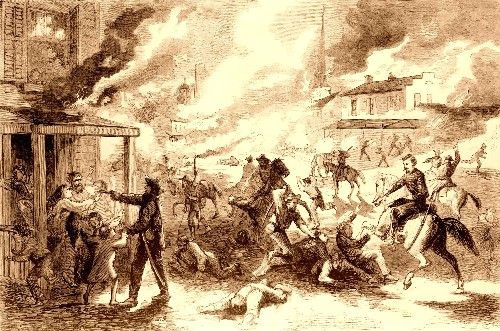
Lawrence, Kansas Massacre.
Just three months after the Lawrence raid, a party of Union soldiers invaded the Samuel farm, looking for information about the location of Quantrill’s camp. Jesse, who was just 15 then, was questioned and horse-whipped when he refused to answer the soldiers‘ questions.
Dr. Samuel, who also denied knowing where the raiders’ camp was located, was dragged from his house and repeatedly hanged from a tree in the yard. Somehow, the doctor managed to survive the interrogation.
No doubt, out of hatred and anger over this event, Jesse joined “Bloody” Bill Anderson’s guerrilla forces at the age of 16. “Bloody Bill” was a Quantrill lieutenant who led a raid on Centralia, Missouri, on September 27, 1864. Over 100 armed guerrillas descended upon Centralia, a community of fewer than 100 people, intent on robbing the train. While waiting for the train, they terrorized local civilians, robbing and burning stores and killing a civilian who had attempted to defend a young woman. The stage from Columbia came into the community, and they robbed the passengers.
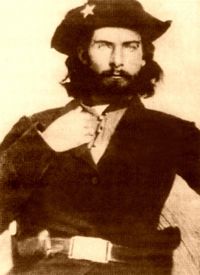
“Bloody Bill” Anderson.
When the train finally arrived, twenty-four unarmed and wounded Union soldiers were dragged from the train by the frenzied ruffians and were murdered in front of the horrified citizens of the town. The guerrillas then set fire to the Centralia depot, sacked and set fire to the train, and then sent it on its way west, with no crew aboard, to crash and be destroyed later.
The band of guerrillas was followed by an experienced Federal Infantry led by Union Major A.V.E. Johnson. About three miles south of Centralia, Missouri, the Union forces were bushwhacked by the band and were nearly annihilated. Over 120 federal troops were killed. Only three guerrilla fighters were reportedly killed in the battle.
Frank and Jesse were part of the battle south of Centralia, though it is disputed that they took part in the massacre of unarmed soldiers earlier in the day. Jesse is said to have killed Union Major Johnson and is “credited” with taking the lives of seven other men on that tragic day.
In late spring of 1865, Jesse rode into Lexington, Missouri, carrying a white flag. He was shot in the chest when he attempted to surrender to Union troops. Afterward, he went to Rulo, Nebraska, to recuperate from his wound before returning to Missouri.
The vicious violence of the Civil War had taken its toll on Missouri. During the official years of the Civil War, 1,162 battles and skirmishes were fought in the state, a total exceeded only by Virginia and Tennessee.
Though the James family owned slaves, they were said to have been kind to them. They often allowed the children to sleep in the main house. When the war was over, the former slaves remained at the farm long after they were set free.
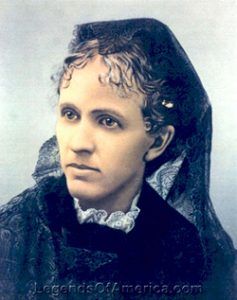
Zerelda Mimms James.
Jesse was living in Kansas City, Missouri, with his aunt in 1865 when he fell in love with his cousin, Zerelda Mimms. Zerelda’s mother was Robert James’ sister, making them first cousins. Zerelda, more familiarly called Zee, was named for Jesse’s mother. This, however, did not stop the pair from beginning to court.
He was known as a very reliable young man, always dressing well, reading his bible, and regularly attending church. He never swore or took the Lord’s name in vain, preferring to make up his own swear words when angry. His favorite was “Dingus,” which his brother Frank quickly nicknamed him.
With the bloody war finally over, Frank and Jesse turned to outlawry. Claiming to have been forced into a life of crime because the family had been persecuted during the war, Frank and Jesse became the leaders of a band of outlaws, which included the Younger Brothers, Jim Reed, and other ex-Confederates.
Jesse justified many of his actions by his hatred of the Industrial North, as if he were continuing the fight through his outlaw activities. Beginning in 1866, the gang robbed its way across the western frontier for the next 15 years.
The first James-Younger bank robbery occurred on February 13, 1866, at the Clay County Saving Association Bank in Liberty, Missouri. In the first daylight robbery during peacetime, the gang made off with over $60,000 in cash and bonds. As they made their escape, gunfire erupted, and an innocent 17-year-old boy by the name of George Wymore was killed.
The gang continued its crime spree for the next several years, robbing eight more banks and a Kansas City Ticket office before robbing its first train. (The list of banks is on the James Gang Timeline.)
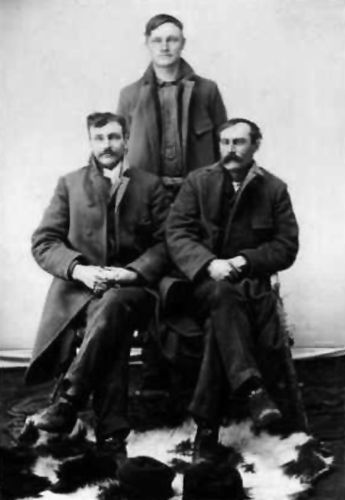
Pinkerton Agents
Not limiting who they robbed or killed, sometimes innocent bystanders were wounded or lost their lives while witnessing one of their crimes. During these years, the Pinkerton Detective Agency constantly trailed the gang.
James and his partners were much adored despite their criminal and often violent acts. In 1866 and 1867, John Newman contributed to the outlaws’ fame by writing glorifying articles and “dime novels.” Eager to entertain Easterners with tales of a wild West, journalists exaggerated and romanticized the gang’s heists, often casting James as a contemporary Robin Hood. While James did harass railroad executives who unjustly seized private land for the railways, modern biographers note that he did so for personal gain. Any humanitarian acts were more fiction than fact.
They could be ruthless. On December 7, 1869, the gang held up the Davies County Savings Bank in Gallatin, Missouri. The teller, John Sheets, was a former Union officer who was said to have been involved in the death of “Bloody” Bill Anderson. Jesse hated him and shot the man in the back of the head. When clerk William McDowell ran for the door, he too was shot but survived the whole affair. After making off with only $700, they were offered a $3,000 reward.
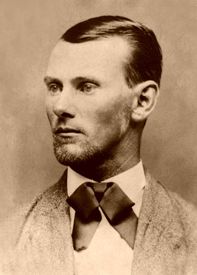
Jesse James.
By the early 1870s, robbing banks was becoming riskier as banks increased their security with time-lock vaults. But that didn’t slow down the gang – they turned to stagecoach and train robbery.
The James-Younger Gang robbed their first train near Adair, Iowa, on July 21, 1873. During the robbery, they wrecked the Chicago, Rock Island, and Pacific Railroad Train and overturned the engine. The train engineer died in the accident, and the gang made off with $3,000 from passengers and funds retrieved from the express car.
By 1874, Jesse’s crimes were a chief issue in Missouri’s campaign: whether or not to suppress outlawry so that “capital and immigration can once again enter our state.” But nothing was done; his raids continued.
After nine years of courtship, Jesse James married Zerelda Mimms on April 24, 1874. The wedding ceremony was performed by Methodist Minister William James, Jesse’s uncle, and held in Kansas City. While honeymooning with his bride, Zee, on the Gulf of Mexico at Galveston, Texas, a reporter from the St. Louis Dispatch did what the Pinkertons had failed to do: track down Jesse.
In June 1874, Frank married Annie Ralston in Omaha, Nebraska. Though the brothers settled down for a time with their new brides, the gang was blamed for almost every bank, stagecoach, or train robbery that occurred almost anywhere in the West. Zerelda, the ever-protective mother, began her public relations campaign, spreading the folksy tales of the James gang and their roles as Robin Hood figures who stole from the rich and gave to the poor.
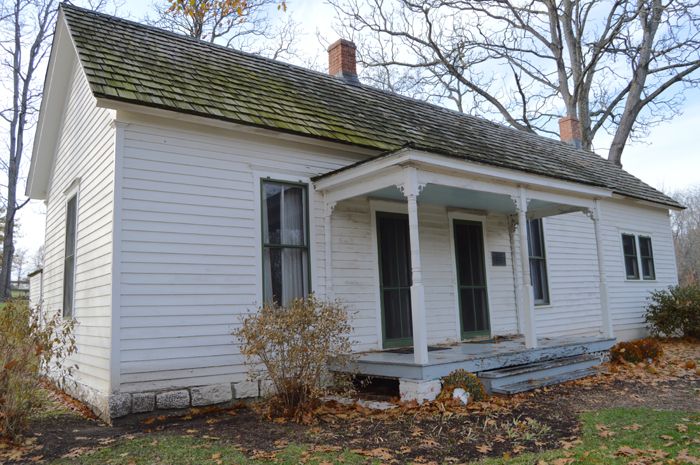
James Home in Kearney, Missouri, by Kathy Alexander.
By 1875, Alan Pinkerton had become infuriated by the agency’s failure to arrest even a single gang member. The agency had been hired in 1871 by several bankers and railroad owners to track down the deadly James-Younger Gang. In January 1875, a Pinkerton agent, Jack Ladd, was posing as a field hand at work on the farm across the road from the James Farm. The farm, belonging to neighbor Dan Askew, served as a hideout for the Pinkerton spy. The agent thought he spotted Jesse and Frank at the farmhouse one afternoon, though the brothers were miles away.
On January 26, six Pinkerton reinforcements surrounded the farmhouse and tossed a smoke bomb into the house to lure them out.
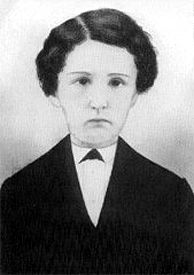
Archie Samuel.
However, Archie Samuel, thinking it was a loose stick from the fire, tossed it “back” into the fireplace, and the “bomb” exploded. The blast killed the young boy and wounded Zerelda’s hand so badly that she later had to amputate it.
Contemporary newspaper reports of the time simply reported the device as a “bomb,” and the public was incensed. However, the public wasn’t the only ones who were angry. On April 12, 1875, Dan Askew, the neighbor who had sheltered Jack Ladd, the Pinkerton Spy, was found with a bullet in his brain at his home. Later in the same month, Jack Ladd was also found shot and killed.
After moving around for a while, Jesse and Zee welcomed their first child, Jesse Edward, on August 31, 1875, on a leased farm near Waverly, Missouri. Jesse and Zee used the aliases Thomas and Mary Howard. While lying low for many months, Jesse dyed his light-colored hair dark and grew a beard to conceal his real identity. He then took to farming with his wife—but not for long. At this farm, the plans for the Northfield, Minnesota, Raid were devised.
The James Brothers, the three Younger Brothers, two Quantrill veterans named Clell Miller and Charlie Pitts, and a local outlaw named Bill Chadwell all traveled north, lured by Chadwell’s tales of easy pickings in his home state. Right down Jesse’s alley, he liked taking on a northern bank. Planning on making Mankato their first target, Jesse was recognized, and they quickly left town.
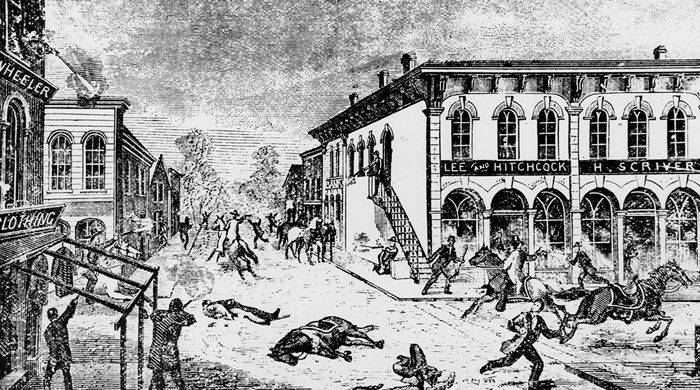
Northfield, Minnesota Raid.
They then rode toward Northfield, Minnesota, 50 miles to the northeast. Meeting on the outskirts of town on September 6, 1876, they cased the First National Bank, planning to rob it in the morning.
Two days after Jesse’s 29th birthday, on September 7, 1876, the James-Younger Gang attempted to rob the First National Bank of Northfield, Minnesota. The attempted robbery was to be the demise of the infamous James-Younger Gang. When asked to open the safe, Heyman, the bank cashier, refused and ducked.
Angered, Jesse put a pistol to his head and shot him. The shot was heard beyond the bank, and when the bank alarm began to go off, the Northfield citizens opened fire upon the gang. Charley Pitts and Bill Chadwell were killed. Cole, Jim, and Bob Younger were severely wounded but escaped. However, they were captured just one week later, east of Mankato. The Younger Brothers were sentenced to life terms in prison. Frank and Jesse escaped back to Missouri unharmed.
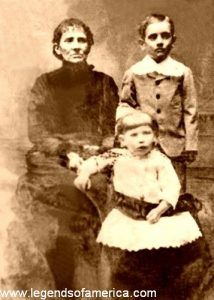
Jesse James Family.
On February 6, 1878, Frank and Annie James gave birth to Robert James, and on June 17, 1879, Jesse and Zee gave birth to a daughter, Mary Susan, who was born in Nashville, Tennessee, where Jesse and Zee stayed with Frank and Annie for a time.
With new gang members, the robberies continued over the next several years, including a stage hold-up near Mammoth Cave, Kentucky, a bank robbery in Muscle Shoals, Alabama, and a train robbery in Winston, Missouri.
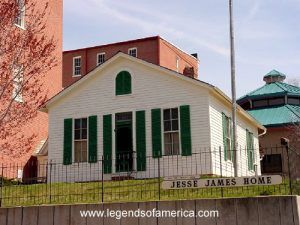
Jesse James Home in St. Joseph, Missouri, by Kathy Alexander.
Shortly after the gang’s last train robbery in Glendale, Missouri, on September 7, 1881, Jesse moved his family to St. Joseph, Missouri. Renting a house on 1318 Lafayette Street on December 24, 1881, the family settled in under Jesse’s assumed name of Tom Howard. With a $10,000 reward over his head, Zee tried to get Jesse to live a more normal life. And Jesse agreed after one last great bank robbery in Platte County, Missouri. Jesse had finally decided to retire, hopefully with enough money to become a gentleman farmer.
Planning the robbery with Bob and Charles Ford, whom Jesse had worked with in the past, the Ford brothers visited the James home in St. Joseph on the morning of April 3, 1882. Outlining his plans for the robbery with Bob and Charles in the parlor of his home, Jesse noticed that a framed needlepoint picture, made by his mother, hung crookedly on the wall. Standing on a chair to adjust the picture, Jesse turned slightly as he heard the sound of Bob Ford’s cocked pistol. Bob shot Jesse just below the right ear, and Jesse toppled to the floor dead. Jesse was 34 years old.
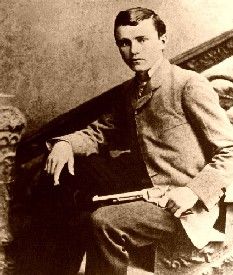
Robert “Bob” Ford.
At the sound of the gunshot, the children ran into the room, being the first to reach him. Zee followed, trying desperately to stop the blood. Bob Ford was already out the door, and Charles spent a few moments trying to tell her how the gun had gone off accidentally. Then, he, too, quickly exited, running after his brother.
Robert Ford killed James for two reasons. The first was that Ford had killed a man named Wood Hite in January 1882. When word of the shooting resulted in Ford’s arrest, he informed the officers that he had access to the much-wanted Jesse James. In a deal made secretly with Governor Thomas T. Crittenden, the governor promised Ford a pardon for the Hite murder if he would kill James. There was also a $10,000 reward on Jesse’s head that Ford hoped to collect.
After his death, Jesse was packed on ice and taken by train to Kearney, where he was displayed to hundreds of friends, admirers, and curiosity seekers. Later, he was buried on the family farm in a plot near the house so that Zerelda could keep an eye out for trespassers or souvenir hunters. His tombstone read: “In Loving Memory of My Beloved Son, Murdered by a Traitor and Coward whose name is not worthy to appear here.”
Initially, Ford was charged with murdering both Wood Hite and Jesse James, but true to his word, Governor Crittenden pardoned him while he stood trial for the murder. As to the money, he received only a fraction of the reward. Returning to their hometown of Richmond, Missouri, Bob and Charles were not greeted kindly, and residents found the killing of Jesse James so distasteful that they made life unbearable for the two brothers.
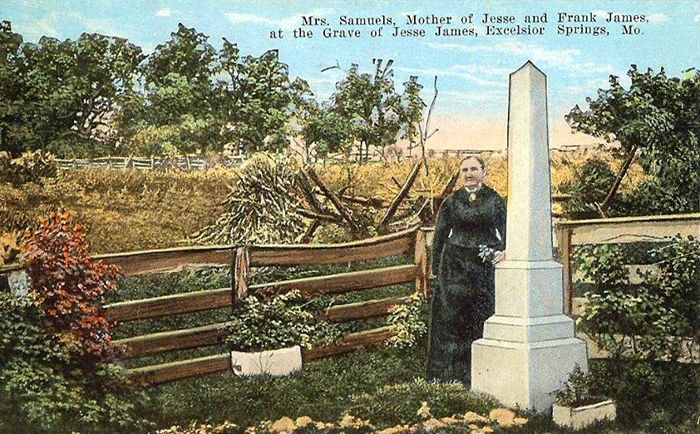
Jesse James’ mother, Zerelda, at his grave on the James Farm
Charles Ford fled Richmond when he heard that Frank James was searching for them to kill them in revenge for his brother’s death. Charles kept running from town to town for the next two years, changing his name several times. He finally committed suicide in 1884.
In the meantime, Bob Ford capitalized on his betrayal of Jesse James, taking to the stage and appearing in an act entitled Outlaws of Missouri.
Night after night, Ford retold his story, carefully omitting that he had shot James in the back. But this charade was short-lived as he was greeted with catcalls, jeers, hoots, and challenges. Ford later took off to Las Vegas, New Mexico, and then Creede, Colorado, where he was shot down in his saloon on June 8, 1892.
During their 15-year crime spree, the James-Younger Gang committed 26 hold-ups, making off with more than $200,000, and killed at least 17 men.
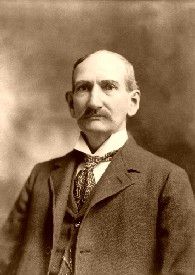
Frank James.
On October 4, 1882, Frank James surrendered to Missouri Governor Thomas Crittenden. The 39-year-old bandit marched into the governor’s office and took off his gun belt, placing it before Crittenden and saying: “Governor Crittenden, I want to hand over to you that which no living man except myself has been permitted to touch since 1861.” Frank was tired of the outlaw life – of being hunted for over 20 years, living in a saddle, and knowing no peace.
The public exhibited universal sympathy for Frank James and his family. After several long trials, Frank was acquitted on all counts. Returning home to the James Farm, he pursued several peaceful pursuits, including working as a horse trainer and a racetrack starter.
Jesse’s mother, Zerelda, allowed tourists to view her son’s grave for 25 cents and sold rocks from his grave. Legend says she restocked from the river when the supply ran low. She also gave paid tours of the farm shortly after Jesse’s death, a practice Frank continued in later years.
Zee James, who had suffered from deep depression after her husband’s death, died in 1900.
Later, when Zerelda could no longer live alone, her son’s body was moved to the Mount Olivet Cemetery in Kearney, Missouri, and placed next to his wife on July 29, 1902. Frank James was present at his brother’s reburial.
In 1903, Frank James appeared in a small Wild West show with his friend Cole Younger, who had been released from prison in 1901.

Zerelda James at her Farm.
On February 10, 1911, Zerelda Samuel, after visiting Frank and Annie at their home in Oklahoma, suffered a heart attack on the train back to Kearney at the age of 86. She is buried at the Mt. Olivet Cemetery next to sons Jesse and Archie, husband Reuben, and daughter-in-law Zee.
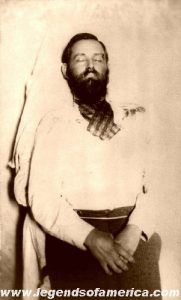
Jesse James Dead.
At 72, Frank James died from natural causes at the James Farm on February 18, 1915. His wife, Annie Ralston James, spent her widowhood at the farm.
©Kathy Alexander/Legends of America, updated June 2026.
Also See:
James Younger Gang – Terrorizing the Midwest
Jesse James, Missouri Attractions
See Sources.