
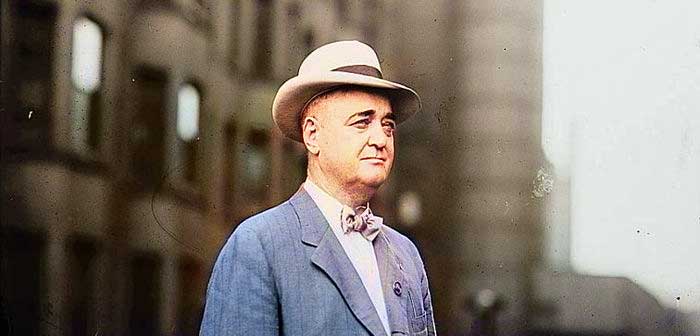
Bat Masterson in the later years of his life.
Bat Masterson, a lawman, gunfighter, gambler, and well-known Old West character, was one of the few who lived through the lawless days of the Old West without making a name for himself or counting notches on his belt. He was a genuine, honest man with no reputation for violence, but he was loyal to the end in defending his friends.
William Barclay Masterson was born on November 26, 1853, in Iberville County, Quebec, Canada. His father, Thomas Masterson, was born in Canada and worked as a farmer. His mother, Catherine McGurk, immigrated from Ireland. He was the second child in a family of five brothers and two sisters. They were raised on farms in Quebec, New York, and Illinois until they finally settled near Wichita, Kansas, in 1871. As a boy, he became an expert with firearms and joined expeditions to hunt buffalo.
In the Fall of 1871, 18-year-old Bat headed West to hunt buffalo along with his 19-year-old brother Ed. During this time, he camped with hunters working along the Salt Fork River in present-day Comanche and Barber Counties in Kansas, and during visits to other buffalo hunting camps, the brothers met several men who would also become legends in western history, including Wyatt Earp, Billy Dixon, Tom Nixon, and “Prairie Dog” Dave Morrow.
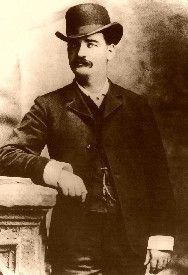
Bat Masterson, 1879.
His companions gave him the nickname “Bat” one day on one of these trips, after Baptiste Brown, or “Old Bat,” whose fame as a leader, hunter, and trapper was well known to the generation that preceded Masterson on the Western stage.
In the summer of 1872, Bat and Ed worked on a construction crew expanding the Atchison, Topeka & Santa Fe Railroad to Colorado. That Winter, they returned to buffalo hunting and were joined by their younger brother, Jim, in their camp along Kiowa Creek Southeast of Dodge City. In January 1873, the Masterson brothers gave up buffalo hunting. Bat remained in Dodge City, but his brothers returned to the family farm in Sedgwick County. However, the next month, Ed returned to Dodge and worked at the Alhambra Saloon. Bat returned to buffalo hunting, but the buffalo population declined. By 1874, the vast numbers of buffalo roaming Kansas had been slaughtered, so many hunters moved South and West into hostile Indian Territory.
In response, several merchants from Dodge City, Kansas, followed the buffalo hunters South into the Texas Panhandle and established Adobe Walls, a large complex near the Fort Adobe ruins. The business included a corral and restaurant, primarily serving the ever-increasing influx of buffalo hunters in the area. In April 1874, they opened a second store, followed by a saloon and blacksmith shop. By the end of spring, some 200-300 buffalo hunters roamed the area, and trade at Adobe Walls was booming.
However, several Indian tribes in the area correctly saw the post and buffalo hunting as a significant threat to their existence. Some buffalo hunters were being attacked. The hostile environment, however, didn’t stop Adobe Walls saloon owner James Hanrahan from leading a party of Dodge City buffalo hunters, including Bat Masterson, southward on June 5, 1874. Along the way, a band of Cheyenne Indians ran off their cattle stock about 75 miles Southwest of Dodge City. The hunters soon joined a wagon train en route to Adobe Walls, arriving just hours before the Indian attack, known as the Second Battle of Adobe Walls.
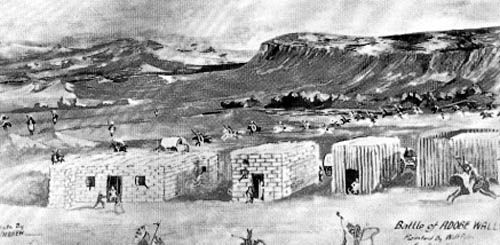
Adobe Walls, Texas.
Early on June 27, 1874, a combined force of some 700 Comanche, Cheyenne, Kiowa, and Arapaho warriors, led by Comanche Chief Quanah Parker and Isa-tai, attacked the buffalo camp. The 28 men, including Bat Masterson and Billy Dixon, took refuge in the two stores and the saloon. Despite being dramatically outnumbered, the hunters’ superior weapons repelled the Indian assault. After four days of continuous battle, about 100 men arrived to reinforce the post, and the Indians soon retreated. While estimates vary regarding the losses, as many as 70 Indians were killed, and many others, including Parker, were wounded. The men at Adobe Walls suffered four fatalities.
In response to the incident at Adobe Walls, Colonel Nelson A. Miles was ordered to lead an expedition against the Indians of the Texas Panhandle in what would become known as the Red River War. Masterson joined the expedition as a civilian scout and a teamster working out of Fort Elliot in what was then called Sweetwater, Texas (now Mobeetie). However, the following spring, he was back to buffalo hunting and spending time at his friend Charlie Rath’s store, located about five miles from the fort, which had become the “headquarters” for the buffalo hunters. He was also a frequent visitor to the many saloons in the area. By early 1876, he worked as a faro dealer in Henry Fleming’s Saloon.
On January 24, he became embroiled in an argument with Sergeant Melvin A. King over a card game and a dance hall beauty named Mollie Brennan. The argument quickly led to gunplay, and King was left dead. However, King’s shot passed through Mollie Brennan’s body in the melee, killing her and then hitting Masterson in the pelvis. The injury caused Bat to walk with a limp for the rest of his life.
After recovering, Masterson returned to Dodge City, Kansas, where he became a lawman with his friend Wyatt Earp under Ford County Sheriff Charles Bassett. During these years, Dodge City was known as a “wicked little town.” Cattle drives had replaced buffalo hunters, as longhorn cattle were driven up from Texas along the western branch of the Chisholm Trail to the railroad. Over five million head were driven on the trail into Dodge City for the next ten years.
In July 1877, Bat was appointed under-sheriff of Ford County under Sheriff Charlie Bassett. That same month, his brother Ed Masterson became an assistant marshal in Dodge City.
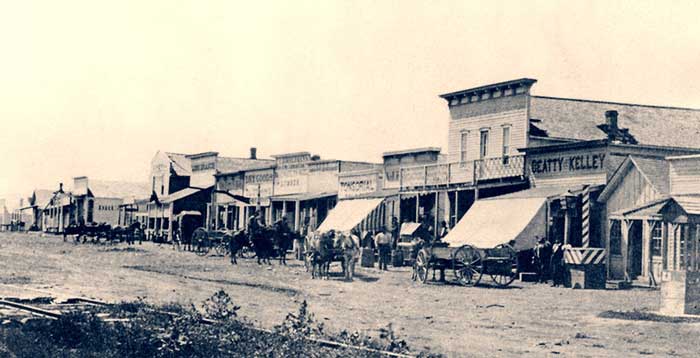
Dodge City, circa 1875
Just a few months later, in October, Bat announced in the Dodge City Times that he was a candidate for sheriff of Ford County, stating:
“At the earnest request of many citizens of Ford County, I have consented to run for the office of sheriff at the coming election in this county. While earnestly soliciting the suffrages of the people, I have no pledges to make, as pledges are usually considered, before the election, to be mere clap-trap. I desire to say to the voting public that I am no politician and shall make no combinations that would be likely to, in any way, hamper me in the discharge of the duties of the office and, should I be elected, will put forth my best efforts to discharge the duties of the office so that those voting for me shall have no occasion to regret having done so. Respectfully, W. B. Masterson.”
The newspaper backed him up by printing:
“Mr. W. B. Masterson is on the track for sheriff. Bat is well known as a young man of nerve and coolness in cases of danger. He has served on the police force of this city and also as undersheriff and knows just how to gather in the sinners. He is well qualified to fill the office and, if elected, will never shrink from danger.”
He was elected on November 6, 1877, and the newspaper reported that “Bat Masterson is said to be cool, decisive, and a bad man with a pistol.”
Bat officially took office as sheriff in January 1878 and wasted no time putting his talents to work. On January 27, 1878, Dave Rudabaugh and four other men attempted to rob a train at Kinsley, Kansas. Their robbery attempt was ineffectual, and the bandits fled. On February 1, Sheriff Bat Masterson led a posse, which included his brother, Ed Masterson, in pursuit of the would-be robbers. They captured two of them—Dave Rudabaugh and Edgar West —and apprehended the other two soon after.
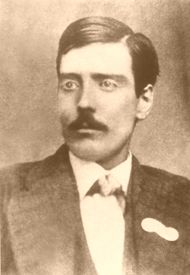
Ed Masterson.
On April 9, 1878, Ed Masterson, who had since become City Marshall, had disarmed a drunken cowboy named Jack Wagner, who violated the town’s ordinance against carrying guns. After taking his gun, Ed started walking away when Wagner produced another pistol and shot him. Although mortally wounded, Masterson could shoot back, hitting Wagner in the chest. Ed then walked across the street to George M. Hoover’s saloon, where he told the tale before sinking to the floor. He was taken to his room, where he died 30 minutes later. Jack Wagner also died the next day. The Dodge City Council then appointed Charlie Bassett as city marshal and, a few months later, appointed Wyatt Earp as Bassett’s assistant marshal.
On July 29, 1878, a cowboy named James “Spike” Kennedy attempted to shoot Mayor James H. Kelley. Marshal Bassett stopped him, fined him, and he ran out of town. However, the young man refused, returned to town, and was arrested again for being disorderly. After paying his fine, Kennedy was told by Marshal Bassett to get out of Dodge and stay out. But Kenedy had not yet seen the Dodge City lawmen’s last day.
In September, Bat and other area lawmen fought a different enemy: the Cheyenne. After the Battle of the Little Bighorn, the Northern Cheyenne Indians were banished to a reservation in Oklahoma. However, they were unhappy there, as hunting was sparse and conditions miserable. In September 1878, about 350 Northern Cheyenne men, women, and children escaped the reservation and began to make their way back North. Along the way, they fought skirmishes and raided throughout western Kansas.
As the Cheyenne continued their trek northward, the lawmen turned their attention back to Dodge City. Two shots rang out in the early morning of October 4, bringing officers running to determine the reason. When Assistant Marshal Wyatt Earp and Policeman Jim Masterson responded to the gunshots, they found that the bullets had been fired through the front door of a small frame house usually occupied by Mayor James Kelley. However, Kelley was out of town, and the shots intended for him killed a guest in the house — a 34-year-old woman named Dora Hand, who had been performing at the Lady Gay Saloon. Though no one saw who fired the shots, all were sure that it was the work of the cowardly James “Spike” Kennedy. The Dodge City Times noted: “The pistol shot was intended for the male occupant of the bed… who had been absent for several days. However, the female lodger occupied the bed at the time of the shooting.”
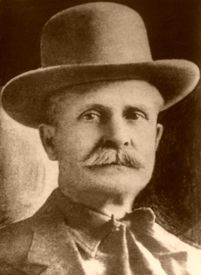
Bill Tilghman.
A posse rounded up that day included Marshal Charles E. Bassett, Assistant Marshal Wyatt Earp, soon-to-be lawman Bill Tilghman, Sheriff Bat Masterson, and Deputy Sheriff William Duffey. They caught up with Kenedy at about 4:00 p.m., and bullets began to fly. Kenedy’s horse was shot from beneath him, and the cowboy took a bullet that shattered his left arm. Kenedy was brought back to Dodge City. Kenedy was the son of a wealthy Texas cattle baron named Mifflin Kenedy, who soon rushed to Dodge City, bringing a large amount of money.
When Kenedy went to trial, he was acquitted for lack of evidence and released. The Ford County Globe reported:
“Kenedy, the man who was arrested for the murder of Fannie Keenan (Dora Hand), was examined last week before Judge [R.G.] Cook and acquitted. His trial occurred in the sheriff’s office, which was too small to admit spectators. We do not know what the evidence was or upon what grounds he was acquitted.”
Rumors abounded about a payoff, and years later, a historian claimed that MifflinKennedyy had paid as much as a $25,000 “fee” to town founder Robert M. “Bob” Wright, a member of the Kansas House of Representatives at the time, and potentially monies paid to Bat Masterson and other Dodge City officials to buy Spike’s acquittal.
The following year would also be eventful for Bat Masterson. In January 1879, Bat accepted an appointment as a deputy U.S. Marshall and successfully arrested “Dutch” Henry Borne, one of the biggest horse thieves in the American West. On February 17, 1879, he was delegated to bring the Cheyenne prisoners imprisoned at Fort Leavenworth, Kansas, to stand trial in Dodge City for depredations committed during the fall raid. The State of Kansas charged them with 40 murders in what would later be identified as the last “Indian raid” in Kansas.
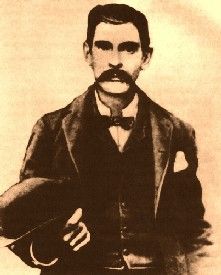
Doc Holliday, gunfighter.
In March, the Atchison, Topeka & Santa Fe Railroad was in major dispute with the Denver & Rio Grande Railroad over the right-of-way through the Royal Gorge in Colorado, and Bat Masterson was tasked with protecting the railroad’s interests. Some sources even allege that the Santa Fe Railroad used its political influence to secure a U.S. Marshal appointment for Masterson so he could legally defend its property. While lawyers argued the dispute in court, armed men hired by the Santa Fe Railroad took control of Rio Grande stations from Denver to Canon City, Colorado. With Bat in charge, he enlisted several well-known gunmen, including Doc Holliday, “Dirty” Dave Rudabaugh, “Mysterious” Dave Mather, Ben Thompson, and about 70 others. Known as the “Royal Gorge War,” the conflict involved extensive legal maneuvering and even threatened violence between rival railroad-worker gangs.
Bat’s men had great success through early June 1879, but on June 10, the courts ruled in favor of the Denver and Rio Grande Railroad. County and city officers drove out the Santa Fe Railroad’s gunmen. The Denver and Colorado Springs groups fell quickly. Bat’s headquarters in Pueblo, Colorado, held out the longest, but they too soon conceded defeat.
Bat then returned to Dodge City, where he ran for re-election in Ford County, Kansas, in November but lost to George Hinkle. In January 1880, he left the sheriff’s office in Dodge City and went to Colorado, where he spent some time gold prospecting but mostly gambling, dealing faro, and betting on sports. He then spent some time in Kansas City before going to Tombstone, Arizona, to work in the Oriental Saloon with Wyatt Earp in early 1881. In April 1881, he received word from a Dodge City friend that his brother James had been injured in a quarrel with the proprietor of the Lady Gay Dance Hall—a saloon operated by a man named Peacock and his barkeeper, Updegraff. He took the first train to Dodge City, arrived at 11 a.m., and soon met Peacock and Updegraff, whom he invited to come shooting. During the altercation, which was participated in by friends on both sides, only one man was hurt, Mr. Updegraff, and he recovered. After the battle, the mayor arrived on the scene with his Winchester rifle and ordered Masterson to throw down his gun, which he did at the solicitation of his friends. He and James were arrested, fined $5 and costs, and asked to leave town. He was 27 years old and had just had his last gunfight.
Bat then returned to Colorado, where he lived primarily as a professional gambler. He also spent a year as Trinidad, Colorado, marshal and served as Sheriff of South Pueblo, Colorado.
In 1883, he returned to Dodge City, where he participated in a bloodless conflict to defend his friend Luke Short in what is known as the Dodge City Saloon War.
In 1888, Masterson lived in Denver, Colorado, where he dealt faro for “Big Ed” Chase at the Arcade gambling house. The same year, he managed and later purchased the Palace Variety Theater. There, he met an actress and singer named Emma Moulton. He lived with her for several years, and reports say they married in November 1891 in Denver. The partnership lasted until Bat’s death.
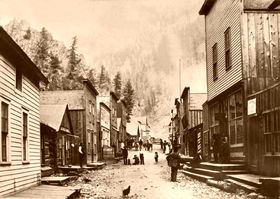
Creede, Colorado, 1892.
In 1892, he moved to the silver boomtown of Creede, Colorado, where he managed the Denver Exchange Club until a fire destroyed the town. Afterward, he continued to travel in the boomtowns of the West, gambling and promoting prize fights. He also began writing a weekly sports column for George’s Weekly, a Denver newspaper. He also opened the Olympic Athletic Club in Denver to promote boxing.
In 1893, he went to New York City at the request of a former superintendent of police, Thomas Byrnes. At that time, a prominent New Yorker named George Gould had received several threatening letters. Byrnes suggested to the multimillionaire that he needed a bodyguard and recommended Bat Masterson. For eight months, Bat shadowed Mr. Gould and hobnobbed with New York’s rich until the letter writer was finally apprehended.
In 1902, Masterson moved to New York and was arrested almost immediately for running a crooked faro game and carrying a concealed weapon. For the next 20 years, he lived and worked within walking distance of Longacre Square (now Times Square). In 1904, he became a sportswriter for the New York Morning Telegraph. The following year, he was appointed U.S. Marshal for the Southern District of New York, a post he held until 1909. During that same time, in 1907 and 1908, he wrote a series of articles for the short-lived Boston magazine Human Life about his old friends and adventures.
In 1910, Bat Masterson returned to Dodge City, Kansas, one last time. He wrote in the Morning Telegraph on July 31:
“In coming down the Arkansas Valley from Pueblo to Dodge… I could not help wondering at the marvelous change that had come over the country in the last twenty years. As I looked from the car window after reaching the Kansas line at Coolidge, I saw in all directions groves of trees, orchards, and fields bearing abundant crops of corn, wheat, and alfalfa… The idea that the plains of Western Kansas could ever be made fertile was something I had never dreamed of.”
On October 25, 1921, Bat Masterson died of a heart attack while working at his newspaper desk. At 67, he collapsed after penning his final column for the New York Morning Telegraph. He was buried in Woodlawn Cemetery in the Bronx, New York.
©Kathy Alexander/Legends of America, updated October 2026.
Articles by Bat Masterson for Human Life, 1907-1908:
Luke Short – A Dandy Gunfighter
Also See:
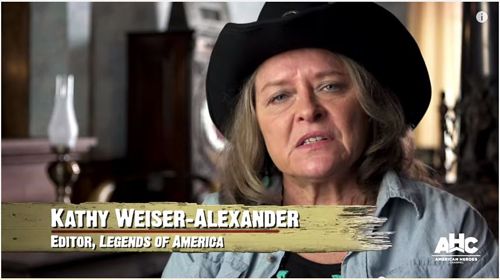
Kathy Weiser-Alexander is discussing Masterson on “Gunslingers,” which originally aired on August 2, 2015, on AHC.
Bat Masterson – King of the Gunplayers (by Alfred Henry Lewis, 1907)
Complete List of Old West Gunfighters
Dodge City – A Wicked Little Town
Sources:
Blackmar, Frank W.; Kansas: A Cyclopedia of State History, Standard Publishing Company, Chicago, IL 1912
Ford County Kansas History
Kansas State Historical Society
Wandering Lizard