
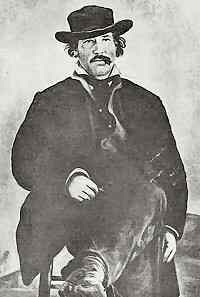
Lucien B. Maxwell.
Elizabethtown – Gone But Not Forgotten
Rayado – On the Santa Fe Trail
Cimarron – Wild & Baudy Boomtown
The Maxwell Land Grant, also known as the Beaubien-Miranda Land Grant, was a 1,714,765-acre Spanish grant that was the largest ever made in what would become the United States.
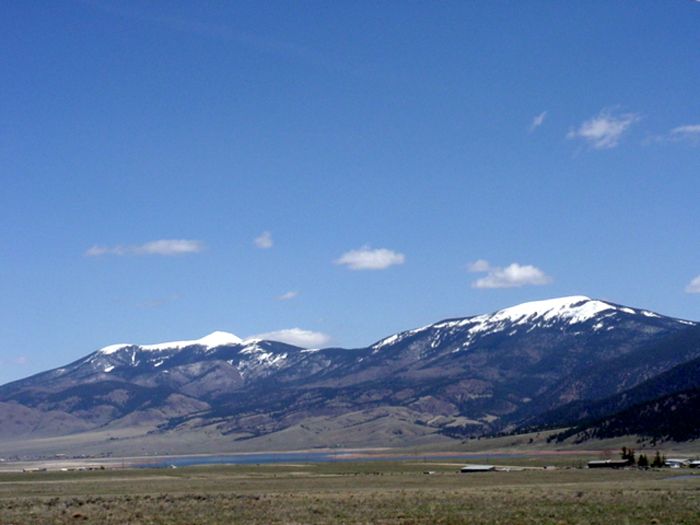
The Moreno Valley, New Mexico, was part of the large Maxwell Land Grant by Dave Alexander.
The large land grant included the western portion of Colfax County, New Mexico, and the southern part of Las Animas County, Colorado. Twice the size of the State of Rhode Island, the area included the towns of Cimarron, Springer, Raton, and Elizabethtown in New Mexico, as well as Segundo and other towns in Colorado. The area is surrounded by breathtaking mountain views, beckoning valleys, fish-filled streams, and hillsides alive with game.
Initially, the land was the undisputed territory of the Apache and Ute Indians, and later the Comanche. In 1841, just five years before the U.S. Army arrived, Charles Beaubien and Guadalupe Miranda of Taos, New Mexico, applied to Governor Manuel Armijo for the grant, promising to encourage new settlers to come to the area and utilize its resources. Beaubien was a French-Canadian trapper who came to New Mexico in 1832, became a Mexican citizen, married a 16-year-old native girl, and opened a store in Taos. Miranda was a gentleman from Chihuahua, Mexico, who had come to New Mexico on business and stayed; later, he was appointed to several government positions, including Governor Armijo’s departmental secretary.
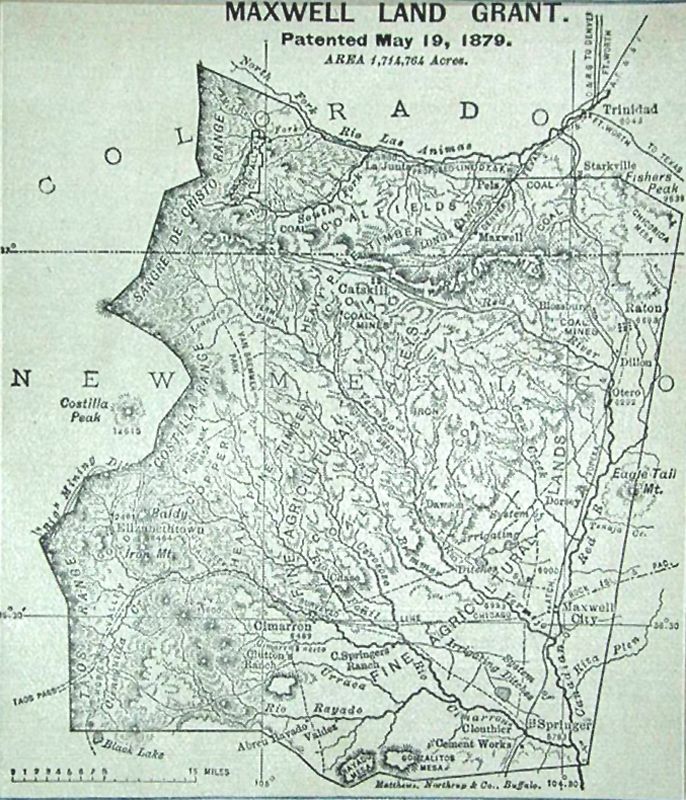
Maxwell Land Grant Map.
The governor supported the grant, thinking that Mexican settlers would fend off the encroaching foreigners from the United States and hostile Indians. Two years later, another consideration was possibly revealed when Miranda and Beaubien conveyed a quarter interest in the grant to Governor Armijo. Another quarter was deeded to Taos merchant Charles Bent in return for his promise to develop the grant. For whatever reason, Armijo approved the grant application within three days of receiving it. In 1843, after Armijo received his quarter interest, he approved an additional adjacent grant to Beaubien’s son, Narciso, and son-in-law, Stephen Louis Lee.
Then, along came Charles Lucien B. Maxwell, a fur trapper from Illinois who worked as a guide in the area. His work often brought him to the Beaubien-Miranda ranch, where he met and married one of Beaubien’s six daughters, Luz, who was only 15. After his marriage, Maxwell led a nomadic existence as a guide and, along with Kit Carson, led Colonel John C. Fremont across the desert to California in 1846.
John Fremont reported in his journal that Maxwell saved the expedition when he bravely confronted a band of 300 Arapaho warriors just as the shooting was about to start. “You’re a fool; God damn you!” Maxwell yelled at one of the attackers. “Don’t you know me?” The Indians were from a village where Maxwell had lived and traded a few years before. Instead of fighting, the two sides shook hands. Maxwell knew the land, its fierce people, and the tasks of courage and self-confidence.
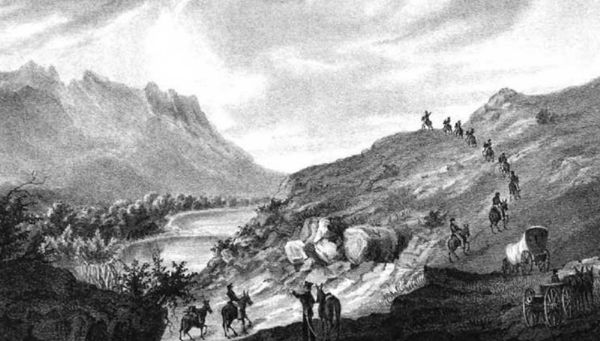
The Army of the West Travels into New Mexico
General Stephen Kearny led the U.S. Army into Mexican territory that same year. Governor Armijo briefly led a ragtag militia defending Santa Fe but fled in fear with Guadalupe Miranda to Chihuahua. After the invasion, New Mexico was incorporated as a territory, but because of its isolation and the hostility of the Apache Indians, the area attracted few settlers. Unaffected by the U.S. Army, Charles Beaubien stayed put, but the Taos Revolt ruined his plans for developing the grant in 1847 against the United States invaders. He turned the management of the grant over to his son, Narciso. However, both Narciso and Beaubien’s son-in-law, Stephen Lee, were killed in the Taos Revolt by a loose coalition of Indians and Mexican patriots. Also killed in the revolt was Charles Bent, whom the U.S. Army had appointed as New Mexico’s civilian governor. Beaubien inherited his son’s interest in the other grant.
Finally, Lucien Maxwell settled down on the ranch, and he and his wife eventually had four daughters and a son. Maxwell was said to have thought his son Peter was “worthless” because the boy did not share his interests and “wasted his time with worthless friends.” He favored his daughter Virginia, who he eventually named a small settlement after. Still, when she grew up and married someone Maxwell disapproved of, he refused to attend the wedding.
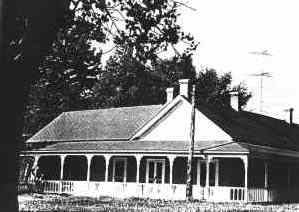
Maxwell House at Rayado, New Mexico.
Meanwhile, in 1848, Beaubien purchased Stephen Lee’s interest from the administrator of his estate for $100. Having lost interest in developing the new area, he turned the project over to his son-in-law, Lucien Maxwell. Maxwell’s success would be astonishing. He lost no time establishing a herd of cattle and increased the herd by setting up individual ranchers with their cattle, making payments on a share basis.
He kept his best animals and continually upgraded the remaining stock, including cattle, horses, sheep, and a large goat ranch. His manager would be well known in later years as Buffalo Bill Cody.
Before Cimarron existed, Maxwell founded the settlement of Rayado, about 11 miles South of where Cimarron sits today. Rayado, which means “streaked” in Spanish, was perhaps named for the beautiful cliffs near the settlement. Maxwell and his wife built a rambling one-story hacienda at Rayado, now a museum on the Philmont Scout Ranch.
Only Ute and Apache Indians were in the area, and they weren’t happy with Maxwell and frequently attacked the settlement. Life was risky, and settlers were reluctant to come until Maxwell brought Kit Carson from Taos, 35 miles West, as protection.
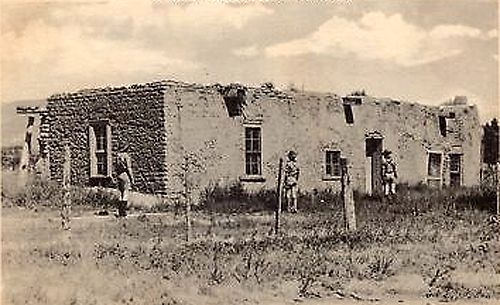
Kit Carson House, Rayado, New Mexico, in the 1940s.
Kit Carson built a place only a few miles away. Rayado was the first settlement East of the Sangre de Cristo Mountains and became a stagecoach and wagon stop along the Santa Fe Trail.
Maxwell and Kit Carson assembled a couple of herds of sheep and drove them over more than 1,000 miles of mountains and desert to California, netting them $20,000 to $50,000 each for their efforts.
On one such drive, they reportedly made a combined $100,000 but lost it to highwaymen on the Oregon Trail. Undaunted, they assembled another herd and did it all over again.
In 1850, the United States Army established a post at Rayado, and Maxwell let the soldiers rent his first home. Partially funded by the $200 monthly rent from the U.S. Army, Maxwell built a second home in the area that eventually grew to 16 rooms.
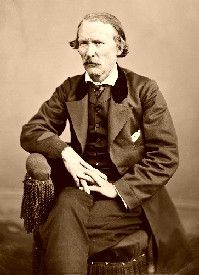
Kit Carson.
In 1857, Maxwell bought Guadalupe Miranda’s interest in the grant for $2,745. In 1858, Maxwell’s father-in-law, Charles Beaubien, paid a Santa Fe law firm to petition Congress to confirm the grant under the terms of the Treaty of Guadalupe Hidalgo. The lawyers said in their application that the grant had never been surveyed and that “no certain estimate of its contents” could be made. The petition also stated that only a small portion of the grant was “fit for cultivation.” The grant’s size was in question because, when Beaubien and Miranda originally applied, Mexican law limited each grantor to no more than 11 square leagues. A league was a variable unit of measurement, typically ranging from three to four miles. It can, therefore, be assumed that Beaubien and Miranda intended to acquire about 22 square leagues – or about 96,000 acres. The grant description was typically vague, contributing to the controversy. The documentation was susceptible to later “interpretation” – so much so that what came to be known as the Maxwell Grant was over 2,000,000 acres.
In a hearing, Kit Carson testified that Maxwell had transformed 200 acres of wilderness into farmland in just ten years, built buildings worth $15,000, and managed 15,000 head of cattle, which he provisioned for both the Indians and the U.S. troops. Congress confirmed the grant in 1858. That same year, Maxwell moved 12 miles North, from Rayado to the banks of the Cimarron River, where he built a third home.
In 1860, prospectors and miners began exploring the area. However, during the Confederate invasion in 1861-62, all mining activity in the territory was suspended. The area continued to become more populated, and as the number of people increased, wildlife dramatically decreased, especially the buffalo, leaving the native Indians with little to maintain their livelihood. The Apache and Comanche Indians retaliated against the newcomers by stealing livestock, including cattle, goats, and sheep, and sometimes killing the settlers. The Indian attacks and the bitter winters made life difficult for the first settlers. The U.S. Government stationed troops in the area after residents appealed.
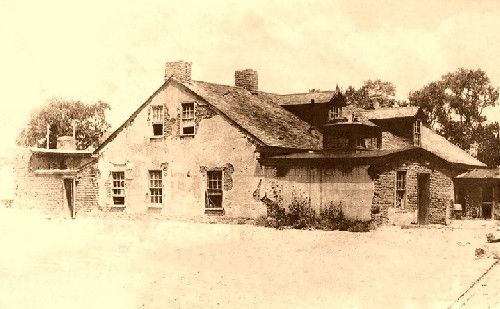
Maxwell House in Cimarron, New Mexico.
In 1864, after his father-in-law’s death, Maxwell and his wife bought out the five other heirs for $3,000 to $6,000. Eventually, the Maxwells owned the entire grant, paying $35,245 (a little over two cents per acre) for the 1,714,765 acres. They became the world’s largest landowners. He renamed the property the Maxwell Land Grant and made Cimarron his headquarters.
The same year, he built the Maxwell House in Cimarron, which was as large as a city block. This was not only his home but also a business that included a hotel, gambling rooms, a saloon, a dance hall, a billiard parlor, and an area for women of “special virtue.” Maxwell’s extravagant lifestyle was a marvel in a region where simple log and adobe houses were the norm. His mansion was said to have high, molded ceilings, deep-pile carpets, velvet drapes, paintings in gold frames, and four pianos. A frequent visitor to Maxwell’s home, Colonel Henry Inman, stationed at Fort Union, 55 miles South, was awestruck by the opulence. Maxwell, Inman wrote, “lived in a sort of barbaric splendor, akin to that of the nobles of England at the time of the Norman conquest.” Old registers included several prominent names, including Kit Carson, Clay Allison, Davy Crockett (the desperado, a nephew of the American frontiersman), and Buffalo Bill Cody, who organized his first Wild West Show in Cimarron.
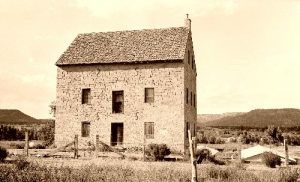
Aztec Mill, Cimarron, New Mexico.
In 1864, Maxwell hired a Boston engineering firm to design the Aztec Mill, a three-story grist mill that could grind 15,000 pounds of wheat daily. The mill supplied flour for Fort Union and distributed supplies to the Ute and Jicarilla Apache, for which the federal government compensated Maxwell. By this time, Maxwell had already become wealthy from his lucrative agriculture, cattle ranching, and real estate businesses.
Maxwell’s workforce is estimated to have been between 500 and 1,000. One of Maxwell’s men once said, “If a Mexican servant didn’t suit him or did anything against his orders, he took a board or plank or anything he could get hold of and whipped him with it. I knew him to tie up one man, a Mexican, and shave off the side of his head close to the skin with a butcher knife, then he struck him 15 or 20 lashes with a cowhide and told him if he ever caught him on the place again, he would kill him. Some 12 or 15 years later, he returned with a bunch of stolen horses, and Maxwell killed him.”
Maxwell gained a reputation for brutality and openly flaunted his wealth. He was said to leave the solid silver table service out in plain sight and keep as much as $30,000 in cash in an unlocked dresser drawer. Colonel Henry Inman, his frequent visitor, suggested Maxwell invest in a safe, to which he “only smiled, while a strange, resolute look flashed from his dark eyes, as he said, ‘God help the man who attempted to rob me, and I knew him!'”
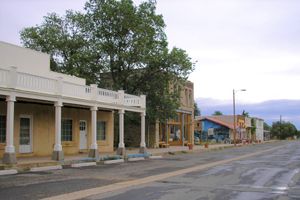
Cimarron, New Mexico, today by Kathy Alexander.
Once, it was said that two thieves took hundreds of dollars’ worth of goods and a valuable horse from Maxwell’s Cimarron store. Maxwell’s posse went after them and brought one of them back, at which time Maxwell clamped a 40-pound chain around his neck, imprisoned him in a cellar for two days without food and water, and then had him stripped and tied to a post and ordered one of his servants to lash him 25 times. Maxwell freed the prisoner when the servant completed the lashing, then ordered the servant to strip and tie him. After Maxwell’s 15th lash, the servant passed out from the pain, and when he revived, Maxwell said: “Now, when I put you to whip a man, I want you to do it as I whipped you!”
Though often harsh, he was also renowned for his generosity as a host, laying out food daily for about 30 people, some guests, and others traveling through the area. His grand house was a place of entertainment, where he built a track, hired a trainer, and ran races for substantial purses at least once a week. In his gaming rooms, cards flashed in a nightly whirl, and balls clicked on his billiard tables. Maxwell and Kit Carson would play poker for hours, and Carson usually won. Maxwell was said to have always extracted the last cent he won, though the next day he would often make a gift or a loan to his unsuccessful opponent from the night before. Once, it is said, after a wealthy traveler from the East insisted on knowing how much he owed for a night’s lodging, Maxwell, at last, roared, “Well, then it is $20, God damn it!” and when the flabbergasted guest handed over the vast sum, Maxwell used the bill to light his cigar.
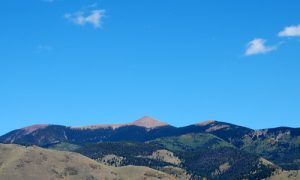
Baldy Peak, New Mexico. Kathy Alexander.
Copper was discovered on Baldy Peak, just West of Maxwell’s ranch, in 1866, a year after the Civil War ended. The value of the Maxwell Land Grant dramatically increased, and Maxwell seriously considered selling it for $75,000. However, he postponed his plans.
Maxwell became involved in mining activities and, in 1867, joined Captain William Moore, the founder of Elizabethtown, and others to form the Copper Mining Company. The company began extracting ore from Baldy Peak and soon found the first gold lode. The “gold fever” had taken root, and Maxwell began collecting rents and royalties from the placer miners, further adding to his vast wealth. Captain Moore’s Elizabethtown was growing by leaps and bounds, with many people flocking to the area in search of their fortunes.
Not to be outdone, Maxwell and some of his business associates, including Territorial Governor R.B. Mitchell, laid out another townsite just six miles from Elizabethtown. But Virginia City, named after Maxwell’s eldest daughter, was too far from the “action” and never really got off the ground.
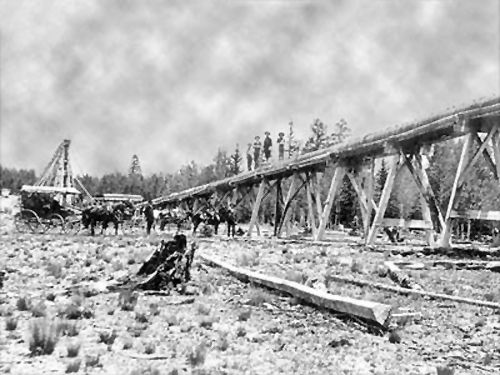
Big Ditch Flume.
One of the most significant problems that the miners faced was the territory’s chronic water shortage. Late in the summer, creeks and streams would dry up, and many placer miners would pack up, not returning until the snows melted the following spring. In 1867, Maxwell, Moore, and other entrepreneurs tried to solve this problem by planning to build “The Big Ditch.” The project involved a 41-mile aqueduct system that brought water from the Red River into Moreno Valley. The “Ditch” cost over $280,000 to build, with Maxwell providing most of the funds.
The New Mexican Miner then reported: “It was a colossal undertaking… a marvelous piece of engineering. The ditch forms three-fourths of a circle in its length of skirting along the edge of the mountains, bridging ravines and gullies.”
Though it was a grand idea, only about one-tenth of the water in the system came out the other end. The lucky entrepreneur, Maxwell, had made his first poor investment. As the water traveled over the 41 miles, it was lost due to the extensive leaks and seepage in the ditches and flumes. Although many repairs and maintenance were made, it was never a success, despite considerable gold being extracted with its aid. Later, the New Mexico Miner amended its initial opinion by stating: “The Lynch Ditch, which carries water from Red River to the Moreno placer mines at Elizabethtown, is to be sold next month at a sheriff’s sale to satisfy a judgment and cost aggregating $7,000.”
From this disastrous investment, Maxwell started the First National Bank of Santa Fe, but was ill-equipped to manage the complexities of banking, and he sold out at a heavy loss. He also invested $250,000 to help finance the Texas Pacific Railroad, but the project failed. It seemed as if the luck of the successful entrepreneur was coming to an end.
In 1869, Colfax County was established and named after the then-Vice President of the United States. Maxwell again considered selling the grant and realized that, to do so, he would need to establish clear title. He requested a survey of the grant from New Mexico’s surveyor-general, T. Rush Spencer. After Maxwell made the required deposit, Spencer sent a survey crew led by Santa Fe engineer William W. Griffin to Cimarron to begin the work.
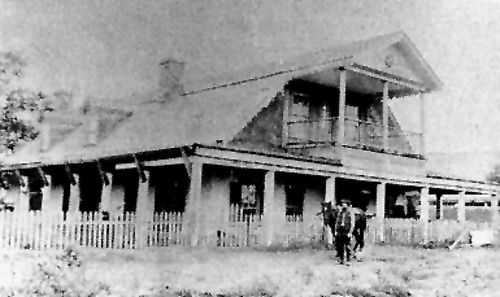
Maxwell’s house in Fort Sumner, New Mexico.
Spencer reported his action to Joseph H. Wilson, the Commissioner of the General Land Office in Washington. When Wilson reviewed the documentation, he noticed that part of the grant extended into Colorado and questioned whether Spencer had jurisdiction over the entire grant. Questions regarding the size of the grant and the jurisdiction nagged at him, so he ordered Spencer to cancel the survey until more information could be obtained. He referred the entire issue to his boss, Secretary of the Interior Jacob D. Cox.
Cox ruled that the New Mexico Congress had not intended to approve more than 22 square leagues to the two original grantees. Furthermore, he stated that if Maxwell agreed to this limit, he could choose the location for the specified amount of land, and the survey could be completed. Otherwise, Maxwell’s money would be returned, and his claim would be ignored.
Maxwell ignored the ruling and moved on. He sold his interest in the grant, and in 1870, he bonded the property to Senator Chafee of Colorado and two others for $650,000. He then sold all his other assets on the property for an additional $100,000 and moved to Fort Sumner, New Mexico, which had been demilitarized.
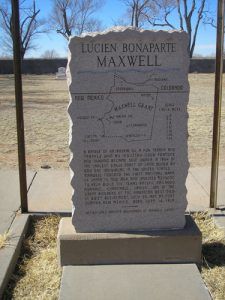
Lucien B. Maxwell Grave.
He purchased the buildings and other improvements and remodeled the officers’ quarters into a luxurious home with 20 rooms. Eventually, he slipped into semi-retirement and turned over most of his business affairs to his son, Peter. Five years after he sold the land grant, Maxwell spent the money and died in poverty on July 25, 1875, from what was diagnosed as uremic poisoning.
Meanwhile, the property he had sold became the site of a major dispute called the Colfax County War. The feud began in 1873 when the new owners of the Maxwell Land Grant attempted to evict local settlers from land they claimed to own. The vicious range war lasted until 1887, when it was finally resolved.
During the 1900s, the land was gradually subdivided, and ranchers, loggers, and private organizations bought the property. Chicago grain baron William Bartlett bought 500,000 acres for a hideaway home and built three mansions and a railroad for his guests’ convenience. Later, 200,000 acres of the private retreat were purchased and became the Vermejo Park Club, whose members included celebrities and the wealthy, such as Mary Pickford, Douglas Fairbanks, Cecil B. DeMille, Herbert Hoover, and Harvey Firestone. However, the club closed as the Great Depression set in, and the property reverted to ranching.
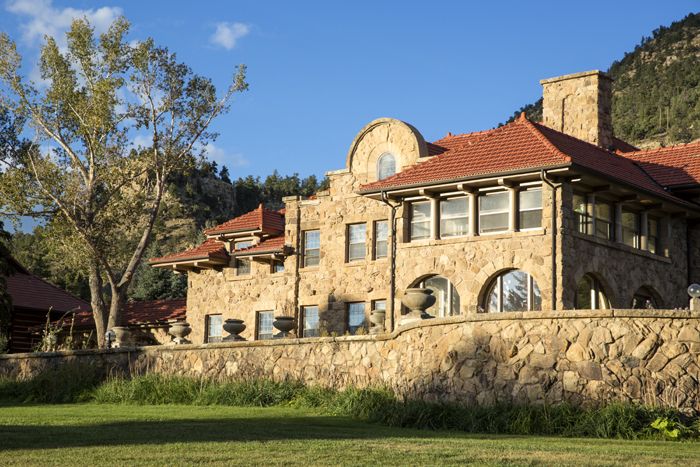
Casa Grande on the Vermejo Park Ranch, New Mexico, courtesy g2g collection.
The Vermejo Park property and other lands, totaling almost one million acres, were eventually sold to W.J. Gourley, a Texas oilman from Fort Worth. Mr. Gourley wanted to expand the existing elk herd and purchased several hundred elk from Yellowstone National Park for $5 per head. He also bred and raised wild turkeys to increase the wild bird population. When Mr. Gourley died in 1970, the land was sold to the Pennzoil Company for $26 million. Pennzoil donated 100,000 acres to the Forest Service in 1982. Now, media magnate Ted Turner owns part of the original land.
In 1922, Oklahoma oil millionaire Waite Phillips bought a significant portion of the land now known as the Philmont Scout Ranch. Mr. Phillips spent six months each year on the ranch, eventually amassing over 300,000 acres, and renamed it Philmont, based on the Spanish word for mountain, “Monte.”

Philmont Scout Ranch, New Mexico, courtesy of the Philmont Facebook Page.
The Philmont Ranch became a showplace where cattle and sheep grazed in the pasture. Phillips built a large Spanish Mediterranean home for his family and named it Villa Monte. He also developed horse trails, hiking trails, and hunting cabins for his friends and family.
In 1938, Waite Phillips donated 35,857 acres of the ranch to the Boy Scouts of America and $61,000 to support its development. In 1941, he added another 91,000 acres. Phillips realized the property’s maintenance and development costs could not come entirely from camper fees, so he included his 23-story Philtower Building in Tulsa, Oklahoma, in the endowment.
Later, in 1963, through the generosity of Norton Clapp, vice president of the National Council of the Boy Scouts of America, another piece of the Maxwell Land Grant was purchased and added to Philmont. This was the 10,098-acre Baldy Mountain mining area. Other large ranches and small tracts were carved out of the grant, and today, many people own the land that Lucien B. Maxwell once owned.
The Old Mill Museum, which Maxwell operated as the Aztec Mill until 1870, is in the Cimarron Historic District. But Maxwell’s Cimarron home didn’t fare so well, as it quickly fell into ruins when Maxwell left.
The Philmont Scout Ranch now maintains Rayado’s reddish adobe buildings. Scout leaders dressed in period costumes lead visitors through Maxwell’s adobe hacienda. It has been restored from the two original rooms that had survived. The 1860 stagecoach stop, store, and accommodations for stage passengers are in neighboring buildings.
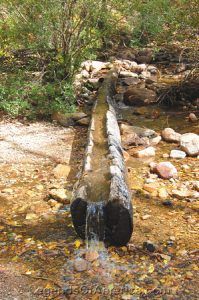
Clear Creek Log near the former site of Weather’s Store in Cimarron Canyon by Kathy Alexander.
Clear Creek, the site where they found the Reverend Tolby’s body after he was killed in the Colfax County War, was once a popular stop along the scenic highway when Weather’s Store resided in Cimarron Canyon, selling refreshments and novelty items to the travelers stopping by for a drink of Clear Creek’s cool waters flowing through a huge log. The store moved to Eagle Nest and remained open for years as an Antique Shop, run by the original owner’s daughter. Today, the site is an RV Park.
Maxwell’s last home in Fort Sumner is long gone, but has been repeatedly recreated in movie sets. After Maxwell’s death, his son, Pete, inherited it. In 1881, Pat Garrett shot a houseguest of Pete Maxwell (and more particularly of his daughter Paulita), William “Billy the Kid” Bonney, in this building.
In eastern New Mexico, 200 miles from Moreno Valley’s snow-capped peaks and cool valleys, the land baron lies buried in an almost forgotten corner of the dusty plains of Fort Sumner. In the same small cemetery, the graves of the outlaw Billy the Kid and two of his companions are buried under a headstone inscribed “Pals.”
Lucien B. Maxwell’s descendants still reside in the area. One of these was Moe Finley, his great-great-grandson, who ran the Mountain View Cabins and the Eagle Nest Marina at Eagle Nest Lake, where Maxwell once had a store. Moe kept a framed copy of a Maxwell Land Grant Company map on his dining room wall. Unfortunately, he didn’t inherit it; instead, he had to buy it. Moe laughingly said of Lucien: “I wish he’d left us the Vermejo, or 100,000 acres–or something!” Unfortunately, Moe Finley died in 2017. The site is now called Eagle Nest Cabins & Marina.
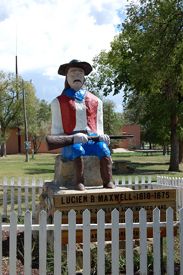
Maxwell Statue in Cimarron, New Mexico, by Kathy Alexander.
The only monument to Maxwell on the original grant is a concrete folk-art sculpture in Cimarron, New Mexico. Maxwell sits restless, facing west with a rifle in hand. Interestingly, the curator of the Aztec Museum said that the statue wasn’t built for Maxwell but for a man named Henry Springer. Mr. Springer didn’t like it and said, “Statues are for dead people.” So, the artist dedicated it to Maxwell instead.
©Kathy Alexander/Legends of America, updated October 2026.
Also See:
Kit Carson – Legend of the Southwest
Santa Fe Trail – Highway to the Southwest
Tales & Trails of the American Frontier
Special Note: This story about the Maxwell Land Grant, one of the first articles published on Legends of America in 2003, explores an area close to our hearts and the inspiration for our website: the Moreno Valley of New Mexico.