

Sioux Warriors by James Ayers.
First Sioux War – 1854-1855
Grattan Fight – August 19, 1854, Wyoming
Battle of Ash Hollow – September 3, 1855, Nebraska
Dakota War of 1862, Minnesota
Battle of Redwood Ferry – August 18, 1862, Minnesota
Battle of Lower Sioux Agency – August 18, 1862, Minnesota
Battle of New Ulm – August 19-23, 1862, Minnesota
Battle of Big Mound – July 24-25, 1863, North Dakota
Battle of Dead Buffalo Lake – July 26, 1863, North Dakota
Battle of Stony Lake – July 28, 1863, North Dakota
Battle of Whitestone Hill – September 3-5, 1863, North Dakota
Battle of Killdeer Mountain – July 28-29, 1864, North Dakota
Colorado War – 1863-1865
American Ranch Massacre – January 14, 1865, Colorado
Sand Creek Massacre– November 29, 1864, Colorado
Battle of Julesburg – January 7, 1865, Colorado
Battle of Platte River Bridge – July 26, 1865, Wyoming
Battle of the Badlands August 7, 1864
Powder River War – July 1-October 4, 1865, Wyoming and Montana
Crazy Woman’s Fork – August 13, 1865, Wyoming
Battle of Bone Pile Creek – August 13, 1865, Wyoming
Powder River Massacre – August 16, 1865, Wyoming
Battle of Tongue River – August 29, Wyoming
Sawyers Fight – September 1, 1865, Wyoming
Powder River Battles – September 1–15, 1865, Montana
Battle of Honsinger Bluff – August 4, 1873, Montana
Battle of Pease Bottom – August 11, 1873, Montana
Red Cloud’s War – 1866-1868, Wyoming and Montana
Cazeau Wagon Train, Wyoming – July 17, 1866
Crazy Woman Creek – July 20, 1866
Fetterman Massacre, Wyoming – December 21, 1866
Overland Route Attacks, Wyoming – Summer, 1867
Wagon Box Fight, Wyoming – August 2, 1867
Hayfield Fight, Montana – August 1, 1867
Bozeman Trail Battles – Fall, 1867
Great Sioux War – 1876-1877, Montana, Wyoming, Nebraska, South Dakota
Battle of Powder River – March 17, 1876, Montana
Battle of Prairie Dog Creek – June 9, 1876, Wyoming
Battle of Warbonnet Creek – July 17, 1876, Nebraska
Battle of Rosebud Creek – June 17, 1876, Montana
Battle of the Little Bighorn – June 25, 1876, Montana
Battle of Slim Butte – September 9, 1876, South Dakota
Battle of Cedar Creek – October 21, 1876, Montana
Dull Knife Fight – November 25, 1876, Wyoming
Battle of Wolf Mountain – January 8, 1877, Montana
Battle of Little Muddy Creek – May 7, 1877, Montana
Wounded Knee Massacre – December 29, 1890 – South Dakota
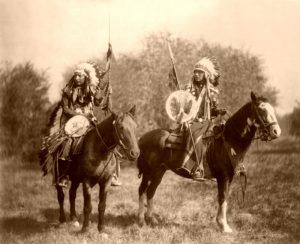
Sioux Indians on Horseback, by Heyn, 1899.
The Sioux Wars were a series of conflicts in the latter half of the 19th century between the United States and various bands of the Sioux people.
Sioux warriors assisted the British during the American Revolution and the War of 1812 and made their first treaty with the United States in 1815. Numerous treaties would follow, giving the tribe control of a vast region that encompassed much of what is today Missouri, Iowa, Wyoming, the Dakotas, Minnesota, and Wisconsin. Over the years, more treaties reduced their landholdings.
The earliest conflict came in 1854 when a fight broke out near Fort Laramie, Wyoming. Attacks and counterattacks followed for the next several decades as white settlers pushed westward and encroached westward upon Sioux lands. The fighting wouldn’t end until the final incident in 1890 during the Ghost Dance War.
There was a time when the land was sacred,
and the ancient ones were as one with it.
A time when only the children of the Great Spirit
were here to light their fires in these places with no boundaries…
In that time, when there were only simple ways,
I saw with my heart the conflicts to come,
and whether it was to be for good or bad,
what was certain was that there would be change.
– The Great Spirit
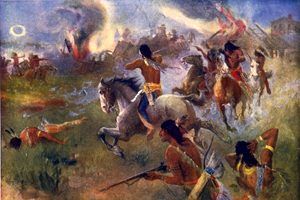
The Siege of New Ulm, Minnesota, by Henry A. Schwabe

Sioux Wars Map, courtesy Wikipedia
“This war did not spring up on our land; this war was brought upon us by the children of the Great Father who came to take our land without a price, and who, in our land, do a great many evil things… This war has come from robbery – from the stealing of our land.”
– Spotted Tail
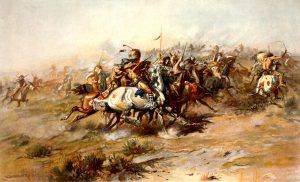
Battle of the Little Bighorn by C.M. Russell.
“One does not sell the land people walk on.” – Crazy Horse, September 23, 1875
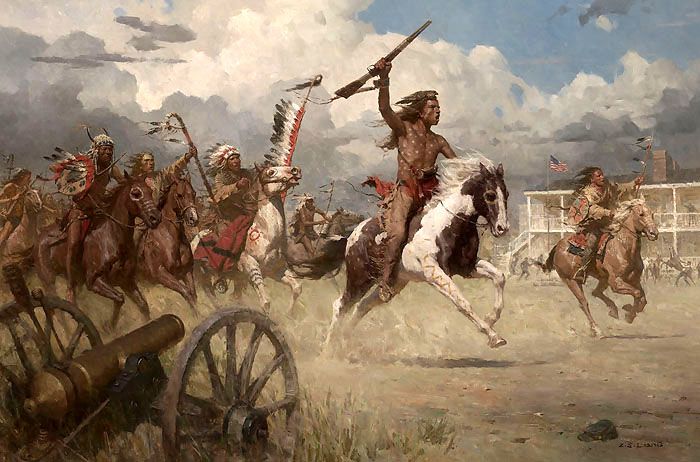
The Charge of Crazy Horse by Z.S. Liang, Greenwich Workshop.
Compiled by Kathy Alexander/Legends of America, updated August 2025.
Also See:
Indian War Campaigns and Battles
Lakota, Dakota, Nakota – The Great Sioux Nation
Winning The West: The Army In The Indian Wars
See Sources.