
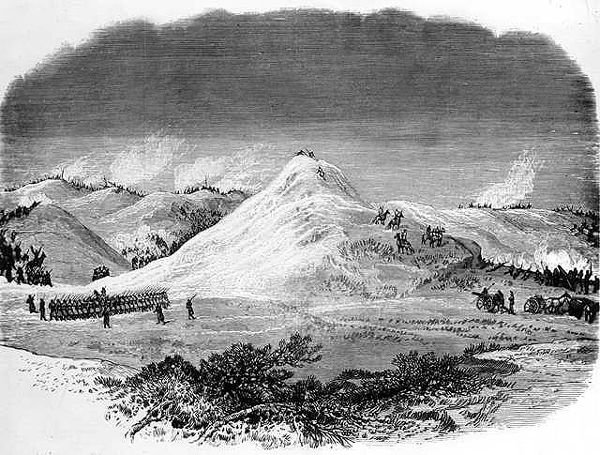
Battle of Wolf Mountain, Montana.
The Battle of Wolf Mountain occurred on January 8, 1877, in southern Montana, when the United States Army faced Lakota Sioux and Northern Cheyenne warriors during the Great Sioux War of 1876.
This battle marked the climax of Colonel Nelson A. Miles‘ Winter drive of 1876-77 to pursue the Sioux under Crazy Horse, who had annihilated the George Custer command the preceding summer on the Little Bighorn. In October, Miles captured and sent 2,000 of them back to the reservation. Despite blizzards and extreme cold, he remained in the field. On January 7, 1877, he camped beside the Tongue River on the southern flank of the Wolf Mountains. The following day, Crazy Horse and 800 Braves made a surprise attack. Miles and his howitzers, disguised as wagons, quickly repulsed it. The Indians took refuge on bluffs overlooking the camp. When the troops assaulted the bluffs, the warriors withdrew under cover of a snowstorm. Many surrendered with Crazy Horse and Dull Knife’s Cheyenne in the spring at Fort Robinson, Nebraska.
The battlefield is on the East side of the Tongue River, beneath Pyramid Butte, a spur of the Wolf Mountains. A gravel road crosses the river from the West, crosses the valley where Miles camped, ascends the bluffs just South of Pyramid Butte, the final Indian position, and continues toward the town of Birney. Except for the road, the site has remained unchanged since 1877.

Battle of Wolf Mountain, Montana.
The site is located in Rosebud County, on an unimproved road, about 15 miles Southwest of Birney, Montana.
The Wolf Mountains Battlefield was listed on the National Register of Historic Places in 2001 and became a National Historic Landmark in 2008.
©Kathy Alexander/Legends of America, updated September 2026.
Also See:
Indian Wars, Battles & Massacres
See Sources.