
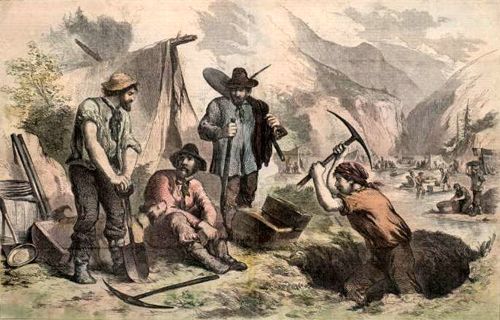
California Gold Miners.
By Zoeth Skinner Eldredge in 1912
Years before the discovery of gold on the American River, gold placers had been worked in California with varying degrees of success. But little attention was paid to this industry, and it was not considered of much importance by the Californians or the foreigners residing there. The priests discouraged mining, the rancheros were indifferent to it, and neither class wished to see the country with a mining population. On March 2, 1844, the deputy for California to the Mexican Congress, Don Manuel Castañares, reported to his government the discovery of gold in the vicinity of Los Angeles the previous year. From about the middle of the year to December 1843, these mines had produced 2,000 ounces, most of which had been sent to the United States.
He said the placers extended a distance of nearly thirty leagues (78 miles). William H. Thomes, writing from San Pedro, where the ship Admittance was taking cargo on June 30, 1843, says: “Here we also received ten iron flasks of gold dust, although where the latter came from no one knew, it was reported that the merchants of the Pueblo Los Angeles traded for it with the Indians and the latter would not reveal the source whence it came. When Alfred Robinson went to the United States in 1843, he carried to the mint in Philadelphia a package of gold dust from Abel Stearns of Los Angeles, the assay of which showed it to be .906 fine.
The placers from which this gold came were on the San Francisco rancho, near the mission of San Fernando. The rancho had formerly belonged to the mission, but at this time, it was in possession of the Del Valle family. The discovery was made in March 1842, and in the following May, Ignacio Del Valle was appointed encargo de justicias to preserve order in the mining district. William H. Davis states that between $80,000 and $100,000 worth of gold was taken from these places in two years. In his report of August 17, 1848, on the gold fields of California, Colonel Mason says: “The gold placer near the mission of San Fernando has long been known, but has been but little worked for want of water.”
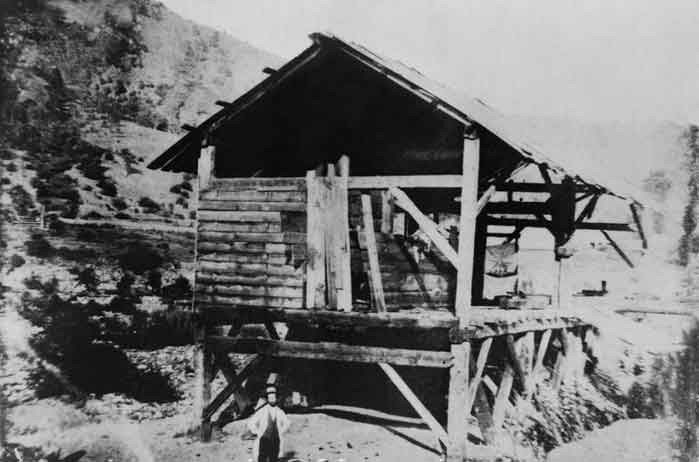
James Marshall at Sutter’s Sawmill, Coloma, California, 1851.
But the event that was to set the world ablaze and create an empire on the shores of the Pacific was the discovery by James W. Marshall of gold on the American River on January 24, 1848. It may seem strange that in a community where the somewhat extensive placers of the San Fernando Valley received so little attention, a discovery of gold placers in the Sacramento Valley should have created such intense excitement. The reason for this may be that reports of the gold region’s great extent and the placers’ astonishing richness followed the discovery on the American River so quickly. The gold deposits were on or near the surface, no capital was required to work them, and a laboring man with nothing but his pick, shovel, and pan could obtain from one to two or more ounces per day, with the possibility, always, of acquiring a fortune in a few weeks.
In the foothills of the Sierras, about 45 miles northeast of the Embarcadero of the Sacramento, on the south fork of the American River, Captain John Sutter was building a sawmill in the fall and winter of 1847 and employed James W. Marshall to superintend the work. In digging a tailrace for the mill, Marshall was habitually turning the water into the ditch at night to wash out the dirt loosened by the workmen during the day.
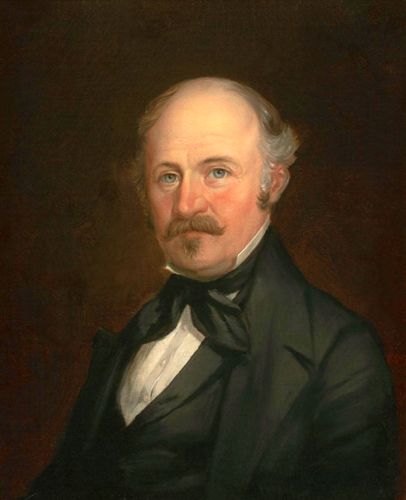
John Sutter.
On the morning of January 24, 1848, Marshall saw and picked up a glittering piece of gold weighing about half an ounce in the mill race. The men picked up other particles, and, satisfied with the importance of the find, Marshall took it to Sutter. Sutter was anxious to complete his mill and a grist mill he was erecting on the American River, and he and Marshall agreed to keep the discovery quiet. The attempt was useless; the men soon quit work and went to dig for gold. Sutter, a sub-agent for the Sacramento Valley, obtained a lease of twelve square miles from the Indians of the Yalesumi tribe on the American Fork and sent it to Governor Mason for confirmation. This Mason refused, stating that the United States did not recognize the right of Indians to sell or lease land to private individuals on which they resided.
The news of the discovery spread like magic. Remarkable success attended the labors of the first explorers, and in a few weeks, hundreds were engaged in the placers. By August 1, it was estimated that 4,000 men were working in the gold district, of whom more than half were Indians, and that from $ 30,000 to $ 50,000 worth of gold was obtained daily. Colonel Mason reported that no thefts or robberies had been committed in the gold region, and it was a matter of surprise to him that such a peaceful and quiet state of things should continue to exist.
The discovery changed the whole character of California. Before engaging in agriculture and cattle raising, its people had gone to the mines or were on their way there. Laborers left their workbenches and tradesmen their shops; sailors deserted their ships as fast as they arrived on the coast. Mason reported that 76 soldiers had deserted from the posts of Sonoma, San Francisco, and Monterey for a few days. He feared that the garrisons would desert en masse. As a laborer, a soldier could earn in one day at the mines double a soldier’s pay and allowances for a month, while a carpenter or mechanic would not listen to an offer of less than $15 or $20 a day.
“Could any combination of affairs try a man’s fidelity more than this?” writes the governor, “I really think some extraordinary mark of favor should be given to those soldiers who remain faithful to their flag throughout this tempting crisis.”
In July 1848, Colonel Mason made a tour of the mining region. “Many private letters have gone to the United States,” he says, “giving accounts of the vast quantity of gold recently discovered, and it may be a matter of surprise why I have made no report on this subject at an earlier date. The reason is that I could not bring myself to believe the reports I heard of the wealth of the gold district until I visited it myself. I have no hesitation in saying that there is more gold in the country drained by the Sacramento and San Joaquin Rivers than will pay the cost of the present war with Mexico a hundred times over.” In November, he writes: “Gold continues to be found in increased quantities and over an increased extent of country. I stated to you in my letter, No. 37, that there was more gold in the country drained by the Sacramento and San Joaquin Rivers than would pay all the cost of the war with Mexico one hundred times over; if I had said five hundred times over, I should have been nearer the mark. Any reports that may reach you of the vast quantities of gold in California can scarcely be too exaggerated for belief.”
San Francisco was not inclined to accept the reports of gold discoveries. However, a few men slipped out of town to investigate for themselves, keeping their movements quiet as if fearing ridicule. Several well-laden diggers arrived, bringing bottles, tin cans, and buckskin bags filled with the precious metal. “Sam Brannan, holding in one hand a bottle of gold dust and swinging his hat with the other, passed along the street shouting: “Gold! Gold! Gold from the American River.” The excitement was immense, and the exodus was already underway in a few days. They went by boat, by mule and horse, or on foot, all eager to reach the mines, fearful that the gold would be gone before they could get there and receive their share. Business houses closed their doors.
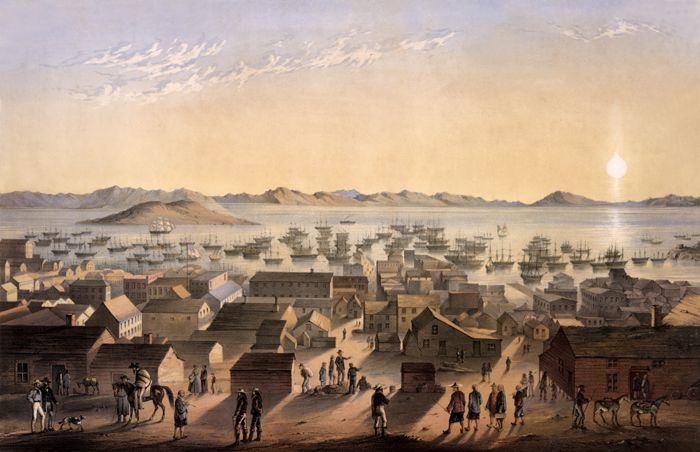
San Francisco, California, by Frank Marry, about 1850.
There was no service in the little church on the plaza, and a padlock was on the door of the alcalde’s office. The ships in the harbor were deserted alike by masters and sailors. Soldiers deserted their posts and fled, taking their arms, horses, blankets, and other belongings with them. Others were sent after them to force them back to duty, and all, pursuers and pursued, went to the mines together. General Sherman, then lieutenant of 3d artillery, tells how he organized a force of seven officers to pursue and bring back 28 men of the 2d Infantry who had deserted in a body, taking their arms and accouterments. They captured and brought in 27 of them.
On July 25, 1848, Governor Mason issued a proclamation that recited the fact that many citizens had gone to the gold mines without making proper provision for the families they had left behind; that many soldiers, tempted by the flattering prospects of sudden wealth had deserted their colors to go to the same region, regardless of their oaths and obligations to the government, thus endangering the safety of the garrison; and he declared that unless families were guarded and provided for by their natural protectors, and unless citizens lent their aid to prevent desertions, the military force in California would concentrate in the gold region, take military possession of the mining district, and exclude therefrom all unlicensed persons. All citizens who employ or harbor deserters would be arrested, tried by military commissions, and punished according to the Articles of War.

San Francisco, Broadway Wharf, by Lawrence and Houseworth
Twelve days after issuing the preceding proclamation, the governor received notice of the ratification of the treaty of peace between the United States and Mexico. He at once ordered the New York volunteers — Stevenson’s regiment — mustered out, their term of service having ended with the war. The Mormon Battalion had been previously mustered out on expiration of their term of service. This left the commander but two companies of regular troops — F Company, 3d artillery, numbering 62 officers and men, and C Company, 1st dragoons, comprised of 83 men, a total in California of 145 soldiers, with the ranks being depleted daily by desertions, and not a warship on the coast of the province. The governor, without the machinery of civil government, with no civil officers, save the few alcades he had appointed. Unsustained by adequate military force, he was compelled to exercise control and maintain order in a country extending over 600 miles in length by 200 in width, over a community composed of about equal numbers of Californians and foreigners, the latter essentially made up of runaway sailors and men accustomed to a lawless life, jealous of each other and the Californians, all wrought up to an intensity of excitement by the gold discoveries, and now increased by a 1,000 soldiers discharged without pay.
It was a case requiring skill, judgment, and determination. All the complex responsibilities of a civil administration thrust upon a military commander, without council or legislative support, were to be met, and the honor of the United States government was to be maintained. The trial of criminals, the establishment of port duties, the registration of vessels, the making of custom-house regulations, the examination of ship’s papers, the collection of duties, the appointment of collectors, alcades, judges, etc., the prevention of smuggling, represent a few of the responsibilities of the governor.
On August 14, 1848, Major Hardie wrote to the governor from San Francisco that the lack of force to support the civil organization at that place was likely to be productive of the most serious consequences. That the lower classes of the community were of the most lawless kind, and when their ranks were swelled by disbanded volunteers, freed from the restraints of discipline, there would be no security for life or property.
Captain Folsom, the assistant quartermaster, wrote the same day that acts of disgraceful violence were of almost daily occurrence on board the shipping in the harbor, and the officials had no power to preserve order; that his “office is left with a large amount of money and gold dust in it, and the volunteers are discharged without pay.” “We collect port charges, etc.,” he writes, “from both foreign and American vessels, and in return, we are under the most imperative obligation to protect trade.” It is not to be wondered at that Mason, as colonel of the 1st dragoons, applied to the War Department on November 24, 1848, to be ordered home, having been absent from the United States for two years.
In addition to the outrages committed by lawless men, the disbanding of the Mormon Battalion and the Stevenson regiment, and the absence at the mines of a large portion of the citizens left the country defenseless against the inroads of hostile Indians.
In an attempt to stem the desertion of his men, Colonel Mason granted furloughs permitting them to go to the goldfields for two or three months. These soldiers met with varying degrees of success. One of them, Private John K. Haggerty, of F Company, 3rd artillery, came back from the mines with 60 pounds of gold ($15,000).
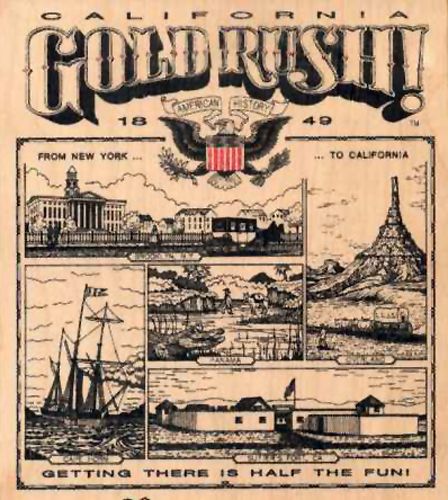 Throughout the Americas and Europe, the most astonishing reports were received from the goldfields of California. General Smith, writing from Panama, January 7, 1849, says that none of the accounts received were exaggerated; there had been brought to Valparaiso and Lima before the end of 1848, gold valued at $1,800,000; that the British consul at Panama had forwarded 15,000 ounces. ($240,000) across the isthmus, and that the commander of the Pandora, Royal Navy, informed him that the truth was beyond the accounts he had heard. General Smith was also informed that hundreds of people from the west coast of South America were embarking for the goldfields. In a subsequent letter, he states that he has learned from various sources that a significant emigration of people from all nations to California has occurred, and that many are departing with large quantities of gold. He says that on his arrival there, he shall consider everyone, not a citizen of the United States, who enters public land and digs for gold as a trespasser and shall so treat him.
On April 12, 1848, the Pacific Mail was incorporated with a capital of $500,000, and contracts were entered into for the construction of three steamers: the California, the Oregon, and the Panama. The California was completed first and sailed from New York on October 6, 1848, under the command of Cleveland Forbes.
Meanwhile, the reports from California of the extent of the goldfields and the marvelous quantities of the metal obtained by men unskilled in mining and without capital were received in the eastern states and Europe. In November 1848, Lieutenant Loeser of the 3rd Artillery arrived with dispatches from the military governor of California, confirming the most extravagant reports from the goldfields and bringing tangible evidence in the form of a box filled with gold dust.
The gold was placed on exhibition at the War Office, and the president embodied Mason’s report in his message to Congress on December 5. The entire community went wild with excitement. With the president’s endorsement, Mason’s report was published in the principal newspapers worldwide. The “gold fever” was on, and companies outfitted for California came from all parts of the world. From Sonora in Mexico, thousands of men came overland, while from the coasts of Chile and Peru, many more came by sea.
Thousands started from the Atlantic ports of the United States for Panama, Vera Cruz, and Nicaragua. The steamer Falcon from New Orleans landed at Chagres, the first adventurers for California, several hundred in number, all determined to board the steamer California at Panama, if possible. The route across the isthmus was a fearful one; by canoe up the Chagres River to Cruces, the head of navigation, then by mule, if one was to be had, or on foot to Panama.
There was an insufficient number of boats to carry the adventurers up the river — a journey of several days– and consequently, people had to wait at Chagres. From Cruces to Panama, the baggage had to be carried on the backs of men. The excessive rains, the trouble, vexation, and exposure caused a vast amount of sickness, and few escaped the “Chagres fever.” To augment their troubles, cholera appeared, followed by several deaths. This caused a stampede when all baggage and property of every description were abandoned and left on the route while the panic-stricken emigrants fled to Panama. Their belongings were afterward brought in by natives who were satisfied with reasonable compensation for their faithful services. The Falcon brought to Chagres Major-General Persifer F. Smith, appointed to command the Third (Pacific) Division. Captain Elliott and Major Fitzgerald of his staff were taken with cholera, and Elliott died and was buried in the churchyard at Cruces. Arriving at Panama, there was a long wait for the steamer. At the same time, the number of emigrants increased daily, and the city’s inhabitants became alarmed at the prospect of pestilence and famine. Provisions rose to famine prices, and the emigrants suffered great distress. At length, the long-looked-for steamer was sighted and anchored in the harbor on January 17. All was excitement, and many hurried off to the ship thinking of securing passage, but they were not permitted to board and were obliged to return. The ship had accommodation for seventy-five, cabin and steerage, and f1,500 clamored for passage. She had stopped at Callao and had taken on fifty passengers for San Francisco, although it was understood that none were to be accepted until Panama was reached. It was decided that the New York passengers holding through tickets should be provided for first; afterward, those from South America, and finally, as many as possible from among the first applicants for passage at the office in Panama. On February 1, the California sailed for San Francisco with 350 passengers. The ship was so crowded it was difficult to move about, either on deck or in the cabin.
On February 28, the California steamed past the rugged cliffs of the Golden Gate into the warm sunshine of a California spring, past the green slopes of Marin and the purple heights of Tamalpais, past the islands of the bay and Alta Loma, and cast anchor before a most disreputable collection of adobe houses, wooden shacks, and tents — the outpost of this new Colchis — with its background of windswept dunes, bleak and desolate. The weary Argonauts were joyfully welcomed. The ships in the harbor donned their gayest bunting; the Pacific squadron’s guns boomed while the warships’ yards were manned with blue jackets. The winter rains had driven the miners to cover, and the town was whole. Gold dust was plenty, and the gambling houses ran day and night. The people were rough and uncouth, but they gave the newcomers a hearty welcome and celebrated with ardor the establishment of steam communication with the world.
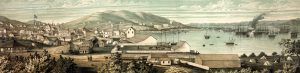
San Francisco, California, by Henry Firks, 1849.
Nothing lofty in the motive that brought this band of adventurers to these shores, and nothing particularly remarkable about the men who composed it. They were strong, courageous, and undaunted. They came to make a fortune and return; they remained to create an empire. It was the part the Argonauts played in the founding and building of a great commonwealth on the Pacific coast that gives significance to their coming.
When the California sailed away from Panama, she left behind a multitude of emigrants, all disappointed, some filled with rage, some with despair. A few sailing vessels were chartered to carry the adventurers to California, and it is said that some tried to follow the coast in log canoes, only to perish or be driven back after futile struggles with the winds and currents. The Oregon, the second Pacific Mail steamer, arrived in Panama about the middle of March. The crowd had doubled. The Oregon took on about 500 and reached San Francisco on April 1. Profiting from the experience of the California, the captain took the precaution to anchor his ship under the guns of a man-of-war and placed the most rebellious of his crew under arrest. With barely enough coal to carry him to San Blas, he sailed on April 12, carrying back the first mail, treasure, and passengers. On May 1, the California, having obtained a crew, sailed for Panama. The Panama, the third steamer of the Pacific Mail, arrived at San Francisco on June 4th, 16 days from Panama. The Oregon brought several other important men, some of whom would leave their mark on the Golden State.
Ships began to arrive from all parts of the world, crowded with treasure seekers, and by the middle of November, upwards of 600 vessels had entered the harbor, and the larger part of these was left swinging at their anchors while their crews rushed to the gold mines. Colonel Mason advises the adjutant general of the arrival of a ship at Monterey loaded with ordnance stores and says that it will cost more to unload the ship than the total freight from New York to Monterey.
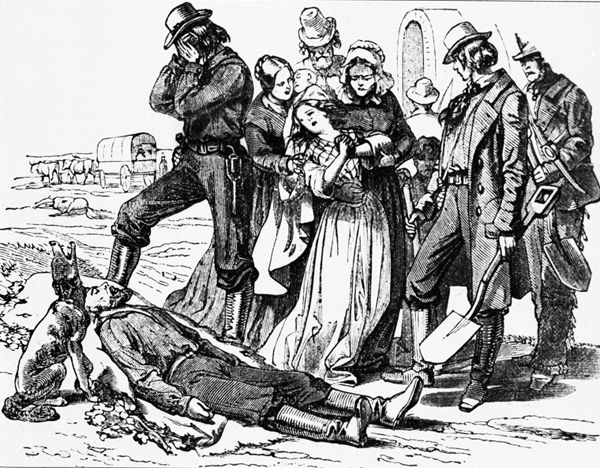
Death on the Trail.
The sufferings of the emigrants who came by sea, great as they were, were nothing compared to those who came by land. Not since the Middle Ages’ Crusades has anything approached the magnitude, peril, and endurance of overland emigration. It is estimated that during 1849, 42,000 emigrants came overland to California, of whom 9,000 were from Mexico. Eight thousand Americans came by the Santa Fé Route and 25,000 by the South Pass and the Humboldt River. Bayard Taylor wrote: “The emigrants we took on board at San Diego were objects of general interest. The stories of adventures sounded more marvelous than anything I had heard or read since my boyish acquaintance with Robinson Crusoe, Captain Cook, and John Ledyard. The emigrants by the Gila route gave a terrible account of the crossing of the great desert lying west of the Colorado River. They describe this region as scorching and sterile — a country of burning salt plains and shifting hills of sand, whose only signs of human visitation are the bones of animals and men scattered along the trails that cross it. The corpses of several emigrants, out of companies that passed before them, lay half-buried in sand, and the hot air was stifled by the effluvia that rose from the dry carcasses of hundreds of mules. There, if a man faltered, he was gone; no one could stop to lend him a hand without a likelihood of sharing his fate.”
The rendezvous for overland emigrants was usually Independence, Missouri, for both the Oregon and Santa Fe Trails. Throughout the eastern states, the winter of 1848-49 was one of preparation. Emigration parties were formed in almost every town, each member contributing a fixed amount to the outfit. These were as elaborate as the members’ taste suggested or their means permitted. Provisions for the journey and one or two years in California with every known implement for digging and washing gold, arms, ammunition, ample supplies of clothing, blankets, etc., and in some cases, goods for barter or sale characterized the equipment of the emigration of 1849. Vehicles of every conceivable kind and quality were seen, from the ponderous “prairie schooner” drawn by three yokes of oxen to the light spring wagon, riding horses and pack mules, together with relays of animals for heavy hauls.
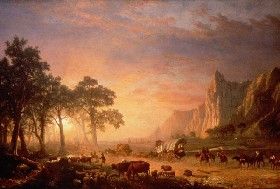
Albert Bierstadt’s Oregon Trail, 1869.
Arriving at the rendezvous, the small parties were joined by a large group, which included individuals and families who had arrived singly. A captain was then selected, and the caravan set out on its 2,000-mile journey. The northern route was by the so-called Oregon Trail, up the north fork of the Platte to the Sweetwater, up the Sweetwater, through the South pass, to the Green River, down the Bear to Soda Springs, to Fort Hall on the Snake River, to the Humboldt, down the Humboldt to the sink, across the desert to the Truckee River, over the Sierra Nevada to the headwaters of the Bear River, then down the river to the Sacramento and Sutter’s Fort. Three routes offered themselves from the sink of the Humboldt: northerly to the Pitt River pass; west, across the desert to the Truckee; and southerly to Carson Valley, where grass and water were, and then over the Sierra to the south fork of the American River.
It is estimated that by the end of April 1849, 20,000 emigrants were in camp on the Missouri River, waiting for the grass on the plains to be high enough to feed. Many companies had started earlier, and by mid-May, the trail from the Missouri River to Fort Laramie presented a continuous line of wagons and pack trains. Through the valley of the Platte, cholera broke out, claiming many victims and spreading terror through the ranks of the emigrants. This began to disappear as they approached the Rocky Mountains. At last, after some days of travel through a rugged and broken country where high bluffs force them from the river to make long detours, Fort Laramie is reached, and the journey’s first stage is completed.
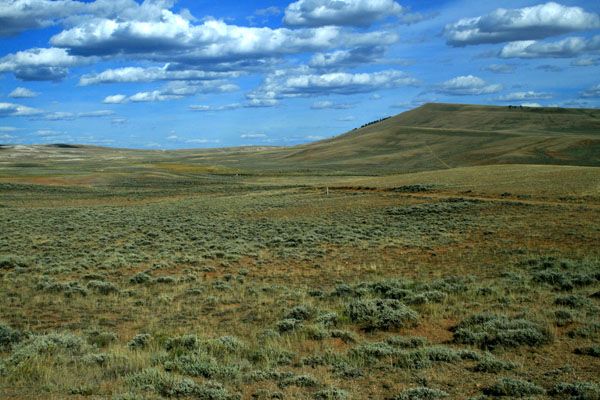
South Pass, Wyoming.
For the next 300 miles, the country is a desert, with little grass and less water, through the forbidding Black Hills, up the Sweetwater River, across the continental divide by the South Pass, at an elevation of 7,085 feet, then through a somewhat better country, the Green River Valley, to Bear River, which here flows northward, making a horseshoe around the mountains. Down the Bear River, they traveled for a distance of about 90 miles to Soda Springs. Here, the Bear turns southward, and the emigrants proceed westerly to the Portneuf River, down which they travel to Fort Hall, Idaho, on the Snake River. The route is now down the Snake to Raft River, then over the hills to Goose Creek and up Goose Creek to the headwaters of the Mary, or Humboldt, as the river now began to be called. This was the regular route. Several shortcuts saved the travelers from one to two hundred miles of distance, but cost them weeks of extra time to get through; shortcuts that were all right for pack-trains but all wrong for wagons.
On reaching the Humboldt, the traveler has two-thirds of the whole distance behind him and is on the last stage of his journey. And what a journey it has been, and how changed he is from the one who set out so blithely from Independence three months ago. How bright the anticipations then! How cozy the snug family retreat within the great canvas-covered “prairie schooner!” How jolly the conversation and the stories around the campfire! The song and music after the day’s toil was over.
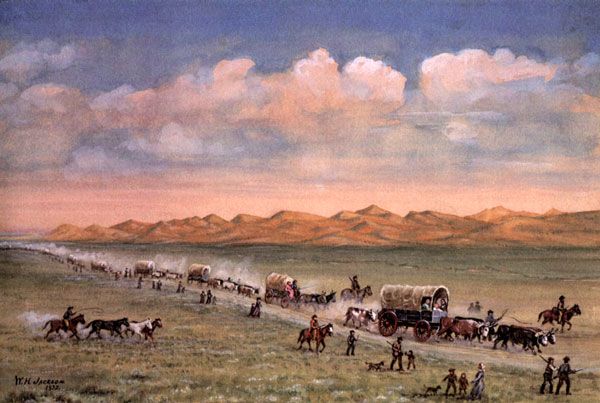
Oregon Trail pioneers pass through the sandhills, as depicted in a painting by William Henry Jackson.
The long weary journey, the dreadful monotony of the endless plains, the barren desert, the bleak and almost impassable mountains, the heat and dust, the scorching sun and the drenching rains, the sickness and suffering, and the deaths that have thinned his party, have long since dulled his spirits and left in place of the joyous buoyancy of the start, a sullen, dogged determination to push forward. The faint-hearted abandoned him at the Platte, at Laramie, and Salt Lake; the weak died, and before him now was the greatest trial of the journey, the most significant test of strength. Many were yet to fail, to die of starvation, cholera, or scurvy, and some, who had passed through so much hardship and suffering, were to die by their own hands as they approached the fatal desert and saw in the distance the lofty barrier of the Sierra Nevada.
Almost before the trains had reached the Platte River, the emigrants realized that they had overloaded their wagons and already begun to throw away useless freight and baggage. As the journey’s difficulties increased and animals gave out, wagons, provisions, and property of all kinds were abandoned. Large quantities of bacon were tried, and the fat was used as axle grease. During the latter part of the 1849 emigration, the difficulties increased significantly. Feed became very scarce; the water of the Humboldt had a harmful effect on the horses, and they died in great numbers; the Indians, ever on the alert, became more aggressive, stealing the stock and leaving many families from four to 600 miles from the settlements without teams or means of conveyance.
The remaining animals are now giving out. Everything that can be dispensed with is thrown away so the loads may be lightened for the weakened oxen. The destruction of property is immense, and the road is lined with abandoned wagons, sheet iron stoves, shovels, picks, pans, clothing, and other articles — even guns. From halfway down the Humboldt to the sink, the carcasses of animals were so thick that had they been laid along the road, one could walk over them without putting foot to the ground.
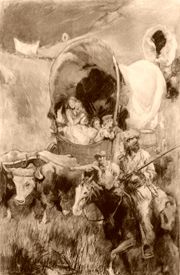
Pioneers in Covered Wagons, by Thomas Fogarty
At last, the sink of the Humboldt is reached, and before the emigrant lies the most dreaded desert. Here are long stretches of alkali with drifts of ashy earth in which the cattle sink to their bellies and moan along their way, amidst a cloud of dust and beneath a broiling sun. The road is covered with putrefying carcasses, and their effluvia poison the air. Even feeble women must walk, and the animals are relieved of every possible burden. To add to the general distress, cholera again broke out and carried the emigrants off by hundreds. The march now resembles the route of an army. All organizations are at an end, and each one pushes on with what strength it has. Wagons come to a stop and are abandoned, while the animals are detached and driven forward. No one now thinks of gold. It has become a struggle in life.
To avoid the desert, a large part of the emigration of 1849 was diverted to the northern route through Lassen’s Pass. They left the Humboldt at the big bend, sixty-five miles above the sink, and took a northwesterly course. They were told they would find grass in ten miles, grass and water in twelve, and at Rabbit Springs, 35 miles distant, an abundance of both, and from there on, they would have no further trouble. It was false information, and it lured thousands to their ruin. There was little water or grass; the deserts to be crossed were much greater in extent than those of the Humboldt; the emigrants traveled some 300 miles out of their way, and those late in the season found themselves in a rugged mountain region, in three feet of snow, and 250 miles from the nearest settlement. The Pitt River Indians were hostile and active, and many lives were lost. Major Rucker, commanding the relief expedition, reported that between 7,000 and 9,000 emigrants, from 1,000 to 1,200 wagons, had taken this route.
Many took the lower or Carson River Route. Crossing from the sink of the Humboldt to the sink of the Carson, a distance of fifteen miles, they followed up the Carson River some eighty miles to Eagle Valley, where there was abundant grass, then southerly through Carson Valley and over the Sierra to the south fork of the American River.
In the latter part of July, the advance trains of the emigration began to arrive in the Sacramento Valley, and soon a steady stream poured in. Gaunt, hollow-eyed men and women leading or carrying children told tales of horror. Behind these, in the Great Basin, were thousands battling famine and pestilence. Notwithstanding the absorbing character of their occupation, the rough miners did not hesitate to go to the relief of the sufferers or to contribute generously of their gold. General Smith ordered all available troops to the Sacramento Valley, and Major Rucker of the First Dragoons was put in charge of the relief operations, while $100,000 was appropriated for supplies.
Parties were sent in all directions with hard bread, pork, flour, rice, barley, beef cattle, work oxen, and riding mules. A relief station was established at the Truckee lower crossing (Wadsworth), at the Carson Valley (Genoa) Hot Springs, and on the upper Feather River. From the relief stations, men were sent out into the desert as far as the sink of the Humboldt, and the sufferers were brought in. Without food, they met whole families, men, women, and children on foot.
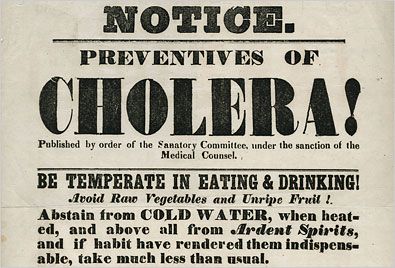
Cholera notice
Women whose husbands had died of cholera, with their little children, without water or food; men scarcely able to walk, who said that for 200 miles back, they had eaten nothing but dead mules; one old man with his wife and daughter, on foot, had nothing but a few blankets which they carried on their backs. The number of sufferers was so significant that the relief corps could barely furnish enough food to enable them to reach the nearest station. In the emigration of this year, 5,000 died on the plains from cholera alone.
In 1849, the rains began much earlier than usual, and the fall was heavy. In the mountains, the snow was of prodigious depth. The northern relief station on the Feather River sent out men on all the trails with food and riding mules to meet the emigrants coming through by the Lassen Route. The amount of suffering was dreadful. Many emigrants had been without food for two or three days when the government trains reached them. There were three feet of snow on the ground through which many were making their way on foot. Three men made desperate efforts to get through. For several days, they had been on a daily allowance of one meal. When still seventy miles distant from the nearest settlement, they took stock and found they had bread for two days only.
Pushing on through the snow, they came a few miles to a wagon containing two women and two or three children who had eaten nothing for two days. With a rare generosity under the circumstances, they gave all they had to these helpless ones and went on without. They got through. The relief corps met women wading through the deep snow, carrying their children, and strong men who had fallen, utterly exhausted. The officer in charge of the camp wrote: “A more pitiable sight I never beheld as they were brought into camp; there were cripples from scurvy and other diseases, women prostrated by weakness, and children who could not move a limb, and men mounted on mules who had to be lifted off the animals, so entirely disabled had they become from the effects of the scurvy.” On December 20, Major Rucker reported that he had brought in all who had crossed the mountains and had closed the relief camps.
In 1850, the suffering was even more severe than it had been in 1849. Throughout the States, the reports of the overloaded wagons had been received, and many went to the opposite extreme. By the time Fort Laramie was reached, provisions had begun to give out, but the emigrants went forward recklessly, trusting to chance to get through. The Mormons at Salt Lake could afford some relief, but they were short of provisions themselves. The supplies of many of the trains held out until the Humboldt River was reached, at which point their stores became exhausted.
Pushing on through the snow, they came in a few miles to a wagon containing two women and two or three children who had eaten nothing for two days. With a rare generosity under the circumstances, they gave all they had to these helpless ones and went on without. They got through. The relief corps met women wading through the deep snow, carrying their children, and strong men who had fallen, utterly exhausted. The officer in charge of the camp writes: “A more pitiable sight I never beheld as they were brought into camp; there were cripples from scurvy and other diseases, women prostrated by weakness, and children who could not move a limb, and men mounted on mules who had to be lifted off the animals, so entirely disabled had they become from the effects of the scurvy.” On December 20, Major Rucker reported that he had brought in all who had crossed the mountains and had closed the relief camps.
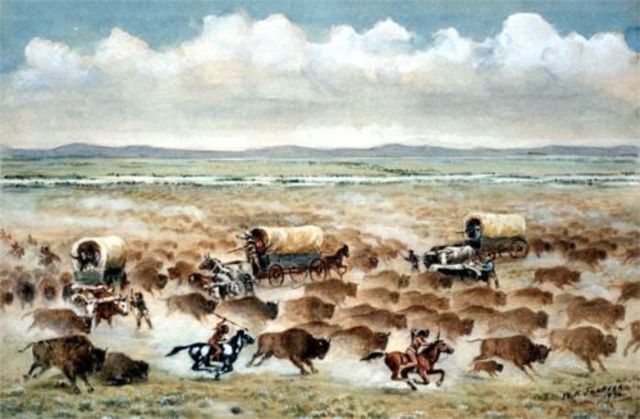
Buffalo along the Oregon Trail.
Emigrants arriving at Sacramento in July 1850 reported the desperate condition of those in the desert; that Mary’s River (Humboldt) was six or seven feet higher than it was ever known before, and that the bottoms, where the only feed grew, were almost entirely underwater. One traveler hired some Indians for fifteen dollars to swim the river and float some grass across to him, thus saving the lives of his oxen. Another said that they had to swim for what little grass they procured on the way down the Humboldt, sometimes cutting it and sometimes being compelled to pull it while standing in the water up to their waists. “I have seen hundreds, more than 150 miles on the other side of the Sink of Mary’s River,” wrote W. Crum to the Sacramento Transcript, “that was out of provisions or had but a few pounds to sustain a miserable existence, with animals that could never reach the Desert, because of the scarcity of forage. From this circumstance alone, it may be possible that three-fourths of the animals on the plains must perish from hunger, and the emigrant, with his scanty fare, must foot until life becomes a burden.
Those who started late will still fare worse; as the season gets warmer, they will feed less and provisions will be shorter. I saw one man with two small boys 120 miles beyond the Sink, who had left his wagon and lost all his animals but one, and all the provisions he had was three or four pounds of rice; another, with his wife and children, I overtook seventy miles beyond the Sink, with four horses that were just able to move with the empty wagon, the wife walking ahead in the burning sand and scorching sun, to relieve the poor laden animals that were destined never to see the Sink.”
M. Sheppards, who arrived about August 1, reported that only about one wagon out of five would get through. His company started with 12 wagons, of which two would get in; many that start with three or four horses get in with one; many emigrants, on arriving in Carson Valley, sell their finest horses for 10 or 15 pounds of flour. After arriving at the Truckee River or the Carson Valley, the emigrants still had the difficult passage of the Sierra Nevada to make. Most of them were destitute of both animals and food.
Each arrival brought tales of distress. Cholera had again broken out, and its ravages were appalling. Nine-tenths of those in the desert were on foot and starving. “Mothers may be seen wading through deep dust or heavy sand of the desert, or climbing mountain steeps, leading the poor children by the hand; or the once strong man, pale, emaciated by hunger and fatigue, carrying upon his back his feeble infant, crying for water and nourishment, and appeasing a ravenous appetite from the carcass of a dead horse or mule; and when they sunk exhausted on the ground at night overcome with weariness and want of food, it was with the certainty that the morning sun would only be the prelude to another day of suffering and torture.”
The miners contributed liberally to succor the unfortunate emigrants. Due to a lack of organization and direction, much of the effort was wasted, and supplies were slow in reaching the desert. Captain William Waldo left Johnson’s ranch on August 27 with a drove of beef cattle after waiting three days for the trains promised from Marysville and Yuba City. Seventeen hundred pounds of flour were deposited on the western side of the Sierra, the committee being unable to transport it across due to a lack of mules. At the Truckee lower crossing, beef was deposited with the relief committee, and Waldo left with them ten good horses and mules to help the sick and destitute cross the desert. He entered the desert on September 7 and pushed on as far as the Great Meadows of the Humboldt about the locality of the present town of Palisade. About midway through the desert, he came upon two men who had lain down to die. They had been living on the putrefied flesh of the dead animals on the road, which had made them sick, and for three days had eaten nothing. He relieved their needs, and they reached the station. Two other men had died of starvation. From Boiling Springs to the Great Meadows, he met few who had any provisions. One-fourth of the entire number on the road was reduced to the necessity of subsisting on the putrefied flesh of dead animals. This had produced fatal consequences, and disease and death were mowing them down by hundreds. “The cholera has carried off eight in one small train in three hours, and seven others are attacked and, it is thought, will die ere three hours more have elapsed.”
From the sink westward, the havoc was fearful. “Sir,” he wrote, “by the time this reaches you, I presume that you will need no evidence from me to satisfy you of the alarming and wretched condition of these people. It appears that the judgment of God has pursued them from the time they set out to the present. First cholera — then starvation — next war, starvation, and cholera. The day has now passed when anyone will have the hardihood to say that there is no suffering amongst the Overland Emigrants; at least no one within 200 miles of this place will make such a declaration. When I tell them (the emigrants) that they are 400 miles from Sacramento, they are astonished and horrified; many disbelieve me. They were induced to believe that they were within 450 miles of Sacramento City when at Salt Lake.” Indians have stolen a great number of the emigrants’ stock, he says, and scarcely a day passes that there is not a skirmish with them. Many women are on the road with their children’s families who have lost their husbands to cholera and will never cross the mountains without aid. There are yet 20,000 back of the desert, and 15,000 of this number are now destitute of all kinds of provisions, yet the period of the most incredible suffering has not arrived. It will be impossible for 10,000 of this number to reach the mountains before the commencement of winter.
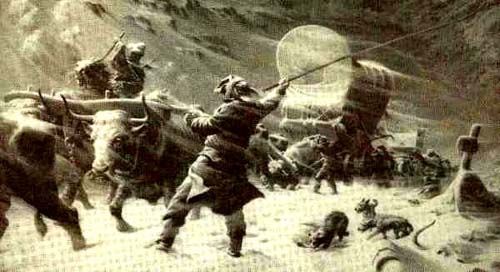
The Donner Party by Andy Thomas,
All remember the fate of the Donner Party. On September 15, Waldo is back on the Truckee River, sending in frantic appeals for supplies. He is issuing, he says, from five to 8,000 pounds of beef per day, and flour only to the sick. The station is surrounded by sick people, unable to proceed on their journey. The flour deposited at Bear Valley by the Marysville train has not arrived. The relief raised by the Feather River towns has failed due to the lack of a system. If the people of California wish to provide efficient relief to the emigrants, their supplies must be placed under the control of a single agent. The emigrants must have bread; thousands must die unless they can be supplied with bread. The cholera is killing them off from this point to the head of the Humboldt.
Ten thousand pounds of flour should be immediately forwarded to the Truckee station, and another station established near the summit with the same amount and other articles necessary for the sick.
Suppose the money cannot be raised for this. In that case, he offers to turn over to the committee, or to any other body of men, real estate in Sacramento, which has cost him $10,000, if they will advance at once $8,000 or $10,000, forwarded in flour and other necessary articles for the sick, to the summit and to the Truckee station to save 10,000 human beings from starvation.
He says that if he were to describe the cases of extreme suffering he has seen in the last 15 days, the account would occupy a quire of paper. He was to leave on the morning of the 16th to head up the Humboldt River, inviting all from 400 to 600 miles back to return to Salt Lake. Ten people died of cholera the day before while trying to cross the desert.
By September, traders were flocking to the desert with supplies, selling flour at one dollar and seventy-five cents to two dollars and fifty cents per pound. They also carried water and grass into the desert and gathered up the animals they found abandoned. They sold water at half a dollar a pint. Many emigrants had no money and were obliged to part with their property. In the beginning, many put nearly all they had into the outfit; others thought they were going to a land of gold but did not bring much money with them. It was a great mistake. Money was required for ferriage across streams, for supplies, and for various purposes, and the want of it caused loss and hardship.
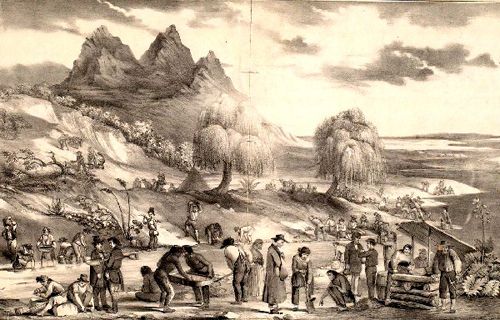
Sacramento Mining District in the 1850s.
At length, the emigrants reached the end of their journey, but their troubles were not over; they were attacked with fevers and bloody flux, and many perished miserably after having endured all but death in crossing the plains; they reached the Sacramento Valley sick and weary, with the horror of the scenes through which they had passed still upon them. For a time, they were distressed and unsettled. Their numbers were so great that the relief extended by the miners, large as it was, could not reach them all, and many suffered and died for want of proper care and the nourishment that their condition required. Many were initially happy to secure employment to pay their board, and even those accustomed to the luxuries of life were glad to accept any servile employment suited to their strength and ability. Gradually, the dark gloom that had overshadowed them was dispelled by the kind treatment and aid they received on all sides. The memory of their suffering faded, and with their returning health, hope revived, and ambition again awoke.
Most of the states of the Union were peopled by a steady influx of settlers from other communities. California was suddenly changed from a quiet pastoral community to a mining camp. A great population was poured into it from all quarters of the globe, all actuated by the most intense and absorbing of motives, the quest for gold. Some to mine for it, some to supply the gold miner with the means of existence, and some to prey upon him. Some saw fortunes in trade and the building of cities; others sought to reap the significant profits from cultivating the fertile soil. The farming class found a large amount of the best lands in private ownership under the Spanish grants. They were not disposed to submit quietly to this condition of affairs, and in many cases, “preempted” what they considered unoccupied land, ignoring the obligations of the Treaty of Guadalupe Hidalgo, which guaranteed the Californians the enjoyment of their liberty and property. Both Colonel Mason, the governor, and General Riley, his successor, endeavored to protect the property owners. Still, the failure of Congress to provide a civil government for the territory, together with an insufficient force to compel obedience to its mandates, made the matter a difficult one.
A significant population had gathered before there was any regular government to maintain order. The great mass of the population was American, and the inhabitants formed their government and preserved local laws regarding the punishment of crime — unwritten, but understood — as well as the size, manner of locating, and recording of mining claims. They visited summary punishment on those who violated the code. All things else were left to individual taste and discretion. The Alcalde of Monterey, Walter Colton, a chaplain in the navy, sold the land on the old Spanish fort (Castillo de San Cárlos). This transaction brought from Colonel Mason a letter asking what law or decree conferred on an alcalde the right to sell the title of a Mexican fort or battery. In reply, the alcalde wrote: “No Mexican law or decree, as I can find, designates any particular spot as sites for forts or batteries. Each military chief put up a post where he chose to either keep or demolish those put up by his predecessor. He asked no leave to build, and none to abandon. When guns were mounted, no alcalde ventured with his right to sell but eagerly extended that right over an abandoned position.
“The only rule which appears to have governed the military and civil authorities in these matters seems to have been that of Rob Roy – “The simple plan, That they shall take who have the power, And they shall keep who can.'”
This flippant reply illustrates the American ignorance of and contempt for Spanish law and methods. Colton was educated, a graduate of Harvard College and of Andover Theological Seminary, and should have known better. A rebuke was administered to him by Henry W. Halleck, captain of engineers and secretary of state. In a formal report to the governor, Halleck said: “Monterey is the next point on the coast deemed of sufficient importance at present for permanent works. The old battery (San Carlos) was built soon after the establishment of the mission of the same name (1770). Although much dilapidated, it was maintained up to about the time the Americans took possession of the country. The Mexicans began another battery in the rear of an auxiliary before July 7, 1846, and afterward enlarged by the Americans and occupied by them without intermission.
Copies of the several claims to the land on which these batteries were situated were given while Monterey was in possession of the American troops, and by an alcalde, who was an officer in the United States Navy.
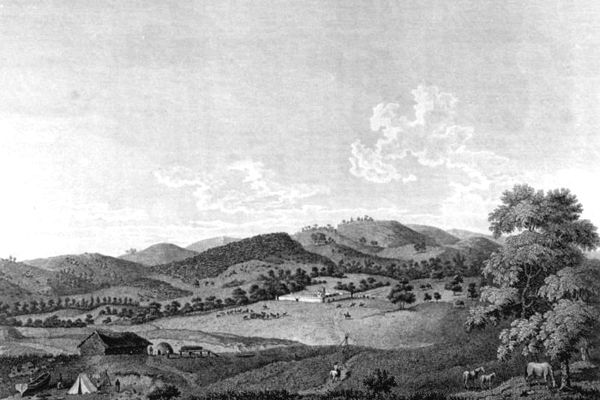
Presidio of Monterey, California
“Unfortunately for the plea set up by the alcalde, the laws relating to the granting of lands in California are, as has already been shown, very minute and perfect, resting upon no such doubtful authority as that of Rob Roy, but upon positive and definite decrees of the Mexican Congress, and the subordinate but no less distinct enactments of the territorial legislature — laws which seem to have been perfectly understood and pretty generally obeyed here previous to the irregular proceedings springing out of the mania for land speculations following the conquest of the country by the Americans. Nor is the alcalde more accurate in his opinion that the Mexican government has never designated any particular spot or site for forts or batteries.
If he had examined the subject with care, he would have found that the ground which he sold has been occupied by works of military defense from about the year 1772 to the present moment, when, in 1775, it was proposed by the authorities here to remove these works to a point on the bay further north, the viceroy positively forbid the removal; that there are in the government archives numerous orders, both from the viceroys of New Spain and the ministers of the Mexican republic, for the repair of these identical works, for the mounting of guns in them, etc.; that these are the very works that were captured by the insurgents under Alvarado and Graham in 1836, by the naval forces under Commodore Jones in 1842, and, though incredibly dilapidated, constituted the only defenses for the harbor and town of Monterey on July 7, 1846.”
In the winter of 1846-47, a party of immigrants from the United States applied to the priests in charge of the missions of San José and Santa Clara for shelter. This was readily granted them, and in the spring, they proceeded to plant the mission fields and make themselves at home. So much at home did they become that they finally put the priests out and excluded them from the premises altogether. The priests complained to Colonel Mason, who ordered Captain Henry M. Naglee of the New York volunteers to proceed with his command to Pueblo de San Jose and assist the alcalde in ejecting the intruders. If the alcalde did not act promptly and efficiently, then the officer must proceed to execute the order himself. He instructed him to use mild and persuasive means to induce the intruders to vacate the premises before resorting to force. “Say to those people they have no right whatever to dispossess the priest and occupy those missions contrary to his consent, any more than they have to dispossess the rancheros and occupy their ranches; that they must respect the rights of others before they can claim any respect for their own; that we are bound to protect, and will protect, the priests in the quiet possession of the mission at Santa Clara and San José, and not suffer their premises to be wrested from them even by the Californians, much less by a people who have just come into the country, who have not a shadow of claim to the premises, and who, in the first place, were permitted from motives of charity to occupy them temporarily to shield them from the last winter’s rains.”
The immigrants did dispossess the rancheros and occupy their ranchos in many instances. In Santa Clara County, the “Squatters’ League” organized an armed force, resisted the execution of the sheriff’s writ, held public meetings and barbecues — which the sheriff’s men attended — and engaged in numerous speeches regarding their rights as American citizens. At the same time, their women kind presented flags to the riflemen and extolled the defenders of their homes. In Contra Costa, armed men took possession of the San Antonio rancho (Oakland), mounted a cannon, and announced that they would defend their rights (to the Peraltas’ property) to the death. They even put Don Domingo Peralta in jail, kept him there for six months, and made him pay a heavy fine for attempting to drive them off his rancho.
The better class of immigrants did not approve of the squatter method and strongly condemned all such proceedings. Still, a portion of the early immigration was from the western frontier states and of the class that considered a dead Indian the only good Indian, and to whom a Spaniard, no matter what his condition or degree of culture and refinement, was a “greaser” and entitled to no respect or consideration when their several claims conflicted. They were in full sympathy with and consistent believers in the good old rule of Rob Roy and did not hesitate to take when they had the power and hold when they could. In 1848, thousands of Indians were engaged in washing gold from the placers, some on their own account, while others were employed by Americans, who turned their labor to good profit. The men of the later emigration, and in particular those who came from Oregon, abused the Indians shamefully and began a war of extermination upon them, shooting them down on the slightest pretext and driving them from their claims, which they took for themselves. They also undertook to drive all foreigners from the gold mines under color of a proclamation from General Smith informing all foreign adventurers coming to California to search for gold that trespassing on the public lands was punishable by fine and imprisonment and that the laws relating to it would be strictly enforced. In this movement, the Americans were joined by English, Irish, and German emigrants, and it was primarily directed against the Sonorans, Chilians, and Peruvians. They even included Californians among the “foreigners.” They attempted to drive Don Andrés Pico from a claim he was working on the Mokelumne River. Still, the hero of San Pascual was not to be frightened as easily as the timid Sonorans, and he maintained his rights as an American citizen.
With the immigration, there came, as was to be expected, a plentiful supply of the scum and riff-raff of the world; escaped convicts and ticket-of-leave men from Botany Bay, desperadoes, fugitives from justice, neer-do-wells, and gamblers from all parts of the globe, drawn to California by the promise of easy money which the rapid accumulation of gold by the people seemed to hold out. Armed bands of desperadoes rode through the country, committing the most atrocious crimes until the citizens, unable to endure longer the reign of disorder, rose and hunted the criminals like wild beasts and drove them from the country. Mason, in an official communication to the war office, reports several murders and the hanging of several men by the citizens and says: “You are perfectly aware that no competent civil courts exist in this country, and that strictly speaking there is no legal power to execute the sentence of death; but the necessity of protecting their lives and property against the many lawless men at large in this country, compels the good citizens to take the law into their own hands. I shall not disapprove of the course that has been taken in this instance and shall only endeavor to restrain the people so far as to ensure to every man charged with a capital crime an open and fair trial by a jury of his countrymen.”
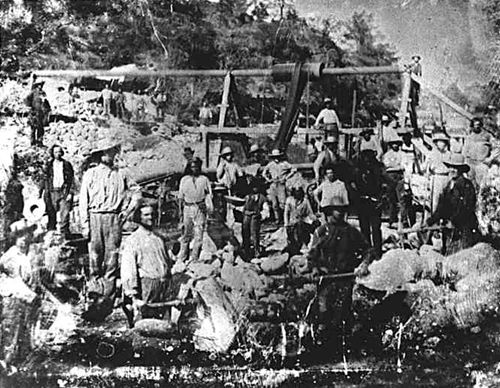
California Gold Miners.
It is evident from the military dispatches that the deserters from the army contributed to the general disorder and committed many outrages against life and property. These deserters were protected by the great mass of the citizens of the mining region, who thought it a shame that the soldiers should be obliged to serve for what was really a nominal sum while all those around them were reaping an extraordinary reward for their labor. Riley recommended the restoration of the war penalty for desertion and, in a letter to the general commanding the division, said: “Information from the south shows that, with very few exceptions, the dragoons of the squadron of the 1st regiment deserted upon being ordered to San Luis Rey. Many had previously deserted from Los Angeles, carrying with them their horses, arms, and equipment; and it is believed that the desertions at that place will be greatly increased when the order breaking up the companies of the 2d dragoons is received; so that I fear I shall not be able to organize from four companies of dragoons one required for the escort of the commissioners. It is known that these deserters had committed many outrages upon the property and, it is feared, upon the persons of the inhabitants they encountered on the route to the mines. The disposition I have proposed (that of establishing a four-company post in the mining region and allowing the men limited furloughs) will be an experiment, but one that should be tried, if only for the sake of preventing a repetition of the outrages of unoffending people have suffered from those they have been led to suppose would protect them from Indian depredations and domestic violence.”
The Indians of the Tulares, who, joined by many of the neophytes of the missions, had for some years been a source of great annoyance to the rancheros by stealing their cattle and horses, now renewed their depredations, emboldened by the withdrawal of the troops from the south. The situation was further complicated by robberies committed by Sonorans, who had been driven from the northern mines, on their way out of the country. The troops under the command of General Riley were the 2d infantry; companies A and E, 1st dragoons; companies D and E, 2d dragoons; and companies F and M, 3d artillery; in all 650 men, the number being constantly reduced by desertion. With this force, he had to garrison the forts at San Francisco, Monterey, and San Diego, furnish an escort for the boundary commission, guard the government stores, send expeditions against marauding Indians, succor starving emigrants, establish relief stations at Warner’s pass and in the Sacramento, and police the territory.
More than two years had elapsed since the conquest. Congress had met and adjourned without providing California with a government. The authorities in Washington recognized the military government established in California, under the laws of war, as a de facto government, to continue until Congress provided otherwise. The people of California, with that executive instinct of self-government and self-preservation which first challenged the wonder of the civilized world and afterward won its approbation, determined they would have a responsible and representative government. In full sympathy with this sentiment, Governor Riley issued, on June 3, 1849, a proclamation calling for the election of delegates to a convention to be held in Monterey on September 1 to form a state constitution.
The territory was divided into ten districts, with 37 delegates, and the election was set for August 1. The number of delegates was later increased to 48 due to the rapid population growth in some of the districts. The convention was composed of men in the full vigor of life, was fairly representative, contained several men of talent, and a good proportion of men of education and refinement. There were five men of European birth, six Californians, twelve natives of New York, five of Maryland, three each from Virginia, Kentucky, and Ohio, two from Massachusetts, and one each from Tennessee, Florida, Missouri, Maine, Vermont, Rhode Island, Connecticut, Pennsylvania, and New Jersey. All the men were of European descent, and nine or ten were American citizens of California before the conquest.
The convention completed its labors on October 12, 1849. On the same day, Governor Riley issued a proclamation announcing the formation of a constitution and calling for a vote on November 13 for its ratification by the people, as well as the election of a legislature and state officials simultaneously. The members presented their bill for services to Governor Riley, charging $16 per day and $16 for each 20 miles traveled. The governor paid from the civil fund. The members now gave themselves up to congratulations on the convention’s success and, assessing themselves twenty-five dollars apiece for expenses, cleared the hall for a grand ball given to the citizens of Monterey. The ball, held on October 13, was a great success. General Riley was in full uniform and wearing the yellow sash he won at Contreras; Majors Canby, Hill, Smith, Captains Burton and Kane, and the other officers stationed at Monterey, accompanying him. Don Pablo de la Guerra acted as floor manager and gallantly discharged his office duties. General Vallejo, Manuel Dominguez, and Jacinto Rodriguez were conspicuous among the Californians. At the same time, Captain John A. Sutter, late of Switzerland, and Don Miguel de Pedrorena, formerly of Spain, actively participated in the festivities.
On December 12, Governor Riley issued a proclamation declaring the Constitution ratified on November 13 and ordained and established the Constitution of the State of California. The legislature met on December 15, and on December 20, Riley resigned his powers as governor to Peter H. Burnett, the new executive. A significant population, coming together from the four winds of heaven with but one idea, to enrich themselves as quickly as possible and then depart, had, recognizing the necessities of the situation, founded a commonwealth.
Many who tried their luck at the mines returned to San Francisco. Even their tremendous success in obtaining gold could not compensate them for all their privations, the exposure, the sickness, the hard labor, and the harder fare that fell to their lot. And the shrewd trader saw that, rich as were the gold placers, a richer field for acquiring wealth lay before him in the town itself. The great prices and rise in various kinds of goods, provisions, and other necessities of life opened the brightest prospects to those who preferred trade to gold hunting. The immigration from the nearest territory was but a mite to that which would flow from abroad when the wild reports of abundant gold should reach and be accredited throughout the eastern states, in Europe, and among the nations of Asia.
It was inevitable that in a community composed almost entirely of men and living far from the steadying influences of the eastern states, there should develop a spirit of recklessness and indulgence in exciting pastimes that led to disorder. Every man did as seemed good in his own eyes until the lawless element aroused in the people the instinct of self-preservation, and a form of order was established. The Argonauts were like boys let loose from school. Overflowing with vigor and abounding in high spirits, their exuberance found vent in the ghastly names with which they afflicted the map of California.
A whole-souled liberality redeemed the struggle for wealth, and no tale of woe failed of a generous response from the miners. Life, hard as it was, was not without its compensations and comforts. Old distinctions of caste were abolished, and the professional man dug for gold with his own hands or worked for wages by the side of the common laborer. The angularities of the ungainly and illiterate in time wore off in the contact with educated men. To many, a farmer boy raised within the narrow confines of a New England village, the experience of a few years in the mines was an education, while fitness to grasp opportunity brought independence.
By Zoeth Skinner Eldredge, 1912. Compiled and edited by Kathy Alexander/Legends of America, updated October 2025.
About the Author: Zoeth Skinner Eldredge (October 13, 1846 – 1915) was an American banker and amateur historian of California. He self-published two books on the local history of San Francisco, one of which was “The Beginnings of San Francisco: From the Expedition of Anza,” published in 1912. This article is a chapter of Eldredge’s book.
Also See: