
From the Texas Historical Commission
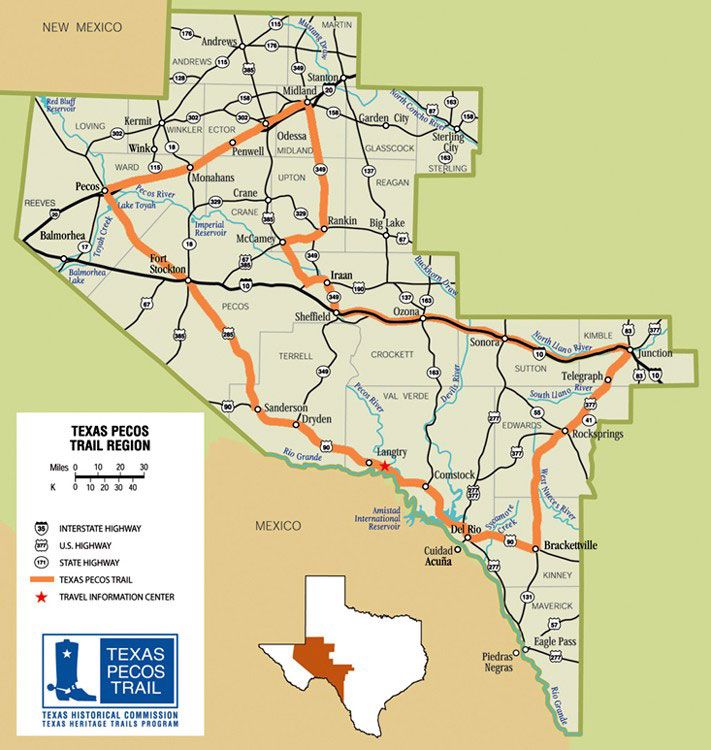
Trekking along the Pecos Trail offers visitors a diverse landscape, including sand dunes, underground caverns, spring-fed pools, numerous rivers and creeks, lakes, and more. At about 1,356 miles long, it will also take time to cover the region encompassing 22 counties, seven state parks, dozens of towns, and hundreds of historical, cultural, natural, and recreational destinations.
Midland to Rankin – 54.9 miles
Rankin to McCamey – 19.2 miles
McCamey to Iraan and Sheffield – 47.3 miles
Sheffield to Junction – 133 miles
Junction to Rock Springs & Brackettville – 108 miles
Brackettville to Del Rio – 30.4 miles
Del Rio to Sanderson – 120 miles
Sanderson to Pecos – 118 miles
Pecos to Midland – 95.6 miles
Located in southwest Texas, this vast, rugged region sits under Texas’ bright blue skies, covers about 35,000 square miles, includes the infamous Pecos, Devil’s, and Rio Grande, and extends from New Mexico to Mexico, south of Midland, Texas.
In addition to the natural beauty that encourages a variety of outdoor adventures, from river rafting to horseback riding, visitors can also enjoy museums, ancient pictographs, landmark churches, historic courthouse squares, and frontier forts.
The area’s rich history offers peeks into the heritage of cowboys, soldiers, Native Americans, Hispanic culture, the hardscrabble people of the Old West, and much more.
Though the vastness of this region can’t be contained in one article, below is summary information with links to more details, mileage, and photographs to whet your appetite for the trail. Plan on a week to see the entire trail, or break it up into segments. Either way, you are sure to enjoy it.
Beginning in Midland, Texas, the trail heads South to Sheffield, then East to Junction, and southwest to Brackettville, before turning back northwest. Passing through Del Rio, Langtry, and Fort Stockton, the path turns northeast again at Pecos, to complete a “circle” back to Midland.
Midland to Rankin – 54.9 miles. Travel South from Midland on Texas Highway 349.
Midland – Located in the heart of West Texas, Midland is a fast-growing city of about 110,000 people. The county seat of Midland County, it was originally founded as the midway point between Fort Worth and El Paso on the Texas and Pacific Railroad in 1881.
American Airpower Heritage Museum & Confederate Air Force Headquarters – The CAF Airpower Museum tells the complete story of World War II military aviation by collecting, preserving, and interpreting World War II material and culture.
George W. Bush Childhood Home – Interprets the history of the Bush Family and George W. Bush’s childhood in Midland, Texas. It celebrates the lives of two presidents, two governors, and two first ladies.
Haley Memorial Library & History Center – The library and history center preserves western heritage by housing more than 25,000 books, manuscripts, and other printed material documenting western history. The collections and programs focus on the common threads among the cowboy, the range cattle industry, the military, and railroads.
Museum of the Southwest – Serves the community as a regional resource for cultural enrichment. Through its Art Museum, Children’s Museum, and Planetarium, it fosters appreciation of art and science and nurtures creativity, sensitivity, and discovery.
Permian Basin Petroleum Museum – The Museum tells the story of petroleum and the rugged lives of men and women who sought a better life.
Sibley Nature Center – The center’s mission is to increase awareness of the natural and historical environment of the southern Llano Estacado through a broad range of interpretive programs and personal experience.
Nearby: Several area ghost towns are near Midland, including Spraberry, about 15 miles Southeast of Midland; Midkiff, a semi-ghost town about 38 miles Southwest of Midland; and Tarzan, about 34 miles northeast.
Rankin – Established in 1911, Rankin is Upton County’s oldest town and county seat. Rankin is home to only about 800 people.
Nearby: Stiles ghost town, about 46 miles northeast of Rankin.
Rankin to McCamey – 19.2 miles. Travel Southwest from Rankin on Texas Highway 349/US-67S.

The 1911 former Reagan County Courthouse in Stiles, Texas. Photo by Barclay Gibson, January 2010, courtesy of Texas Escapes.
McCamey – Founded in 1925, when the McCamey Oil Field brought the oil boom to the region. Its early years were colorful, filled with typical boomtown problems of disorder and lawlessness tied to rapid growth. Today, it is known as the “Wind Energy Capital of Texas” because many wind farms have been built in the area. It is home to about 1,800 people.
Mendoza Trail Museum – Exhibits include relics of this recent frontier: Indian artifacts, fossils, oil-boom mementos, and antique furniture. The museum grounds also include the historic Adrian House and a Santa Fe Railroad depot.
Nearby: Dinosaur Tracks – 25 Miles West of McCamey, on Highway 67 behind Side Park
McCamey to Iraan and Sheffield – 47.3 miles.
Travel Southeast from McCamey via Ranch Road/FM 305, turn left at US-190 E for 5.3 miles, and turn right at TX-349 S/US-190 E to Iraan. Turn left onto TX-349 S/Drake St, continue to follow TX-349 S for 13.3 miles, turn left at TX-290 E/TX-349 S, and continue to follow TX-290 E to Sheffield.
Iraan – Situated in the vast Permian Basin of West Texas, where Dinosaurs once roamed, Iraan was an oil boomtown that developed quickly after the discovery of the gigantic Yates Oil Field in 1926. Called home to about 1,200 people, the correct pronunciation is “Eye-ruh-ann.” It was named for Ira and Ann Yates, who owned the ranchland on which the town was built.
Alley Oop Park and Museum – A playground and museum dedicated to V.T. Hamlin, who lived in Iraan when he created the Alley Oop comic strip.
Sheffield – Situated along the old San Antonio-El Paso Road, the site was long popular because of the Pecos Spring and the Pecos River. However, a town wasn’t formed until 1898. It boomed with other area towns in the 1920s. Today, it is home to about 600 people.

Ruins at Fort Lancaster, Texas. Photo by Kathy Alexander.
Fort Lancaster Historic Site – About 10 miles East of Sheffield, just off U.S. 290. Spanning 82 acres in the Pecos River valley, Fort Lancaster State Historic Site commemorates the vestiges of one of four posts established in 1855 to protect the San Antonio-El Paso Road.
Sheffield to Junction – 133 miles. Take TX-290 East to I-10 and follow to Junction.
Ozona – Called the “Biggest Little Town in the World,” Ozona is the county seat of Crockett County and is home to about 3,500 people. Surrounded by vast ranching and oil lands, the area is known for its wool production. Although it is the county seat, Ozona is unincorporated, meaning it has no city government and no city taxes.
Crockett County Museum – 3-story museum with a wide variety of exhibits, including an award-winning Native American exhibit.
David Crockett Monument – Located on 11th Street on the town square, it honors the Alamo hero.
Historic buildings include the 1902 Crockett County Courthouse, the 1892 Crockett County Jail, the 1912 Heritage Building, which once served as a school, the 1905 Ozona National Bank building, and others.

Sutton County Courthouse in Sonora, Texas. Photo by Kathy Alexander.
Sonora – Established in 1889, the town’s pioneering spirit is commemorated throughout the community with Historical Markers and a variety of historic sites & museums. The county seat of Sutton County, it is home to about 3,000 people. Sonora is the site of the famed Will Carver shootout, and the city’s Old Sonora Ice House Ranch Museum features the gun that brought the outlaw down, along with a number of historic relics. Interestingly, Sonora evidently works hard to eliminate any lawlessness of its Old West days, as it is one of the leading speed trap cities in West Texas, averaging more than 48,000 citations per year, which amounts to over 10 per capita per year.
Eaton Hill Wildlife Sanctuary – A 37-acre nature park offering over 3 miles of hiking trails and showcasing a diverse array of plants and wildlife.
Miers Home Museum – Built in 1888, this home was only the fifth structure built in Sonora. It is now a museum containing artifacts and memorabilia from Sonora’s past.
Old Sonora Ice House Ranch Museum – A museum featuring Sonora’s rich Western Heritage.
Tour Sonora – Numerous historic sites, including the site of the Will Carver (of the Wild Bunch) shootout, the 1891 Sutton County Jail, the 1891 Sutton County Courthouse, Will Carver’s grave, and more.
Veterans from All Wars & Pioneer Ranch Women Museum – The veterans’ museum spotlights its stories, photos, military equipment, letters, and uniforms. Pioneer Ranch Women Museum tells the stories of the women who moved to the area with their husbands and children. It features photos, clothing, postcards, and information on how they lived and worked on ranches in Sutton and surrounding counties.
Caverns of Sonora – Recognized as the most beautiful cave in Texas and one of the most beautiful show caves in the world. Located on Interstate 10, 15 miles Southwest of Sonora.
Roosevelt – A virtual ghost town today, Roosevelt never supported more than about 150 people. Established in 1898, it was named for Theodore Roosevelt, who reportedly visited the area with the Rough Riders. The town today is home to only about 15 people.

The local post office retains its old-fashioned look in the Simon Bros Mercantile, Kathy Weiser-Alexander.
Simon Bros Mercantile – Step back in time at this general store that hasn’t changed much since the early 1900s when Uncle Ben F. Simon owned it. It also includes a café.
Nearby: Fort McKavett – 30 miles North of Roosevelt. Remains of a 150-year-old fort beckon visitors to what is now considered one of the best-preserved and most intact examples of a Texas Indian Wars (1850-1875) military post.
Junction – Called the “Land of Living Waters” for its hundreds of natural springs, Junction got its start in 1876 after the formation of Kimball County. The county seat, Junction, now boasts about 2,600 residents.
Kimble County Historical Museum
South Llano River State Park – Known for water and wildlife, is located on the western edge of the Edwards Plateau just South of Junction. Visitors can hike and go birding on the trails or head back to the river fed by the Lower Colorado River.
Nearby: Cleo ghost town – 10 miles northwest of Junction on Farm Road 2291
Junction to Rock Springs and Brackettville – 108 miles.
Travel Southwest from Junction on US-377 to Rock Springs. Turn left at Ranch Rd/FM 674.
Telegraph – Telegraph came into being sometime before 1900 – the year a post office opened. The name comes from the telegraph that connected the string of military installations – or the telegraph poles that were cut nearby. It is a ghost town today.

Rock Spring Hotel.
Rock Springs – Founded in 1891, it was named for the springs favored by pioneers and native peoples. The county seat and the only incorporated town in Edwards County, it has a population of about 1,300. The area is popular year-round for camping, hiking, and fishing.
Devil’s Sinkhole State Natural Area – 6 miles northeast of Rock Springs. Peer into the depths of Devil’s Sinkhole, then watch as millions of bats emerge into the Texas evening sky. The natural area is home to the largest single-chambered cavern and the third-deepest in the state.
Kickapoo Cavern State Park – 39 miles Southwest of Rock Springs. Containing nearly 6,400 acres in the southwestern Hill Country, the park is relatively undeveloped – a natural open space where visitors find solitude.

Though Brackettville is not a ghost town, it is filled with old abandoned buildings, Kathy Alexander.
Brackettville – Founded in 1852, it was initially a supply stop on the old San Antonio-El Paso Road and a supply depot for the U.S. Army’s Fort Clark. It is the county seat of Kinney County and is home to about 1,900 people.
Fort Clark – About 25 to 30 buildings dating from the 19th century have survived, including officers’ quarters, barracks, the commanding officer’s house, the quartermaster storehouse, and the guardhouse.
Fort Clark Springs – A unique oasis nourished by the Las Moras Spring, which has provided comfort and enjoyment to visitors for over 12,000 years.
Seminole Indian Scout Cemetery – 3 miles South of Brackettville. Includes the graves of four Congressional Medal of Honor Recipients With Service at Fort Clark, Texas.
Nearby: Spofford ghost town ten miles South of Brackettville.
Brackettville to Del Rio – 30.4 miles. Travel northwest on US-90.
Del Rio – Rio Grande City – A border city and the county seat of Val Verde County, Texas, Del Rio connects with Ciudad Acuña, Mexico, via the Lake Amistad Dam International Crossing and the Del Río-Ciudad Acuña International Bridge. Del Rio began in the late 1870s and was first called San Felipe Del Rio. However, when a post office was established, it was shortened to Del Rio. The city supports about 50,000 people today and is home to the Laughlin Air Force Base, the busiest pilot training base in the United States Air Force. See full article HERE!
Devils River State Natural Area – Twenty-thousand remote and wild acres provide access to the pristine Devils River, with unique angling opportunities and a put-in for whitewater float trips.
George Paul Bull Riding Museum and Gift Shop
Glenn-Dowe House – One of the oldest houses in Del Rio, continuously used as a home since it was built in 1900-1901.
Val Verde Winery – The oldest continuously running winery in Texas.
Whitehead Memorial Museum – Includes 9 buildings and contains various artifacts and period pieces that help preserve the history of Del Rio and Val Verde County.
Del Rio to Sanderson – 120 miles. Travel northwest on US-90. See Full article HERE!
Amistad National Recreation Area – The U.S. portion of International Amistad Reservoir, formed on the Rio Grande. Amistad is known for excellent water-based recreation and camping, and it is surrounded by a landscape rich in prehistoric rock art, a vibrant border culture, and a wide variety of plant and animal life.
Comstock – This small town was founded around 1882 on the Galveston, Harrisburg, & San Antonio Railroad named for John Comstock, a railroad dispatcher. Today, it is home to only about 375 people.
Seminole Canyon State Park – Jagged canyons cut through the Chihuahuan Desert wilderness where the Pecos River flows into the Rio Grande. People of antiquity once lived in these natural rock shelters carved into the canyon walls by the river.
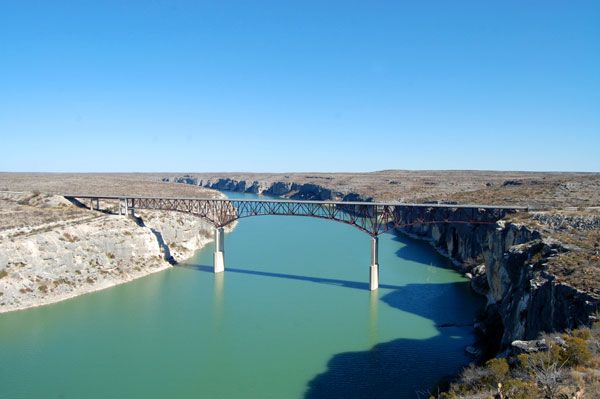
Highway Bridge over the Pecos River, Kathy Weiser-Alexander.
The Pecos River – Properly pronounced “pay-cuss” has headwaters located North of Pecos, New Mexico. The river played a major role in Spanish exploration of Texas. In the latter half of the 19th Century, “West of the Pecos” referred to the rugged frontiers of the Wild West.
Pecos River Railroad Bridge and Vinegarroon – A few miles beyond the Pecos River Highway Bridge is a lookout that designates the old townsite of Vinegarroon, and where the Pecos River Railroad bridge can be seen in the distance.
Shumla – Seminole Canyon State Park is the old townsite of Shumla. Another stop along the railroad, it was once a tent city stretching more than a mile long. Today, only a couple of decaying buildings mark it.
Bonfire Shelter – This large rock shelter was the scene of several prehistoric buffalo jumps.
Langtry – Home of the Only Law West of the Pecos – Starting in 1882 as a stop along the Galveston, Harrisburg, & San Antonio Railroad, Langtry is best known as the home of Judge Roy Bean, the “Law West of the Pecos.” It is home to about 145 people today.
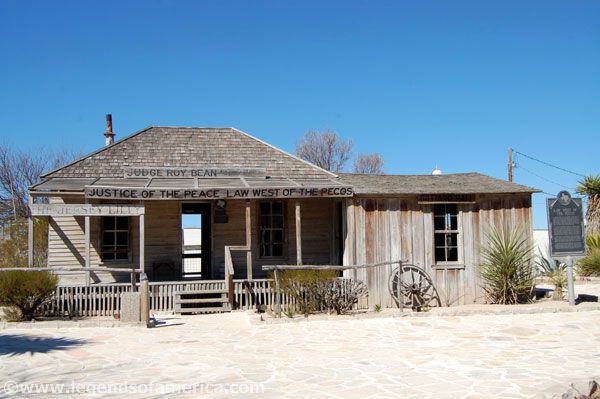
Judge Roy Bean’s Jersey Lilly Saloon, 2011.
Judge Roy Bean Visitor Center – Features a rustic saloon, courtroom, billiard hall, and the opera house of Judge Roy Bean, the colorful and controversial “Law West of the Pecos” in the 1880s.
Nearby: Pumpville ghost town, about 15 miles northwest of Langtry, is a turnoff to the old Pumpville townsite. It is about two miles North of Highway 90 on FM 1865.
Dryden – Dying Along the Railroad – A ghost town today, Dryden got its start when the Galveston, Harrisburg, & San Antonio Railroad arrived in 1882. Only a few residents remain, along with the ruins of several abandoned buildings.
Sanderson – The Town Too Mean For Bean – Known as the Cactus Capital of Texas, Sanderson began as a stop along the Galveston, Harrisburg, & San Antonio Railroad in 1882. The county seat of Terrell County, it is home to about 900 people today.
East Gate Park – Outdoor art gallery painted on monoliths of local limestone.
Snake House – Local reptile exhibit and education center with live snakes on display.
Terrell County Memorial Museum – Museum displays feature railroad memorabilia, period costumes, cowboy and ranching relics, tools and pioneer furnishings, and mementos of Terrell County History.
Sanderson to Pecos – 118 miles. Travel northwest on US-285.
Paisano Pete welcomes you to Fort Stockton.
Fort Stockton – The county seat of Pecos County, Fort Stockton grew up around Comanche Springs near the military fort founded in 1859. Comanche Springs was a favorite rest stop on the Comanche Trail to Chihuahua, San Antonio-El Paso Road, the Butterfield Overland Mail Route, and the San Antonio-Chihuahua freight-wagon road. It has a population of about 7,800 people today.
Annie Riggs Memorial Museum – Step back in time in this 1900 Adobe Hotel, appointed with a wide variety of items from the era.
Historic Fort Stockton – Features original and reconstructed military buildings, including Officers’ Row, the Guardhouse, Enlisted Men’s Barracks, Parade Grounds, and a museum/visitor’s center.
Pecos – Established in 1881 as a stop on the Texas and Pacific Railroad, Pecos gained early fame as a hangout for rowdy cowboys and fast-draw lawmen. Touted as “Home of the World’s First Rodeo,” Pecos hosted a cowboy contest in 1883 that was the forerunner of today’s popular sport. The county seat of Reeves County, it is home to about 9,500 people today.

A collection of hats at the Pecos Museum
West-of-the-Pecos Museum and Park – Situated in an old hotel, the museum preserves the colorful history of not only Pecos and Reeves Counties, but the entire region West of the Pecos River. The gunfighter Clay Allison is interred in Pecos Park.
Pecos to Midland – 95.6 miles. Travel northeast on I-20.
Barstow – Ten years after the Texas and Pacific Railway reached Barstow in 1881, Barstow was established, and the next year, when Ward County was organized in 1892, Barstow became the county seat. However, by 1918, Barstow began to decline due to the dam on the Pecos River in New Mexico. Twenty years later, it lost its county seat status to Monahans. Once home to more than 1,200 people, Barstow continued to decline and now has only about 400 residents.
Pyote – Pyote began as a small town. Its fortunes rose with oil, but its population decreased when the railroad was built away from the town. At one time, Pyote had 3,500 residents. The 1942 development of the Pyote Air Force Station and the 1967 development of what would become the West Texas State School raised the town’s fortunes. However, when those operations moved out, the town declined rapidly and now is home to only about 130 people.
Pyote Museum & Rattlesnake Bomber Base – Displays World War II memorabilia in an old building from the base.
Nearby: Wink – Just 15 miles North of Pyote, Wink features the Roy Orbison Museum and several mysterious sinkholes.
Wickett – The opening of the Hendrick oilfield in 1926 established Wickett as a tank and refining center. Its oil heyday lasted until the 1960s, when Wickett reached a peak population of about 1,000 people. Today, it has about 450.
Monahans – Established in 1881 as a railroad stop, but remained a small settlement until oil was discovered in the area in 1926. Today, the city is the Ward County seat and a financial and marketing center for cattle and oil. It has a population of about 6,800 people.

Monahans Sandhills State Park
The Million Barrel Museum – A 14.5-acre site with historic exhibits, including a 1928 oil storage tank, the original Monahans Jail, a section of railroad track with a vintage caboose, an eclipse windmill, a display of antique farm equipment, and more.
Monahans Sandhills State Park – These dunes are only a small part of a larger 200-square-mile dune field that stretches into New Mexico. Includes dunes that rise as high as 70 feet.
West Odessa – West Odessa is on the western edge of Odessa and Monahans Draw in central Ector County. It was named for its proximity to Odessa and was settled primarily from 1979 to 1982, during the last oil boom. Its population today is about 18,000.
Odessa – The county seat of Ector County, Odessa was founded as a water stop and cattle shipping point on the Texas and Pacific Railway. The first post office opened in 1885. It remained a small town until the opening of Penn Field in 1929 and Cowden Field in 1930. Today it has a population of nearly 100,000 people.
Ellen Noel Art Museum – An independent art museum on the University of Texas at the Basin campus, it features rotating exhibitions of historical and contemporary art.
Odessa Meteor Crater – Approximately 550 feet in diameter, the crater is the second largest in the nation. It resulted from a barrage of meteors crashing into Earth some 20,000 to 50,000 years ago. It is located about 10 miles West of Odessa. Parker House Ranching Museum – It represents the lifestyle of a prominent ranching family, who served the communities of Andrews and Ector counties since 1907.
Petroleum Museum – The Museum tells the story of petroleum and the rugged lives of men and women who sought a better life.
Presidential Museum and Leadership Library – Contains information on each president, along with documents and paraphernalia related to their lives and time in office.
White-Pool House Museum – Built in 1887, it is Odessa’s oldest structure of importance. Exhibits provide visitors an opportunity to view and learn about different periods in Odessa’s history. The barn replica gives a view of early ranching life.
More Information:
Texas Pecos Trail Region
P.O. Box 7045
Midland, TX 79708
432-262-1927
© Kathy Alexander/Legends of America, updated October 2026.
Also See:
Del Rio to Sanderson on the Pecos Trail
See Sources.