
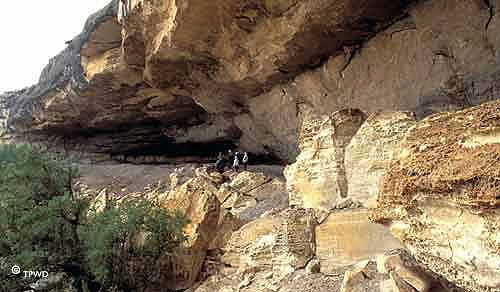
Seminole Canyon State Park.
About ten miles northwest of Comstock is Seminole Canyon State Park. Spanning more than 2,000 acres, the historic site features jagged canyons carved through the Chihuahuan Desert where the Pecos River meets the Rio Grande.
Humans have inhabited the area for approximately 12,000 years, living in natural rock shelters carved into the canyon walls. In those early days, now-extinct elephants, camels, mammoths, bison, and horses roamed the landscape, and people thrived on hunting big game. During the Pleistocene ice age (10,000-12,000 years ago), the climate was more moderate, and the terrain was covered with lush vegetation, such as pine, juniper, and oak woodlands in the canyons and luxuriant grasslands on the uplands.
Some 5,000 years later, the region underwent a dramatic climate shift, resulting in an arid landscape similar to today’s. This culture, known as the “Archaic people,” survived primarily by hunting small animals and gathering wild plants. They lived in the dry rock shelters that line the canyon walls, but in smaller groups than earlier inhabitants because the land could not support larger groups for long.
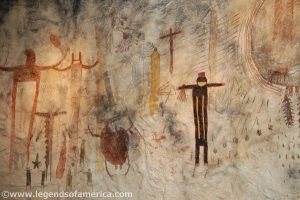
Rock art at Seminole Canyon State Park, Kathy Alexander.
These people left their mark on the environment through some 200 rock paintings throughout the area. The park contains some of the most outstanding examples not only in Pecos River Style, attributed to the Middle Archaic period of 4,000 years ago, but also in rock shelters throughout its canyons. Research into the meaning of Lower Pecos River-style murals suggests that the images may communicate essential elements of the culture’s belief system, such as shamanic journeys to the land of the dead and symbolic relationships with animals and peyote, a hallucinogenic cactus. The pictographs, ranging from single paintings to large panels hundreds of feet long, appear in several locations along the Lower Pecos River Country.
Spanish Explorers and colonists Gaspar Castano de Sosa were the first known Europeans in this area. In 1590, they set out from Monclova, Mexico, to establish a new colony in New Mexico. The U.S. Army was the first American presence in the Lower Pecos region. In 1851, Lieutenant Nathaniel Michler did a reconnaissance of the Rio Grande above and below its junction with the Pecos River for the United States and Mexico Boundary Commission.
After the Civil War, Lieutenant John L. Bullis and his Black Seminole Scouts operated in the area. They blasted a wagon road into Pecos Canyon near the Rio Grande to give the military a shorter route between Forts Clark and Davis. The canyon is named for these scouts.
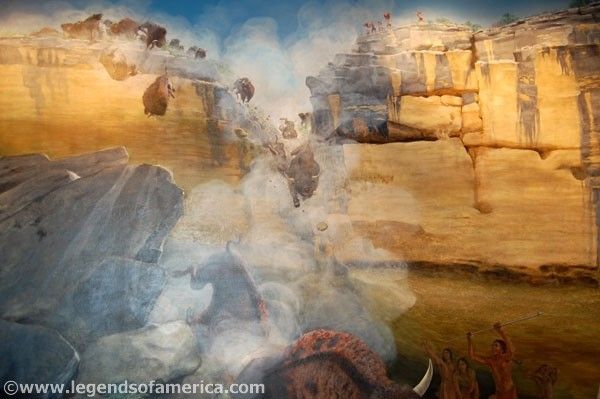
Bonfire Shelter was the scene of a series of prehistoric buffalo “jumps.” Long before Native Americans obtained horses, they stampeded bison herds on the edge of this cliff near Langtry, Texas. Nola Davis’s mural is displayed in the Seminole Canyon State Park Museum, South of the Buffalo Jump site.
In 1882, the Southern Pacific Railroad reached the present park location. The route to connect El Paso with San Antonio began after the Galveston, Harrisburg, and San Antonio Railroad merged with the Southern Pacific. The railroad section in the Rio Grande Canyon was finally abandoned in 1892 when a new bridge spanning the entire breadth of the Pecos River Canyon was completed. The present bridge was built at the same site during World War II. Sections of the old railroad bed still line the park’s landscape.
The historic pictographs are visible only on guided tours of the Fate Bell Shelter, one of the oldest cave dwellings in North America, and it contains some of North America’s oldest Indian pictographs. The tour involves a reasonably rugged hike to the bottom of the canyon and then up to the shelter. Outside of the tours, no hiking is allowed in the canyon area.
The park also features an interpretive center with exhibits on the area’s history, campsites, and hiking and biking trails.
Contact Information:
Seminole Canyon State Park and Historic Site
PO Box 820
Comstock, Texas 78837
432-292-4464
©Kathy Alexander/Legends of America, updated October 2026.
Also See:
Del Rio to Sanderson on the Pecos Trail
Val Verde County Photo Gallery
See Sources.