
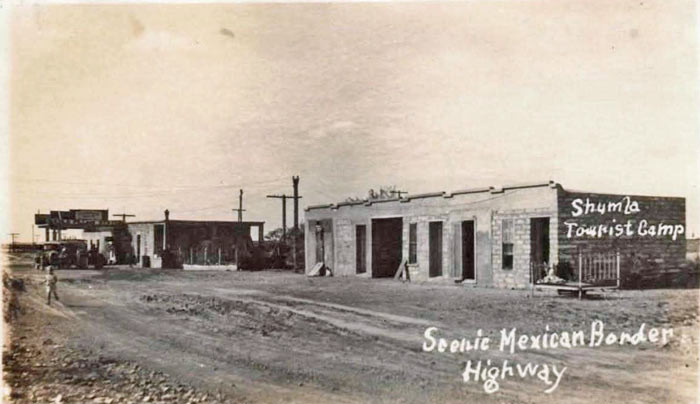
An old Postcard of the Shumla Tourist Camp, February 1929. Courtesy Lori Cooper Smith.
About eight miles northwest of Seminole Canyon State Park is the old townsite of Shumla, Texas. Yet another stop along the Galveston, Harrisburg, & San Antonio Railroad, this station, situated on the north side of the tracks, got its start in 1882, the same year as the other railroad towns of the area. The year before, hundreds of Chinese and European immigrants worked to connect the eastern and western halves of America’s second and southernmost transcontinental rail line.
Once a tent city stretching more than a mile long, it teemed with hundreds of graders and tracklayers as well as crew bosses, engineers, and a variety of camp followers, including peddlers, whiskey sellers, gamblers, and “working women.”
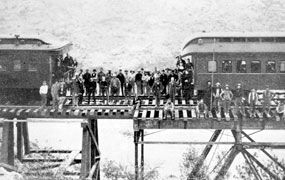
Southern Pacific silver-spike-ceremony.
One of the railroad engineers, who had been to Eastern Europe, thought the area looked like the countryside around the Ottoman fortress of Shumla in the Balkans. The name was borrowed, and the settlement of Shumla, Texas, was born. On January 12, 1883, at a site east of Shumla, the railroad tracks from the east and the west were ceremoniously connected by a silver spike.
Though most people left the area once the tracks were laid, the site continued as a water station for the railroad, including a depot, water tank, and foreman’s house. Soon, several settlers made their homes around the depot, but Shumla grew slowly and was never very large. In 1906, it gained a post office, but it was short-lived, closing just three years later in 1909. A freight station continued to function on the railroad into the 1930s.
In 1914, Rancher W.A. “Will” Cooper bought the land encompassing Shumla. In 1917, he married Erna Winterberg, and two years later, moved the family to Florida, while leasing the ranch. But when payments stopped in 1923, the land reverted back to Cooper, and he returned to Texas. According to family member Lori Cooper Smith, in 1923 Cooper built the Shumla Tourist Camp, a gas station, store, and small motel/cabins on the south side of the railroad tracks to service travelers, along what was called at the time the “Scenic Border Highway”, later part of Highway 90. In 1929, Cooper sold the property, along with his ranch, to the Ross brothers of Del Rio, after which he moved his ranching operations to Persimmon Gap in Big Bend National Park.
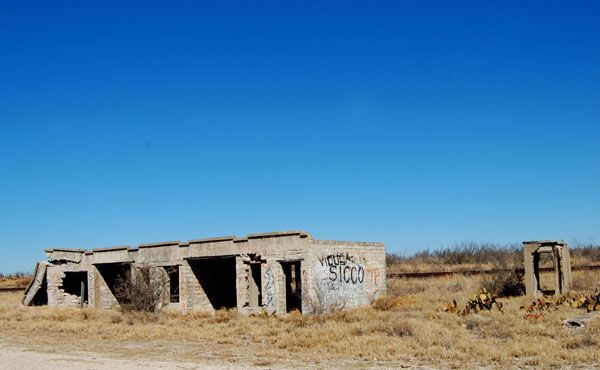
All that’s left of Shumla is an old combination motel, gas station, and store that was closed in the 1970s. Photo by Kathy Alexander, 2011.
The road stop store and cabins continued to operate until the early 1970s and today are the only remaining remnants of this old town, except for the creatures and critters of the desert. Nothing is left of the original townsite, located about 100 yards northwest of these old buildings on the other side of the tracks. The old depot was long ago moved to a private ranch about a mile west of Shumla and is now used as a barn. The original foreman’s house was also moved.
Over the years, numerous items representing the early days of railroad construction have been found in the area, including Chinese coins, opium bottles, fragments of teacups, and more. In 1995, an archaeological survey noted the remnants of a rectangular dry-laid stone structure about 20 feet wide and 70 feet long, a collapsed dome oven used for bread baking, a piled stone forge for blacksmith work, and rock piles suggesting tent sites.
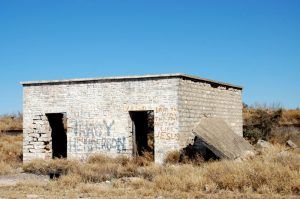
An old building in Shuma, Texas, by Kathy Alexander, 2011.
We were notified in previous years that the few remaining buildings in Shumla were slated to be torn down. However, we are unable to verify if that has been the case.
©Kathy Alexander/Legends of America, updated March 2026.
Also See:
Texas Ghost Town Photo Gallery
See Sources.