
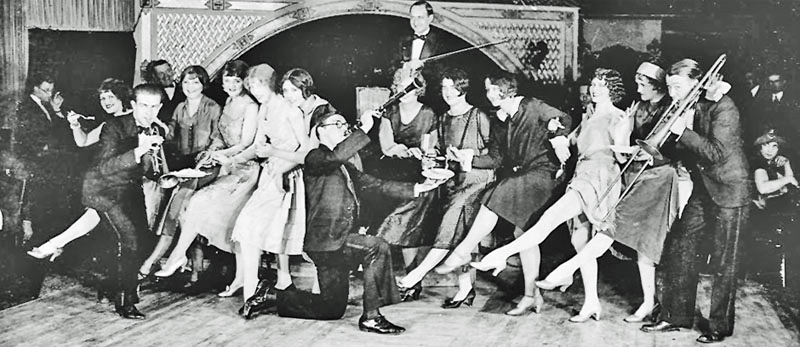
Roaring Twenties.
The Roaring Twenties were the post-World War I era of prosperity and new opportunities. The economy was booming, and the middle class was enjoying a higher standard of living. With unprecedented prosperity, technology, and leisure like no decade before it, the 1920s America roared, soared, and was never bored.
Before World War I, the country remained culturally and psychologically rooted in the 19th century. However, in the 1920s, America seemed to break its wistful attachments to the recent past and usher in a more modern era. The most vivid impressions of that era are flappers and dance halls, movie palaces and radio empires, Prohibition, and speakeasies. Scientists shattered the boundaries of space and time, aviators made men fly, and women went to work. The country was confident and rich. But the 1920s were an age of extreme contradiction. The unmatched prosperity and cultural advancement were accompanied by intense social unrest and reaction. The same decade that bore witness to urbanism and modernism also introduced the Ku Klux Klan, Prohibition, nativism, and religious fundamentalism. America stood at a crossroads between innovation and tradition. Many Americans were looking boldly ahead, but just as many were gazing backward, to cherished memories of a fabled national innocence.
Beginning in major cities, the movement quickly spread nationwide, marked by a sense of novelty and a break from tradition. It was driven by new technologies such as automobiles, motion pictures, and radio, as well as innovative music, fashion, and architecture.
The decade before survived the First World War and the deadly global influenza pandemic, bringing about a cynical post-war mindset: “Eat, drink, and be merry, for tomorrow you may die.”
At the same time, the temperance movement gained prominence, leading to well-intentioned laws that unintentionally turned ordinary citizens into lawbreakers.
The 1920s saw the large-scale development and use of automobiles, telephones, films, radio, and electrical appliances in the lives of millions in the Western world.
Aviation rapidly evolved into a major business, spurred by its growth. The media, supported by the emerging mass-market advertising industry, which fueled consumer demand, highlighted celebrities, especially sports heroes and movie stars. Cities rallied around their home teams, filling newly built cinemas and large sports stadiums. Jazz music flourished, the flapper fashion redefined the modern look for women, and Art Deco reached its peak. American women gained the right to vote, empowering many young women and giving them a newfound sense of independence.
When the decade ended in 1929 with the stock market crash, Americans were left wondering what had happened.
Prohibition in the United States
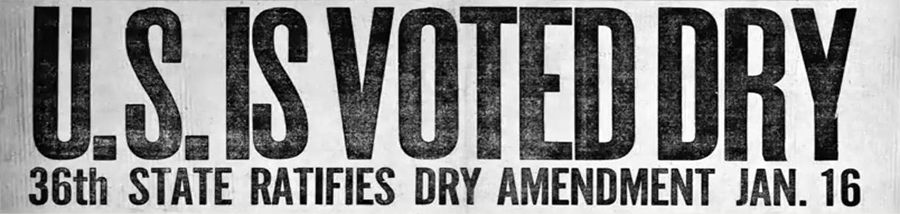
The United States is Voted Dry.
In the United States, the decade began with the enactment of the 18th Amendment to the U.S. Constitution, which prohibited the manufacture, import, and sale of alcohol on January 17, 1920. This was the culminating event in a long effort by conservative forces to check the growing power of America’s immigrants and urban dwellers. The laws were specifically promoted by evangelical Protestant churches and the Anti-Saloon League to reduce drunkenness, petty crime, domestic abuse, and corrupt saloon-politics. These restrictions were widely unpopular, leading to rampant and flagrant violations of the law, and consequently to a rapid rise of organized crime around the nation.
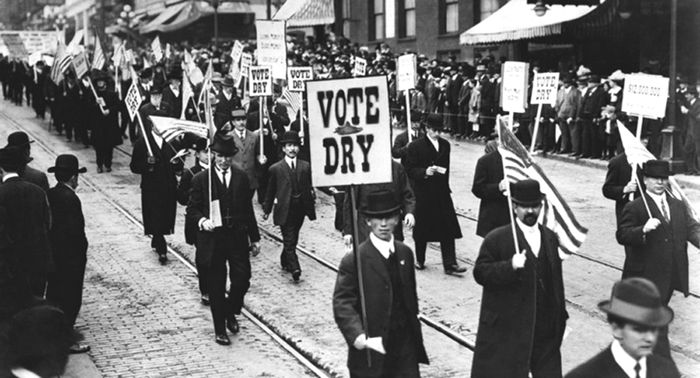
Anti-Saloon League.
Over the next decade, there would be no shortage of bathtub gin and woodshed stills in the countryside, as well as hundreds of thousands of unregulated drinking establishments called speakeasies popping up. Although Prohibition was meant to ban alcohol and reduce crime, the illegal speakeasy became an American craze, creating a nation of lawbreakers and emboldening criminals to exploit the new racket.
The massive profits generated by these illicit saloons were often funneled to gangsters such as Lucky Luciano, Al Capone, Meyer Lansky, Bugs Moran, Moe Dalitz, Joseph Ardizzone, and Sam Maceo. They became popular in major cities and helped fund large-scale organized crime and liquor smuggling. While U.S. Federal agents raided such establishments and arrested many small-time figures and smugglers, they rarely managed to capture the big bosses. Police and government officials were notoriously bribed by speakeasy operators to either leave them alone or at least give them advance notice of any planned raid. In the meantime, crime rates rose.
The business of running speakeasies was so lucrative that the establishments continued to flourish nationwide. In major cities, speakeasies could often be elaborate, offering food, live bands, and floor shows. Unlike the previous legal saloons, speakeasies were not subject to pre-Prohibition controls and welcomed women as patrons.
Despite the emergence of bootleggers and speakeasies and the glamour associated with drinking illegally, the temperance movement succeeded in significantly reducing Americans’ consumption of alcohol.
Economic and Technological Boom

Electricity.
By the dawn of the 1920s, a decade of economic growth and widespread prosperity was driven by the recovery from wartime devastation and deferred spending. The Second Industrial Revolution transformed the United States into a global economic power and drew millions of Americans to cities. With a concurrent rise in immigration, the 1920 U.S. census was the first in which the majority of the population lived in urban areas. Although World War I had strained the country’s finances, the fact that the United States had entered the war late and that the fighting took place overseas helped it secure a more dominant economic position relative to its European allies.
During this time, the American economy continued to accelerate. One reason was the expansion of electricity throughout the country, and its widening use in factories led to increased productivity. Also contributing to the economic boom were mass production methods, such as the assembly line, which spurred growth in the automobile industry. Mass production made technology affordable to the middle class. The automotive, film, radio, and chemical industries took off during this time. Passenger car numbers more than tripled, which in turn stimulated the expansion of transportation infrastructure and the oil and gas industries. There was also a boom in construction and in the rapid growth of consumer goods such as automobiles and electricity.
With electricity also came a range of new household appliances, such as the refrigerator, vacuum cleaner, and washing machine, and the increased availability of credit made it possible for many Americans to afford them.
Between 1922 and 1929, the country’s real gross national product increased by nearly 40%, and the unemployment rate remained low.
The growth of the advertising industry and the development of sophisticated marketing techniques also helped create demand for these and other products in an expanding mass-media landscape.
Jazz Age
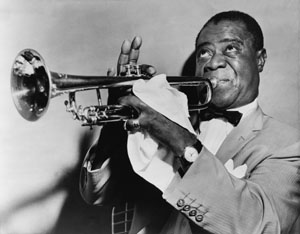
Louis Armstrong, a famous Jazz musician.
During Prohibition, as competition between speakeasies grew, so did the demand for live entertainment. With its roots in ragtime and blues, Jazz emerged and spread into the mainstream among rebellious youth across racial and age lines, becoming the fad of the 1920s. Dance crazes like the Charleston, Black Bottom, and the Shimmy dominated dance floors. Jazz music and the dances it inspired were the perfect fit for the era’s party mood.
Performers and singers from the 1920s included Louis Armstrong, Duke Ellington, Sidney Bechet, Jelly Roll Morton, Joe “King” Oliver, James P. Johnson, Fletcher Henderson, Frankie Trumbauer, Paul Whiteman, Roger Wolfe Kahn, Bix Beiderbecke, Adelaide Hall, and Bing Crosby.
Along with this new music came new fads in fashion and the birth of the Flapper—a new, independent, sexually liberated woman who wore lipstick and slinky dresses, smoked and drank, worshipped jazz, and bobbed her hair.
As such, the period is often referred to as the Jazz Age.
Fashion

Clara Bow, 1921.
Paris set the fashion trends for Europe and North America. Women’s fashion was all about being loose, and women wore dresses all day, every day.
Women’s restrictive clothing was loosened and lightened to make movement easier. Day dresses had a drop waist, which was a sash or belt around the low waist or hip, and a skirt that hung anywhere from the ankle on up to the knee, never above. Daywear had sleeves and a skirt that was straight, pleated, hemmed, or tailored. Jewelry was less conspicuous.
Immortalized in movies and on magazine covers, young women’s fashions of the 1920s set both a trend and a social statement, a break from the rigid Victorian way of life. These young, rebellious, middle-class women, labeled ‘flappers’ by older generations, discarded the corset and wore slinky, knee-length dresses that exposed their legs and arms. The hairstyle of the decade adopted a “boyish” look, with a chin-length bob, which had several popular variations. Cosmetics, which until the 1920s were not typically accepted in American society because of their association with prostitution, became extremely popular.
Actress Clara Bow was the on-screen embodiment of the flapper, and her off-screen life mirrored her films. She made 15 movies in 1925 alone, capturing the spirit of the “flaming youth” and becoming the “IT” Girl of the 1920s.
During this era, Americans generally became more fashion-conscious as fashion trends spread beyond the upper classes. Men’s clothing also went through changes. Men wore their hair short and slicked back. Raccoon coats, patent leather shoes, bow ties, and fedoras were the epitome of men’s style. Like the rise in women’s hemlines, men’s hemlines also rose, in the form of knee-length knickers influenced by Britain’s Prince of Wales, whose good looks and style were regularly featured in the American press.
Fashion was influenced by matinee idols–a craze for male theater or film stars adored by female fans.
The African American community, particularly that of the Harlem Renaissance–a golden age of African American music, literature, and art that took place in the Harlem neighborhood of New York, also placed great emphasis on stylishness. The conk hairstyle–created with a hair straightener made from lye–was trendy among African American men and was popularized by musician Cab Calloway, a jazz singer, songwriter, and bandleader.
Social Change
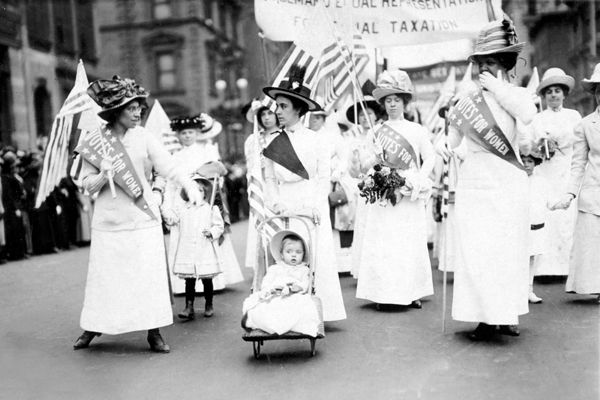
Suffrage Parade, New York City.
The 1920s also brought about social changes for women in the United States. Women entered the workforce in significant numbers during World War I, filling jobs vacated by men sent to war and taking new roles that aided the war effort. Their contributions galvanized support for the suffrage movement, which culminated in the ratification of the 19th Amendment in 1920. Many women remained in the workforce after the war, especially as industrialization expanded opportunities. Young women who were employed in cities enjoyed unprecedented economic independence, and the increased use of contraception, with the country’s first birth control clinic opened in 1916, provided sexual freedom as well. Perhaps the most enduring symbol of the Roaring Twenties was that of the flapper, the emancipated “New Woman” who bobbed her hair, wore loose, knee-length dresses, smoked and drank in public, and was more open about sex.
In a rapidly modernizing world, young people guided creative movements that often defied convention. Jazz music, which had developed into an exciting style defined by improvisation and swinging rhythms, became the dominant sound of the new generation. (Its prominence earned the era another nickname, the Jazz Age, popularized by the writer F. Scott Fitzgerald.) The vitality of jazz was part of a broader flourishing of African American art and culture known as the Harlem Renaissance, which was centered in New York City but reverberated far beyond it. Fitzgerald himself was a leading figure of the Lost Generation, a group of writers whose work captured the era’s decadence and spoke to the disillusionment of many who came of age during World War I.
Women’s Suffrage
Many countries expanded women’s voting rights, such as the United States, Canada, Great Britain, India, and various European countries, between 1917 and 1921. This influenced many governments and elections by increasing the number of voters (though not doubling it, since many women did not vote in the early years of suffrage, as evidenced by the large drop in voter turnout). Politicians responded by focusing more on issues of concern to women, especially peace, public health, education, and children’s status. On the whole, women voted much like men, except they were more interested in peace, even when it meant appeasement.
The Lost Generation was composed of young people who emerged from World War I disillusioned and cynical about the world. The term usually refers specifically to American literary notables who lived in Paris at the time. Famous members included Ernest Hemingway, F. Scott Fitzgerald, and Gertrude Stein, who wrote novels and short stories that criticized the materialism they perceived as rampant in this era.
Art Deco

Art Deco Poster.
Art Deco was the design and architectural style that marked the era. Originating in Europe, it spread to the rest of Western Europe and North America by the mid-1920s. It was a glamorous, modern design movement symbolizing luxury, progress, and the Jazz Age’s exuberance, characterized by bold geometric shapes, streamlined forms, rich materials such as chrome, lacquer, exotic woods, vibrant colors, and influences from ancient Egypt and machine-age aesthetics, appearing in skyscrapers, fashion, cars, furniture, and jewelry, reflecting the era’s optimism and fascination with technology and speed.
During the Art Nouveau period, posters usually advertised theatrical productions or cabarets. In the 1920s, travel posters, made for steamship lines and airlines, became extremely popular. The style changed notably in the 1920s, focusing attention on the advertised product. The images became simpler, more precise, more linear, and more dynamic, often set against a single-color background.
In the U.S., one of the more remarkable buildings in this style was the Chrysler Building, which at the time was the tallest building. The forms of Art Deco were pure and geometric, though the artists often drew inspiration from nature. In the beginning, lines were curved, though rectilinear designs would later become increasingly popular.
Radio

Radio, 1920s.
Radio became a sensation in the 1920s, bringing entertainment and information into American homes for the first time. Although invented in the late 19th century, radio saw significant commercial growth in this decade. The first live broadcast for a popular audience occurred on November 2, 1920, when KDKA in Pittsburgh aired the election returns for Harding and Cox, though few had the technology to listen.
Advancements led to the development of earphone-free radios, prompting many families to gather around the radio to listen to scheduled shows such as soap operas, comedies, and Westerns. By 1922, over three million households owned radios. The era also introduced male idols known as crooners. Notable figures included Jack Smith, “The Whispering Baritone,” and Art Gillham, who gained fame in 1924 alongside Will Rogers. In 1925, electrical recording became commercially available, and the Grand Ole Opry premiered as an hour-long “barn dance.”
The establishment of the Federal Radio Commission in 1927 marked a new era of regulation. Enterprising businessmen, however, built powerful “X-stations” across the border in Mexico to evade these regulations, broadcasting music by artists such as “Fiddlin’ John Carson” and the Carter Family throughout the country.
By 1929, over twelve million households owned radios, generating $852 million in annual sales.
Not only was the radio one of the most popular new electric devices, installed in 40% of homes by 1930, but the airwaves became an effective advertising medium.
Cinema & Sound Movies

Vitaphone.
The cinema thrived during this period, marking the decline of Vaudeville as performers flocked to the film industry for better pay and working conditions. The Orpheum Circuit, a chain of Vaudeville and movie theaters, was integrated into new film studios.
Movies became cheap and accessible, attracting large audiences to downtown movie palaces and neighborhood theaters. At the beginning of the decade, films were silent and colorless. In 1922, the first all-color feature, The Toll of the Sea, was released.
In 1923, Lee de Forest released short sound films, while Theodore Case developed the Movietone sound system, sold to Fox Film. The Vitaphone system debuted in 1926 when Warner Bros. released Don Juan, the first film to feature a synchronized musical score and sound effects, though it lacked dialogue. The Jazz Singer, released in October 1927, was a major success and innovative for its use of sound, featuring limited live-recorded audio. Its profitability convinced the film industry to invest in sound technology.
By 1928, many major studios, including Paramount and MGM, began converting to sound films, with Warner Bros. releasing Lights of New York, the first all-talking feature. The animated short Steamboat Willie, featuring Mickey Mouse, also debuted that year. For much of that year, Warner Bros. dominated the talking film market, prompting other studios to rapidly adopt sound technology. Columbia Pictures released its first talking feature in February 1929, and in May, Warner Bros. introduced On with the Show!, the first all-color, all-talking film. Silent film production ceased soon after, with The Poor Millionaire being the last silent feature released in April 1930.
Warner Bros. ended the decade by unveiling On with the Show in 1929, the first all-color, all-talking feature film.
Dance

The Cotton Club in Harlem, New York City.
Dance clubs became very popular in the 1920s. Dance clubs across the U.S. sponsored dancing contests in which dancers invented, tried, and competed with new moves. Professionals honed their tap dance and other dance skills throughout the stage circuit across the United States. With the advent of talking pictures, musicals became all the rage, and film studios flooded the box office with lavish musicals. The representative was the musical Gold Diggers of Broadway, which became the decade’s highest-grossing film. Harlem played a key role in the development of dance styles. Several entertainment venues attracted people of all races. The Cotton Club featured black performers and served a white clientele, while the Savoy Ballroom served a mostly black clientele. Some religious moralists preached against “Satan in the dance hall” but had little impact.
The most popular dances throughout the decade were the foxtrot, waltz, and American tango. However, a variety of eccentric novelty dances were developed, including the Breakaway and the Charleston, both based on African American musical styles and rhythms, such as the widely popular blues. Charleston’s popularity exploded after its feature in two 1922 Broadway shows.
A brief Black Bottom craze, originating from the Apollo Theater, swept dance halls from 1926 to 1927, replacing the Charleston in popularity.
By 1927, the Lindy Hop, a dance based on the Breakaway and Charleston and integrating elements of tap, had become the dominant social dance. Developed in the Savoy Ballroom, it was set to stride piano ragtime jazz. The Lindy Hop later evolved into other Swing dances. These dances, nonetheless, never became mainstream, and the overwhelming majority of people in Western Europe and the U.S. continued to dance the foxtrot, waltz, and tango throughout the decade.
Dance music came to dominate all forms of popular music by the late 1920s. Dance clubs’ popularity peaked in the late 1920s and reached into the early 1930s.
Automobiles

Ford Model T.
Before World War I, cars were a luxury good. In the 1920s, mass-produced vehicles became commonplace in the U.S. and Canada. The 1927 Ford Motor Company discontinued the Ford Model T after selling 15 million units. It had been in continuous production from October 1908 to May 1927. The company planned to replace the old model with the Ford Model A. The decision was a reaction to competition. Due to the commercial success of the Model T, Ford had dominated the automotive market from the mid-1910s to the early-1920s. In the mid-1920s, Ford’s dominance eroded as competitors caught up to its mass production system. They began to surpass Ford in some areas, offering models with more powerful engines, new convenience features, and styling.
Only about 300,000 vehicles were registered in Canada in 1918, but by 1929, there were 1.9 million. By 1929, the United States had just under 27,000,000 motor vehicles registered. Automobile parts were being manufactured in Ontario, near Detroit, Michigan. The automotive industry’s influence on other segments of the economy was widespread, jump-starting industries such as steel production, highway building, motels, service stations, car dealerships, and new housing outside the urban core.
Ford opened factories around the world and proved a strong competitor in most markets for its low-cost, easy-maintenance vehicles. General Motors, to a lesser degree, followed. European competitors avoided the low-price market and concentrated on more expensive vehicles for upscale consumers.
Aviation
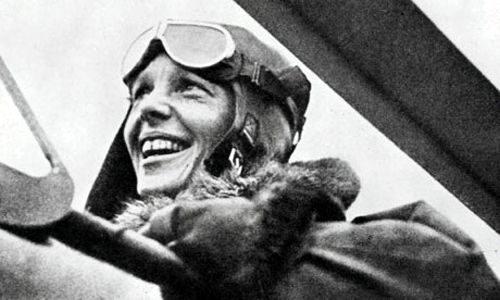
Amelia Earhart.
The 1920s marked the golden age of aviation, during which pilots emerged as heroes, records were shattered, and aircraft became increasingly advanced. Aviators like Charles Lindbergh and Amelia Earhart, his female counterpart, were celebrated and admired by the American public. Amy Johnson distinguished herself as the first woman to fly solo from Britain to Australia.
Air races and daring record-setting flights captivated audiences, as aviation grew more popular. Barnstorming also captured public attention: pilots traveled to rural areas, rented local barns as bases, conducted flying exhibitions, and performed aeronautical stunts. This form of entertainment came to be known as flying circuses.
One of the most popular stunts was “wing-walking,” in which performers would step out onto an airplane’s wings during flight, often with tragic consequences. Charles Lindbergh began his career as a wing walker, like many other young men. However, it was primarily young women performing this stunt who attracted the largest crowds.
Baseball

Babe Ruth.
The 1920s transformed baseball into America’s premier spectator sport, marked by the “live-ball” era’s offensive surge, the rise of Babe Ruth and the Yankees dynasty, and a 50% jump in attendance. It also gained national popularity as advances in radio technology enabled the transmission of scores over longer distances. During this time, many national newspapers began to have sports sections devoted solely to the game. While pro football was in its infancy and basketball was not yet a national or professional sport, baseball had the run of the roost in the newspapers.
The National Negro Leagues began in 1920, providing an opportunity for some of the greatest talent the game has ever seen. Rube Foster’s business sense provided a sound foundation for the next 30 years for African-Americans and Latin greats to play in the US.
Professional baseball player “Babe” Ruth was a huge celebrity, and his fame went way beyond the game. He led the Yankees to seven World Series championships and was a home run champion for 12 seasons. His hitting prowess not only made him a millionaire for the Yankees franchise, but he was also credited with “saving” baseball from national disgrace after the 1919 Chicago Black Sox scandal. In addition to being an amazing ballplayer, Ruth was a colorful character, and newspapers endlessly reported on him. Following the 1919 Black Sox scandal, the game saw a rapid pace, more home runs, and the construction of new, larger concrete-and-steel stadiums.
By the end of the decade, the teams for the next 30 years had been established. Until expansion arrived in the 1960s, the league itself changed little for over three decades, until the Dodgers and Giants moved west.
Literature

The Jazz Age.
The Roaring Twenties was a period of literary creativity, and several notable authors produced works during this time. It saw a variety of social and cultural changes that gave rise to a new kind of literature, reflected in the rise of the Lost Generation, as described by Gertrude Stein. The decade included authors such as F. Scott Fitzgerald, Ernest Hemingway, and Virginia Woolf.
One novel that sparked its own mania was Stephen Harrison and Sarah D. Coffin’s The Jazz Age, which explored American taste and style during the 1920s. This lavishly illustrated publication showcased developments in design, art, architecture, and technology as a vital part of the emerging marketplace for Art Deco luxury goods, mirroring the ecstatic spirit of the times.
D.H. Lawrence’s novel Lady Chatterley’s Lover was a scandal at the time because of its explicit descriptions of sex. The Great Gatsby, often considered the novel that personifies the social, cultural, and political tensions of the 1920s, wasn’t a bestseller upon its release. It did not become popular until the 1950s, decades after its first publication and the death of its author, F. Scott Fitzgerald. Sinclair Lewis’s Main Street became a publishing phenomenon in 1921.
This decade’s literature examines how culture, society, politics, race, gender, and sexuality changed. Other popular books included All Quiet on the Western Front by Erich Maria Remarque, which recounts the horrors of World War I and the deep detachment from German civilian life many men returning from the front felt; This Side of Paradise by F. Scott Fitzgerald, in the post-World War I era, portrays the lives and morals of youth; and The Sun Also Rises by Ernest Hemingway, about a group of expatriate Americans in Europe during the 1920s.
The 1920s also saw the widespread popularity of the pulp magazine. Printed on cheap pulp paper, these magazines offered affordable entertainment to the masses and quickly became among the most popular media of the decade. Many prominent writers of the 20th century got their start writing for pulp magazines, including F. Scott Fitzgerald, Dashiell Hammett, and H. P. Lovecraft. Pulp fiction magazines would last in popularity until the 1950s.
Travel & Health
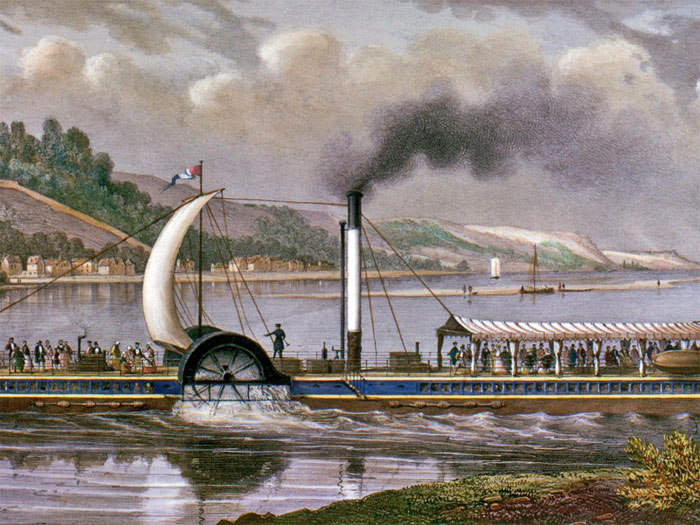
Steamship
Steamship travel among the middle class also took off during the era. New immigration laws significantly cut the flow of immigrants to the U.S. in the 1920s. Facing a huge loss of income, steamship companies converted their steerage spaces into low-cost cabins marketed to middle-class tourists. While the wealthy continued to sail in style, those in the middle class, for the first time, found themselves on luxury liners with more pleasant second-class and third-class accommodations. Steamship lines also began to experiment with cruising—leisure trips to scenic spots around the world. The U.S. economy was booming, and steamship travel among the middle class became the thing to do.
Another fad among the average American was visiting a health resort, usually a thermal underground mineral spring or “hot spring,” where they could “take the water.” The automobile, which became much more affordable by the 1920s thanks to Henry Ford’s assembly line manufacturing, now made it possible for city dwellers to drive out to the country to visit these spas. White Sulphur Springs, West Virginia, and Mineral Wells, Texas, were popular destinations with luxury hotels and posh amenities. In 1924, Franklin D. Roosevelt went to a spa town in Georgia for his paralytic illness, and it was he who would rename the town Warm Springs and bring it fame as the “Little White House” years later. For fashionable East Coasters, it was Saratoga Springs in upstate New York, which had the luxurious Grand Union Hotel, mineral waters, and a race track. For those living in the middle of the country, in cities like Chicago, Illinois, it was Hot Springs, Arkansas. Railroads and highways brought droves of people to Hot Springs for health-related ailments and relaxation, and it became a place for celebrity sightings, including the Chicago White Stockings baseball team and Al Capone. Taking the waters became less fashionable toward the end of the decade, as the discovery of penicillin for certain diseases and the financial crisis of the Great Depression took hold.
Ku Klux Klan
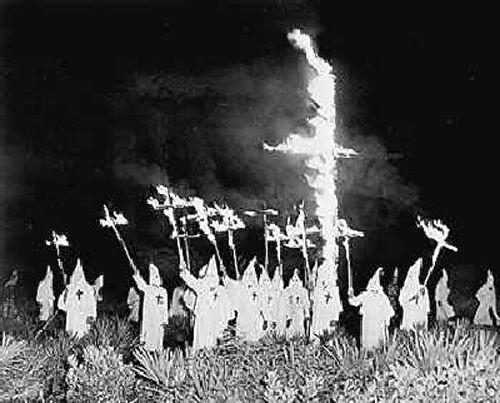
Ku Klux Klan.
In the 1920s, the Ku Klux Klan experienced a resurgence, spread across the country, and achieved significant popularity. The Reconstruction-era paramilitary group had faded from American life until 1915, when Colonel William Simmons re-founded the organization at a small ceremony on Stone Mountain in Georgia.
It was claimed that at the height of the second incarnation of the Ku Klux Klan, its membership exceeded four million people nationwide. It controlled politics in Indiana, Texas, Oklahoma, and Colorado; it was enormously powerful in several other states, notably California and Georgia. The organization promoted “100 percent Americanism,” white supremacy, prohibition, and anti-Catholic/anti-immigrant sentiment.
The Klan did not shy away from using burning crosses and other intimidation tools to strike fear into their opponents, who included not just blacks but also Catholics, Jews, and anyone else who was not a white Protestant. Several massacres of black people took place in the 1920s, including on May 31, 1921, when a white mob descended on “Black Wall Street”, a prosperous black neighborhood in Tulsa, Oklahoma. Over the next two days, they killed as many as 300 people, burned down 40 city blocks, and left 10,000 black residents homeless.
In 1924, the second iteration of the Ku Klux Klan reached the peak of its power and influence in the United States, boasting millions of members, largely in the Midwest and North, rather than just the South. At that time, it joined a broad coalition of conservative groups that won passage of the Immigration Act of 1924, which shaped the U.S. population over the course of the 20th century by greatly restricting immigration and ensuring that arriving immigrants were mostly from Northern and Western Europe. It closed the door on almost all new Asian immigration and shut out most European Jews and other refugees fleeing fascism and the horrors of the Holocaust in Europe. One of the most restrictive immigration laws in U.S. history, it played a key role in ending the previous era of largely unrestricted immigration. Its numerical limits on annual arrivals and use of national-origins quotas, aided by Great Depression-era restrictions, limited religious, ethnic, and racial diversity, and sharply reduced the size of the country’s foreign-born population for four decades.
New Infrastructure

Telephone, 1920s.
The automobile’s dominance led to a new psychology celebrating mobility. Cars and trucks required road construction, new bridges, and regular highway maintenance, largely funded by local and state governments through gasoline taxes. Farmers were early adopters, using their pickups to haul people, supplies, and animals. New industries were spun off to make tires and glass, refine fuel, and service and repair cars and trucks by the millions. New car dealers were franchised by the car makers and became prime movers in the local business community. Tourism gained an enormous boost, with hotels, restaurants, and curio shops proliferating.
Electrification, which had slowed during the war, progressed significantly as more of the U.S. and Canada were connected to the electrical grid. Industries switched from coal power to electricity. At the same time, new power plants were constructed. In America, electricity production almost quadrupled. Telephone lines were also being strung across the continent. Indoor plumbing was installed for the first time in many homes, made possible due to modern sewer systems.
Urbanization reached a milestone in the 1920 census, the results of which showed that slightly more Americans lived in urban areas, towns, and cities, populated by 2,500 or more people, than in small towns or rural areas. However, the nation was fascinated by its great metropolitan centers, which contained about 15% of the population. The cities of New York and Chicago vied in building skyscrapers, and New York pulled ahead with its Empire State Building. The basic pattern of the modern white-collar job was set during the late 19th century, but it now become the norm for life in large and medium-sized cities. Typewriters, filing cabinets, and telephones brought many unmarried women into clerical jobs. By the end of the decade, one in five workers in Canada were women. Interest in finding jobs in the ever-growing manufacturing sector of U.S. cities had become widespread among rural Americans.
Changing Role of Women
The passage of the 19th Amendment in 1920 granted women the right to vote, marking a significant achievement for American feminists seeking political equality. This ultimately created a generational divide between the “new” women of the 1920s and previous generations. Prior to the amendment, many believed that women could not successfully balance careers and families. However, in the 1920s, more women began to aspire to both, fueled by expanding higher education opportunities.

Ford Car Women Advertisement.
Advertising agencies took advantage of this changing status by featuring automobiles in women’s magazines, even though most car buyers were men. These ads highlighted new freedoms for affluent women and served as symbols of modernity and mobility. They provided a visual way for women to envision their new social and political roles.
During this decade, World War I allowed many women, including Black women, to join industries previously deemed inappropriate for them. Despite temporarily entering fields such as chemical manufacturing, most Black women returned to lower-paying roles, with 75% of the Black female labor force by 1920 working as agricultural laborers, domestic servants, or laundry workers.
At the beginning of the 20th century, legislation established a minimum wage and reduced workdays in many factories. This shift during the 1920s emphasized job performance to meet demand, leading to pressure on workers through speed-ups and bonus systems. Although women in factories faced challenges, the booming economy created new opportunities, allowing many young girls from working-class backgrounds to pursue work or vocational training, fostering social mobility.
With the achievement of suffrage, feminists like the National Woman’s Party refocused their efforts, proposing the Equal Rights Amendment in 1923 and advocating against sex-based discrimination. Many women, however, began to challenge traditional definitions of womanhood rather than pursue political goals.
The 1920s saw the rise of co-ed education as women entered large colleges, often seeking suitable husbands. Despite greater sexual freedom and private courtship, women mostly took classes focused on home and family. The “feminine mystique” emerged, suggesting that women wanted to marry, stay home with children, and wield purchasing power to enhance their families and homes.
Women’s Sexuality
The 1920s were a period of social revolution as society changed, as inhibitions faded, and youth demanded new experiences and greater freedom from old controls. Young women, especially, began staking claim to their own bodies and took part in a sexual liberation of their generation.
Many of the ideas that fueled this change in sexual thought were already circulating in New York intellectual circles before World War I. Thinkers claimed that sex was not only central to the human experience, but also that women were sexual beings with human impulses and desires, and restraining these impulses was self-destructive. By the 1920s, these ideas had permeated the mainstream.
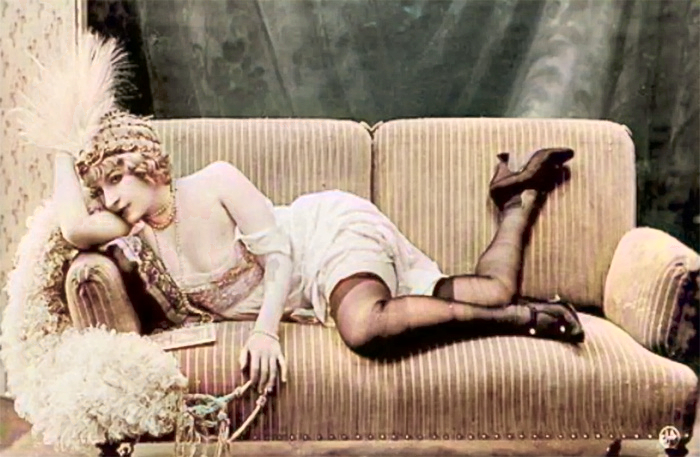
Women’s Sexuality.
Chaperones waned in importance as “anything goes” became a slogan for youth taking control of their subculture. A new woman was born—a “flapper” who danced, drank, smoked, and voted. This new woman cut her hair, wore make-up, and partied. She was known for being giddy and taking risks. Women gained the right to vote in most countries. New careers opened for single women in offices and schools, with salaries that helped them to be more independent. With their desire for freedom and independence came a change in fashion. One of the more dramatic post-war changes in fashion was the silhouette of women’s clothing: dress length shifted from floor length to ankle- and knee-length, becoming bolder and more seductive. The new dress code emphasized youth: Corsets were left behind and clothing was looser, with more natural lines. The hourglass figure was no longer popular, and a slimmer, boyish body type was considered appealing. The flappers were known for this and for their high spirits, flirtation, and recklessness when it came to the search for fun and thrills.
Organized Crime

Mobsters.
During the 19th century, vices such as gambling, alcohol, and narcotics had been popular throughout the United States in spite of not always being technically legal. Enforcement against these vices had always been spotty. Indeed, most major cities established red-light districts to regulate gambling and prostitution despite the fact that these vices were typically illegal. However, with the rise of the progressive movement in the early 20th century, laws gradually became tighter, with most gambling, alcohol, and narcotics outlawed by the 1920s. Because of widespread public opposition to these prohibitions, especially alcohol prohibition, a significant economic opportunity arose for criminal enterprises. Organized crime blossomed during this era, particularly the American Mafia. After the 18th Amendment went into effect, bootlegging became widespread. So lucrative were these vices that some entire U.S. cities became illegal gaming centers, with vice actually supported by local governments. Notable examples include Miami, Florida, and Galveston, Texas. Many of these criminal enterprises would long outlast the Roaring Twenties and ultimately were instrumental in establishing Las Vegas as a gambling center.
American Politics
The 1920s saw dramatic innovations in American political campaign techniques, based on new advertising methods that had worked so well selling war bonds during World War I.
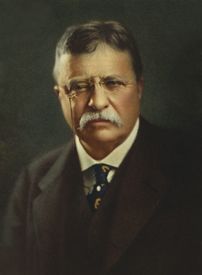
President Theodore Roosevelt by Forbes Litho.
Since the dawn of the 20th century, American politics had been dominated by Theodore Roosevelt and Woodrow Wilson, two presidents whose outsized personalities and dueling visions of the progressive spirit defined the tone of public life. After 1920, Americans seemed to aspire to “normalcy.” In Warren G. Harding, they got exactly what they voted for. His campaign slogan was “America First”.
His best qualities were his extreme friendliness and striking good looks, both of which got him in trouble regularly. As a successful newspaper publisher, local politician, and, later, U.S. senator from Ohio, Harding joined several fraternal organizations, played the trumpet in the town’s marching band, relished poker games, and excelled at public speaking.
The 1920 presidential campaign was the first to be heavily covered by the press and to receive widespread newsreel coverage, and it was also the first modern campaign to use the power of Hollywood and Broadway stars, who traveled to Marion, Ohio, for photo opportunities with Harding and his wife. Some of these included Al Jolson, Lillian Russell, Douglas Fairbanks, and Mary Pickford. Business icons Thomas Edison, Henry Ford, and Harvey Firestone also lent their support to Harding’s campaign. On election night, November 2, 1920, commercial radio broadcast coverage of election returns for the first time. Announcers in Pittsburgh, Pennsylvania, read telegraph ticker results over the air as they came in. This single station could be heard over most of the Eastern United States by the small percentage of the population that had radio receivers.
The ever-genial Harding stacked his Cabinet with cronies from Ohio. He let his attorney general sell pardons and pledges of government non-interference to the highest bidders, looked the other way while his Secretary of the Interior accepted almost $400,000 in kickbacks in exchange for a long-term lease on oil-rich federal lands at Teapot Dome, Wyoming. In the meantime, he adhered to a limited, conservative vision of government, pressing for lower taxes and less regulation.
Despite his limitations, Warren Harding was widely admired by the American electorate. When he died halfway through his term, the public offered up a great outpouring of sorrow and sympathy. It was only in the following months that Warren Harding’s countrymen learned of their late president’s extramarital affairs and scandal-ridden administration.
Calvin Coolidge was inaugurated as president after Warren G. Harding’s sudden death in 1923, and he was re-elected in 1924 in a landslide against a divided opposition. Coolidge used the new medium of radio and made radio history several times while president: his inauguration was the first presidential inauguration broadcast on radio, and on February 12, 1924, he became the first American president to deliver a political speech over the air. Herbert Hoover was elected president in 1928.
Decline of Labor Unions
During World War I, unions experienced rapid growth. However, after a series of major strikes in industries such as steel and meatpacking failed, the labor movement entered a long period of decline. Membership in unions decreased even as employment levels rose. Radical unionism nearly collapsed primarily due to federal repression during the war, enforced through the Espionage Act of 1917 and the Sedition Act of 1918.
The 1920s marked a significant downturn for the labor movement. Union membership and activities sharply declined during this decade of economic prosperity, a period marked by a lack of leadership within the movement and widespread anti-union sentiment from both employers and the government. Unions found it increasingly difficult to organize strikes. For example, in 1919, over 4 million workers—representing 21% of the labor force—participated in approximately 3,600 strikes. In contrast, by 1929, only about 289,000 workers (1.2% of the workforce) staged around 900 strikes. Additionally, unemployment rarely dropped below 5% during the 1920s, and most workers did not experience significant wage losses.
Wall Street Crash of 1929
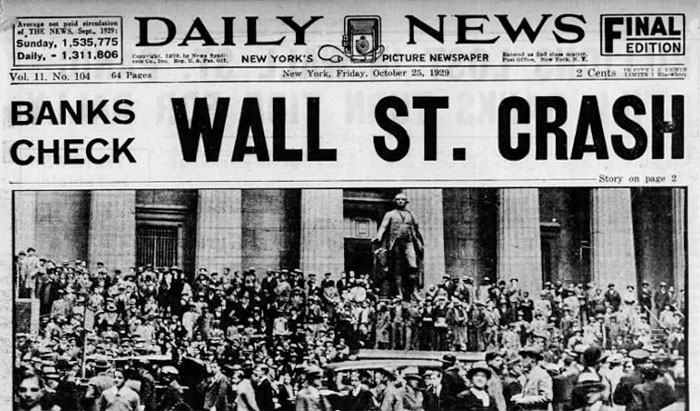
Wall Street Crash, 1929.
The Dow Jones Industrial Stock Index had continued its upward move for weeks, and, coupled with heightened speculative activity, it gave the impression that the growing market of 1928 to 1929 would last forever.
The “Roaring Twenties” of the previous decade had been a time of industrial expansion in the U.S., and much of the profit had been invested in speculation, including in stocks. Many members of the public, disappointed by the low interest rates offered on their bank deposits, committed their relatively small sums to stockbrokers. By 1929, the U.S. economy was showing signs of trouble: the agricultural sector was depressed by overproduction and falling prices, forcing many farmers into debt, and consumer-goods manufacturers had unsellable output due to low wages and thus low purchasing power. Factory owners cut production and fired staff, further reducing demand. Despite these trends, investors continued to buy shares in areas of the economy where output was declining, and unemployment was rising, so stock prices greatly exceeded their real value.
The Wall Street crash began in October 1929 with a sharp decline in prices on the New York Stock Exchange. On October 29, 1929, also known as Black Tuesday, stock prices on Wall Street collapsed when 16.4 million shares were traded on the New York Stock Exchange.
It triggered a rapid erosion of confidence in the U.S. banking system and marked the beginning of the worldwide Great Depression, which lasted until 1939 and put millions of people out of work worldwide throughout the 1930s. It was the most devastating crash in the country’s history.
End of an Era

Leonard Electric Refrigerator.
The 1920s were something of a Gilded Age. Even amid the great prosperity and excess of the decade, America’s economy was fundamentally weak. Over 40% of Americans lived on less than $1,500 a year, which economists cited as the minimum family subsistence level. The income of the top 0.1% of families equaled the income of the bottom 42%. Most people in the countryside did not experience the prosperity of the Roaring Twenties. Farm prices hit rock bottom in the aftermath of World War I, widening the gulf between America’s relatively prosperous cities and impoverished farms.
Such glaring inequality had consequences. Boom times relied on mass consumption, and eventually, working people reached their limit. The very wealthy could only buy so many cars, washing machines, radio sets, and movie tickets. When consumer demand bottomed out, America’s economy simply stopped functioning.
By 1929, American families spent over 20% of their household earnings on such items as phonographs, factory-made furniture, radios, electric appliances, automobiles, and “entertainment.” What people couldn’t afford, they borrowed. By the mid-1920s, Americans bought over three-quarters of all furniture, phonographs, and washing machines on credit.
When the stock market collapsed in 1929, and when the twin influences of under-consumption and over-speculation began wreaking structural havoc on the American economy, the nation’s revolution in values and aesthetics remained incomplete. The 1920s were arguably the nation’s first modern decade, but many of its social and cultural revolutions would play out in the years that followed.
Repeal of Prohibition
The 21st Amendment, which repealed the 18th Amendment, was proposed on February 20, 1933. The choice to legalize alcohol was left up to the states, and many states quickly took this opportunity to allow alcohol. Prohibition was officially ended with the ratification of the amendment on December 5, 1933.

Jobless Men Keep Going.
Also See:
Geography of the United States
Sources:
Encyclopedia Britannica
Gilder Lehrman Institute of American History
Library of Congress
Migration Policy
Sutori
Wikipedia