
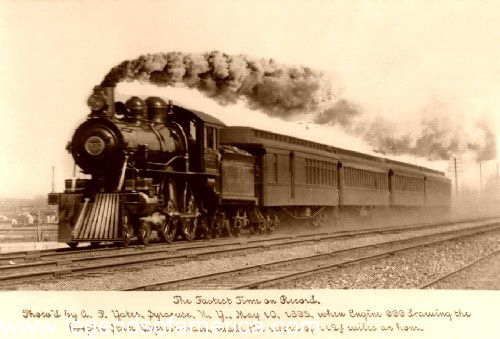
The Fastest Time on Record by A.J. Yates, May 10, 1893, when Engine 999, drawing the Empire State Express train, made the record of 112.5 miles an hour.
By John Moody in 1919.
In 1862, the United States Government granted a charter to construct a railroad from Omaha, Nebraska, to the Pacific coast. At that time, Iowa and Missouri were the only states west of the Mississippi Valley where any railroad construction of importance existed.
During the three decades that had passed since the first railroad construction, the earlier transportation methods, including those by boat, canal, and stagecoach, had given way to more modern transportation methods in the Eastern half of the United States. As a result of these new conditions, states, cities, and towns were consolidated. Population and prosperity increased rapidly in those inland sections that had formerly languished because they had no means of easy and rapid communication.
However, the construction of extensive railways, particularly the consolidation of small, experimental lines into large systems, dates back to the California Gold Rush era. The nation did not begin to realize the extraordinary possibilities of the vast Western territory until its attention was thus suddenly drawn. Definitely, it concentrated on the Pacific by the annual addition of over fifty million dollars to the circulating medium.
The wealth drawn so copiously from this Western part of our continent stimulated the commerce, manufacturing, and trade of the entire Eastern section. People began to understand that with the acquisition of California, the nation had gained nearly half a continent, whose future possibilities were almost unlimited, particularly in terms of developing natural resources and generating wealth.
The public conviction that a railroad linking the West and the East was an absolute necessity became so pronounced after the gold discoveries of ’49 that Congress passed an act in 1853 to survey several lines from the Mississippi River to the Pacific. Although the published reports of these surveys shed a flood of light on the continent’s interior, they led to no definite result at the time because the rivalry between sections and groups of interests for selecting this or that route held up all progress.
The Act of 1862, which created the Union Pacific Railroad Company, together with the amending Act of 1864, authorized the construction of a mainline from an initial point “on the one-hundredth meridian of longitude,” in the Territory of Nebraska to the eastern boundary of California, with branch lines to be constructed by other companies and to radiate from this initial point to Sioux City, to Omaha, to St. Joseph, to Leavenworth, and to Kansas City.* Provision was made for a subsidy of $16,000 a mile for the level country east of the Rocky Mountains, $48,000 a mile for the lines through mountain ranges, and $32,000 a mile for the section between the ranges. The original plan to secure the government subsidies by a first mortgage on the lines was amended to allow private capital to take the first mortgage and the Government to take a second lien for its advances. In addition to these subsidies, several companies were to receive land grants of 12,800 acres to the mile in alternate sections contiguous to their lines. Upon the same terms, the Central Pacific Railroad, a company incorporated under the laws of California, was authorized to construct a line from the Pacific coast, at or near San Francisco, to meet the Union Pacific Railroad.
*These ambitious designs were never fully realized. The mainline ran eventually west from Omaha, meeting the Sioux City branch at Fremont.
The only other branch constructed to connect with the Union Pacific was the one from Kansas City, which initially ran to Denver.
The public was quick to realize the significance of this vast enterprise, for the newspapers of the day were full of such comments as the following:
“It is useless to enlarge upon the value and importance of this great work. It concerns not the United States alone but all mankind. Its line is coincident with the natural and convenient route of commerce for the world… Over it, the trip will be made from London to Hong Kong in forty days, over a route possessing every comfort and attraction, which takes a continent in its course, and which, from the variety and magnitude of its sources, from the race which now dominates it, and from the extent of their numbers, wealth and productions, must soon give law to the commercial world.”
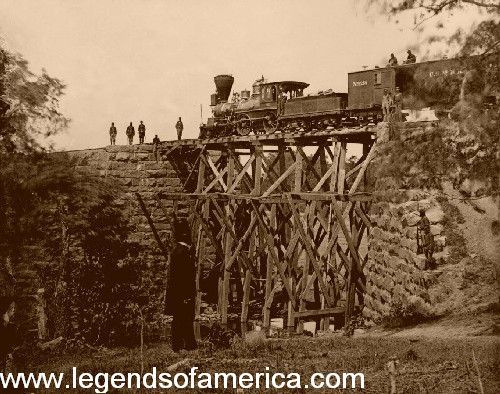
The engine “Firefly” on a trestle of the Orange and Alexandria Railroad.
Although the Government had liberally subsidized the construction, gross extravagance had promptly crept in; the juggling of accounts to secure profits on the government advances was freely indulged in, and after only a small section of the line had been completed, it was announced that more capital must be forthcoming or the work would cease.
Notwithstanding these and similar optimistic sentiments, the enterprise’s meager public financial support in this situation led to a plan to sublet the work to a construction company known as the Pennsylvania Fiscal Agency. This name was later changed to that of the Credit Mobilier of America. With its irregularities involving conspicuous politicians, the story of the Credit Mobilier is one of the most disgraceful in American history. The detailed history of these operations need not be considered here; it is sufficient to say that, in the end, despite political scandals, the Union Pacific lines were completed. Within two years after the contracts were let to this new company, in 1866, over 500 miles of road were completed and put into operation. An advertisement published late in 1868 announced that “five hundred and forty miles of the Union Pacific Railroad, running west from Omaha across the continent, are now completed, the track being laid and trains running within ten miles of the Rocky Mountains… The prospect that the whole grand line to the Pacific will be completed by 1870 was never better.”
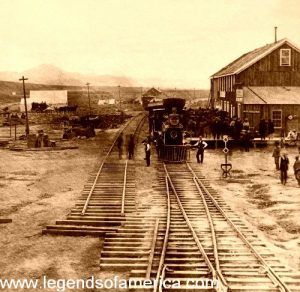
Depot at Elko, Nevada, in 1869.
As a matter of fact, the line to the coast was finished earlier than was predicted. One factor that accelerated the construction process was the company’s growing financial difficulties. The through-line needed to be completed so that the resulting business could make train operations pay. But aside from this, another influence was at work, encouraging rapid construction. The Act of 1862 provided that the Central Pacific Railroad might also build across Nevada to meet the Union Pacific on the condition that it completed its allotted section first. As the Central Pacific was also receiving a heavy government subsidy per mile, and since there was great profit in construction undertaken with this government subsidy, there was naturally a strong incentive for both companies to build as much mileage as possible and as rapidly as possible.
The Central Pacific enterprise was backed by a group of men who were aware of the possibilities in the situation and had made large fortunes during the gold-mining boom of previous years, such as Leland Stanford, Collis P. Huntington, Mark Hopkins, and the Crocker family.
The rivalry between them and the Union Pacific interests woke the whole continent. It formed a chapter in American railroad history as startling and romantic as anything in the stories of the Vanderbilts and Goulds, with their financial gymnastics.
As the contest proceeded, public interest increased, and the entire country watched to see which company would win the significant government subsidies through the mountains. Throughout the winter of 1868, work on the Union Pacific continued with unabated energy, and freezing weather caught the builders at the base of the Wasatch Mountains. However, blizzards could not stop them. The workmen laid tracks across the Wasatch range on a bed of snow and ice, and one of the track-laying trains slid bodily, track and all, off the ice into a stream. The two companies had over 20,000 men at work that winter. Suddenly, the Central Pacific Railroad surprised the Eastern builders by filing a map and plans for building as far as Echo, Nevada, some distance east of Ogden. The Union Pacific forces, however, were equal to the occasion. Initially, one mile a day was considered a rapid pace for construction. Still, even with the limited daylight of the winter months, they were laying over two miles a day, and they finally crowned their efforts by laying nearly eight miles of track in one day between sunrise and sunset.
In the meantime, the Central Pacific Railroad also had stopped at nothing. The company had a dozen tunnels to build, but did not wait to finish them. Supplies were hauled over the Sierra Nevada, and the work was pushed ahead regardless of cost. On May 10, 1869, the junction was formed, the opposing track layers meeting at Promontory Point, fifty miles west of Ogden, Utah. Spikes of gold and silver were driven into the joining tracks, and the through-line from the Missouri River to the Pacific Ocean had been completed; the first engine from the Pacific coast faced the first engine from the Atlantic. The whole country celebrated this achievement, from President Grant in the White House to the newsboy who sold extras. Chicago held a parade several miles long; in New York City, the chimes of Trinity were rung, and in Philadelphia, the old Liberty Bell in Independence Hall was tolled again.
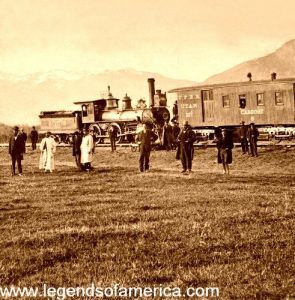
Central Pacific Railroad at Ogden, Utah, in 1869.
The cost of the Union Pacific Railroad from Omaha to its junction with the Central Pacific Railroad formed a controversy for a generation. The loss of six months of the allotted time for completing the road, no doubt, increased its cost to the builders, for they sometimes borrowed money in the East at rates as high as 18 and 19%. Besides, in pushing the line far beyond the bounds of civilization without waiting for the slower pace of the settler and the security that his protection afforded, it often became necessary for half the total number of workmen to stand guard and thus reduce the working capacity of the construction force. Even so, hundreds were killed by the Indians.
Governmental restrictions of various kinds also increased the road’s cost. For example, the stipulation that only American iron should be used increased the cost by at least ten dollars for every ton of rail laid. The requirement that a cut be made through each rise in the Laramie Plains, thus giving the track a dead level instead of conforming to the natural roll of the country, ultimately resulted in a waste of between $5 million and $10 million.
Extraordinary costs, combined with the extravagant methods of construction and financing, increased the property’s total cost to what was, in those days, a substantial sum. The records indicate that the profits accrued through Credit Mobilier and other means in the construction, up to the opening in 1869, exceeded $50 million.
While the Union Pacific was being built, from 1862 to 1869, other railroads were not idle; many were rapidly expanding into the Central West. Not only had the Chicago and North Western reached Omaha and connected with the Union Pacific, but the Kansas Pacific Railroad had penetrated as far west as Denver and joined the Union Pacific at Cheyenne, Wyoming.
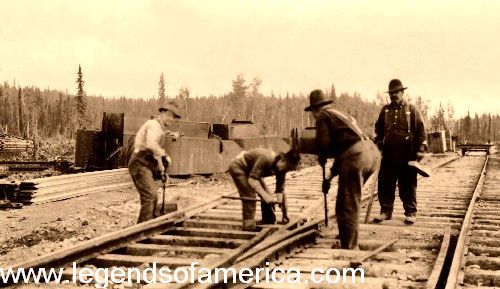
Railroad Building, 1900.
The close relationship between railroad expansion and the country’s general development and prosperity is nowhere brought more distinctly into relief than in connection with the construction of the Pacific railroads. With the opening of a transcontinental line, the vast El Dorado of the West was laid practically at the doorstep of the Eastern capital. Not only did American pioneers turn toward the West, but foreign emigrants also bent their steps in vast numbers in that direction, and capital steadily increased in amounts. Towns sprang up everywhere and soon developed into busy centers of trade and commerce.
Caravan trains, which had followed a single westward line a few years before, now started from points along the railroad artery and penetrated far to the north and south. The settlers knew that the time was not far distant when all the vast territory west of the Missouri River, from the Canadian border to the Rio Grande, would be reached by the rapid spread of the railroad.
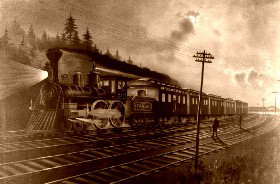
Night Train, 1884.
In the 1960s and 1970s, centers such as Kansas City, Sioux City, Denver, Salt Lake City, Cheyenne, Atchison, Topeka, Helena, Portland, Seattle, Duluth, St. Paul, and Minneapolis, along with numerous smaller places, rapidly expanded in size and importance. The entire Pacific slope was soon dotted with towns and cities, and even the great arid plains of the West–as well as the “Great American Desert” covering Utah, Arizona, New Mexico, and parts of Nevada — began to take on signs of life which had not been dreamed of a decade before.
But the development of this great section of the country during the next few years was even more notable. By 1880, four different railroad lines were running through the Pacific States, and a fifth, the Denver & Rio Grande, had penetrated through the mountains of Colorado and across Utah to the Great Salt Lake. These were the years when the modern industrial era was really beginning. Man’s viewpoint was changing, and instead of remaining content with the material achievements of the Atlantic and Central sections of the continent, he began to realize that the vast Western regions and the thousand miles of Pacific coastline were destined to be America’s inexhaustible patrimony for the years to come.
In 1880, the Union Pacific began its eastward expansion, acquiring control of the Kansas Pacific, which was in decline, as well as the Denver Pacific, a crucial connecting link. In January 1880, these two companies were acquired by the Union Pacific, thereby establishing a continuous line from St. Louis to the west. In the meantime, the Central Pacific, operating from Ogden west to the coast, had added many branches. At the same time, a new company — known as the Southern Pacific Railroad of California—had been constructing a system of lines throughout the state south of the Central Pacific for some years. By 1877, it had penetrated Yuma, Arizona, 727 miles southeast of San Francisco. It had also built lines into Arizona and New Mexico and soon joined the Santa Fe route, which had been working westward for some time.
In 1881, the Southern Pacific Railroad continued its eastern extensions along the Rio Grande to El Paso, Texas, where it connected with a new road under construction from New Orleans. A junction was also established at El Paso with the Mexican Central, which was under construction to connect to the City of Mexico.
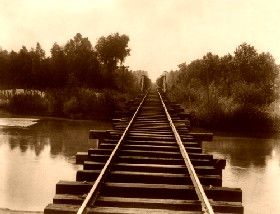
Southern Pacific Railroad bridge over the Calloway Canal, Kern County, California, 1888.
The Southern Pacific Railroad was closely allied with the Central Pacific interests headed by Collis P. Huntington. In 1884, the great Southern Pacific Company was formed, which acquired control of the stock of the entire aggregation of railroads in the South and Southwest. At the same time, the Central Pacific came under the direct control of the Southern Pacific through a long lease.
During these eventful years, while the Southern Pacific properties were penetrating eastward through the broad stretches of the country to the south of the Union Pacific lines, equally interesting events were occurring in the north. In 1879, the Oregon Steamship and Navigation Company was consolidated, with several short railway lines in Oregon and Washington, under the name of the Oregon Railway and Navigation Company.
These railroad lines extended east from Portland to the Oregon state line and north to Spokane, finally connecting with the new Northern Pacific. At the same time, another road, known as the Oregon Short Line Railroad, was built from Granger, Wyoming, on the line of the Union Pacific to a junction with the Oregon Railway and Navigation Company at Huntington, Oregon, on the Snake River. The Oregon Short Line came under the control of the Union Pacific and was opened for traffic in 1881. Later, a close alliance was made with Henry Villard, the controlling spirit in the Oregon Railway and Navigation Company. Ultimately, the entire Oregon lines system passed under Union Pacific control, only to be lost in the receivership of 1893; however, it was later recovered under the Harriman regime.
When, after ten more years of expansion, the great Union Pacific property was placed in the hands of receivers in 1893, it had grown into a system of more than 8,000 miles of track. It completely controlled the Oregon Railway and Navigation Company and the lines to St. Louis. Additionally, it owned a necessary extension known as the Union Pacific, Denver, and Gulf Railroad, which ran from a point in Wyoming across Colorado to Fort Worth, Texas. The system’s financial failure was due to several causes. Its management had been extravagant and inefficient, and construction and expansion had been too rapid. The policy of building expensive branch lines where they were not needed and obligating the parent company to finance them had been a grievous mistake, contributing mainly to the company’s downfall.
Furthermore, the credit of the Union Pacific was steadily weakening because the time was drawing near when its heavy debt to the United States Government would come due. In its more than 20 years, the company had never paid any interest in government debt, nor had it maintained a sinking fund to meet the principal when due. Consequently, the accruing interest had mounted year by year, and should the Government enforce payment at maturity in 1897-99, the company would be doomed to bankruptcy. This government debt, including accrued interest, totaled $ 54 million.
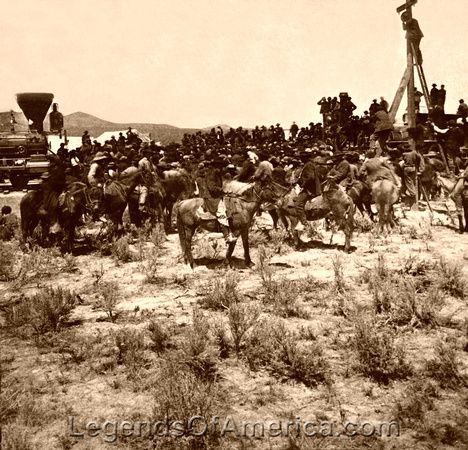
The last rail, by Alfred Hart, 1869.
Attention should not be diverted from the fact that during all these years, a vast expansion of competitive lines had been going on far southward of the Union Pacific. Under the guiding genius of Collis P. Huntington, the Southern Pacific Company had consolidated and solidified a gigantic system of railways by 1884, extending from New Orleans to the Pacific and throughout the entire State of California to Portland, Oregon, with branch lines radiating through Texas and making close connections with roads entering St. Louis. In addition to these railroads, Huntington acquired control of a steamship line operating from New York to New Orleans and Galveston, and subsequently of the Pacific Mail Steamship Company, operating along the coast from Oregon south to the Isthmus of Panama and across the Pacific Ocean.
The ever-growing effects of this robust and well-managed competitor–combined with the significant development of the Santa Fe system during these years, the competition of the completed Northern Pacific, and the possibilities of the new Great Northern Railway or Hill line, now completing its main artery to the Pacific–were far-reaching enough in themselves to bring the Union Pacific upon evil days. Consequently, few were surprised when, under the tremendous pressure of the panic of 1893, the property was forced to confess insolvency.
The Union Pacific had followed the same pattern as most American railroads; it had been constructed in advance of population growth and had to pay the penalty. Yet, it had more than justified the hopes of the daring spirits who projected it. It may have left individuals bankrupt, but it magnificently fulfilled the role it was expected to play. It had opened up millions of acres to cultivation, given homesteads to millions of people, many of whom were immigrants from Europe, developed mineral lands of incalculable value, created several new great States, and made the American nation a unified whole. Its subsequent history belongs to another chapter of this story — a history that is richer in financial success, but can never surpass the early pioneering years in real and lasting achievement.
By John Moody, 1919. Compiled and edited by Kathy Alexander/Legends of America, updated March 2006.
About the Author: John Moody wrote The Railroad Builders, A Chronicle of the Welding of the States in 1919. A Century of Railroad Building is the first chapter of the book. Although the content remains essentially original, it has been edited for clarity, grammar, and readability to suit the modern audience.
Also See: