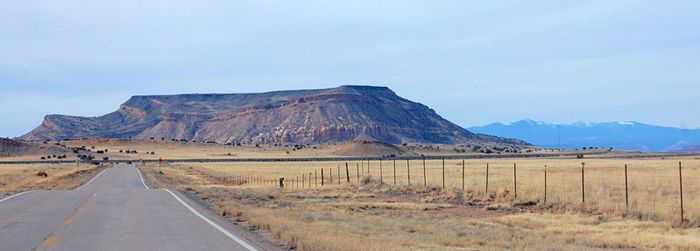
Pre-1937 Route 66 west of Los Lunas, New Mexico. Photo by Kathy Alexander.
New Mexico’s stretch of Route 66 offers travelers a variety of landscapes, from beautiful mountain ranges and sandstone mesas to desert sagebrush, ponderosa pines, and ghost towns. Along the vintage pavement, you will also see ancient pueblo cities, abandoned motels, neon signs, and an eclectic mix of ancient and contemporary cultures. Dating back thousands of years, you will enjoy New Mexico’s rich history, beginning with the Native Americans, continuing through the Wild West days, into the era of the Mother Road, and beyond.
Route 66 was created when the state was only 14 years old, crossing New Mexico and becoming the gateway to the southwest. New Mexico Governor A.T. Hannett introduced Route 66 to the state in 1926 and was instrumental in leading the charge for the National Highway System formed in 1927.
Initially, the meandering roadway was little more than 500 miles of gravel, slicing together many former wagon-train and railroad trails. However, when New Mexico’s economy was in a downward spiral, the Mother Road put hundreds of unemployed men to work as the state began paving the road. From 1926 to 1937, historic 66 meandered north through the upper Pecos Valley to Santa Fe, then turned south through Sandoval County to Albuquerque, and into Valencia County and Los Lunas. When the later fully paved alignment was completed in 1938, 126 miles had been shaved from the route, bypassing the many small towns of the Pecos Valley and Santa Fe.
Today, over 260 miles of pre-interstate era Route 66 remain drivable. The old road is still designated as a state highway in a few places, although none continue to carry the U.S. 66 designation. Other portions have reverted to county or tribal maintenance. The remaining miles have long since been “covered over” with the superhighway, I-40.
To further preserve Mother Road and the many historic landmarks along the old sections of the highway, New Mexico established those original roads that were still open to traffic as a National Scenic Byway in 1994. Starting at the New Mexico-Texas State Line, the byway travels more than 300 miles through compelling, scenic, and dramatic stretches of the famed highway, offering travelers a quintessential motoring experience.
Another major undertaking in New Mexico was the Route 66 Neon Sign Restoration project by the New Mexico Route 66 Association. The Association has led a tremendous effort along Route 66, restoring vintage neon signs in Tucumcari, Santa Rosa, Moriarty, Albuquerque, Grants, and Gallup. As a result, business owners and entire communities have a renewed pride in their Mother Road heritage. The project is a partnership of the New Mexico Route 66 Association, the New Mexico Historic Preservation Division, and the National Park Service Route 66 Corridor Preservation Office.
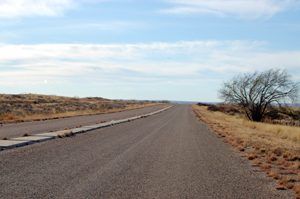
Glenrio, Texas, Route 66.
Your westbound journey through the Land of Enchantment begins at the ghost town of Glenrio, straddling the Texas and New Mexico border. Beyond Glenrio is a 20-mile gravel stretch of the old highway to San Jon. This was the last remaining segment of Route 66 before it became I-40 in 1982. Along this dusty road, you can get the flavor of early-day travel on the Mother Road through vast ranchlands and the tiny, long-dead communities of Endee and Bard. The accommodations and services once available to those long-ago travelers have all closed down until you are long ago. The stretch from Glenrio to San Jon is almost entirely dirt and gravel, and the bridges along this original route have load limits of 8 tons.
From San Jon, travelers can drive an almost entirely intact 24-mile paved chunk of Route 66 to Tucumcari. Just west of San Jon, Cedar Hill was a major stop for travelers, particularly those going east, because the steep hill would cause radiators to boil over. The remains of a small motel and general store can still be seen. The store’s roof is shingled with flattened metal oil cans.
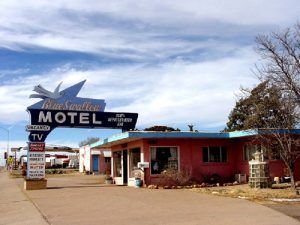
Blue Swallow Motel, Tucumcari, New Mexico by Kathy Alexander.
Along the stretch to Tucumcari, the early roadbed paralleled the Tucumcari and Memphis Railroad, constructed in 1910 and abandoned in 1954. Today, travelers can still see the old wood-and-steel bridge supports along the highway.
Along Tucumcari Boulevard, you will see a long stretch of the authentic Mother Road, where you can enjoy many vintage 1940s and 1950s icons, including the Cactus Motor Lodge, Lasso Motel, the Pine Lodge, the Blue Swallow Motel, Teepee Curios, the Westerner Drive-in, The Palomino, Travelodge Motel, and Del’s Restaurant. The Tucumcari-Quay County Chamber of Commerce has a beautiful four-color brochure on Route 66, so be sure to ask for a copy at either the museum or the Chamber’s office. The brochure also outlines a special Route 66 history tour of Tucumcari.
From Tucumcari, travel approximately ten miles west on I-40 to the Palomas Exit, where the drive returns to Historic Route 66.
This section of the Mother Road travels along the Union Pacific Railroad tracks through ranch lands surrounded by scenic mesas on each side of the road. By crossing I-40 at Montoya, you will continue on the Mother Road into Guadalupe County.
Located on Hwy 54, 21 miles west of Tucumcari, the ghost town of Montoya started when the Southern Pacific Railroad came through. Montoya’s once-busy Richardson’s Store & Gas Station (1925) marks the beginning of an almost uninterrupted 38 miles of old Route 66, through the tiny ghost towns of Newkirk and Cuervo, all the way to the west side of Santa Rosa. Montoya Mesa stands out with the washes of Caliche, nitrate-bearing gravel, down the side. These deposits of Caliche were used to build the roadbeds for I-40 and to surface many unpaved roads in Quay and Guadalupe counties.
The 4,984-foot Cuervito Peak is one mile northwest of the village of Cuervo. To continue your journey, return to I-40 at Cuervo and take exit 277 into Santa Rosa.

Richardson’s Store, Montoya, New Mexico.
In Santa Rosa, travelers will find that Will Rogers Drive is the city’s four-mile stretch of Route 66. Stop in at Joseph’s Restaurant, built in 1956, for refreshment. There is also an earlier jog (circa 1930) past the renowned Blue Hole. Several smaller, locally owned hotels along Santa Rosa’s main streets were also part of Route 66.
At Santa Rosa, you must decide whether to travel the pre-1937 or post-1937 alignment. The earlier alignment is more picturesque, taking you through numerous small towns in the Pecos River Valley, northwest to Santa Fe, before dropping south to Albuquerque. However, the latter alignment will save travelers time and miles while providing numerous views of the past.
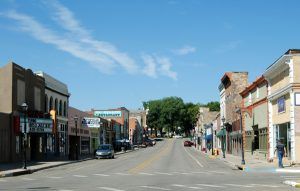
Las Vegas, New Mexico.
By taking the earlier alignment, travelers can visit Las Vegas, a city with a boisterous Old West history, said to be more wicked than Dodge City, Kansas. From there, the old route follows the Santa Fe Trail through several small towns, passing the Pecos Pueblo and on to the beautiful city of Santa Fe. Steeped in rich history, “must-see” stops in Santa Fe include the New Mexico State Capitol, La Fonda Hotel, Palace of the Governors, and San Miguel Mission, the oldest church in the United States. The road then heads south to Santa Domingo Pueblo, Algodones, and Bernalillo, then continues to Albuquerque.
If taking the latter alignment directly west from Santa Rosa, the first stop will be Cline’s Corners, where travelers can see an abundance of Southwest souvenirs, from rattlesnake ashtrays to beaded belts, tomahawks, and Indian lore. For those who are hungry, try a taste of the home-cooked southwestern flavors served at this Route 66 icon.
Next to Moriarty, where a 58-mile chunk of the highway to Rio Puerco begins. Along New Mexico Highway 333, the former Buford Courts, Blackie’s Restaurant, and the one-time Yucca, Cactus, Lariat, and Sands Motels stand.
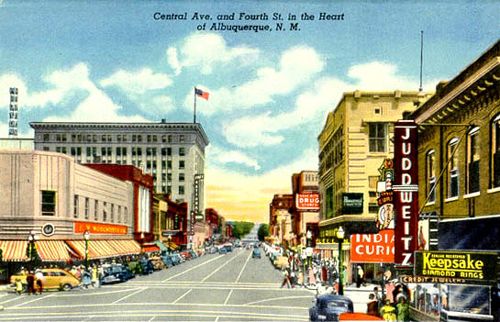
Central Avenue, Albuquerque, New Mexico.
In Albuquerque, Central Avenue is an 18-mile stretch of old Route 66. When the realignment of Route 66 was completed in 1938, Central Avenue was already filled with motels. By 1955, there were more than 100 motels on Albuquerque’s Central Avenue, and finding an open room in the summer was hard. You can still see many vintage icons, such as the De Anza Motel, the Royal Motor Inn, the Town Lodge Motel, and the old Aztec Motel sign, all built in the 1930s. Also here is Nob Hill, built in 1936-47, and the Lobo Theater and Lobo Pharmacy & Bookstore (originally Barber’s El Rancho Market), also built in the 1930s.
Downtown, several buildings were highlighted during the 1940s and 50’s era, including the Sunshine Building (built in 1923-24), the First National Bank Building (1922), the Rosenwald Building (1910), and the KiMo Theater (1927). Other sites west of Old Town include Lindy’s Restaurant (1929), Maisel’s (circa 1940), and the El Vado Motel (1937) — now closed. Continuing the journey, head north on I-25, take the Algodones exit, and return south via NM Highway 313. Original Route 66 is now Fourth Street, Isleta Boulevard, and New Mexico Highway 314.
Albuquerque is another option for taking the pre-1937 alignment or the later alignment of Route 66. The earlier route heads south past Sandia and Isleta Pueblos to Los Lunas, where travelers turn west onto Main Street, passing the Luna Mansion, built in 1881. From there, New Mexico Highway 6 continues along 33 miles of the historic highway through the Rio Puerco Valley to Correo. The latter route travels directly to the Rio Puerco Bridge, beyond which the alignments merge.
At Mesita, old 66 reappears as NM 124, slithering 25 miles through Laguna, New Laguna, Paraje, Budville, Cubero, and McCartys.
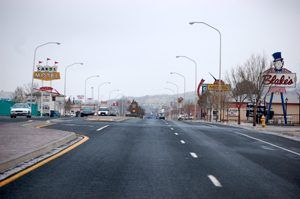
Route 66 in Grants, New Mexico.
In Grants, the old Mother Road is called Santa Fe Avenue. Here, you will find several vintage motels and restaurants. The original highway reemerges near Iyanbito as a 13-mile introduction to Gallup. Along the city’s nine-mile segment are Earl’s Restaurant, built in 1947, and the El Rancho Hotel, built in 1936 and home to some Hollywood stars when Gallup was a Western film capital (from 1929-64.) You can also visit the one-time Drake Hotel (1919), the Santa Fe Railroad Depot (1923), the former White Cafe (1928), the Richardson’s Trading Post, the old Palace, the Rex Hotels (both circa 1900), and Virgie’s Restaurant. (1950).
You are about to enter the great state of Arizona as you continue along the final 16 miles of old 66.
Enjoy the ride!
©Kathy Alexander/Legends of America, updated November 2025.
See Sources.
Also See: