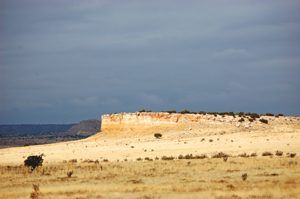
Landscape West of Albuquerque, New Mexico by Kathy Alexander.
Just a few miles West of Los Lunas, New Mexico, lies the beautiful Rio Puerco Valley, home to over 10,000 archeological sites. Amid this haunting landscape, most of these sites date back to the Puebloan cultures of the ancient Anasazi Indians. This area also has 50 volcanoes, one of the largest being Cabezon Peak, which rises to about 8,000 feet (northwest of Albuquerque).
Approximately eighteen miles beyond Los Lunas, on the western side of the Rio Grande, lies New Mexico’s Mystery Stone, also known as the Inscription Rock. Believe it or not, this ancient petroglyph has raised doubts about whether Christopher Columbus or the Norsemen were truly America’s first explorers.
Although people were aware of the rock when New Mexico became a territory in 1850, no one could decipher it. In 1871, local Indians informed the landowner that the rock predated their arrival in the area.
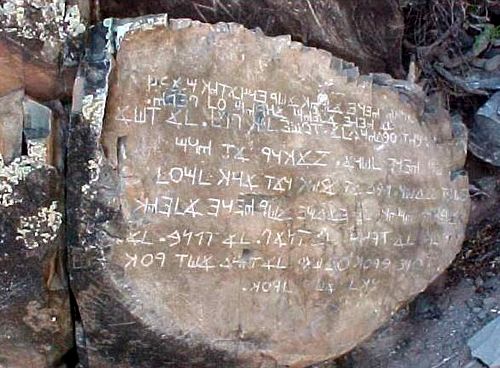
Mystery Stone in the Rio Puerco Valley, New Mexico.
The locals have known the site as “Mystery Mountain,” but it is more commonly known as “Hidden Mountain.” At the foot of this hill, on the lower right side of a large lava mound, stands a boulder weighing an estimated 80 to 100 tons. The lava mound lies in a little canyon. Nine rows of characters are chiseled into the North face of the boulder, resembling an ancient Phoenician script.
Over the years, numerous interpretations and translations have been made, but most agree that it is an ancient version of the Ten Commandments, which has also led to it being called the “Ten Commandments Rock.” Whatever the case, the circumstances surrounding this inscription are mysterious, giving the Mystery Stone its well-deserved name.
In 1999, Stan Fox, a linguist and Bible expert from Colchester, England, produced a fresh translation of the Los Lunas Inscription, based on photographs and a careful drawing of the text.
“I am Jehovah your God who has taken you out of the land of Egypt, from the house of slaves. There must be no other gods before my face. You must not make any idols. You must not take the name of Jehovah in vain. Remember the sabbath day and keep it holy. Honor your father and your mother so that your days may be long in the land that Jehovah your God has given to you. You must not murder. You must not commit adultery. You must not steal. You must not give false witness against your neighbor. You must not desire the wife of your neighbor nor anything that is his.”
In 2006, vandals destroyed the first line of the inscription. Its origins remain controversial, with some experts claiming it’s a fake.
There’s also a range of cultural periods to explore. Chacoan-era ruins have been uncovered, and evidence of Spanish habitation during the 18th Century can be found in these lands.
Numerous backcountry roads allow visitors to experience the western landscapes of piñon/juniper woodlands, ponderosa pine parklands, open rangeland, and sagebrush flats, all set against a backdrop of sandstone bluffs and dry washes.
Visitors must purchase a Recreational Access Permit from the New Mexico State Land Office to access the land where the Mystery Stone is located.
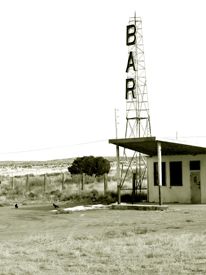
An old and abandoned bar in Correo, New Mexico
Correo
Heading West, Route 66 paralleled the railroad as it climbed the steep slope of the Rio Puerco Valley and curved northwest toward Correo. Though this old town still appears on maps, nothing remains of Correo but a lonely building that once served as a bar and its towering signpost.
The “town” started as a railroad siding called San Jose, named for the San Jose River to the South. However, in 1902, its name was changed to Suwanee because there was already a station called San Jose in Oklahoma. In 1917, a post office and a small store were established, and the place’s name was changed again—this time to Correo, derived from the Spanish word meaning “mail.” However, the locals, chiefly area ranchers, used both names- Suwanee and Correo- to describe it. It was where old Route 66 and the Atchison, Topeka, & Santa Fe Railroad tracks converged.
A one-room schoolhouse, located in an old boxcar, also served the children of the railroad crews. Later, a café, gas station, bar, and tourist cabins were added. The post office closed its doors forever in 1960, about the same time I-40 bypassed the town.
The old bar building appears to be the only building left in Correo today; only a scattering of houses and foundations remain in the area.
Update: Our photo of the abandoned bar in Correo was taken in January 2015. However, photos taken in December 2016 show that the BAR letters are no longer visible.
©Kathy Alexander/Legends of America, updated October 2026.
Also See:
New Mexico – The Land of Enchantment
See Sources.