
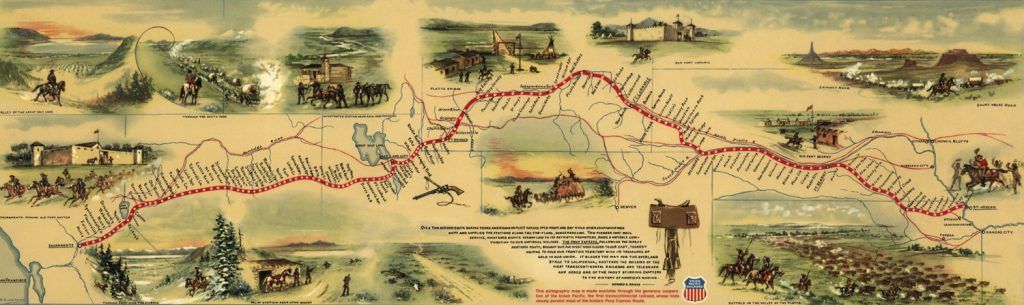
Pony Express Route by William Henry Jackson, 1860.
Pony Express Divisions:
Division One – St. Joseph, Missouri to Fort Kearny, Nebraska
Division Two – Fort Kearny, Nebraska to Horseshoe Creek, Wyoming
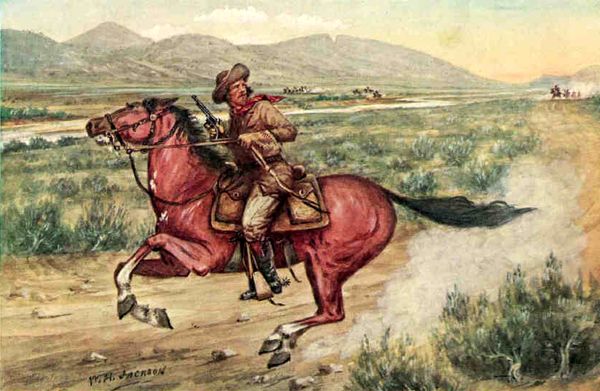
Pony Express Rider
Division Three – Horseshoe Creek, Wyoming to Salt Lake City, Utah
Division Four- Salt Lake City, Utah to Robert’s Creek, Nevada
Utah
Nevada
Division Five – Robert’s Creek, Nevada to San Francisco, California
Nevada
California
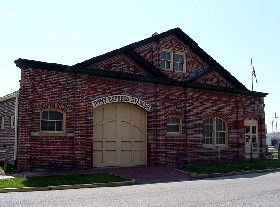
The original Pony Express Stables in St. Joseph, Missouri, now serve as a museum. Photo by Kathy Alexander.
The Pony Express operation was divided into five operating divisions. The first division ran from St. Joseph, Missouri, to Fort Kearny, Nebraska; the second division from Fort Kearny to Horseshoe Station (above Fort Laramie), Wyoming; the third from Horseshoe Station to Salt Lake City, Utah; the fourth from Salt Lake City to Roberts Creek, Nevada; and the fifth division, from Roberts Creek to Sacramento, California. For the final segment—the stretch from Sacramento to San Francisco—the mail was first transported by horse relays. Later, it was usually transported by steamers unless there was a problem.
Each division of the Pony Express route had an established number of “home” stations with various “relay rider” or “swing” stations between them. The country’s character determined the numbers and distances between home stations and relay stations. During its 19-month history, the distances and specific stations on the route changed over time and with varying circumstances.
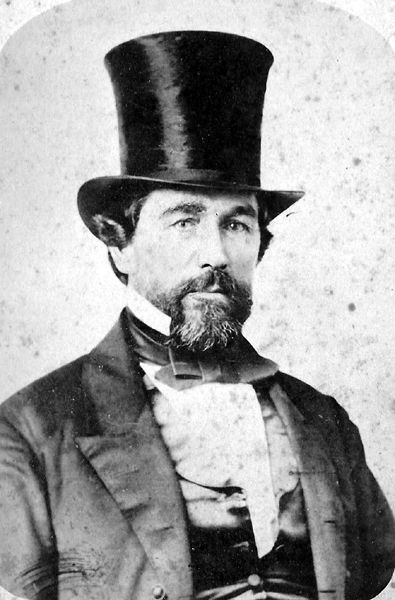
Alexander Majors.
Alexander Majors stated that home stations were located approximately 65-100 miles apart. At home stations, usually associated with previously established stagecoach stations, employees of the stage company were required to care for the ponies and keep them ready when needed. Typically, home stations had an agent or station keeper in charge of five or six boys. Some stagecoach stations were built under either Hockaday & Company or the Chorpenning Company lines and later absorbed by the Leavenworth & Pike’s Peak Express Company or its successor, Central Overland California and Pike’s Peak Express.
Several relay riders, or swing stations, were located between home stations. At first, relay rider stations were set about 20-25 miles apart, but later more relay rider stations were established at shorter intervals, about 12-15 miles apart. Relay rider stations usually had a single caretaker for the horses.
Life at both the home and relay stations was very hard. Sir Richard Burton, an English adventurer-writer, who was traveling on the Central Overland California and Pike’s Peak Express stage route in 1860 and witnessed the arrival and departure of Pony Express riders, said:
“Setting aside the chance of death… the work is severe; the diet is sometimes reduced to wolf-mutton, or a little-boiled wheat and rye, and the drink to brackish water; a pound of tea comes occasionally, but the droughty souls are always out of whiskey and tobacco.”
Ironically, maintaining even this hard living at each Pony Express station was expensive. Feed had to be hauled, in some cases, hundreds of miles, at a heavy expense, and, because the country produced nothing then, provisions were hauled by wagon from the Missouri River, Utah, and California.

Hollenberg, Kansas Pony Express Station by Kathy Alexander.
Compiled by Kathy Alexander/Legends of America, updated October 2026.
Also See:
Central Overland California and Pike’s Peak Express Company
Pony Bob Haslam & the Longest Ride
Johnny Fry – First Rider of the Pony Express
See Sources.