
“Texas John” Slaughter.
Unlike squalid old badge-wearers such as John Selman and Wild Bill Hickok, John Slaughter was a very reserved man. Nobody who wished to keep on calling terms with him overstepped that boundary.
— Judge Clayton Baird, who rode with Slaughter
“Texas John” Slaughter was a Civil War veteran, trail driver, cattleman, Texas Ranger, famed Cochise County, Arizona, Sheriff, professional gambler, and an Arizona State Representative during his lifetime. Before he died at age 80, he was a symbol of the American West and a widely celebrated hero.
John was born in Sabine Parish, Louisiana, on October 2, 1841, to Benjamin and Minerva Mabry Slaughter. However, when he was three months old, his family moved to a land grant near Lockhart, Texas, and began raising cattle.
Though schooled in Sabine and Caldwell counties, Slaughter’s formal education was brief. But the boy learned quickly and found other ways to expand his knowledge, such as learning Spanish and mastering cowboy skills from Mexican vaqueros. As a young man, he ranched with his father and brothers, and just before the Civil War began, he enlisted as a Texas Ranger with Captain John Files’ Tom’s company to fight the Comanche.
The diminutive, 5-foot-6-inch man, with penetrating black eyes and a sometimes stuttering voice, was determined to make his mark upon the world.
On March 9, 1862, he joined the Confederate Army, but by 1864, he was sent home because of an illness. However, after he recovered, he returned to service with the Third Frontier Division, Texas State Troops, in Burnet County, where he earned a reputation as a fearless fighter skilled with firearms.

Chisholm Trail Statue in Waco, Texas by Carol Highsmith.
After the war, he and his brothers established the San Antonio Ranch Company in Atascosa County, Texas, where they not only raised their own cattle but also transported herds to Mexico, California, Kansas, and New Mexico. They were some of the first to drive cattle up the Chisholm Trail. While he was in California on a cattle drive, he became an avid poker player, a compulsion that would follow him throughout his life.
On August 4, 1871, he married Eliza Adeline Harris. The two eventually had four children, though only two survived to adulthood.
In 1876, Slaughter was playing poker in a saloon in San Antonio, Texas, when he caught another player, Barney Gallagher, cheating. When Gallagher won the hand, Slaughter challenged him with a gun and took back his losses. Later, the cheating man was so enraged that he followed Slaughter to his ranch, where he told the foreman to call him out, intending to kill him. As soon as John came in sight, Gallagher shot him but missed. Slaughter returned fire, and Gallagher fell dead on the ground with a bullet in his heart.
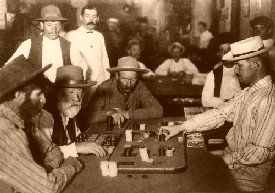
Playing Faro.
By the late 1870s, Slaughter felt Texas had become too crowded and left his wife and children there while he looked for a new place to settle in New Mexico.
He bought cattle but didn’t purchase any land in New Mexico. Leaving his cattle there, he began looking for land in southern Arizona. This evidently took time, and he soon sent for his wife and children, who joined him in Tucson. However, his wife died shortly afterward of smallpox in 1877.
Returning to New Mexico to get his cattle, Slaughter left his children in Arizona and traveled eastward. While camping on the banks of the Pecos River, he met a family named Howell, who had a 16-year-old daughter named Viola. John married the girl on April 16, 1878, and convinced the entire family to move to Arizona.
They first settled South of Tombstone before Slaughter bought the 65,000-acre San Bernardino Ranch near Douglas in 1884. From Arizona down into Mexico, Slaughter built a large and sophisticated operation that employed 20 cowboys and 30 families working the farmlands. John and Viola had no children of their own, but adopted several.

“Texas John” Slaughter.
In 1886, Slaughter was elected Cochise County Sheriff, tasked with ridding Tombstone and Galeyville of lawlessness. Working closely with Wells Fargo Express Agent and former U.S. Deputy Marshal Jeff Milton, the two were deadly in tracking and capturing fugitives. During this time, Slaughter was known to carry a pearl-handled .44 and a 10-gauge, double-barreled, sawed-off shotgun, which he called an “equalizer.”
Slaughter also made the “mistake” of hiring Burton Alvord as deputy sheriff. Though Alvord quickly earned a reputation as an excellent tracker, bringing in several cattle rustlers and other wanted fugitives, he was also a heavy drinker. Within a few years, he would turn “outlaw.”
One of Slaughter’s first tasks was to bring in the Jack Taylor Gang, which had robbed a train near Nogales and shot at the train crew. He and his men heard the gang was hiding out at Flora Cardenas’s home. However, by the time they arrived, the bandits had fled. They then traveled to Willcox and Contention, where they found gang members Manuel Robles and Nieves Deron sleeping at Manuel’s brother Guadalupe Robles’s camp.
When Slaughter shouted for the two men to get up, a gunfight ensued, in which Guadalupe Robles, who had otherwise been an upstanding citizen, joined in. He was immediately shot and killed.
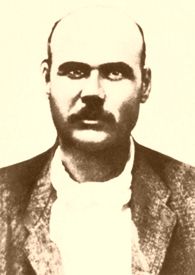
Burton Alvord – Lawman and Outlaw.
Manuel Robles and Deron tried to run away while still blasting their six guns. One bullet caught Slaughter’s ear, who returned fire, killing Nieves Deron. Manuel Robles, though seriously wounded by a shot from Burton Alvord, was able to escape. Soon, the leader of the gang, Jack Taylor, was arrested in Sonora, and Manuel Robles, along with Geronimo Miranda, were killed by the Mexican police in the Sierra Madre mountains.
During his first term, Slaughter also assisted the United States Cavalry against Geronimo’s Apache. Slaughter was so successful as sheriff that he was reelected in 1888.
Meanwhile, Slaughter’s deputy, Burton Alvord, began to slip in his efficiency as a lawman by 1889, as his drinking increased. Frequenting Tombstone’s many saloons, Alvord began socializing with criminal elements and was known to get into frequent scuffles. As Slaughter chastised him, Alvord soured on both the sheriff and the law. Alvord soon moved on, but Slaughter would face criticism forever for hiring him, especially when he turned full-blown outlaw at the end of the century.
By 1890, the lawless Cochise County had primarily been tamed, and Slaughter retired from law enforcement to tend to his ranch.
In 1906, Slaughter served briefly in the territorial assembly but concentrated primarily on his business investments and ranch. Eventually, he bought a meat market in Charleston and two butcher shops in Bisbee. His investments were so successful that he also began to act as a “banker” for his neighbors, lending money for mortgages when needed.
In his later years, his health began to deteriorate as he suffered from eczema on his hands and feet and high blood pressure. He died in his sleep in Douglas, Arizona, on February 16, 1922, after complaining of a headache the previous evening. He was buried at the Calvary Cemetery in Douglas, Arizona.
Imposing the law with his six-shooter and a sawed-off shotgun, Slaughter cleaned up Arizona Territory more than any other single individual. Along the way, he met and was highly respected by other famous Old West characters such as Wild Bill Hickok, Ben Thompson, Wyatt Earp, Big Foot Wallace, King Fisher, Sam Bass, Billy the Kid, and Pat Garrett.
One lawman who rode with Slaughter said, “He was like a spider spinning its web for the unwary fly.”
Today, the Slaughter Ranch has been fully restored and serves as a museum.

Slaughter Ranch.
©Kathy Alexander/Legends of America, updated October 2026.
Also See:
See Sources.