
By Henry Howe, 1857.

Texas Map.
Texas is a Native American word signifying “Friends.” This country was first settled by Sieur de La Salle in 1685, who took formal possession in the name of the French Monarch, and built a small fort at the head of Matagorda Bay. However, the Indians soon broke up the colony. In the meantime, intelligence of the founding of this settlement having reached Mexico, the Viceroy sent a military force to drive out the French, but on its arrival, the colonists had disappeared.
In 1690, the Spaniards founded two small missions, and, in 1692, commenced their first settlement at San Antonio de Bexar. After the settlement of Louisiana in 1699, the French assumed nominal possession of the territory as far west as the Bay of Matagorda. Hostilities broke out between them and the Spaniards, who established several posts in eastern Texas and drove the French out. The conflicting claims of the two nations to Texas were temporarily settled by the Treaty of 1763, in which France ceded to Spain all of Louisiana west of the Mississippi River. In 1800, Spain, having ceded Louisiana back to France, left the question of the country’s rightful claim open again.
In 1803, Louisiana, having been ceded by France to the United States, transferred to the American nation the same claim to Texas, which, however, was never enforced.
In 1810, at the commencement of the first Mexican Revolution, Texas had no settlements of note, except those of San Antonio de Bexar, Goliad, and Nacogdoches. In the interior were a few Spanish forts and missions, around each of which were a small number of Indian converts. Some of these missionary establishments, each consisting of a massive stone fortress and a church, still retain their walls almost intact. The Mexicans seemed not so desirous to occupy this country as to keep it a desolate waste, to form an impassable barrier between them and their Anglo-Saxon neighbors, toward whom and other civilized nations, their jealousy was so intense that they enacted a law making it death for a foreigner to enter any of the Spanish provinces without a license from the Spanish King. Hence, until after the outbreak of the Mexican Revolution, Texas remained almost wholly unknown to the Americans.
In 1812, Don Gutiérrez and Toledo, officers of the Revolutionists, formed a project to invade the eastern provinces of Mexico with the aid of American volunteers. They succeeded in raising a force of about 450 men, nearly one-half of whom were Americans from the southwestern states, and the remainder French, Spaniards, and Italians; they were led by officers Magee, Kemper, Locket, Perry, and Ross. Crossing the Sabine River, they routed a body of royalists near Nacogdoches and took possession of Goliad. The following winter, from 1812 to 1813, they were besieged by 2,000 Spaniards. The Revolutionists sallied from the town and routed the Spaniards with a loss of about 400 killed and wounded. The latter retreated and were again defeated near San Antonio, from which they soon after surrendered. Twelve of the principal Spanish officers, after their surrender, were secretly massacred by Don Guttierez, which, becoming known to the Americans, most of them, with Kemper at their head, abandoned the service in disgust. The invaders, thus reduced in numbers, remained at Bexar.
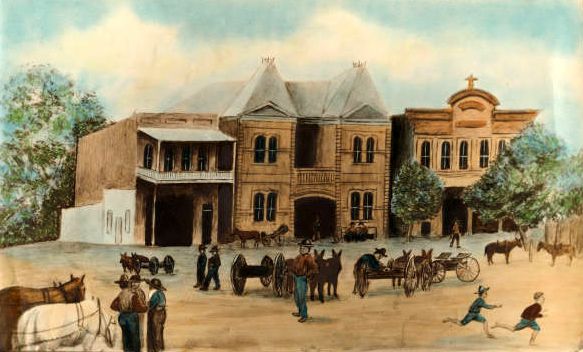
Historical Nacogdoches, Texas.
In June, a Spanish army of 4,000 men having approached toward the place, the garrison advanced against them, and routed them four miles west of the town, with a loss in killed and wounded nearly equal to their own number. Guttierez, having been removed from the supreme command as a punishment for his agency in the massacre, was succeeded by Toledo, when Kemper returned to San Antonio from the United States with 400 Americans.
In August, an army of several thousand advanced toward the place. The garrison, 1,100 in number, marched out nine miles to the Medina River and gave them battle. They drove the enemy to their intrenchments, where half their force was in reserve, when a heavy fire was poured on them. The Mexican Revolutionists fled, and the Americans, after a desperate resistance, were nearly all killed in the battle or captured in the subsequent flight toward the American frontier. This total defeat for five years suspended the Mexican Revolutionary struggle in Texas.
After this event, the United States, acting upon strictly neutral principles toward the contending parties in Mexico, interposed its authority and prevented hostile expeditions from crossing the frontiers. Individuals in small parties, however, visited Texas and brought back with them glowing descriptions of its fertility and resources. To accommodate privateers under the Mexican flag, the Revolutionists formed stations at Matagorda, Galveston, and other points, which, becoming piratical establishments, were broken up by the United States. The war in Mexico, called “the first revolution,” lasted eight years and ended in favor of the Royalists.
The Treaty of 1819, by which Spain ceded Florida to the United States, established the Sabine River as the western boundary of Louisiana. Moses Austin, a native of Durham, Connecticut, applied for, and received in 1819, a grant of land in Texas to plant a colony. The Spanish authorities in Mexico, desirous of defense against the fierce and hostile Comanche, had, contrary to their usual policy, made laws favoring American emigration, on the condition that the emigrants should become Catholics and teach the Spanish language in their schools. After Moses Austin died, his son, Stephen, carried out his plans and, founding a colony between the Brazos and Colorado Rivers, became the leader of American colonization in Texas. Austin’s enterprise, joined by others, soon attracted the attention of the Mexican clergy. They found that the law, which required the settlers to make an oath that they were Catholics and to establish Spanish schools, had been regarded by them as an insignificant formality. They felt the utmost alarm at a colony of foreign heretics being planted among them, and desired that they should either submit to the law or be routed out.
“The second revolution” began in 1821 under Mexican General Iturbide, who led Mexico to independence from Spain. Iturbide made himself a Monarch, but the people, wishing for a republic, deposed and banished him, and, on his return, had him executed.
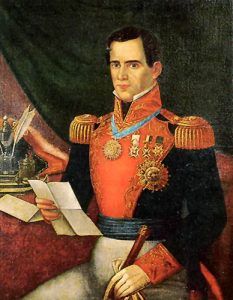
Antonio Lopez de Santa Anna.
Another leader arose, Santa Anna, under whose auspices a federal constitution was formed in 1824, by which Mexico, like our republic, was divided into States, each with its own legislature, and over the whole a general government.
Fresh jealousies arose in consequence of the futile attempts made by a few of the settlers in the vicinity of Nacogdoches, in 1826, to throw off the Spanish yoke and establish a republic by the name of Fredonia; this ill-feeling was further increased by propositions made from time to time by the United States to purchase Texas. In whatever was done, the Mexicans fancied some plot against them, in which the American nation at large was concerned. They even surmised that the settlers in Texas were sent, but as a cover to a concealed purpose of the American authorities to take their territory and destroy their nationality. Texas, under the constitution of 1824, was united with the adjacent province of Coahuila into one state. The Spanish Mexicans of this province outvoted and pursued an oppressive policy against the Texans.
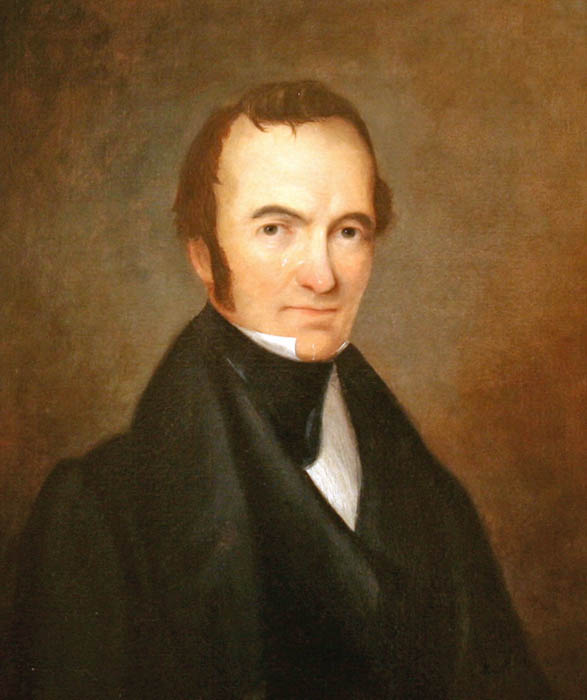
Stephen F. Austin.
In 1833, Stephen F. Austin was sent to the city of Mexico to petition against these grievances, and for the privilege of forming Texas into a separate State. Being treated with neglect by the Mexican Congress, he wrote a letter to the Texans advising them, at all events, to proceed in forming a separate State government. This letter fell into the hands of the Mexican authorities, and he was made prisoner while returning, carried back to Mexico, and thrown into a dungeon.
Meanwhile, the crafty Santa Anna, subverting the constitution of 1824, became a military tyrant, and, to divert attention from his lawless acts, commenced a series of oppressions against the Texans and placed the civil rulers there in subjection to the military.
In 1835, Austin, having returned from his imprisonment in Mexico, appointed vigilance committees throughout the country, and the people were resolved to insist upon their rights under the constitution. At this time, the population of Texas was near 20,000, of whom scarcely 3,000 were Mexicans. Appeals were made through the press to the Texan people, and arrangements were made to raise funds to defend themselves against a threatened invasion by Santa Anna. The first hostile action by the Mexicans was directed against the town of Gonzalez. At that time, 1,000 Mexicans had been sent there to demand a field-piece; the Texans, on October 2, 1835, attacked and drove them from the ground with loss. On October 8, Goliad was taken by the Texans with valuable munitions. On October 28, 92 Texans under Colonels James Bowie and James Fannin defeated 400 Mexicans, below San Antonio, with a loss of nearly 100 killed and wounded; the Texan loss being simply one killed. In November, the Texan Convention of Delegates assembled at San Felipe, issued a declaration of rights, and established a provisional government. Henry Smith was chosen governor, and Samuel Houston was chosen commander-in-chief.
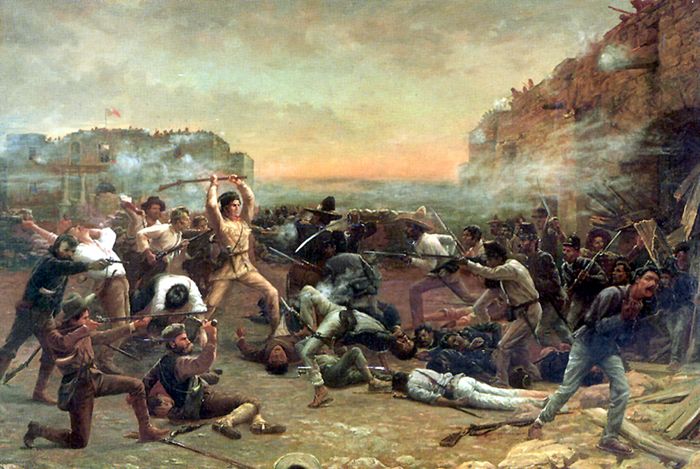
Battle of the Alamo by Robert J. Onderdonk, 1903.
On December 11, 500 Texans, after a bloody siege and assault, took the strong fortress of the Alamo and the city of San Antonio de Bexar. This was a gallant enterprise: the Mexicans numbered 1,000 regular troops under General Cos. Almost every house was in itself a fortress, each built of stone, with walls three feet in thickness. The bulk of the garrison was posted in the public square, the approach to which was strongly fortified by breastworks mounted with artillery. At 3:00 a.m. on December 5, Colonel James Neil, with 200 men, commenced a false attack upon the Alamo; while with 300 volunteers, the heroic Benjamin Milam, the projector of plan about to be described, having provided his men with crowbars and other forcing implements, effected entrance into the suburbs, and amidst a heavy shower of grapeshot and musketry, took possession of two houses. For four days, the Texans, bravely maintaining their position, continued to advance from one point to another, breaking a passageway through the stonewalls of the houses and opening a ditch and throwing up a breastwork, where they were otherwise unprotected, while the enemy’s artillery raked every street. On the third day of the assault, the gallant Milam received a rifle-shot in his head, but otherwise their loss was trifling, while that of the enemy was severe, as the rifle brought them down as often as they showed their faces at a loophole.

Benjamin Milam is calling for volunteers.
On the fourth day, the Mexicans were reinforced by 300 men. The following night, the Texans penetrated to a building that commanded the public square. Still, while the daylight dawned to give them the benefit of rifle practice, the Mexicans had lowered their black and red flag, which had been waving from the Alamo during the contest, in token of no quarter. They sent in a flag of truce to signify their desire to surrender. Unfortunately, at this time divisions prevailed in the Texas councils, and no adequate force had been raised to oppose Santa Anna, who, in February, appeared before Bexar with an overwhelming force. On their appearance, the Texan force, numbering only 150 men, under William B. Travis, retired to the Alamo, where there were a few pieces of artillery. The enemy encircled the Alamo with intrenched encampments and maintained a continuous bombardment for several days. With the exception of 32 volunteers from Gonzalez, who made their way into the fort on the morning of March 1, no succor arrived at the garrison, whose physical energies were worn down by constant watching, but whose resolution was unsubdued. In the language of the heroic Travis, they were determined “never to surrender, nor retreat.”
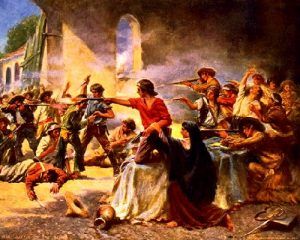
Battle of the Alamo during the Texas Revolution.
In the meantime, the enemy’s reinforcements had increased to 4.000. They were humiliated by being baffled by fewer than 200 men during a week-long siege to reduce a poorly fortified place. Santa Anna, after midnight on March 6, surrounded the Alamo, determined to carry it by storm at any cost. They advanced amid the discharge of musketry and cannon, and were twice repulsed in their attempts to scale the walls. A third attempt was made by the exertions of their officers, when borne onward by those in their rear, they tumbled over the walls “like sheep.” Then commenced the last struggle of the garrison. William Travis received a shot as he stood on the walls, cheering his men. As he fell, a Mexican officer rushed forward to dispatch him, when Travis, summoning his failing powers for a last effort, met his assailant with an upward thrust of his sword, and they both expired together. Unable from the crowd and for want of time to load, the Texans clubbed their rifles and continued to fight and resist until life had ebbed out through numberless wounds, and the enemy had conquered the Alamo, but not its heroic defenders. They perished but yielded not; one only remained to ask for quarter, which the unrelenting enemy denied him. Total extermination succeeded, and the darkness of death reposed over the memorable Alamo.
Of all the persons in the place, Mrs. Dickerson, her child, and a negro, were alone spared. The storm lasted less than an hour. Major Evans was shot while setting fire to the magazine, according to the order of Travis. David Crockett was found dead, surrounded by a pile of the enemy, who had fallen beneath his powerful arm. Colonel James Bowie, who was confined by sickness, was murdered in his bed. The enemy, exasperated to the highest degree by this desperate resistance, treated the bodies with brutal indignation. Santa Anna, when the body of Major Evans was pointed out to him, drew his dirk and stabbed it twice in the breast. General Cos, with his sword, mangled the face and limbs of the heroic Travis with the malignancy of a savage. The bodies were finally stripped, thrown into a heap, and buried.
The loss of the Mexicans on this occasion has been variously estimated at from 1,000 to 1,500 men. Never in the world’s history had defense been more heroic; it has scarcely been equaled, save at the Pass of Thermopylæ. On March 2, 1836, the Texan delegates assembled at Washington, unanimously agreed to a declaration of independence, and constituted Texas an independent republic.
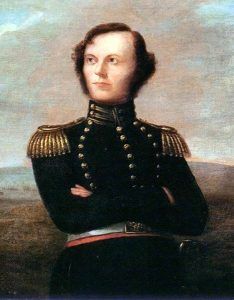
James Walker Fannin.
On March 17, they adopted a Constitution and appointed David G. Burnett, Provisional President. While Santa Anna was concentrating his forces at San Antonio, another division of the forces under General Urrea proceeded along the line of the coast. Colonel James Fannin, then at Goliad, learning of the advance of the Mexican army, sent 14 men, about 25 miles distant, under Captain King, to remove some families to a place of safety. They lost their way in the prairie and were taken prisoners and shot by Urrea. Colonel Fannin, having received notidings from King, sent out Colonel Ward with a larger detachment, who, falling in with the enemy, had two engagements with him; in the last, overwhelmed by numbers, he was obliged to surrender.
On March 18, Fannin’s force, being reduced to 275 men, left Goliad and commenced retreating toward Victoria. On that afternoon, he was overtaken on a prairie and surrounded by the Mexican infantry and some Indian allies. The Texans, forming a hollow square, successfully repelled all charges. At dusk, the Indians, by command of Urrea, threw themselves upon the ground, and, under cover of the tall grass, crawled up and poured in a destructive fire upon the Texans. As soon as it was sufficiently dark to discern the flashes of their guns, the Texans soon picked them off and drove them back. The Mexicans withdrew and encamped for the night, having lost about 500 men. The Texan loss was seven killed, and about 60 wounded.
The Texans threw up a breastwork during the night, but when morning dawned, they discovered that their labor had been in vain, for 500 fresh troops had joined Urrea with artillery. Upon this, Fannin, seeing the inutility of further resistance against an army, sometimes his superior, surrendered on condition that they should be treated as prisoners of war. The Texans were marched back to Goliad, where, with the prisoners of Ward’s detachment, they numbered 400 men.
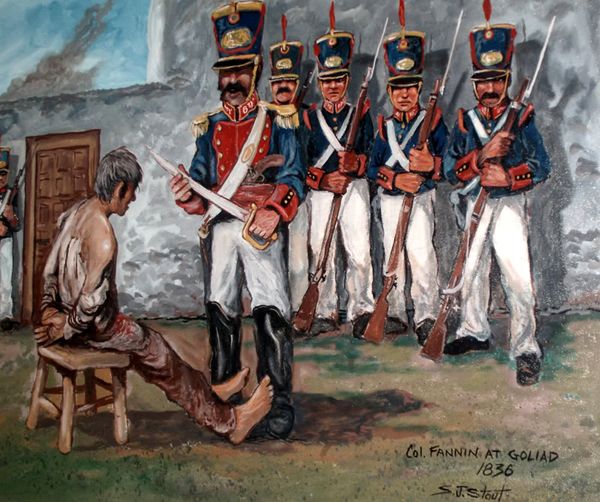
James Fannin Execution.
In a few days, orders were received from Santa Anna for their execution, which occurred on the morning of March 27, with four surgeons and three laborers only being spared. Escorted by a strong Mexican guard, they were marched out of their quarters under various pretexts and, after advancing a few hundred yards, were ordered to halt, thrown off their blankets and knapsacks, and sat down with their backs to the guard. Immediately, volleys of musketry were poured in upon them, and the swords of the cavalry cut down those who escaped the bullets. A few escaped by springing over a brush fence and concealing themselves in a thicket. What rendered this butchery more aggravating was that when led to their execution, the minds of the men were cheered by the promise of being speedily liberated and sent home. A prisoner who escaped related that just before the Mexicans fired upon them, a young man named Fenner sprang to his feet and exclaimed, “Boys, they are going to kill us-die with your faces to them, like men!” At the exact moment, two other young men, flourishing their caps over their heads, shouted at the top of their voices, “Hurrah for Texas!”
Fannin, who was murdered apart from his men, requested to be shot in the breast, and not in the head. He tied a handkerchief over his eyes, and with his hands opened his bosom to receive the balls. The next day, he was seen lying on the prairie among a heap of the dead, with the fatal wound in the head. Santa Anna now deemed that the Texans were subdued. The bones of the greater part of the Texans, who had been distinguished for their bravery, were bleaching upon the prairies, and nearly every seaport in Texas was under Mexican dominion. As soon as the fall of the Alamo and the butchery of Fannin’s men was known in the United States, a spirit of stern revenge was aroused among the hardy population of the West, and volunteers poured in to assist in driving every Mexican soldier beyond the Rio Grande.
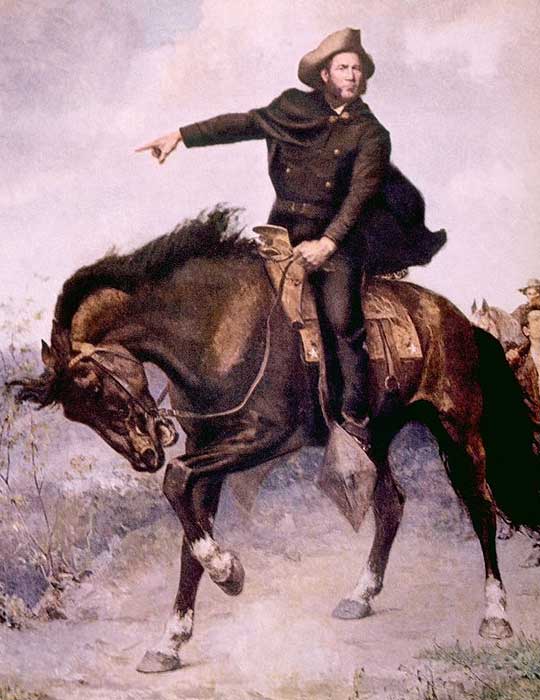
General Sam Houston at the Battle of San Jacinto.
On April 21, the main Texan army under General Samuel Houston, 783 strong, met the advance of the Mexicans under Santa Anna, 1,600 in number, near the San Jacinto. With the exception of the artillery, not a gun was fired by the Texans until they had come closest to the enemy’s lines, when they rushed on with the dreadful war-cry, “Remember the Alamo!” Driven to a frenzy of fury by its thrilling recollections and the knowledge that the murderers of Fannin’s men were before them, they threw themselves with such a desperate charge upon the enemy that the Mexicans, panic-stricken, threw down their arms and fled in wild dismay. Many of the poor Mexicans, as the exasperated Texans overtook them, would fall on their knees and beg piteously for mercy, crying in broken English, ” Me no Alamo! Me no Alamo!”
The whole Mexican army was annihilated, scarce a soldier escaping. During the battle, 838 were killed and wounded, and the remainder were made prisoners. So infuriated were the Texans that the number of killed to the wounded bore the unusual proportion of three to one. It was, in fact, a massacre. Conquerors lost but eight men killed, and 17 wounded. The next day, Santa Anna was taken, disguised in a coarse dress, on the banks of a neighboring bayou. When brought into the presence of Houston, he was greatly agitated from fear that his life would be taken, and some opium was given to him to quiet his nerves; after which, turning to Houston, he said, “You were born to no common destiny; you have conquered the Napoleon of the West” A majority of the Texans demanded his execution, for the murder of Fannin and his men, and it required extraordinary exertions on the part of Houston and his officers to preserve him from their just vengeance.
As the supreme ruler of Mexico, Santa Anna, by treaty, acknowledged Texas’s independence, with the Rio Grande as its western boundary. Although the United States, England, and other powers acknowledged her independence, Mexico, through all her changes of rulers, ever claimed the country, and occasionally sent troops to renew the war by predatory excursions. Santa Anna procured himself to be sent by the Texans to the United States, where he so far gained President Jackson’s favor as to be returned by him to Mexico, where, disavowing all his former treaties and professions, he again entered upon a course of hostilities against the Texans.
In 1841, Texas President Mirabeau Lamar organized what has been termed the “Santa Fe Expedition,” the objective of which was to open a trade with Santa Fe, New Mexico, and to establish Texan authority, in accordance with the treaty of Santa Anna, over the territory east of the Rio Grande. Santa Fe, lying east of that river, was still in possession of the Mexicans. On June 18, the expedition, numbering 325 men under General M’Leod, left Austin, the capital of Texas, and after a journey of about three months, arrived at the Spanish settlements in New Mexico. They were intercepted by a vastly superior force and surrendered on condition that they be allowed to return. Still, instead of this, they were bound with ropes and leather thongs, in gangs of six or eight, stripped of most of their clothing, and marched to Mexico City, a distance of 1,200 miles. On their route, they were treated with cruelty, beaten and insulted; forced to march at times by night, as well as by day; blinded by sand; parched by thirst, and famished with hunger.
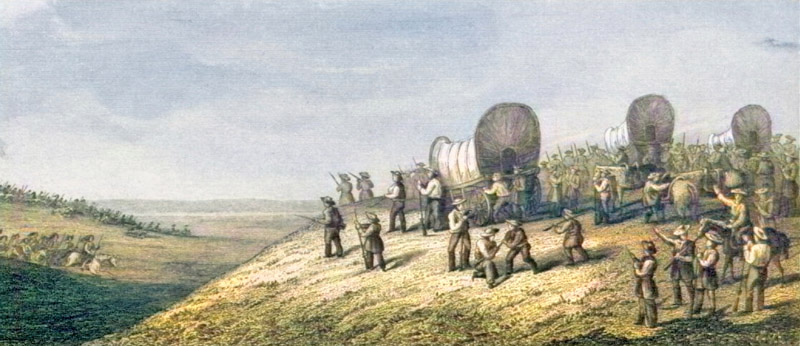
Santa Fe Expedition.
Having arrived at Mexico in the latter part of December, they were, by the orders of Santa Anna, thrown into filthy prisons. After a while, some were compelled to labor as common scavengers in the streets of the city, while others were sent to the stone quarries of Pueblo, where, under brutal taskmasters, they labored with heavy chains fastened to their limbs. Of the whole number, three were murdered on the march; several died of ill treatment and hardship. A few escaped, some were pardoned, and nearly all were eventually released.

Meir Expedition by Frederic Remington.
Soon after the results of this expedition were known, rumors of an intended invasion of Texas circulated. In September 1842, 1,200 Mexicans under General Woll took the town of San Antonio, but subsequently retreated beyond the Rio Grande. A Texan army was assembled, zealous to carry the war into Mexico. After various disappointments and the return of most of the volunteers, 300 Texans crossed the Rio Grande. They attacked the town of Mier, which was garrisoned by more than 2,000 Mexicans, strongly posted. In a dark, rainy night, they drove through the guard, and in spite of a constant fire of the enemy, effected a lodgment in some houses in the suburbs, and with the aid of the deadly rifle, fought their way into the heart of the place. At length, Ampudia sent a white flag, accompanied by General LaVega and other officers, to inform the Texans of the utter hopelessness of resisting an enemy ten times their number. The little band at length very reluctantly surrendered, after a loss of only 35 killed and wounded, while the Mexicans admitted theirs to have been over 500.
The Texans, contrary to the stipulations, were marched to Mexico, 1,000 miles away. On one occasion, 214 of them, although unarmed, rose upon their guard of over 300 men, overpowered and dispersed them, and commenced their journey homeward. Still, ignorant of the country and destitute of provisions, and being pursued by a large party, they were obliged to surrender. Every tenth man was shot for this attempt at escape. The others were thrown into the dungeons of Perote, where about 30 died of cruel treatment. A few escaped, and the remainder were eventually released.
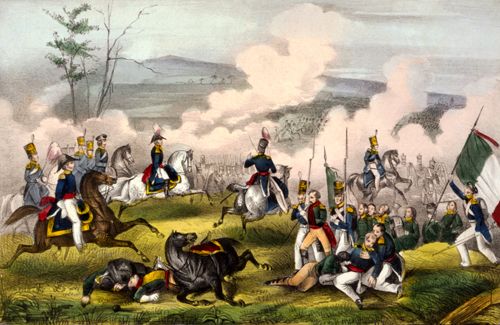
Mexican-American War.
An early application was made by Texas to be annexed to the United States. President Andrew Jackson and Martin Van Buren, in turn, objected on the grounds of the unsettled Texas boundary and the peaceful relations with Mexico. President John Tyler brought the measure forward, but it was lost in Congress. Having been the test question in the ensuing presidential election, and the people deciding in its favor by the election of the Democratic candidates, Texas was annexed to the Union by a joint resolution of Congress on February 28, 1845. The Mexican minister, Juan Almonte, who had before announced that Mexico would declare war if Texas were annexed, gave notice that since America had consummated “the most unjust act in her history,” negotiations were at an end. From this and other causes, followed the Mexican-American War, and by the subsequent treaty of peace, an acknowledgment by that power of the independence of Texas. The boundaries of Texas were finally settled with precision by an act of Congress in 1850, and Texas acquiesced in that decision.
Texas, the southernmost state of the Union, contained about 270,000 square miles and about 200,000 inhabitants by the late 1850s. The general aspect of the country was that of a vast inclined plane, gradually sloping from the mountains eastward to the sea, and intersected by numerous rivers running in a southeast direction. The territory was naturally divided into three separate regions, each in many respects different. The first is a level region along the coast, with a breadth of 30 to 100 miles. The soil of this section was principally a rich alluvion, with scarcely a stone, yet singularly free from stagnant swamps. Broad woodlands fringed the banks of the rivers, between which were rich and extensive pasture lands.
The second division was the undulating prairie region, which extended over 200 miles farther inland, with its vast grassy tracts alternating with thickly timbered areas. These last were especially prevalent in the east, though many of the bottomlands and river valleys elsewhere were woodland. Limestone and sandstone formed the common substrata of at least the middle and southern part of this region; the upper soil consisted of a rich, pliable sandy loam. This region could support a dense population.
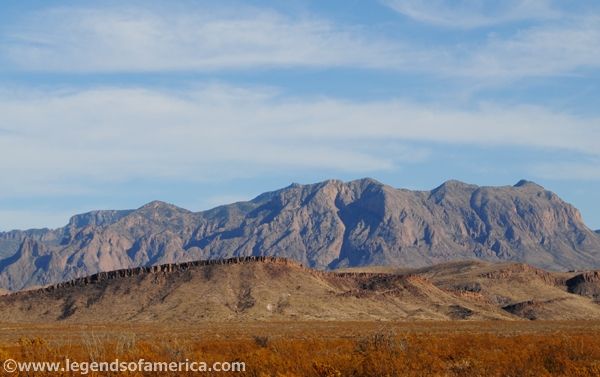
Big Bend Mountains by Kathy Alexander.
The third, or mountainous, region was situated principally in the west and northwest and formed part of the Sierra Madre, or Mexican Alps, but was little explored and still unsettled. Near its remote extremity, it consisted of an elevated tableland, where the prairies not unfrequently resembled the vast steppes of Asia. The mountain sides were clothed with forests, and they enclosed some alluvial valleys, which were susceptible to irrigation and cultivation.
On the west, it was mountainous; the remainder was mostly an elevated, sterile plain, forming a part of what is called the “Great American Desert“. The Texan year was divided into a wet and dry season. The former lasts from December to March; the latter, the remainder of the year. In summer, the intense heat is tempered by strong, continuous breezes from either the elevated tablelands of the interior or the waters of the Gulf, which continue from sunrise until three or four p.m., and the nights are cool throughout the year.
In the lowlands near the coasts, intermittent rains were common in summer, though not to epidemic levels. The surface was, in most parts, covered with a luxuriant wild grass. The climate of Texas was believed to be equal, if not superior, to that of any other part of North America; the winters being milder and the heat of summer less oppressive than in the northeastern section of the United States. The forests were destitute of that rank undergrowth which prevailed in the wooded districts of Louisiana and Mississippi, and the level region was generally free from those putrid swamps which poison the atmosphere and produce disease and death.
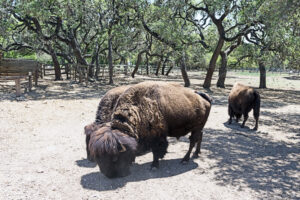
Buffalo, or American bison, at the Enchanted Springs Ranch, a working ranch in Boerne, Texas, by Carol Highsmith.
So delightful was the temperature in the greater portion of Texas proper that rheumatism and chronic diseases were very rare, and pulmonary consumption almost unknown. With the exception of the apple, almost every fruit of temperate climates came to perfection. Peaches, melons, figs, oranges, lemons, pineapples, dates, and olives were grown in different localities. Cotton and sugar cane were the principal agricultural staples, and they attained great perfection. Indian corn and wheat were the principal grains cultivated. Sweet and common potatoes yielded remarkably well. The rearing of livestock was a favorite pursuit of the inhabitants, and many of the prairies were almost literally covered with immense herds of oxen. Horses and mules abounded, and vast herds of buffalo and wild horses wandered over the prairies. In many parts of the rolling prairies, excellent coal and iron ore were found, and silver mines were worked in the mountains. Granite, limestone, gypsum, and slate were abundant in some parts.
Austin, the capital, on the Colorado River, is 200 miles from the sea and had about 1,000 inhabitants in the mid-1850s. The other principal towns had, respectively, populations of: Bastrop, 400; Brazoria, 500; Corpus Christi, 1,000; Galveston, 5,000; Houston, 4,000; Matagorda, 700; Nacogdoches, 1,000; San Antonio de Bexar, 1,000; San Augustine, 1,500; and Washington, 1,200.
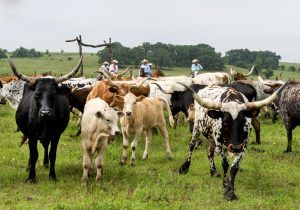
Modern-day cowboys herding longhorn cattle in Texas by Carol Highsmith.
By Henry Howe, 1857 – Compiled and edited by Kathy Alexander/Legends of America, updated November 2025.
About the Author and Article: This article was a chapter in Henry Howe’s book Historical Collections of the Great West, published by George F. Tuttle, of New York, in 1857. Henry Howe (1816 -1893) was an author, publisher, historian, and bookseller. Born in New Haven, Connecticut, his father owned a popular bookshop and was a publisher. Henry would write histories of several states. His most famous work was the three-volume Historical Collections of Ohio. As he collected facts for his writing, he also drew sketches, which helped create interest in his work. The article, as it appears here, is not verbatim, as it has been edited for the modern reader; however, the content remains essentially the same.
Also See: