
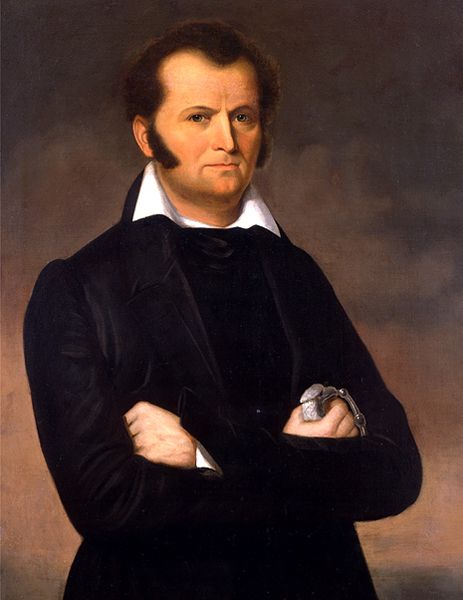
James “Jim” Bowie.
James “Jim” Bowie was a frontiersman, explorer, and pioneer who played a prominent role in the Texas Revolution, culminating in his death at the Battle of the Alamo.
James was born in Logan County, Kentucky, on April 10, 1796, to Rezin Bowie, Sr., and Elve Catesby Jones Bowie. He was the ninth of ten children. In 1810, the family relocated to Madrid, Missouri, where they lived for two years before moving again to Louisiana. They moved a couple of more times before finally settling in southeastern Louisiana. Rezin Bowie, Sr., purchased 640 acres on the Vermilion River and developed a plantation near Opelousas, where he grew cotton and sugarcane, raised livestock, and bought and sold slaves.
Raised on the frontier, the Bowie children worked hard, clearing land, planting crops, fishing, hunting, and running a farm and plantation. All the children learned to read and write, but James and his older brother Rezin also learned to read, write, and speak Spanish and French fluently. As a boy, James also became proficient with pistols, rifles, and knives, and had a reputation for fearlessness. When he grew up, he was described as standing six feet tall, weighing about 180 pounds, having light hair, grey eyes, and a temper.
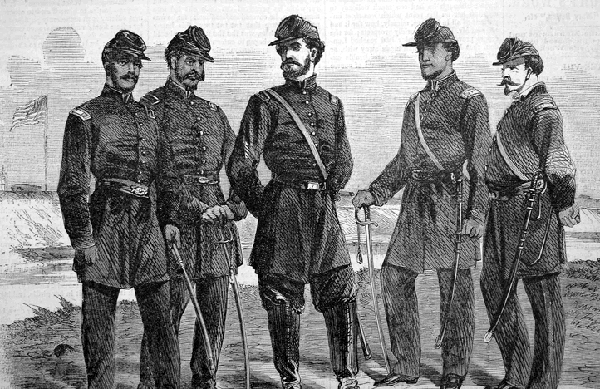
Louisiana Soldiers.
James and his older brother Rezin enlisted in the Louisiana Militia in late 1814 to fight in the War of 1812, but they arrived in New Orleans too late to participate in any fighting. Afterward, Bowie settled in Rapides Parish, where he supported himself by sawing planks and lumber and floating them down the bayou for sale. He also invested in property on the Bayou Boeuf and owned and traded slaves, just as his father had.
In June 1819, he joined the Long Expedition, an effort to liberate Texas from Spanish rule. After capturing Nacogdoches, the group encountered little resistance and declared Texas an independent republic. The extent of Bowie’s participation is unclear, but he returned to Louisiana before Spanish troops repelled the invasion.
At some point, James and his brothers became acquainted with Jean Lafitte, the legendary Gulf Coast pirate involved in the illegal smuggling of slaves. Before long, Laffite was delivering slaves to Bowie’s Island in Vermilion Bay. The brothers would then declare that they had “found” them and sold them at auction. After earning $65,000, they quit the business. Afterward, they dabbled in land speculation and, in 1825, established the Arcadia sugar plantation of some 1,800 acres near the town of Thibodaux, Louisiana.
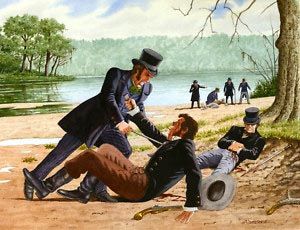
Sandbar Fight in Mississippi.
On September 19, 1827, Bowie was involved in the legendary “Sandbar Fight” in Natchez, Mississippi. Samuel Levi Wells III and Dr. Thomas Harris Maddox had agreed to fight a duel, and each man had brought several seconds along. Bowie was there on behalf of Wells. When the principals exchanged shots, neither hit the other, but all hell broke loose.
Though the Battle of the Sandbar lasted less than ten minutes, General Samuel Cuny and Major Norris Wright were dead, and Jim Bowie and Alfred Blanchard were wounded. Eyewitnesses who remembered Bowie’s “big butcher knife” began to spread the word of Bowie’s prowess with the lethal blade, capturing public attention and starting the legend of Bowie’s reputation as the South’s most formidable knife fighter. Soon, men were asking blacksmiths and cutlers to make them a “Bowie Knife.”
At age 34, James Bowie and a friend from Thibodaux, Louisiana, named Isaac Donoho, traveled to Texas in January 1830, where they presented a letter of introduction to empresario Stephen F. Austin at Nacogdoches. James took an oath of allegiance to Mexico on February 20. Then he proceeded to San Antonio, Texas, where he once again presented his letter of introduction to wealthy and influential Mexicans.
Bowie’s party then continued to Saltillo, Mexico, the state capital of the Texas colony. There, he discovered that a Mexican law of 1828 offered its citizens 11 league grants (a league was 4,428.4 acres) in Texas for $100 to $250 each. Bowie soon urged Mexicans to apply for these grants, which he purchased from them. He left Saltillo with about 15 of these grants. These activities irritated Stephen F. Austin, but he eventually allowed the tracts.
Bowie renounced his American citizenship and became a Mexican citizen on September 30, 1830. He then partnered with Juan Martín de Veramendi to build cotton and wool mills in Saltillo. As a Mexican citizen, Bowie had the right to buy up to 11 leagues of public land and convinced more Mexicans to apply for grants, which he bought from them. Over time, he owned some 700,000 acres. The Mexican government finally passed laws in 1834 and 1835 that curbed much of the land speculation.
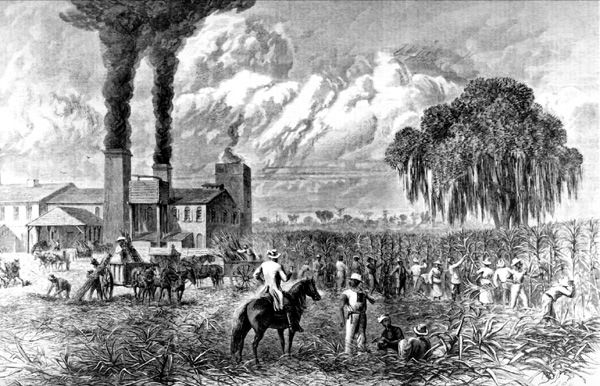
Sugar Plantation in Louisiana.
In the meantime, the Bowie brothers sold the Arcadia sugar plantation, other landholdings, and 82 slaves for $90,000 in March 1831. The following month, on April 25, 1831, Bowie married 19-year-old Maria Ursula de Veramendi, the daughter of his business partner. The couple would have two children. Though the couple built a house in San Antonio on land Veramendi had given them near the San José Mission, they moved into Maria’s parents’ house a short time later.
Shortly after his marriage, Bowie became fascinated by the story of the “lost” Los Almagres Mine (also known as the lost San Saba Mine and the lost Bowie Mine), said to be located northwest of San Antonio, near the ruins of the Spanish Mission Santa Cruz de San Saba. After obtaining permission from the Mexican government to mount an expedition to search for the legendary silver mine, Bowie, his brother Rezin, and ten others set out for San Saba on November 2, 1831. On November 19, six miles from their goal, they were attacked by a large raiding party of about 160 Caddo and Apache Indians. Known as the Battle of Calf Creek, the fight began when the Indians surrounded the men and lasted 13 hours. One of Bowie’s men — Tom McCaslin — was killed, and two were wounded. But the Indians suffered more losses, reportedly 40 dead and 30 wounded, and soon fled the area.
Bowie and his men began the long walk back to San Antonio after losing their horses. In the meantime, a party of friendly Comanche rode into San Antonio, bringing word of the attack, and citizens believed the members of the Bowie expedition must have perished. James Bowie’s wife, Maria, began wearing widow’s weeds. On December 6, 1831, San Antonio residents were surprised when Bowie and his men arrived.
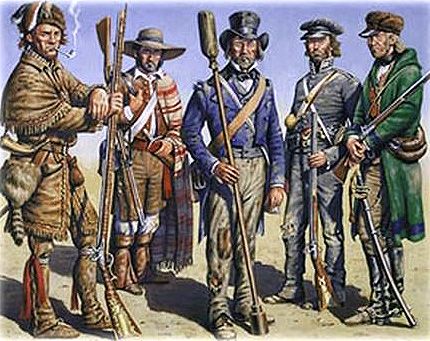
Texian Soldiers.
In 1832, Bowie was elected a commander of a citizen militia, with the rank of colonel, to keep the peace and protect the colonists from attacks by hostile Indians. During this time, he would be in several confrontations. This militia group would later become known as the Texas Rangers.
In September 1833, Maria Ursula Bowie and their children, her parents, and her brother were visiting Monclova, Mexico, which had become the new capital of the Texas colony. Between September 6 and September 14, all of them would die of cholera. At that time, James Bowie was in Natchez, Mississippi, and was ill with yellow fever. He would not find out about the deaths until November. Afterward, he began to drink heavily.

William B. Travis.
The following year, he returned to land speculation and was appointed a land commissioner tasked with promoting settlement. His appointment ended in May 1835 when President Antonio López de Santa Anna abolished the Texas government. At about this same time, Texians began agitating for war against President Santa Anna, with Bowie and William B. Travis among the agitators.
In late October 1835, an army of men led by Stephen F. Austin and James Fannin, including Bowie, marched on San Antonio, where Bowie’s contacts among the local population proved extremely helpful. On October 28, the Battle of Concepción, which occurred on the grounds of Mission Concepción, two miles south of San Antonio, was fought. At that time, the Texian Army was split, some at Concepcion and others encamped outside San Antonio. When General Martín Perfecto de Cos learned of this, he sent 400 soldiers to attack the Texians camped at Concepción. When the Mexicans attacked at dawn, the Texians took cover in a horseshoe-shaped gully and, because of their excellent defensive position, longer firing range, and better ammunition, were able to repel the Mexican soldiers, who retreated after three hours of fighting. Mexican losses included 14 killed and 39 wounded, some of whom died later. Texas losses included one killed and one wounded. This was the first major battle of the Texas Revolution.
Bowie was hailed as a hero. He was also involved in the Grass Fight on November 26, 1835, which became the last engagement in the Siege of San Antonio.
“Bowie was a born leader, never needlessly spending a bullet or imperiling a life. His voice is still ringing in my old, deaf ears as he repeatedly admonished us. Keep undercover, boys, and reserve your fire; we haven’t a man to spare.”
— Noah Smithwick, volunteer soldier in the Battle of Concepción
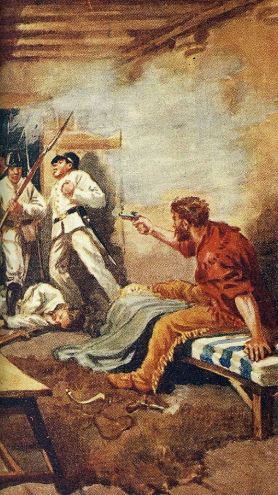
Death of James Bowie by Charles A. Stephens.
In January 1836, Jim Bowie was in charge of a group of volunteers at the garrison of the Alamo. Lieutenant Colonel William Travis arrived in February to take command of the Alamo, bringing with him a group of troops to bolster the defenses. There was some tension between the two leaders; however, when the famous frontiersman Davy Crockett arrived, he defused it.
The Mexican Army arrived on February 23, 1836, under the command of General Santa Anna, and began its attack on the Alamo. Bowie was seriously ill and delirious by that time, confined to his bed. According to legend, when Travis drew a line in the sand and told the men to cross it if they would stay and fight, Bowie, too weak to walk, asked to be carried over the line. The battle lasted until March 6, 1836, when all the remaining 188 defenders, including James Bowie, Davy Crockett, and William Travis, were killed.
©Kathy Alexander/Legends of America, updated April 2026.
Also See:
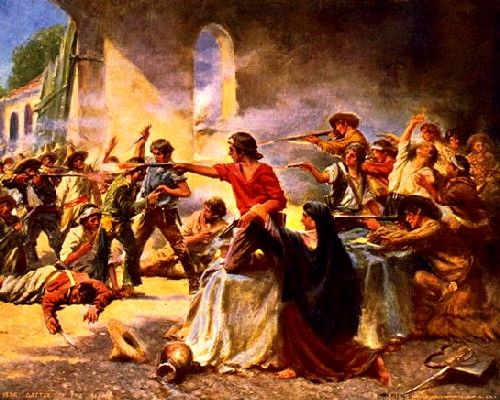
Alamo Battle
Sources: