

Battle of San Jacinto by Henry Arthur McArdle.
The Texans won the final, decisive engagement of the Texas Revolution against Mexico on April 21, 1836, at the Battle of San Jacinto. Although the battle lasted only 18 minutes, its repercussions were significant. The victory at San Jacinto secured Texas’s independence from Mexico and paved the way for the United States’ continued westward expansion.
The United States annexed Texas in 1845, which led directly to the Mexican-American War. When that ended, Mexico ceded the American Southwest and California to the United States. Today, the San Jacinto Battleground State Historic Site and Monument preserves the site of this critical battle. It commemorates the Texans’ victory over Mexico and the battle’s lasting effect on U.S. history. San Jacinto Battlefield is a National Historic Landmark.
After Mexico gained independence from Spain in 1821, the newly formed Republic of Mexico encouraged American immigrants to settle in Texas, part of the Mexican State of Coahuila y Tejas. The Mexican government offered U.S. settlers land at low prices. By 1830, the American population of Texas had grown to around 25,000 people, significantly outnumbering the Mexican population and prompting the Mexican government to become increasingly concerned about protecting its claims to frontier land in the region. Tensions between the Mexican government and U.S. settlers rose as the Mexican government forbade further American immigration to Texas in 1830.

Antonio Lopez de Santa Anna.
Over the next five years, Texans of both American and Mexican ancestry grew increasingly dissatisfied with the Mexican government. Some American settlers disagreed with Mexico’s prohibition of slavery. In contrast, other settlers were upset that under Mexican law, they did not have many of the rights that they had enjoyed in the United States. Mexico did not provide rights such as trial by jury or freedom of religion that the settlers had grown accustomed to in the United States. Other issues arose when the Mexican government increased property taxes in Texas and tariffs on goods shipped from the United States.
All of these issues came to a head in 1835 when the newly elected President of Mexico, Antonio Lopez de Santa Anna, dissolved Mexico’s federal Constitution of 1824. By dissolving the Constitution of 1824, Santa Anna centralized power and removed Mexico’s Congress and state legislatures. Texans of American and Mexican heritage alike felt outraged at the changes to the Mexican government.
By October of 1835, Texans of American and Mexican heritage organized a rebellion against the Mexican government, launching the Texas Revolution. Five months later, on March 2, 1836, delegates signed the Texas Declaration of Independence (which reflected American democratic principles and paralleled the United States Declaration of Independence) at Washington-on-the-Brazos, formally declaring the Republic of Texas independent of Mexico.
Signing the Texas Declaration of Independence was a crucial step toward establishing the Republic of Texas as an independent nation. However, March 1836 proved challenging for General Samuel Houston, Commander-in-Chief of the Texas forces. Mexican General Antonio Lopez de Santa Anna moved three armies, totaling roughly 5,500 men, north to suppress the revolt. Santa Anna’s armies killed and defeated Texans throughout the month at settlements such as San Antonio de Bexar, Agua Dulce, Refugio, and Victoria. The largest and most upsetting of these defeats were the massacres at the Alamo(March 6) and Goliad (March 27). The annihilation of Texans at the hands of the Mexican army both enraged and frightened Houston’s men. Some troops fled to help their families before the advancing Mexican army reached them in what became known as the “Runaway Scrape,” while others continued the fight, fueled by a desire for revenge.
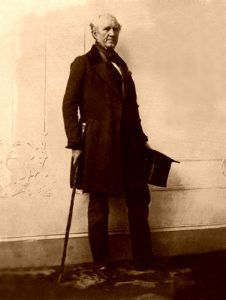
Sam Houston, 1856.
Houston slowly retreated east throughout March, realizing his army was small and had only meager provisions. He spent late March and early April training recruits into a semblance of a disciplined army. By April 18, Houston began to move strategically after documents captured from a Mexican courier revealed that Santa Anna had isolated himself from most of his troops and had only about 750 men (slightly fewer than Houston’s 820). The intercepted documents also revealed that Santa Anna planned to move East to pursue interim Texas President David G. Burnet and other Texas government officials. These officials had avoided Santa Anna in Harrisburg (an extinct town about 11 miles west of the San Jacinto Battleground).
Houston expected Santa Anna to cross the San Jacinto River, where it joins Buffalo Bayou at Lynch’s Ferry. Confident their chance had come, Houston and his troops crossed south of Buffalo Bayou and moved in the vicinity of Lynch’s Ferry. Houston established a camp in the woods slightly North of the ferry to wait for Santa Anna on the morning of April 20, 1836.
As expected, on April 20, 1836, Santa Anna took position where the San Jacinto River joined Buffalo Bayou, setting up camp slightly South and East of Houston’s forces. On the morning of April 21, Santa Anna’s forces swelled from 600 to 1,200 as his brother-in-law’s troops joined as reinforcements by crossing the bridge over the Brazos River. Santa Anna expected Houston to attack on the morning of the 21st, and when he did not, he let his now-numerous Mexican troops relax, eat, and sleep.
Houston was dismayed at Santa Anna’s reinforcements and ordered the destruction of the bridge crossing the Brazos River to prevent further swelling of Mexican troops. This also prevented both the Mexican and Texan armies from retreating. By that afternoon, Houston had a battle plan. He sent out three forces – the main frontal force advanced quietly, hoping to take the Mexican army by surprise, as two other forces circled the left and right flanks of the Mexican camp. Houston’s men got within 200-300 yards of the Mexican camp before the Mexicans detected them.
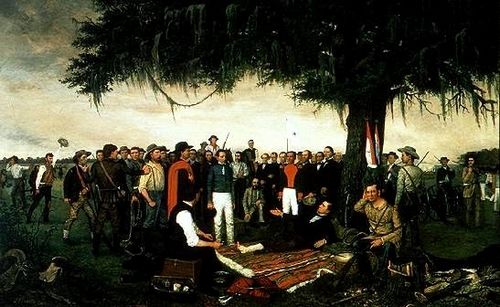
William Huddle’s 1886 depiction of the end of the Texas Revolution in 1836.
As the Texans attacked, they chanted, “Remember the Alamo! Remember Goliad!” At the end of the violent battle that lasted only 18 minutes, the Mexican Army surrendered. Caught off guard by the bold broad-daylight attack, the Mexican Army hardly had time to respond. Nine Texans died, and only 30 more suffered wounds, while the Mexican losses totaled 630 killed, 208 injured, and 730 taken prisoner.
Santa Anna ordered his troops to withdraw from Texas. The Texans captured Santa Anna the following day, disguised as a Mexican private. On May 14, 1836, Presidents David G. Burnet and Santa Anna signed the public and private treaties of Velasco, confirming Mexican retreat and declaring an end to the war. However, Mexico did not formally recognize Texas’ independence until the Treaty of Guadalupe Hidalgo, which ended the Mexican-American War in 1848.
Today, visitors to the San Jacinto Battleground State Historic Site and Monument can take a walking tour of the battleground to see where significant events leading to Texas’ independence took place. San Jacinto Battleground State Historic Site includes the San Jacinto Monument, the world’s largest column memorial (taller than the Washington Monument by 12 feet). Constructed between April 21, 1936, and April 21, 1939, the Monument memorializes all who fought in the Battle of San Jacinto and all others who contributed to Texas’ independence. A large star atop the Monument symbolizes the Lone Star State, while friezes along its base depict eight significant periods in the history of the Republic of Texas. The San Jacinto Museum of History is located at the base of the Monument and offers information on the Battle of San Jacinto and the history of Texas and the Spanish Southwest. The museum promotes friendship between Texas, Mexico, Spain, France, and Latin America.

San Jacinto Monument, La Porte, Texas. Photo by Dave Alexander.
For more information, see the San Jacinto Museum and Battlefield website.

DRT Battlefield Memorial Sundial, located in De Zavala Plaza, with the San Jacinto Monument in the background.
Compiled and edited by Kathy Alexander/Legends of America, updated October 2026.
Also See:
Battle of Coleto & The Goliad Massacre
San Felipe de Austin, Texas – First Colony
Source: National Park Service