

While Cripple Creek, Colorado, is not a ghost town, it was one of Colorado’s most important mining camps. Photo by Kathy Alexander.
During the late 19th Century, gold fever roared through Colorado like wildfire, and mining camps and towns were born overnight. Seeking their fortunes, thousands of men arrived in the Centennial State searching for glittery minerals. Settlements grew on rocky hillsides, in grassy meadows, and along creeks and rivers—wherever gold or silver was thought to be found.
Many towns, such as Central City, Leadville, and Cripple Creek, were so successful they grew into large cities, some of which were larger than Denver at the time. This mining boom brought national recognition to Colorado as one of the most lucrative places in the late 1800s.
Colorado has more than 600 ghost towns, most of which were mining towns and are among the most popular with visitors. At least that many more were established and have no remains to show they ever existed.
Most of these towns died out when the ore played out, and the mines closed. Many were ruined by the 1893 devaluation of silver. Some settlements existed purely to mill or smelt the ore. These also died when the mines played out. A few, however, never really died, as they shifted to other economic ventures, were located on major roads, and took advantage of tourist opportunities. These include towns like Leadville, Breckenridge, and Idaho Springs.
Just three Colorado “ghost towns” still have active mining activities—Victor, Lake City, and Gold Hill. Also included here are Colorado Forts. Most were established during the Indian Wars of the Old West and were abandoned when they were no longer needed. Several still display remains or reconstructions. Others have turned into entire towns.
Many of these old settlements, even though people may still live in them, are referred to as ghost towns by most historians and authors. Why? Though many believe a ghost town is totally abandoned, modern books and literature define it as any historical town or site that leaves evidence of a town’s previous glory. One dictionary definition of a “ghost town” is “a shadowy semblance of its former self.”
Mining was not always the cause of towns becoming “ghosts.” Some are farming towns, especially on the eastern plains of Colorado, where some towns have been deserted due to rural depopulation; other towns died when stage stops were abandoned; settlements that were established to support railroad lines that no longer exist or no longer stop are gone or dwindled; a few were built as resort towns that didn’t work, and a couple were buried underwater when reservoirs were created.
Of those that survive in any way, they offer interesting peeks into history, a view of the Wild West, tales of legendary people, and more.

Central City, Colorado, 1865
Alpine Loop National Backcountry Byway, Colorado
Animas Forks – Favorite on the Alpine Loop
Lakeshore & the Golden Fleece Mine
Carson – Atop the Continental Divide
Silverton Road to the Alpine Loop
The Alpine Tunnel – An Engineering Marvel
Boggsville – On the Santa Fe Trail
Buckskin Joe – Gone But Not Forgotten
Central City – From Boom To Bust
Creede, Colorado – Silver & Gold on the Rio Grande
Cripple Creek – World’s Greatest Gold Camp
Ghosts of Clear Creek Canyon (Beaver City, Vicksburg, Rockdale, Winfield)
Guffey, Colorado – Quirky Mining Town
Colorado Ghost Towns Photo Gallery
Hastings & the Worst Mining Accident
Ludlow and the Colorado Coalfield War
Nevadaville – Another Gilpin County Ghost Town
Red Mountain Town – Queen of the District
Guston and the Yankee Girl Mine
Ironton – Supplying the Mining District
Silverton – High in the San Juans
Silverton Road to the Alpine Loop
St. Elmo – A Haunted Ghost Town
Virginia Dale – Overland Trail Ghost Town
Take nothing but photos – leave nothing
but footprints – break nothing but
silence – kill nothing but time.
— Explorer’s Code

Nevadaville, Colorado, Kathy Weiser
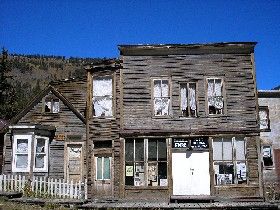
Stark Home and Store, St. Elmo, Colorado by Kathy Alexander.
A “ghost town” is “a shadowy semblance of its former self.
— One dictionary definition
©Kathy Alexander/Legends of America, updated October 2026.
Also See: