

Frontier Exploration.
By Ralph Henry Gabriel, 1929
Only yesterday, as the geologist would reckon time, North America was in very truth “a lair of wild beasts.” Then, through this wilderness, where no human voice had ever sounded, Stone Age men came, following a route that skirted the North Pacific. Over time, these people, whose descendants were called Indians, overran two empty continents. Theirs was the first American frontier.
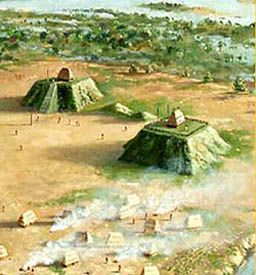
Indian Mound.
Only fragmentary records remain of this significant human conquest—primarily evidence from graves and long-forgotten village sites. The story of this first frontier’s expansion across America may never be fully documented, as its triumphs and tragedies have been lost to time. However, the retreat of the race that once claimed the continent is recorded history. The Native Americans who reluctantly yielded to the white settlers were, in many respects, a talented people. The Maya civilization, which flourished for over a thousand years in Mexico and Central America, represents a remarkable intellectual achievement. Similarly, the Pueblo and Mound Builder cultures, which developed in what would eventually become the United States, were also significant accomplishments. Had North America not faced the environmental challenge of having few domesticable animals, these civilizations might have advanced beyond the Stone Age and altered the course of world history. Instead, they were forced to submit to the superior power of European settlers.
In the 15th Century, while the Maya of Yucatan were slipping back into barbarism, the peoples of western Europe were embarking upon that marvelous age of expansion which carried their culture to the uttermost corners of the world. To the Americas, which Christopher Columbus stumbled upon just as the 15th Century was drawing to a close, came in the decades that followed Spaniards, Frenchmen, Englishmen, Dutchmen, Portuguese, and many others. Before the white man had made the New World his own, others of his race were overrunning Australia and New Zealand and were establishing a foothold in southern Africa. The story of the westward advance of the frontier within the area now known as the United States is but a phase of this broader movement: the struggle of the American Indians against the invaders, an episode in the conflict of the undeveloped peoples of the world to stay the advance of the conquering Caucasians.
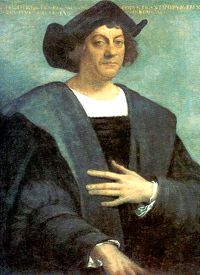
Christopher Columbus.
In 1521, the potent and wide-flung Aztec empire, an afterglow of Mayan greatness, collapsed under the blows of the Spaniard, Hernan Cortez. In the West Indies, in Mexico, and in the country which stretched away to the South, the Castilians found rich soil for great plantations, crude native mines for the acquisition of precious metals, and an Indian population to supply the needed labor. They exploited lands, mines, and men to make Spaniards rich and Spain great.
Yet the subjects of Charles V and Philip II did not forget that the dark-skinned natives of the New World possessed immortal souls that might be saved to join the throng of the blessed in Paradise. Ruthless as were many of the white masters of New Spain, they did not expel the conquered race from its original habitat or seek to destroy it with fire and the sword. For them, the Indian had value expressible in terms of economics, empire, and the Church’s glory. Spain, moreover, sent relatively few men and fewer women to the New World. A mingling of racial blood resulted. Within the area where Montezuma had ruled, a stratified society emerged. White men were the masters, Indians the mudsills; and between the two a growing class of mixed-bloods developed.
Beyond the borders of the old Aztec Empire, the Spaniards expanded their territory northward into Texas, New Mexico, and California. They continued a policy of compromise with the Native Americans, attempting to transform the wild tribes into useful yet subordinate subjects of the Spanish crown. A line of missionaries, accompanied by small groups of soldiers, formed the forefront of New Spain’s advancing northern frontier. Missions and presidios marked the outposts of Spanish culture in this region. At these stations, natives were taught to worship and work like Europeans. However, in many areas that once belonged to New Spain, the Spaniards did not entirely transform the New World into a European society; instead, in much of this vast territory, the mestizo population of the 20th Century has replaced the Castilians.
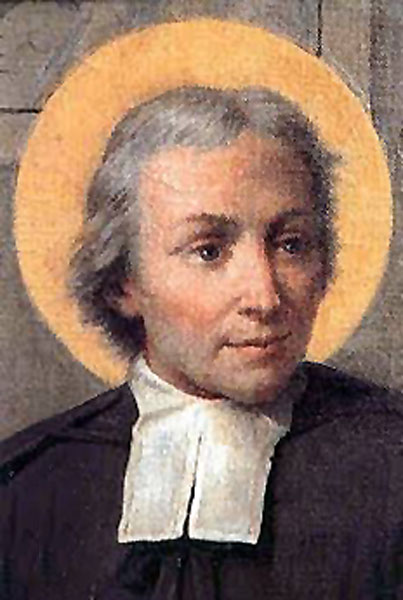
Jean-Baptiste de La Salle.
In the 17th Century, the Spaniards watched with some concern as French power rose in the St. Lawrence Valley and the central lowland of the Mississippi River system. The ambition for a mighty empire inspired both Jean-Baptiste de La Salle and his king, Louis XIV. However, despite the grand visions held by a few, only a few thousand Frenchmen ventured into the wilderness of New France. The Bourbon empire in the New World covered a vast area of untouched forest, dotted with forts and a few small farming communities. The most significant was a compact settlement of seigneurs, habitants, and merchants in the St. Lawrence Valley. This region was the heart of New France, showcasing the distinctive features of the French phase of European cultural expansion.
More French women immigrated to New France than Spaniards. The shores of the Bay of Fundy and the banks of the St. Lawrence River were home to white communities that excluded the Indigenous people from residency. However, the French were the most welcoming of all European nations towards the Indigenous populations in the New World. Tribes in Canada and the Mississippi Valley were unaware of the Aztec Empire or the civilization of the Mayas. These northern peoples had only reached a Neolithic culture and were primarily in the hunting stage of development. Without domestic animals, they could not establish a stable agricultural food supply in their harsher northern environment.
Advancing to civilization would have been impossible without the security and leisure that come from a surplus of food. The French displayed a remarkable ability to engage with these untutored representatives of the Stone Age. French priests, known as the “black robes,” traveled through forest trails to reach villages deep within the continent. Their goal was to introduce the Indigenous peoples to Christianity while minimizing changes to their material way of life. Although the black robes largely failed to spread the light of the gospel into the darkness of barbarism, they did manage to earn the goodwill of the Indigenous communities toward the French.
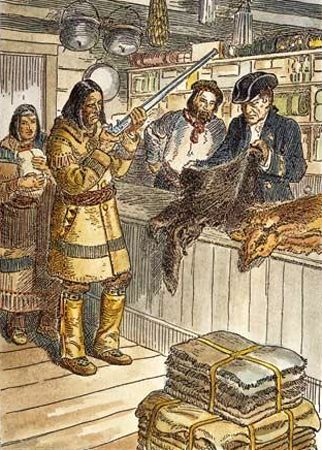
Trading with Native Americans.
The fur trader strengthened this friendship between the races and built it on the sound basis of mutually profitable coöperation. The coureur de bois, following the age-old traditions of successful traders, sought to adapt to the peculiarities of the people with whom he did business. He was not interested in changing the redskin’s way of life except in ways that would increase profits. The fur trade became the cornerstone of New France’s economic foundation.
The Spanish grandee exploited the conquered natives, turning them into laborers and serfs, while the coureur de bois viewed the forest hunters as partners. The Indigenous people were encouraged to hunt and trap, exchanging their pelts for goods from the white traders. The French traders adopted native clothing and lifestyles, often marrying one or more daughters of the wilderness. Despite their successes, the coureur de bois never gained the friendship of the Iroquois. Throughout the French regime, the hostile Five Nations, who aimed to control trade among the tribes around the Great Lakes, posed a constant threat to New France.
In the agricultural and trading French community centered in Quebec and Montreal, Canada, the constant threat from beyond the Adirondacks led to a unique adjustment in the history of the white frontier in North America. The challenges faced by the Jesuits and their converts also contributed to this distinctive French adaptation to the wilderness conditions. The Iroquois, whom the Jesuits had converted, were driven into exile by their kin and were settled on an island in the St. Lawrence River near Montreal, where the Church could closely monitor their well-being.
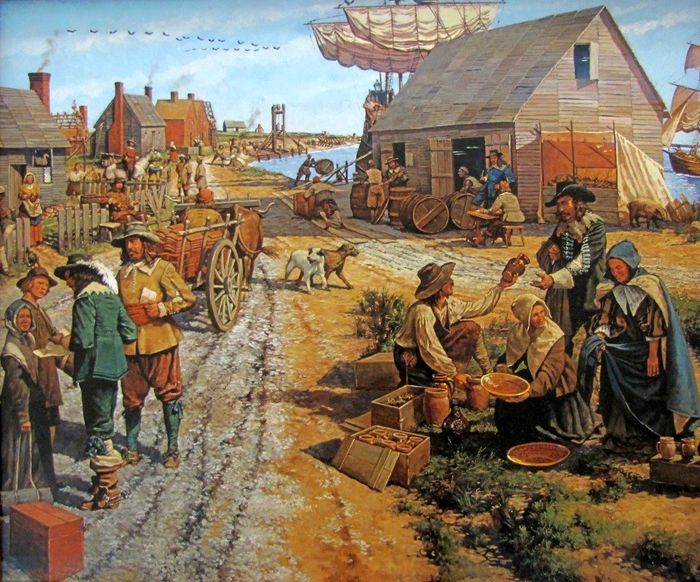
Jamestown, Virginia.
The unfortunate remnants of the semi-Christianized Huron people, who had suffered from the brutal attacks of the Five Nations, were gathered near Quebec. A protective group of converted Indigenous peoples helped safeguard the heart of New France from enemies lurking in the forests. In the 17th Century, the English established settlements between the French along the St. Lawrence River and the Spanish in Florida. Unlike their white neighbors to the North and South, the subjects of the Stuart kings arrived in relatively large numbers. They established thriving farming and fishing communities along the Atlantic coast. Like the French settlements in the St. Lawrence River valley, places such as Jamestown, Boston, Charlestown, and Philadelphia were inhabited exclusively by white settlers.
Marriage across racial lines, such as that of John Rolfe and Pocahontas, was exceptional. Many English women came with the men, helping firmly establish white civilization along the eastern shore of the continent. In contrast, both the Spanish and French often compromised with Native Americans for economic reasons. Although trade with Indigenous peoples was an important part of life, English settlers primarily founded their communities on agriculture, fishing, and, over time, maritime trade. Indian labor, whether as serfs or hunters, was not essential to the English colonists’ economy. Those who migrated to the New World quickly adopted many Native American adaptations to the forest environment and also began cultivating maize.
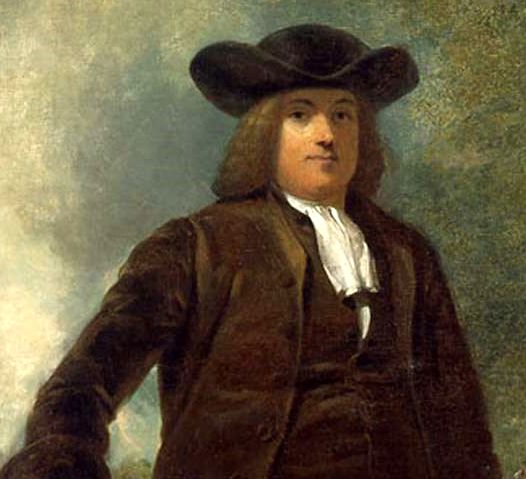
William Penn.
After adopting useful aspects of Indigenous culture, the colonists eventually turned against the Native peoples. They began forcing the natives out of their original homes. Some individuals, like John Eliot, Roger Williams, and William Penn, saw the Indigenous peoples as potential allies rather than inevitable enemies. However, most of their fellow colonists strongly believed the so-called “savages” had to give way for the advancement of civilization. It was uncommon for an Englishman to view Native peoples as brothers and feel responsible for their well-being.
The racial conflict that emerged almost from the inception of the English colonies helped shape the official English theory of their political relations to Native tribes. The French and Spaniards considered Indians subjects of their respective kings; the English tended to view the tribes as independent nations. Tribal chieftains, like Powhatan, were sometimes referred to as “kings.” Pocahontas’s visit to England caused a stir partly because she was regarded as an American princess.
The English settlers found it beneficial to establish formal treaties with tribal leaders. Some of these agreements focused solely on friendship, while others involved ceding land. Initially, the English believed that the king had exclusive rights to grant titles to territories claimed by England in the New World. One reason Roger Williams was banished from the Massachusetts Bay Colony was his belief that the colony did not have a legitimate title to the land until it purchased it from Indigenous peoples.

Treaty.
By the middle of the 18th Century, both the colonists and the British government recognized the need to resolve Indian land titles to facilitate westward settlement. The United States adopted the British approach to political relations with Native American tribes, viewing them as independent yet subordinate nations governed by their own tribal laws and customs. The national government’s only formal interaction with these tribes occurred through treaties the President negotiated, and the Senate ratified.
At the same time, the government asserted its complete sovereignty within its boundaries and claimed the right of eminent domain over the lands occupied by the Native Americans. The idea that the tribes were independent nations was, in reality, a legal fiction. For the Native American, the concept of a treaty was often vague and unclear. Private land ownership was foreign to his experience and hard to comprehend. When he sat in solemn council with a representative of the United States, he often understood little of what he was negotiating away. Additionally, the tribes were politically loose-knit; therefore, many who were not present at the council did not feel bound by the agreements made during the discussions.
The unquenchable desire for land among white settlers pushed the more advanced tribes of the Old Southwest to impose the death penalty on any tribesman who aided in the further loss of Indian lands. However, these desperate measures proved ineffective against white encroachment. Along the edges of United States territories, intense racial hatred developed. Time and again, anger and desperation led the Native Americans to engage in futile wars.
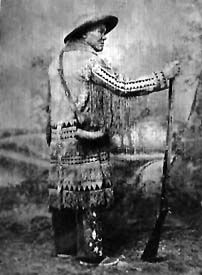
Frontiersman.
The two types of frontiersmen, fur traders and missionaries, did not engage in active hostility toward Native Americans. However, the farmers, who were clearing the forests as they moved westward, viewed the Indigenous people as deadly enemies. For the agricultural frontiersman, the status of Native Americans was considered to be even lower than that of enslaved African Americans. The latter had a defined value to society, while civilization’s interests, in their view, would advance through exterminating the former. The prolonged racial conflict that swept westward across the continent, much like a forest fire, led to some of the most serious abuses for which the American people and government have been held responsible.
In the latter part of the 19th Century, after Native Americans made their last stand and lost, an inevitable reaction followed. In communities far removed from the frontier, sentimentalism gave rise to the perception of the “noble savage,” a figure portrayed as having his face turned in adoration toward the sun. This romanticized image replaced the previously accepted view of Native Americans as ruthless killers in the wilderness, who wielded their bloody tomahawks with equal violence against both warriors and defenseless infants.
In the 20th Century, as the extremes of hatred and sentimentality began to fade, Native Americans encountered some wise and friendly advisors among their conquerors, who were eager to help them navigate the challenging process of finding their place in American society. However, racial conflict and adjustment were not the only aspects of frontier life. Over more than two and a half centuries, as white settlers faced the wilderness in the area now known as the United States, the edge of settlement advanced from one position to another, much like an army on the move.

Appalachian Mountains.
The first frontier consisted of a series of villages along the Atlantic Coast in the 17th Century, which was then on the outskirts of the European cultural sphere. By the middle of the 18th Century, small outpost cabins had been established in the backcountry, located in the eastern shadow of the Appalachian Mountains. Progress across the coastal plain and the Piedmont Plateau was slow, as the white population in the New World was still relatively small and transportation—both across the ocean and within the continent—was quite challenging.
In the last decades of the 18th Century, Americans possessed a considerable area West of the Alleghenies: Kentucky, Tennessee, and part of Ohio. By the first third of the 19th Century, the frontier had moved into Missouri and Iowa, establishing settlements on the grasslands West of the Mississippi River, with settlements dotting the Old Southwest and others pushing northward against the forests of Wisconsin and Michigan. By the end of the first half of the Century, frontiersmen, crossing the Great Plains and the western mountains, were founding communities on the Pacific Coast.
In the following 40 years, the mountains and the plains, an area of imperial extent, were occupied. The slow advance of the 17th and 18th Centuries was transformed in the 19th Century into one of the most amazing population movements in modern history. Improvements in transportation and the development of the mechanical arts were fundamental causes of the acceleration. From first to last, earth hunger and the desire for profit were the two chief forces which caused men to detach themselves from civilized communities and to risk the uncertainties of the wilderness.
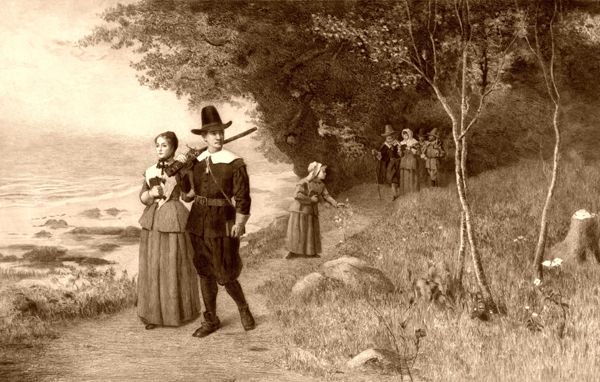
Pilgrims.
There were other motives. Desire for greater religious freedom took the Pilgrims to Plymouth in the 17th Century and the Mormons to Utah in the 19th Century. Believing he could create an ideal social order that might become a model for the world, Robert Owen founded New Harmony on the Indiana frontier. An interest in Indian culture and a compelling desire to pierce the mystery behind the race were perhaps as important as the quest for gain in persuading James Adair in the 18th Century to continue living among his friends, the Chickasaw, Creek, and Cherokee. The desire to bring Christianity and civilization to the red man led Marcus Whitman to Oregon in the 19th Century. Naturally, many individuals unwilling to abide by the laws of civilized communities found in the wilderness an escape from retribution for criminal acts or the burdens of social responsibility. Other individuals, shiftless and incompetent, gravitated to the border’s low standard of living and drifted aimlessly westward with the frontier. Thomas Lincoln was such a one.
Many restless spirits found solace in the wild country, despite its hardships and dangers. In this environment, life offered them the satisfaction they craved. They lived vibrantly, deeply connected to nature. The most remarkable among them carved out careers filled with adventure, stirring the elemental emotions of the more settled Americans living in cities, towns, and quiet farms. However, escaping civilization often came with the steep cost of an untimely death. The wilderness was unforgiving to the injured, the ill, or the elderly. Nevertheless, fully aware of the risks their freedom entailed, many of these nature enthusiasts persisted with reckless abandon, embracing life in the moment and allowing uncertain tomorrows to take care of themselves.
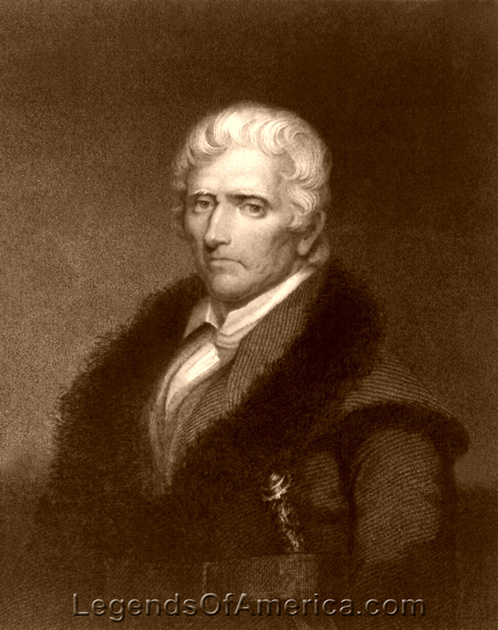
Daniel Boone.
Daniel Boone, who loved the freedom of the wilderness, had no conception of the freedom which civilization offers. The hunter-pioneer, who followed his calling for the love of it, could not comprehend the attitude of the best of the farmer-pioneers. The hunter saw only the hard, dull grind of tilling the soil and tending livestock. Vastly different were the emotions in the heart of Abram Garfield and of his wife, Eliza Ballou, both under 21 when they built their cabin in the Western Reserve. They sought the freedom that came with economic independence. They coveted for themselves and their children a greater share of the rich culture man has created. They saw the frontier as a chance to get a start in life and viewed its hardships as temporary deprivations that would be compensated for by the richer years that would follow. No social-class barriers confined their lives to narrow limits. For them, the frontier was the door that opened onto unbounded opportunities. The hopes of Abram were destined to be dashed when disease struck him down while still in early manhood. His young wife carried on, reared the brood that had come to their cabin, and lived to share in the plaudits heaped upon her second son when he was elevated to the presidency of the United States.
Though many motives took Americans to the frontier, the pioneers were all molded by certain common experiences. In the border zone on the edge of the wilderness, the busy hum of civilized life was stilled. The marketplace, the college, and the seats of government were far away. Frontier life was isolated; the frontiersman enjoyed but the slightest contact with the thought-life of his race. Yet isolation did not of necessity bring mental stagnation. The pioneer mind was concentrated on the difficult task of adjusting to an untamed environment. The result was mental alertness and upstanding self-reliance. On the frontier the American people kept returning to an almost primitive struggle for existence where elemental virtues and the vices of the wilderness developed side by side. The artificialities of old communities disappeared in the fur trader’s lodge and the pioneer farmer’s cabin.
During the century between when the frontier was defined by the eastern shadow of the Appalachian Mountains and when it finally disappeared, Americans made significant advances in civilization. However, on the frontier during this period, social organization remained simple, and American life was continually starting anew. Democracy and individualism were as natural on the edge of the wilderness as racial conflict. As civilization advanced, the wilderness’s roughness quickly faded on every 19th-century frontier. Still, the democratic frontier carried old attitudes as it integrated into the nation of self-governing people. Democracy emerged as a national characteristic and an ideal.
Optimism, born of the swift progress that forever obliterated frontier conditions, spurred the nation to dreams of future greatness. The frontier helped to make at least one American dream come true as the Government of the United States slowly changed its attitude toward the unoccupied land ofthe national domain. Alexander Hamilton, as a member of George Washington’s cabinet, sought to establish the credit of an impoverished nation and looked to the western lands as a source of revenue.

Nebraska Homestead.
During the first half of the 19th Century, however, Americans came to understand more and more clearly that population growth would profit the nation more than revenues. In 1862, when the planter aristocracy of the South had embarked upon its struggle for independence, American democracy reached the acme of its development. The Homestead Act gave farms to all Americans who would take and improve them and to the nationals of other lands who announced their intention to become citizens of the republic. Never more truly was America a land of opportunity than during the years between 1862 and the passing of the frontier.
The summer of 1893 found the people of the United States commemorating in the World’s Fair at Chicago, Illinois, the 400th anniversary of Christopher Columbus‘ epoch-making discovery. Not far from the fair grounds, Indians, 81 years before, had wreaked a bloody vengeance upon the little garrison of Fort Dearborn. The exposition was America’s notice to the world that a new age had dawned in the republic West of the Atlantic. In a quiet Chicago auditorium, far from the blaring bands and gaping crowds of the Fair, Frederick J. Turner addressed a small group of scholars in July 1893.
“What the Mediterranean Sea was to the Greeks, breaking the bond of custom, offering new experiences, calling out new institutions and activities, that, and more, the ever retreating frontier has been to the United States directly, and to the nations of Europe more remotely. And now, four centuries from the discovery of America, at the end of a 100 years of life under the Constitution, the frontier has gone, and with its going has closed the first period of American history.”
Within these pages, an effort has been made to chronicle only the work of exploration which preceded the advance of civilization: the activities of the fur trader, the westward progress of the fringe of settlement, and the long, sad story of race conflict. Contact with civilization almost universally brought the deterioration to the untamed children of the forest. Retrogression bred despair which, again and again, bore fruit in unavailing war. Thrice among the Indians despair brought forth new religions, those of Handsome Lake, the Prophet, and the Ghost Dancers. The narrative of the retreat of the red man has been coupled with that of the whites’ advance.
Also See:
Frontier In History by Emerson Hough
Source: Gabriel, Ralph Henry; The Pageant of America; Yale University Press, 1929. Updated October 2026.