
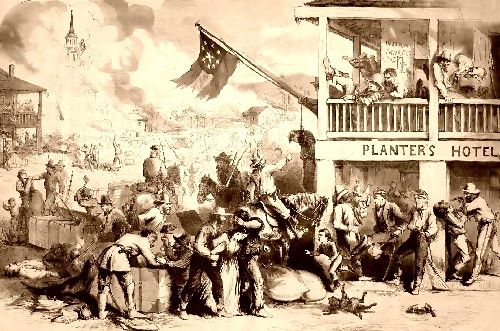
Quantrill’s Raiders sacking a town.
Quantrill’s Raiders was a band of Confederate irregulars that employed guerrilla tactics to ambush Union army patrols and terrorize Northern sympathizers, primarily in Kansas during the Civil War. These raiders were the best-known of the pro-Confederate partisan guerrillas, also known as “bushwhackers.” Their leader was William Clark Quantrill, and they included Jesse James and his brother Frank. Its most notable operation was the Lawrence Massacre, a revenge raid on Lawrence, Kansas, in August 1863.
In some respects, the Civil War began in Kansas and Missouri long before it officially erupted at Fort Sumter, South Carolina, on April 12, 1861. Nearly seven years earlier, when President Franklin Pierce signed the Kansas-Nebraska Act on May 30, 1854, it allowed settlers in the Kansas Territory to decide whether to allow slavery. Sponsored by Illinois Senator Stephen A. Douglas, he believed that allowing the voters to decide would mend the sectional divide over the extension of slavery. Instead, it fanned the flames when settlers and ruffians on both sides of the issue rushed into Kansas Territory to influence the vote. This resulted in a turmoil and violence-filled era known as Bleeding Kansas.
In February 1861, Missouri voters elected delegates to a statewide convention, which rejected secession by a vote of 89-1.
When the Civil War began, William Quantrill, a schoolteacher who had emigrated to Kansas from Ohio in 1857, enlisted in the Confederate Army. He was soon serving as a private in Company A of the 1st Cherokee Regiment, which joined up with General Sterling Price’s forces in Missouri. At that time, the Missouri-Kansas border region was fertile ground for guerrilla warfare.
For over six years, ever since Kansas was opened up as a territory by Stephen A. Douglas’ Kansas-Nebraska Bill of 1854, its prairies had been the stage for an almost incessant series of political conventions, raids, massacres, pitched battles, and atrocities, all part of a fierce conflict between the Free State and pro-slavery forces that had come to Kansas to settle and to battle.
— Albert Castel, American historian and author
At the same time, Unionists, led by regular U.S. Army commander Nathaniel Lyon and Frank Blair of the politically-powerful Blair family, fought for political and military control across the state against the increasingly pro-secessionist forces led by Governor Claiborne Jackson and future Confederate General Sterling Price. By June, open warfare occurred between Union forces and troops supporting the Confederacy. Guerrilla warfare erupted throughout the state and intensified on August 10, 1861, after the Union defeat at the Battle of Wilson’s Creek, Missouri, and the First Battle of Lexington, Missouri, on September 12-20, 1861.
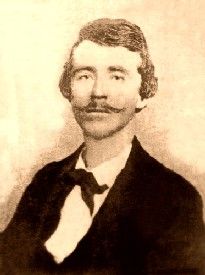
William Quantrill.
Early in the war, Missouri and Kansas were nominally under Union government control and became subject to widespread violence as groups of Confederate bushwhackers and anti-slavery Jayhawkers competed for control.
However, by December 1861, Quantrill deserted the Confederate forces and began assembling a band of irregulars that used guerrilla tactics to ambush Yankee patrols and terrorize Northern sympathizers. Initially, the extra-military irregulars endeavored to support the Confederate regular forces in the field. However, their goals and methods soon embraced lawlessness. The young men who organized the band lived in the Blue Springs neighborhood of Jackson County, Missouri. By 1862, Quantrill’s feared band of followers included infamous figures such as William T. “Bloody Bill” Anderson and the James and Younger brothers, who led notorious gangs of outlaws after the war.
Quantrill was not the only Confederate guerrilla operating in Missouri, but he rapidly gained the greatest notoriety. He and his men ambushed Union patrols and supply convoys, seized the mail, and occasionally struck towns on both sides of the Kansas-Missouri border. Reflecting the destructive nature of the guerrilla conflict in Missouri, Quantrill directed much of his effort against pro-Union civilians by attempting to drive them from the territory in which he operated. Quantrill’s guerrillas attacked Jayhawkers, Missouri State Militia, and Union troops, relying primarily on ambushes and raids.
Under his direction, Confederate guerrillas perfected military tactics such as disguises, coordinated and synchronized attacks, planned dispersal after an attack using preplanned routes and horse relays, and technical methods such as using multiple Colt revolvers for increased firepower and their improved accuracy.
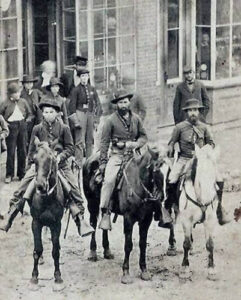
Jayhawkers in the Civil War
By August 1862, with the Union victory at the Battle of Pea Ridge, Arkansas was free of significant regular Confederate troops, but the insurgent violence continued. The most notorious guerrilla force was led by William Quantrill.
On August 15, 1862, Quantrill was granted a field commission as a captain in the Confederate Army under the Confederate Partisan Ranger Act. The men elected other officers, and Quantrill often referred to himself as a colonel. Despite the legal responsibility assumed by the Confederate government, Quantrill often acted on his own with little concern for his government’s policy or orders. This outraged the Confederate government, which withdrew support for the irregular forces.
As the size of Quantrill’s unit grew, his sorties expanded to include entire communities. Just after midnight on September 7, 1862, Quantrill’s force of roughly 140 men stormed Olathe, Kansas. While holding the citizenry captive, they looted the town’s businesses and homes, after killing six men.
The next month, Quantrill’s Raiders came across a Union supply train near Shawneetown (now Shawnee), Kansas, on October 17. Quietly surrounding the unsuspecting Federals, the guerrillas launched a surprise attack, easily killing 13 soldiers. Quantrill’s men then donned the uniforms of their victims and rode unmolested into Shawneetown, where they murdered several citizens, pillaged and burned the community’s businesses and homes, and then rode out with seven prisoners whom they later executed.
Quantrill’s most significant raid was the Lawrence Massacre that occurred on August 21, 1863, at Lawrence, Kansas, as retribution for a series of events that began earlier in the year. For years, Lawrence was a center of anti-slavery sentiment in Kansas and the historic base of operations for abolitionist and Jayhawker organizations. Pro-slavery forces also operated in the area, as both sides tried to gain power to determine whether Kansas would allow slavery. During the period of border warfare between 1855 and 1861, the region became known as “Bleeding Kansas” in the press.
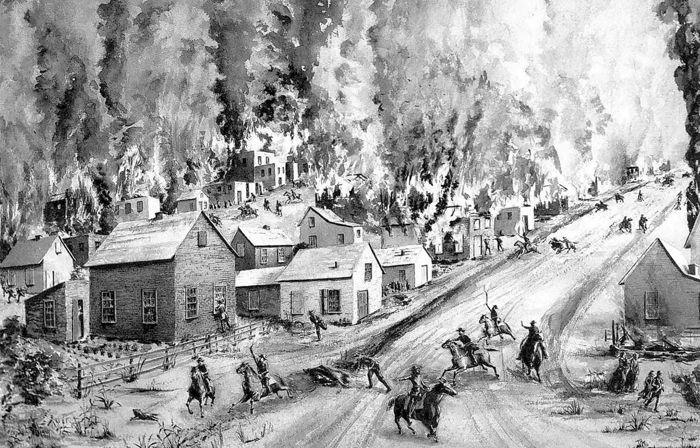
Lawrence Massacre by Lauretta Louise Fox Fiske
In the weeks immediately preceding the raid, Union General Thomas Ewing, Jr., frustrated by the hit-and-run tactics of Quantrill’s guerrillas, commanded Federal troops to round up civilians who were aiding guerrillas operating within the District of the Border. Among those arrested were several female relatives and friends of Quantrill’s band. The Federals detained the women in makeshift jails in Kansas City, Missouri, including the house on Grand Street. Union soldiers enlarged the space on the first floor by removing supporting beams. On August 13, 1863, the building collapsed, killing four of the prisoners, including the sister of William T. “Bloody Bill” Anderson. A few days later, a fifth girl died from her injuries. Quantrill’s supporters alleged the collapse was a deliberate attack, fanning their fury.
Calling for revenge, Quantrill organized a unified partisan raid on Lawrence, although evidence suggests the raid had been planned before the collapse. Coordinating across vast distances, small bands of partisans rode 50 miles across open prairie to rendezvous on Mount Oread in the early morning hours before the raid. During the predawn hours of August 21, 1863, about 450 of Quantrill’s Raiders rode into Lawrence as most of the town’s unsuspecting residents slept. They murdered between 160 and 190 men and boys, many of whom were unarmed. After occupying the Eldridge Hotel, they broke into small groups and plundered the town for the next four hours. By the time the pillagers rode out, they had burned nearly one-quarter of the town’s buildings, robbed the bank, and looted every home. Afterward, the Leavenworth Daily Conservative’s account of the raid, published two days later, estimated that financial losses exceeded $2,000,000 (in 1863 currency). Home of free-state U.S. Senator James H. Lane, who was in town when the assault began, escaped by hiding in a nearby cornfield. The Lawrence raid was the most deadly and infamous operation of Missouri’s Confederate guerrillas, and one of the most vicious atrocities of the Civil War.
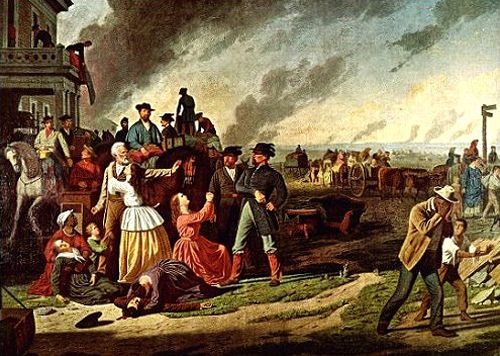
Evacuation of Missouri Counties under General Order No. 11, painting
by George Caleb Bingham, 1870.
The Confederate leadership was appalled by the raid and withdrew even tacit support from the “bushwhackers.” Addititionally, Union General Ewing issued General Order No. 11, which evicted thousands of Missourians from their homes near the Kansas border. Quantrill’s band took part in the subsequent Confederate retaliation but, in the face of continued Union advance, finally fled south. Along the way, Quantrill and his men raided Fort Blair, a small federal outpost in the southeast corner of Kansas near Baxter Springs. As Quantrill’s advance scouts neared the fort on October 6, 1863, they surprised a black officer and a civilian practicing their marksmanship and murdered both unsuspecting men.
Quantrill then split his force and attacked Fort Blair from two directions. At about noon, the Rebels charged the garrison’s 90 soldiers as they sat down for lunch outside the fort. Amidst a hail of gunfire, the startled Federals fled for the safety of the fort. Once safely behind the breastworks, the outnumbered but better-disciplined Union soldiers stymied the guerrilla attack. After losing the element of surprise, along with about ten of his men, Quantrill suspended the assault.
Afterward, Quantrill reassembled the Raiders north of the fort, where he spotted a wagon train approaching. Deprived of his initial objective, he opted to pursue a consolation prize. Led by Major General James G. Blunt, the convoy comprised Blunt’s headquarters staff and a military band accompanied by a few cavalrymen on their way to Fort Smith, Arkansas.

Baxter Springs Massacre by Edmund Victor Ness.
Concealing most of his men in a grove of nearby trees, Quantrill ordered an advance party dressed in Federal uniforms to ride forward to meet Blunt. In return, the unsuspecting Union general sent his chief scout, Captain William Tough, forward to greet the advancing party. Tough soon recognized the approaching riders as members of Quantrill’s band, and he beat a hasty retreat to warn Blunt. However, Tough’s alarm came too late for Blunt to mount a defense against the guerrillas who swarmed out of the woods, and many of Blunt’s men fled in terror. Quantrill’s men quickly rode down and dispatched the fleeing Yankees. The Raiders also executed others as they tried to escape on foot or after they tried to surrender, even murdering unarmed men. When it was over, Quantrill’s men had killed most of Blunt’s party, but Blunt and 14 of his men escaped by hiding in the woods and tall prairie grass. By the time the action ended on October 6, about 100 Union soldiers and sympathizers were dead, including six of the fort’s garrison, a few civilians, and over 80 of Blunt’s men. Estimates for the number of guerrillas killed were about ten.
As Quantrill and his men continued southward to Sherman, Texas, for the winter, they splintered, breaking into several smaller units. One group was led by his lieutenant, William “Bloody Bill” Anderson, who wore a necklace of Yankee scalps.
Upon arriving in Texas, Quantrill’s outlaws soon began targeting pro-Confederate residents of the Lone Star State. Their presence reached its rock bottom on March 28, 1864, when authorities arrested Quantrill for murdering a Confederate officer. Before being tried, Quantrill escaped into Indian Territory (Oklahoma).
In May 1864, two of Quantrill’s Raiders, the Calhoun Brothers, were killed in a gunfight with Collin County, Texas Sheriff Captain James L. Read. Read was able to escape Quantrill’s rage after he went into hiding, but was lynched by Quantrill’s supporters in Tyler, Texas, on May 18, 1864. In the meantime, most of Quantrill’s men had dispersed into splinter gangs led by George Todd and “Bloody” Bill Anderson.
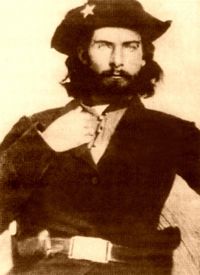
William “Bloody Bill” Anderson.
George Todd and Bill Anderson’s units returned to Missouri. On September 27, 1864, they took part in the Centralia Massacre that resulted in the execution of 24 unarmed Union soldiers, and the ensuing Battle of Centralia that culminated with the death of another 123 Federals. Afterward, George Todd’s splinter group joined Major General Sterling Price’s raid south of the Missouri River, and Todd served as a cavalry scout. Todd died after being shot out of his saddle by a Union sniper at the Second Battle of Independence, on October 21, 1864.
Bill Anderson’s splinter group of guerrillas was assigned to duty, north of the Missouri River, during General Sterling Price’s raid. He was to disrupt Union operations north of the Missouri River and draw Union troops toward his cavalry command. Anderson was reportedly shot dead north of Orrick, Missouri, on October 26, 1864. His body was dragged through the streets of Richmond, Missouri. His grave marker is in the old Mormon Pioneer cemetery, in the extreme southwest corner, behind some pine trees and near the road.
By 1865, William Quantrill, leading only a few dozen men, staged a series of raids into Kentucky. On May 10, 1865, Quantrill was trapped in a barn on the James H. Wakefield farm in Spencer County, Kentucky, by Edward Terrell and his cavalry detachment of hired assassins. While attempting to escape on horseback, he was struck by two Spencer balls, one in the hand, the other paralyzing him from the waist down. He was then transferred to a hospital in Louisville, where he died a few weeks later on June 6, 1865, at the age of 27.
Several of Quantrill’s Raiders eluded capture in Kentucky and returned to Kansas or Missouri. Following the war, authorities captured, imprisoned, and later pardoned some of Quantrill’s followers.
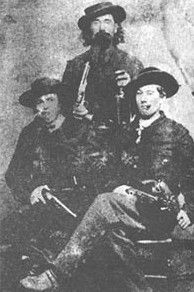
Quantrill’s Raiders.
Some of the guerrillas continued under the leadership of Archie Clement. He kept a group together after the war and harassed the Missouri state government in 1866. In December 1866, state militiamen killed Clement in Lexington, Missouri. Several of his men continued as outlaws, emerging in time as the James-Younger Gang, notorious for its high-profile bank and train robberies during the 1870s.
Other band members lived on to hold reunions many years later, when the name Quantrill’s Raiders began to be used. The last survivor of Quantrill’s Raiders died in 1940.
©Kathy Alexander/Legends of America, February 2026.
Also See:
Sources:
American History Central
Blair, Ed; History of Johnson County, Standard Publishing Company, Lawrence, KS, 1915
My Civil War
Oklahoma Historical Society
Wikipedia